


You're finishing a night shift as your spouse heads out to teach. You both want to read Scripture together, but the Bible on the kitchen table keeps getting buried under tomorrow's responsibilities. When you finally overlap, neither of you wants another assignment.
An online Bible study for couples can make room for that reality. The useful change isn't putting the same reading plan on both phones. It's giving each partner a voice, protecting a manageable conversation, and deciding what you'll carry into everyday life.
Why Couples Study the Bible Together Online
For the nurse and teacher with mismatched schedules, a fixed evening meeting may never work reliably. Reading separately and exchanging reflections later is a reasonable alternative. Together doesn't always mean simultaneous.
The deeper distinction is between individual reading and dyadic practice, a shared activity shaped by both partners. Finishing the same chapter doesn't tell you whether either person felt heard. A couple study needs room for questions, differences, and a response from the other person.
Shared faith matters to many spouses. In Pew Research Center's survey on religion in marriages and families, 44% of U.S. adults described shared religious beliefs as very important to a successful marriage, and nearly eight in ten people in same-faith marriages discussed religion with their spouse at least some of the time.
The point isn't matching reading streaks. It's making space to understand how your partner is living their faith.
Start with the relationship you actually have
An online format lets you replace an inflexible meeting with a conversation both partners can access. That might mean a video call, a shared document, or spoken reflections exchanged around shifts.
But convenience isn't evidence of marital improvement. Research on shared religious life usually examines broader practices, not online couple-specific Bible study. Treat the format as support for a shared habit, not a cure for relationship distress.
Before choosing material, name your starting point:
- Shared faith: You broadly agree on beliefs, but may approach Scripture differently.
- Mixed beliefs: You're willing to explore together without promising agreement.
- Different commitment levels: One partner wants more religious involvement than the other.
Choose for both people, not just the more enthusiastic reader.
Pick a Format and Plan Both Partners Can Keep
Use this comparison as a planning aid. The time commitments are suggested starting schedules, not research-tested doses.
| Format | Best for | Weekly time | Main risk |
|---|---|---|---|
| Same-time video session | Couples with overlapping availability who prefer live conversation | A pair of short appointments | Scheduling slips and one partner dominating |
| Read apart, talk together | Partners on rotating shifts | Separate reading plus a protected call | Reading gets skipped and discussion becomes a quiz |
| Asynchronous shared journal | Long-distance partners or couples without reliable overlap | Brief entries and agreed reply windows | Slow replies leave disagreements unresolved |
| Audio-first with captions | Partners who need listening options, text support, or lower-bandwidth access | A short listening session and discussion | Missing visual cues or relying on inaccurate captions |
Mutual participation matters more than an impressive schedule. Research discussed in the Journal for the Scientific Study of Religion associates shared religious participation with relationship quality and stability, while showing that outcomes differ depending on whether both partners participate. That doesn't establish that a digital devotional prevents separation.
Choose the least complicated format both people will willingly use. Video offers immediate clarification but requires overlapping energy, not merely overlapping availability. An asynchronous journal accommodates shifts, but you need an agreement about when replies are expected.
Choose material before choosing extra features
For a starter plan, select a short, self-contained sequence rather than committing to an entire biblical book. A suggested approach is to gather passages around a concrete concern: waiting through uncertainty, offering forgiveness, or serving others when you're tired.
Avoid choosing material mainly to correct your spouse. A plan about patience won't feel neutral if you introduce it immediately after criticizing their temper.
Mixed-belief couples should look for questions that invite observation before agreement. Ask what a passage presents, what feels difficult, and what each person understands differently. Don't require a statement of shared doctrine before you've begun.
Settle the reading and technology choices
Agree on a translation early. You can use the same version for easier discussion or compare different versions when wording raises a genuine question.
A paper Bible and private notebook remain workable alongside a phone call. A digital journal adds convenient sharing, but check who can see each entry before writing anything sensitive.
If you use an AI study assistant for background or cross-references, agree on its role beforehand. Check suggested references against the passage. Don't let a generated explanation become the deciding vote between spouses.
Practical rule: If your chosen format repeatedly excludes either partner, change the format before asking for more effort.
Launch Your Study and Start This Week
Prepare a device for each partner or a shared screen, your chosen passage, and a protected window. Don't begin by configuring every available feature.
Use this visual checklist to gather the basics.
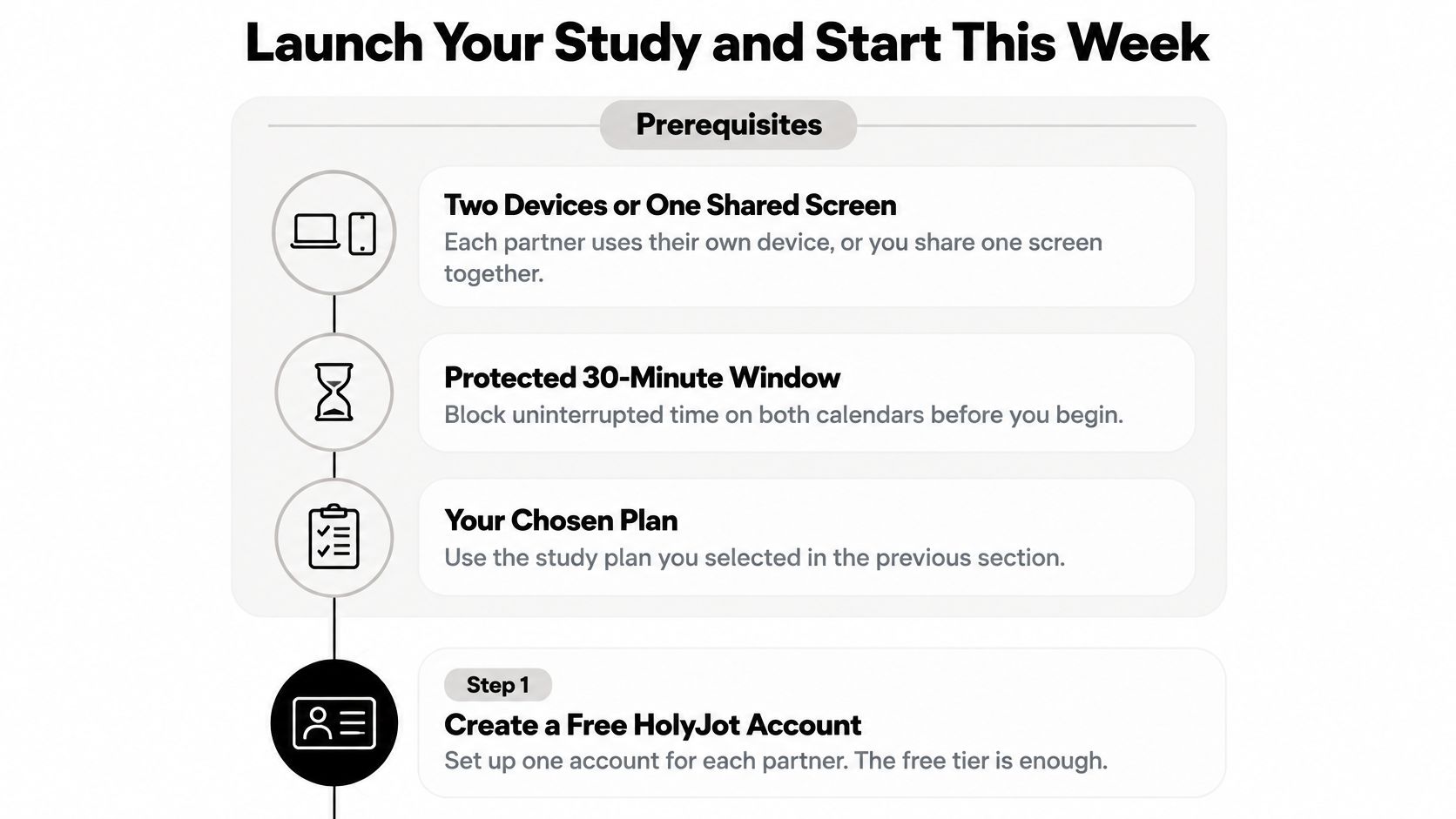
A suggested launch sequence
Set up separate accounts if you're using a platform. Each partner should control their own access. Check the free tier before paying for features you may not need.
Choose the opening passage and a realistic start date. Put the passage somewhere both people can find it without searching through messages.
Book the first appointments. Include a buffer so you aren't ending a difficult conversation at the exact moment someone must leave for work. Calendar reminders should name the passage, not just say “Bible study.”
Write your participation agreements together: “We'll share speaking time fairly.” “Either person may pass.” “A missed appointment won't become evidence against either of us.” Keep them visible.
Decide what stays private. Separate personal reflection from material you deliberately share. If you use a group space, review its audience and permissions together; this guide to an online Bible study community can help you think through that setup.
Turn on reminders only with both partners' agreement. Use completion tracking as a record of appointments, not as a measure of who cares more about God or the relationship.
Put a review date on the calendar. An endpoint gives you permission to evaluate the experiment rather than continuing indefinitely out of guilt.
Run a brief rehearsal. Open the passage, write a reflection, and test how sharing works. Notice practical friction: tiny text, unreliable sound, distracting notifications, or uncertainty about where notes go.
Keep the first meeting modest
Your first appointment doesn't need an ambitious discussion. It needs a passage both people can access and enough attention to hear each other.
Avoid launching immediately after an argument as a way to force reconciliation. If you're still trying to establish what happened, have that conversation separately before adding interpretation and prayer.
A shared appointment can count as a successful start even when the conversation is short. It's a beginning, not proof that every relationship concern has been resolved.
How to Run a 25-Minute Couples Session
The following is a suggested session schedule, built around reading, personal reflection, reciprocal sharing, and an agreed response.
| Minutes | Step | Partner A does | Partner B does |
|---|---|---|---|
| 0–5 | Read the passage alone | Reads and marks a key verse | Reads and marks a key verse |
| 5–10 | Write notes | Records an observation, personal application, and question | Records the same categories |
| 10–15 | Partner A shares | Shares without interruption | Listens and paraphrases before responding |
| 15–20 | Partner B shares | Listens and paraphrases before responding | Shares without interruption |
| 20–25 | Agree on an action and close | Proposes a concrete action | Helps confirm the action; optional prayer or silence |
Research distinguishing individual from joint religious practice supports paying attention to the couple's interaction, not just their reading. In research on dyadic religiosity, joint practice was associated with relationship outcomes, but a diary study also found that greater daily connection could coexist with slightly lower same-day satisfaction. Feeling closer and feeling pleased aren't identical outcomes.
Ask questions that leave room for an answer
Keep the discussion grounded in the passage rather than in assumptions about your spouse's motives. These prompts provide useful starting points:
- Observation: What did you notice that surprised you?
- Understanding: What does this reveal about God?
- Application: What would faithful action look like this week?
For mixed-belief couples, the question about God may need different wording: “How does this passage portray God?” That allows honest engagement without requiring someone to affirm a belief they don't hold.
Reflective listening means paraphrasing before adding your interpretation. For example: “You hear this as an invitation to rest, and you're worried we turn everything into another obligation.” Ask whether you understood correctly before responding.
It doesn't mean agreeing with every interpretation. It means showing that you heard the person before evaluating the idea.
Finish with something observable
Choose an action you can recognize later: make an apology, take responsibility for a household task, or follow through on an offer of help. Don't assign your partner a spiritual improvement project.
If a historical or textual question blocks discussion, consult background material briefly and return to your own responses. The group Bible study guide offers a broader reference for organizing discussion without turning it into a lecture.
Prayer is optional. If either partner is uncomfortable, close with quiet reflection rather than treating spoken prayer as a participation test.
Keep Journaling and Prayer Going All Week
Between meetings, keep reflection small enough to fit ordinary life. A journal entry doesn't need to become an essay or an update your spouse must approve.
Let the between-session routine stay simple and unhurried.

Rotate the kind of reflection
Choose a category according to what needs attention, rather than answering the same question every day.
- Scripture reflection: What phrase stayed with me after our discussion?
- Prayer: What concern am I ready to name candidly?
- Gratitude: What did my partner do that I appreciated?
- Self-examination: Where did my actions differ from my intentions?
- Relationships: What practical kindness could I offer without expecting repayment?
Use these prayer journal prompts when you need a starting point. Share a request deliberately, not by granting blanket access to everything you've written.
Private self-examination should remain private unless its author chooses otherwise. Don't ask to inspect entries as evidence of sincerity or progress.
For another resource alongside your written reflections, use the video below.
Review the routine without grading each other
At a regular weekly check-in, ask what felt hard, what helped, and what should change. Revisit shared prayer requests and acknowledge developments without insisting that every request has a clear resolution.
After a missed day, return at the next planned opportunity. Don't create a backlog of spiritual homework.
A shared habit shouldn't depend on one partner continually reminding, organizing, and apologizing for the other.
Alternate who brings a prompt or opens the discussion. Keep responsibility mutual without turning it into supervision.
Measure Progress and Know When to Pause
A couple can complete every planned reading and still feel less safe or less willing to speak openly. Track how the practice affects each partner, not just whether you opened the same passage.
Use this table to spot concerns and choose a response. A warning sign can have more than one cause. Ask what is happening before drawing conclusions.
| Warning sign | Possible concern | What to do |
|---|---|---|
| Either partner feels less emotionally safe | The conversation may have escalated | Pause study talk and focus on listening and validation |
| Scripture is used to win an argument | The study has become a debate tool | Stop and calmly name the pattern |
| One partner avoids sessions or feels monitored | Pressure or coercion may be present | Suspend shared study and seek confidential support |
| Connection improves while satisfaction falls | Expectations may be rising or tension may remain unresolved | Compare expectations and discuss the mismatch |
| Conflict continues after a pause | The issue may exceed what a study plan can address | Seek help from a qualified pastor or licensed counselor |
Track experience, not just attendance
Try an eight-week review period and have each partner rate connection and satisfaction from 1 to 5 at a weekly check-in. Set a schedule you can both keep, such as a pair of short appointments each week. These ratings are a tool for conversation, not a validated measure of treatment success. The scholarly review on relational spirituality offers context on spiritual intimacy and notes the limits of largely correlational evidence.
Keep answers separate. An average can hide one partner's discomfort. If a week gets crowded, reduce the plan rather than treating missed sessions as a debt to repay.
Look for changes outside the appointment. Are apologies becoming more specific? Can either person disagree without punishment? Does the agreed action happen? These signs tell you more about the shared practice than attendance alone.
Treat safety as a condition of participation
You can agree in advance to pause if either partner rates emotional safety below 3 out of 5. Treat that threshold as your own planning rule, not as a research-backed standard. Don't resume just because the other person says the concern is unreasonable.
Listening and validation can help with ordinary tension. They are not a response to coercive control or abuse. Evidence about positive religious participation does not establish that shared devotionals are suitable in unsafe relationships. Research addressing shared religious practice and participation barriers highlights the need to distinguish an association from whether a practice is appropriate for a particular couple.
Persistent conflict calls for qualified support. Fear, threats, or monitoring call for confidential safeguarding or domestic-abuse support, not another joint session or pressure to submit. Seek help when needed, without waiting for the review date.