


You remember underlining a verse that helped during a difficult week. It's somewhere in your Bible, or perhaps in the notebook beside it. Your phone holds a screenshot, a sticky note marks another passage, and the topical list you started hasn't been opened since.
Bible verse organization should make returning to Scripture easier, not create another project you feel behind on. Start with the passage you're reading, the question you're carrying, and the place you'll use. You can build a useful collection without designing an elaborate filing system first.
Why Most Verse Organization Systems Fail
A notebook full of underlined verses can look productive while remaining difficult to use. You've saved meaningful passages, but when someone asks for help preparing a discussion, you're searching through loose paper and trying to remember which color meant encouragement.
That's not necessarily a discipline problem. It may be a design problem: you've asked yourself to classify everything before deciding what you need to retrieve.
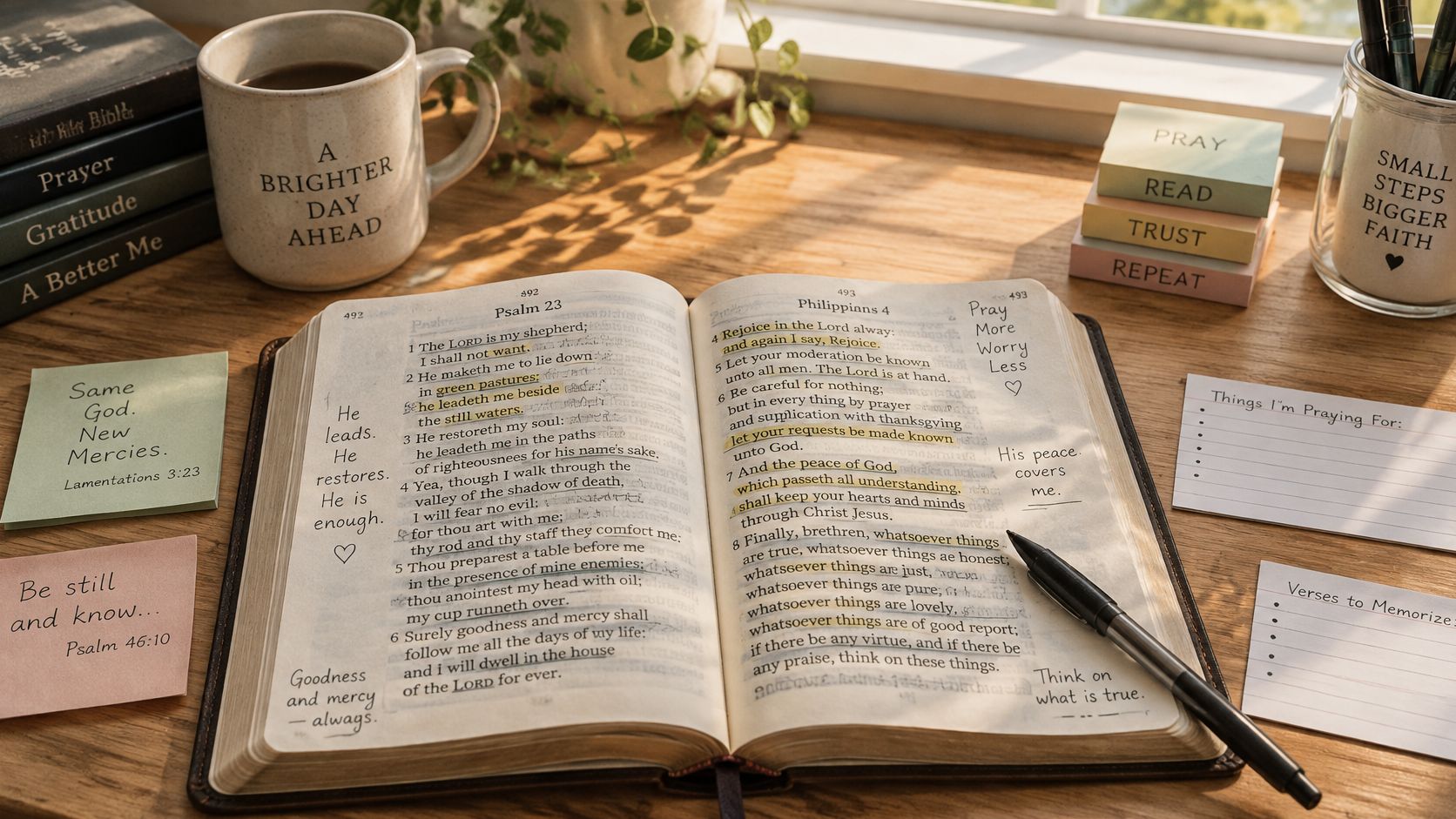
A familiar study space can hold plenty of notes without providing a clear way back to them.
Reduce decisions before adding categories
Huge topical lists require distinctions you may not yet understand. Complicated color schemes make you stop reading to choose a highlighter. A rigid chronological plan can become an unhelpful filing structure if your actual purpose is preparing a group discussion.
None of those approaches is wrong in itself. They become burdensome when maintaining the method takes more attention than reading the passage.
The 2025 State of the Bible church research identifies knowing where to start and having enough time as major barriers for the “Movable Middle,” and reports that 43% of church attenders don't consistently interact with Scripture in ways that shape choices and relationships. An intimidating organization system doesn't address either barrier.
Practical rule: Organize around your next use, not every possible future use.
Before creating folders, answer these questions:
- Purpose: Will you return to these passages for personal reflection, teaching, prayer, or memorization?
- Available attention: What can you maintain during an ordinary busy week?
- Retrieval location: Will you reach for a notebook, your phone, or your computer?
Make your answers concrete. “Find passages for the discussion I lead” gives you a clearer starting point than “organize everything I know.”
Leave the old collection alone initially. Begin with your current reading, then bring older material into the system when you need it. Otherwise, the backlog becomes the project, and Scripture study gets postponed until the filing is finished.
Choosing Your Organizing Principle
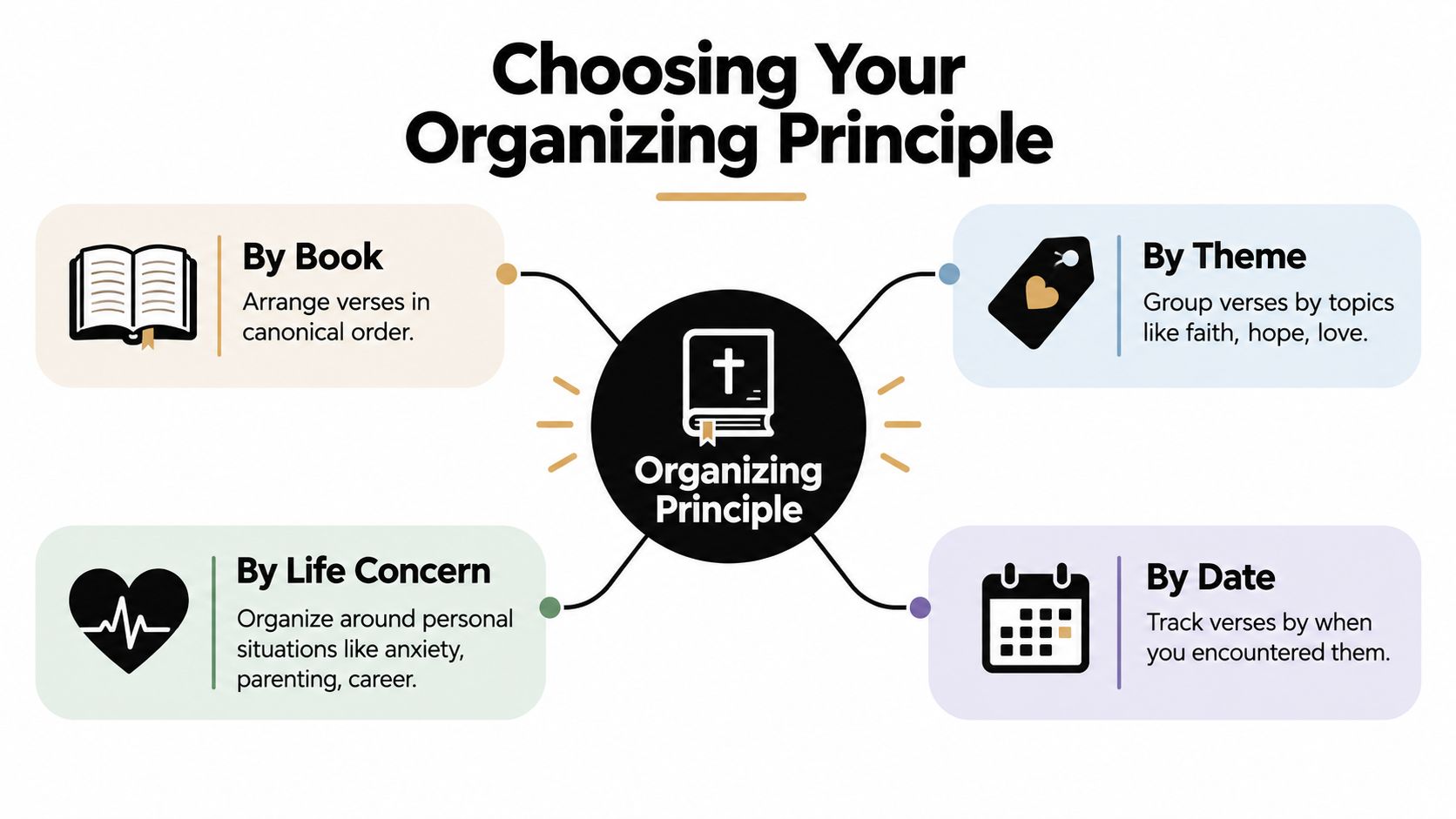
Choose a primary home for each entry. Other categories can help you find it, but they shouldn't force you to maintain duplicate copies.
Organizing by book is a sensible starting point when you're learning to follow a passage in context. Keep observations beside the book you're studying, rather than immediately distributing them across topical folders. This also suits teaching preparation when you expect to return to the same text.
Organizing by theme suits a different task: comparing passages connected with prayer, identity, suffering, or relationships. The trade-off is interpretive. A shared topic tells you why you collected passages together, not whether they make the same claim.
Match the structure to the task
- Life concern: Use a collection such as parenting, grief, or work when you need a practical entry point. Include a note explaining why each passage belongs there.
- Repeated personal need: Keep an ongoing collection for a question you repeatedly revisit, such as responding to conflict. Retain earlier reflections instead of replacing them whenever your understanding changes.
- Date: Use chronological entries when you want to trace your reading and responses over time. Add another retrieval method so remembering the date isn't required.
The diagram distinguishes several useful organizing routes.
For a beginner, I'd recommend the book currently being read as the main structure, with a personal-concern tag when useful. That keeps the reading manageable without requiring an extensive topical vocabulary.
A pastor preparing a teaching series might instead keep a series collection with passage-linked study notes. A facilitator might organize around discussion sessions, while retaining an index of the passages used.
Test your choice with a realistic question: “Where would I look for this before my next meeting?” If the answer requires searching several competing folders, simplify. Keep dates, themes, and personal concerns as secondary access points rather than parallel filing systems.
Building a Tagging and Taxonomy System
A taxonomy is an agreed way to name and group things. You don't need a complicated hierarchy, but you do need consistency: Relationships/Forgiveness and Forgiving others shouldn't become separate categories accidentally.
Write your preferred names on a tag key. Use the same wording in your notebook index, digital entries, and shared resources.
Start with broad families
A workable starter structure could look like this:
- Identity: Belonging, worth, purpose.
- Suffering: Grief, endurance, unanswered questions.
- Prayer: Praise, confession, intercession.
- Relationships: Forgiveness, conflict, encouragement.
- Calling: Work, service, discernment.
These are proposed filing labels, not claims about how every passage should be interpreted. Another reader might prefer the doctrine, practice, and life-area arrangement shown below. Choose a structure rather than adopting both complete hierarchies.
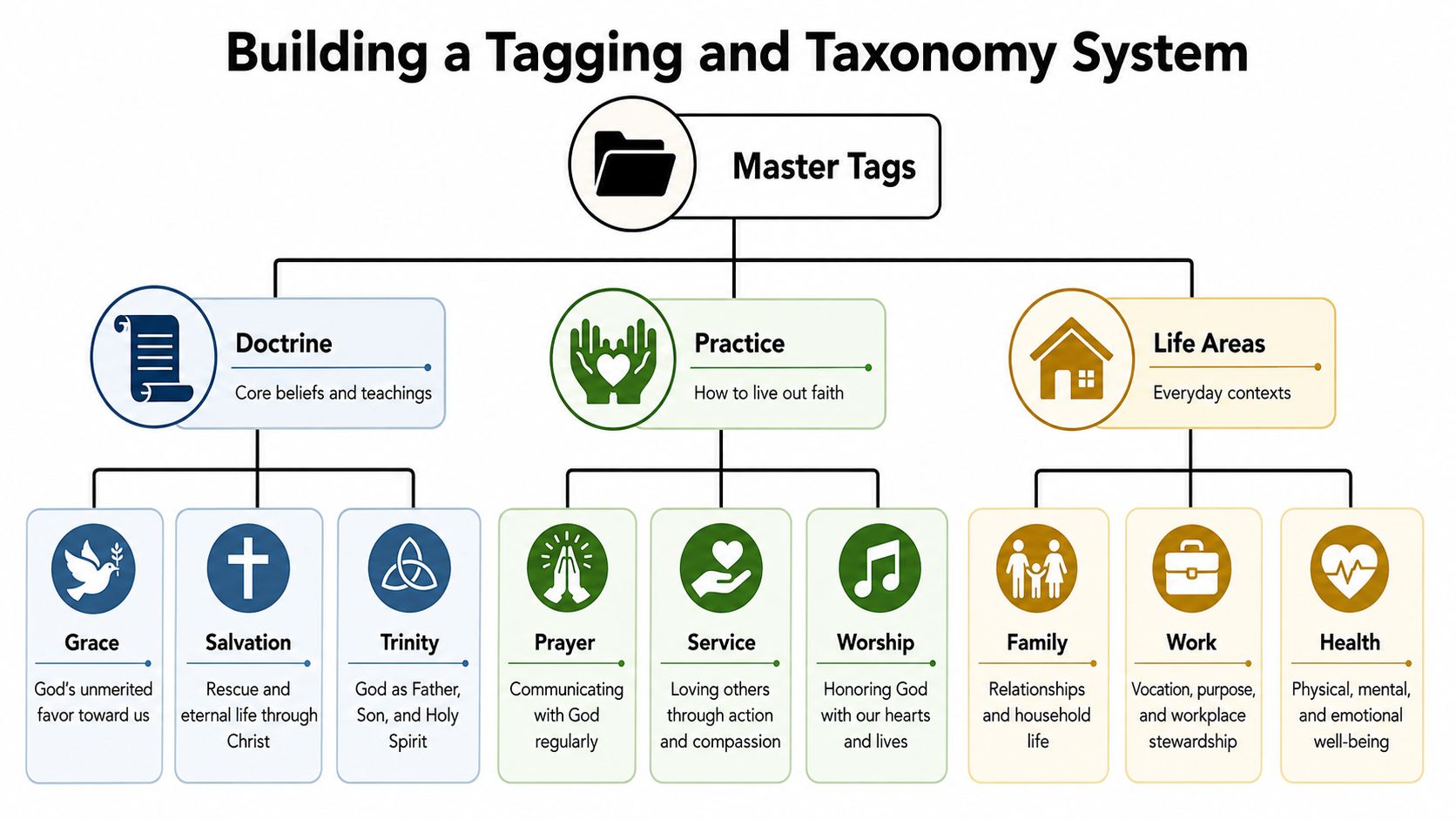
Topical tags describe what you're investigating. Passage-level labels describe the material you're working with, such as narrative, poetry, or instruction. Keep those labels distinct so a search for prayer doesn't conceal differences in genre.
Reuse an existing tag unless the new label answers a retrieval question the old one can't. Split an overcrowded category when you can name a useful distinction, not just because the list looks long.
Keep references separate from tags
For digital records, treat the reference as its own data, not as another topic. The eBible corpus and reference files illustrate verse-aligned text with a parallel reference structure; a sound pipeline normalizes book identifiers, parses chapter and verse, resolves ranges and versification differences, attaches translation and language metadata, and validates references.
A personal spreadsheet can follow that logic with separate columns for book, chapter, verse range, translation, and notes. You don't need to build a database, but don't store “peace passage” as the only identifier.
When an entry fits several topics, attach additional tags to the same record. Multiple routes to an entry are useful; multiple competing copies are not.
Setting Up Your Physical Notebook System
Use a notebook you're willing to write in without rehearsing the page first. Leave space at the front for an index, number pages as you use them, and add entries in sequence rather than reserving fixed blocks for topics.
A consistent layout matters more than decorative supplies.
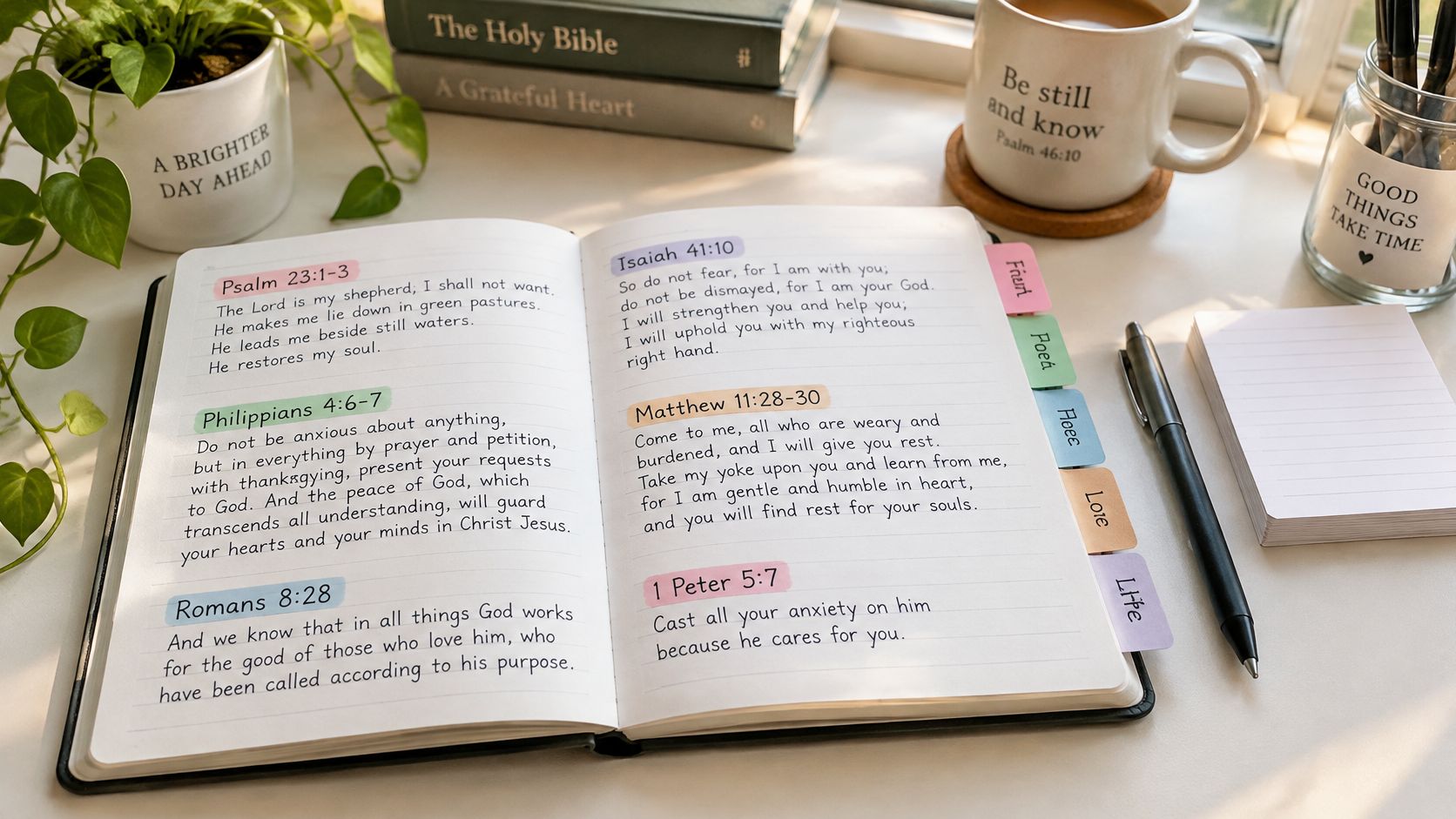
Give each entry a repeatable layout
Use these fields as writing prompts:
- Reference and translation: Record the passage boundaries and the edition you read.
- Text: Copy the wording carefully, or note where to read it if you're studying a longer passage.
- Context: Describe who is speaking, the audience, and what surrounds the selected text.
- Reflection: Record your understanding and unresolved questions.
- Prayer or application: Keep your response visibly separate from the passage itself.
- Tags and index terms: Add the names you'll use to find the entry again.
Read the surrounding passage before filling the page. Then write, tag, and index the entry in that order. Indexing immediately avoids leaving a pile of completed pages that you still can't locate.
For margin annotations that point back to longer journal entries, use a consistent symbol and page reference. These practical suggestions for taking notes in your Bible can help you coordinate the Bible and notebook without copying every reflection into both.
Leave room for a changed understanding. A study notebook should record learning, not require every early conclusion to remain final.
Let the index handle expansion
If your prayer entries outgrow their original pages, continue on the next available page and update the index. Colored tabs or washi tape can mark major sections, but write labels too, so color isn't the only navigation aid.
Use the video as an optional companion while considering your own notebook setup.
When you fill the notebook, give it a volume label and list its main subjects inside the cover. Keep the same entry format in the next volume rather than redesigning everything.
Organizing Verses in Digital Tools
A digital collection is worth using when it makes capture and retrieval easier in your actual reading environment. Don't choose an app solely because its demonstration looks tidy.
The Scripture engagement overview of The Quiet Revival reports that weekly-or-more Bible reading in England and Wales increased from 6% in 2018 to 12% in 2024, alongside prominent app and audio use among younger churchgoers. For your own system, the practical question is whether an entry remains identifiable when you move between listening, reading, and discussion.
Test with a real entry
Before migrating an existing collection, try these tasks:
- Attach a passage: Can you preserve the exact reference and translation alongside your reflection?
- Retrieve it: Can you find the entry through its reference, wording, and tags?
- Protect it: Can you restrict sensitive reflections without hiding ordinary study notes?
- Move it: Can you export readable material that remains useful outside the tool?
A general note-taking app can suit mixed research, lesson drafts, and personal writing. You'll need to establish your own reference conventions. A purpose-built faith journal may offer verse-linked entries and integrated Bible reading, but check translation availability, export options, and privacy controls before committing.
A practical Bible journaling app guide can help you compare those requirements. Treat feature lists as a shortlist, then test the tasks yourself.
Capture without interrupting study
While reading on your phone, attach the passage and add a brief reason for saving it. While listening, record the book and chapter plus a recognizable phrase, then verify the exact reference before treating the entry as complete.
On a computer, use the additional space for context and comparison rather than creating a more elaborate category system. Keep a temporary inbox for unprocessed captures, separate from reviewed study notes.
For multilingual study, retain the original wording and identify its language and translation. Don't overwrite it with a preferred rendering. Label personal paraphrases explicitly, and use written labels rather than relying on highlighting alone.
Cross-Referencing and Linking Techniques
A cross-reference should explain why passages belong together. A list of references without that explanation leaves your future self to reconstruct the connection.
Chapter and verse numbers are useful addresses, but they aren't the original structure of the manuscripts. Bible Gateway's history of chapters and verses credits Stephen Langton with widely adopted chapter divisions in the early thirteenth century and identifies the 1560 Geneva Bible as the first English Bible commonly recognized for applying verse divisions throughout. Use those addresses to locate material, then read beyond them.
Label the relationship
Distinguish the kind of connection you're making:
- Shared theme: The passages contribute to a subject you're exploring.
- Shared story: The passages concern connected events or narrative material.
- Theological concept: You're comparing contributions to a doctrinal question.
- Personal association: You encountered the passages together or responded to them similarly.
That last label matters. A connection meaningful in your own prayer journal isn't automatically a textual or theological relationship.
Also distinguish direct match from related passage. A direct match locates the specific wording or passage requested. A related passage may be relevant without saying the same thing.
For fuller study habits, use this guide to cross-referencing the Bible alongside your own context notes.
Build a peace collection without flattening meaning
Suppose you save a passage during a study of peace. Create an entry titled “Peace study,” then record what you think peace means in that particular passage and what evidence you still need to examine.
As you encounter candidates elsewhere, place them on a comparison page rather than immediately declaring them equivalents. Give each candidate a reference, translation, genre label, and a question: Is this describing personal reassurance, relationships, communal wellbeing, or something else?
A candidate from poetry and a candidate from a letter can remain in the same collection. Your notes should explain their differences, not conceal them under a shared tag.
On the original entry, add a short “see also” line pointing to the comparison page. Digitally, link to that page or collection instead of pasting the entire growing list into every note.
Study safeguard: A helpful connection invites comparison. It doesn't prove that connected passages are interchangeable.
If an AI tool suggests references, check that each location exists and read the exact text. An Emory academic case study on Bible verse extraction reported 62.5% accuracy on fact-based questions and 58.5% on theological questions for commercial models in its evaluation. Those results support treating generated suggestions as candidates for review, not authoritative conclusions.
Retrieval Methods Compared
| Method | Best For | Limitation |
|---|---|---|
| Reference index | Returning to a known passage | Requires a recognizable reference |
| Topic tags | Gathering material for a subject | Depends on consistent classification |
| Phrase search | Finding remembered wording | Translation differences can interfere |
| Linked comparison page | Preparing a connected study | Requires explanations and upkeep |
| Date index | Reviewing earlier reflections | Weak when the date is forgotten |
When you remember wording but not the reference, search a distinctive phrase in the translation you probably used. If that fails, try a shorter phrase, then review related tags. Verify the result before attaching it to an older note.
Keep the collection recoverable and private
During a weekly review, process unfinished captures, repair broken references, and merge synonymous tags. Leave unresolved interpretation questions marked as unresolved.
Export digital notes regularly, and open an export to confirm that references and reflections are readable. Check whether attachments and links survive, rather than assuming that downloading a file preserves everything.
Photograph important notebook pages and their index when you've added substantial material. Store copies separately from the physical notebook.
Keep pastoral details and sensitive journal entries out of shared collections. Before using cloud storage, review who can access notes, what sharing permissions mean, and how deletion works. A convenient study resource shouldn't become an accidental record of someone else's private circumstances.
Applying Your System in Real Life
The same basic method can serve personal study, group preparation, and church records, but each setting needs a different boundary around ownership and sharing. These are example setups, not requirements to reproduce.
Personal devotions
Keep your current book study as the main notebook or collection. An entry might carry Prayer/Intercession and a private reflection label, with a link to an earlier question you're reconsidering.
When a recurring concern surfaces, don't abandon the current reading to rebuild the library around it. Add a retrieval tag and continue reading in context. Over time, review how your understanding has changed rather than judging progress by the size of the collection.
For a family devotional, let participants contribute questions in their own words. Keep the passage reference shared, while allowing personal responses to remain private.
Small-group discussion
Create a shared session page containing the passage reference, reading instructions, discussion questions, and reviewed cross-references. Keep the leader's preparation notes separate from the material participants receive.
Use labels such as Discussion/Questions, Follow-up, and Needs review to distinguish purposes. A member's question can stay open without being filed as the group's conclusion.
- Share the method lightly: Give members a usable page, not a requirement to adopt your entire tagging vocabulary.
- Identify contributions: Distinguish the biblical text, the facilitator's interpretation, and participant observations.
- Preserve boundaries: Don't copy personal disclosures into a permanent shared study archive.
Church teaching archives
For a church archive, organize around teaching series and passage references, with clear ownership of edits. Keep draft material, reviewed teaching resources, and confidential pastoral records in separate locations.
A sermon preparation entry might link to a series folder, a passage comparison page, and a discussion resource. Mark the translation and review status so another leader can understand what they're opening without asking the original author.
Scale the responsibility, not the complexity. An individual needs a dependable place to return; a group needs clear sharing boundaries; a church needs continuity when contributors change.
Start with the next passage you're already planning to read. Create a complete entry, test whether you can retrieve it, and adjust only what caused friction.
HolyJot offers verse-linked journaling, an online Bible, and guided study plans for keeping Scripture and reflection together. Visit HolyJot to begin with your current passage and build a collection you can return to for prayer, study, or your next group discussion.