


It's Wednesday night. The passage is open, your notes are spread across the desk, and the sermon outline is still blank. You love the text, but you also know that listeners need more than a collection of observations. They need a clear path through the message, one that respects the passage and gives them something to carry into the week.
A 3 point sermon outline can provide that path, but it isn't a rule every passage must obey. The structure works when three connected movements help one biblical claim become clear, persuasive, and practical. By the time you've worked through this guide, you'll have a method for drafting the sermon, planning its delivery, and carrying its central idea into weekday discipleship.
Why Three Points Still Works on Sunday Morning
The blank outline can tempt a preacher toward two opposite mistakes. One is to keep adding observations until the sermon becomes a commentary tour. The other is to force the passage into three neat headings before its shape is clear. Neither serves the congregation well. Listeners need structure, but the text must supply the substance.
A three-point outline is useful because it gives a single controlling idea a shape people can follow. The three points should not be three interesting facts gathered from the passage. They should be connected steps in the passage's argument or movement, each preparing listeners for what follows. When that progression is real, the structure makes a complex message easier to hear without pretending the text is simple.
That's why a strong outline begins with listening rather than numbering. Read the passage in context. Mark its repeated words, shifts in speaker or scene, commands, contrasts, and conclusions. Then ask what claim holds those details together. If the passage's own movement gives you three meaningful stages, use them. If it doesn't, don't make it.
The practical payoff is more than a tidy page. A clear structure helps you decide what to emphasize, where to slow down, and how to connect explanation to response. It also gives listeners a thread they can remember after the service, not just a set of headings they heard once.
A preacher's test: Can you explain why each point follows the one before it? If not, the outline may be arranged for convenience rather than drawn from the text.
Treat the afternoon's work as a workshop. Find the controlling idea, map the passage, write the points as a connected argument, then prepare the opening, ending, and weekday follow-up. The framework is there to serve the message, not to replace the work of interpretation.
The Anatomy of a Strong Three Point Sermon Outline
The three-point form has deeper roots than a modern presentation trick. In the later medieval period, Franciscan and Dominican preachers developed the university sermon, which organized a central theme into three major divisions. A fifteenth-century manuscript compared the method to a tree: one trunk with three principal limbs, each capable of supporting smaller branches. The form later became associated with the conventional Western sermon, until the New Homiletic movement of the 1970s placed greater emphasis on narrative movement and listener experience. An introduction to the history of preaching traces that development.
The metaphor remains useful. A sermon needs one trunk, not three competing trees. Start by writing a controlling sentence that names the passage's subject and what it asserts about that subject. It should be specific enough to guide your choices. “God is faithful” may be true, but it doesn't yet tell you what this passage says about God's faithfulness or what listeners should see.
Build from the passage outward
Before drafting point headings, map the passage's actual movements. Note where the author develops an idea, where the story changes direction, or where a command leads to a reason. Then ask whether those movements form a genuine progression. A useful outline might move from problem to promise to response, but the passage itself must justify that sequence.
Once you see the movement, phrase each point as a complete, parallel sentence. Matching grammar makes the relationship between points easier to hear. A 2000 Christianity Today pastors' resource identifies introduction, body, and conclusion as the sermon's three main parts, while the Logos preaching guide recommends points that are exegetical, sequential, and memorable, functioning as “one sermon in three steps” rather than three unrelated mini-sermons. The Logos guide to choosing sermon points offers a helpful standard for testing the outline.
For additional planning tools, browse HolyJot's sermon preparation resources. Use a resource to organize your work, not to decide the passage's structure in advance.
Then apply the deletion test: remove one point. If the controlling sentence still stands just as strongly, that point may be decorative. Cut it or merge it with a movement that advances the sermon. Three is a durable framework, not a biblical requirement.
Writing Each Point as a Mini Argument
An outline often looks solid until you try to preach it. “Trust God,” “wait patiently,” and “have faith” may sound memorable, but the congregation still needs to know why the passage supports each claim and what to do with it. Build each point as a mini argument: claim, biblical evidence, explanation, objection or warrant, and application.
Consider Mark 5:21–43, where Jairus seeks help for his daughter and a woman suffering from bleeding reaches for Jesus. A controlling sentence might be: Jesus meets desperate people with compassion and calls them to trust him. The outline should follow the narrative rather than divide it into three unrelated lessons.
A worked argument from Mark 5
Claim: Jesus gives attention to people others might overlook. Biblical evidence: The woman reaches for him in the crowd, and Jesus stops to address her. Explanation: The interruption isn't a distraction from the story's meaning; it reveals how Jesus treats someone who has been suffering in isolation. Warrant or objection: A listener might ask why Jesus pauses when Jairus's need appears urgent. The narrative shows that compassion for one person doesn't cancel concern for another. Application: Notice someone routinely overlooked in your church or workplace, and make a concrete plan to listen to them this week.
Claim: Jesus remains worthy of trust when circumstances worsen. Biblical evidence: Jairus hears that his daughter has died, and Jesus tells him not to fear but to believe. Explanation: The story doesn't minimize grief. It presents a crisis that exceeds Jairus's ability to solve it. Warrant or objection: Trust here isn't a guarantee that every painful situation will resolve in the way we want. It's a response to Jesus' authority and presence. Application: Bring a specific fear to prayer, and ask a trusted person to pray with you rather than carrying it alone.
Claim: Jesus' power brings life where human hope has ended. Biblical evidence: Jesus takes the girl by the hand and tells her to rise. Explanation: The scene brings the two stories together: the woman is restored, and Jairus's daughter is raised. Warrant or objection: The miracle is not a promise that every present loss will be reversed immediately. It reveals Jesus' authority and points beyond the family's immediate relief. Application: When supporting someone in grief, offer presence and practical help instead of easy explanations.
Use one dominant illustration per point. An illustration should clarify the claim, not compete with the passage for attention. The application should name an observable response, not merely tell listeners to “be more faithful.”
A 2025 mixed-methods study involving 1,492 participants across 23 churches found stronger comprehension, engagement, and behavioral intention in sermons using explicit warrants, rebuttals, and structured argumentation than in traditional approaches (study details). The pastoral implication is straightforward: show how the evidence supports the claim, and address a real question rather than pretending no one has one.
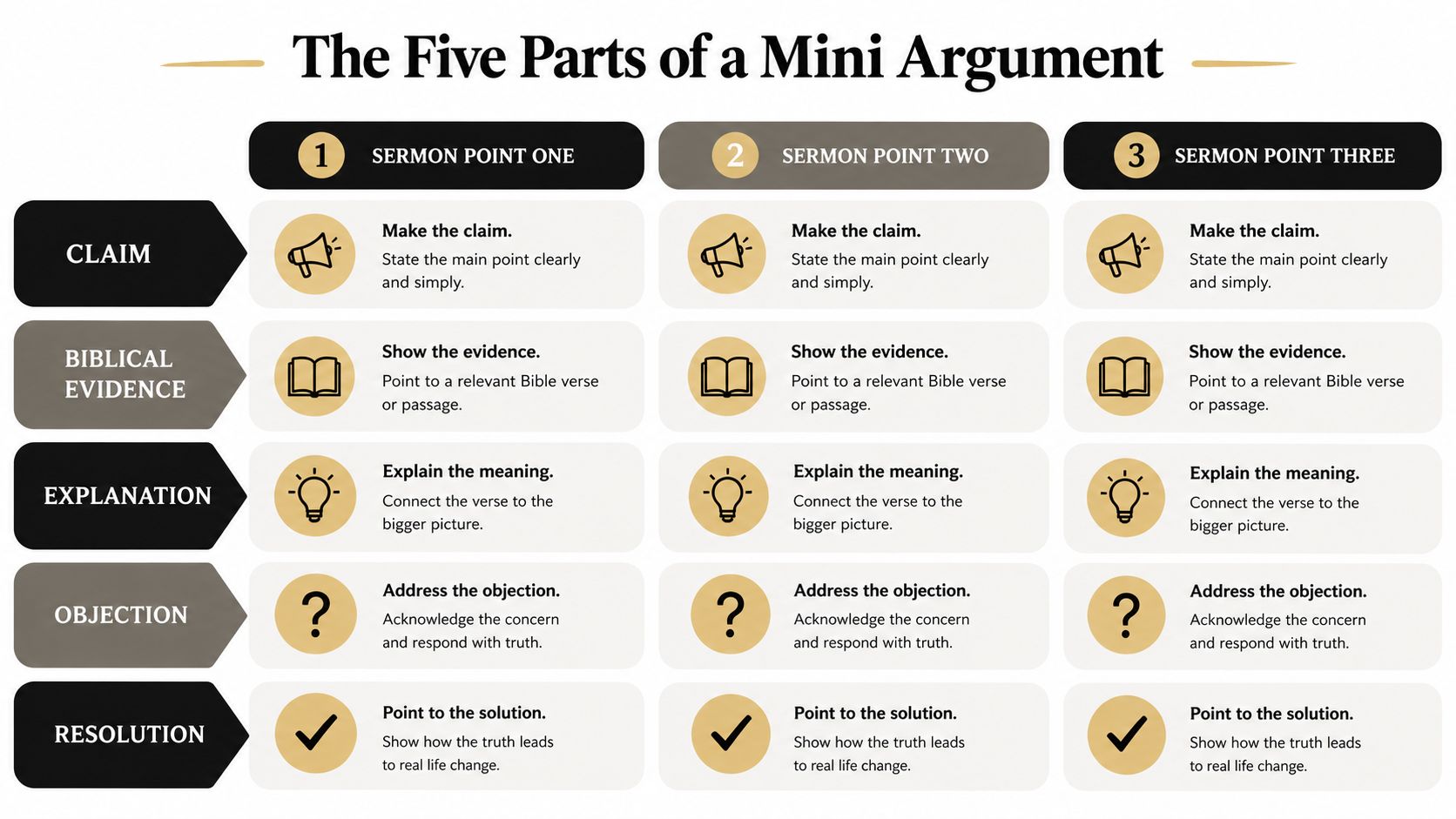
| Argument part | Weak treatment | Strong treatment |
|---|---|---|
| Claim | A broad slogan with no connection to the passage | A clear sentence that names what the text asserts |
| Biblical evidence | A verse reference with no explanation | The detail or movement in the passage that supports the claim |
| Explanation | Repeating the point in different words | Showing how the evidence leads to the claim |
| Objection | Ignoring the listener's likely question | Naming a real tension and answering it with care |
| Resolution | A vague call to “do better” | A specific response that follows from the text |
Crafting the Introduction and Conclusion That Frame the Outline
The introduction earns attention by meeting listeners where they are. The conclusion should make the message's central claim land as one response, not leave listeners sorting through a last-minute list of ideas. Give each its own work to do.
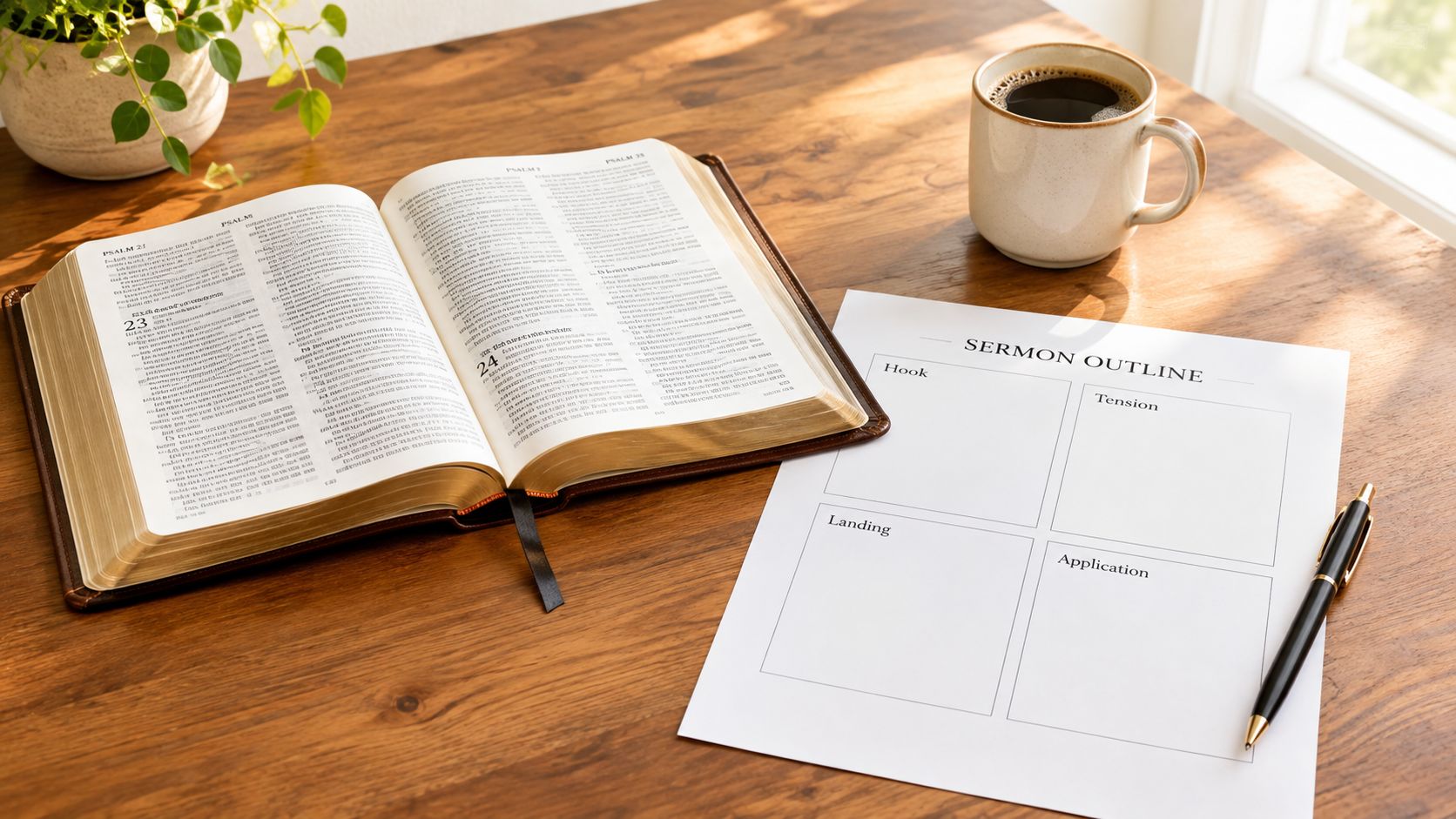
Start with an opener that moves from the listener's world to the text. Begin with a hook drawn from an ordinary pressure or question, then name the tension the passage addresses. Add a brief context-setting sentence so listeners know where they are in the passage, and state the controlling sentence plainly. Resist the urge to announce a roadmap of headings before you've shown why the message matters.
A conclusion needs a different kind of discipline. Restate the controlling sentence, gather the three movements into one memorable image or idea, then issue a specific call to respond. Don't add a fresh argument or introduce new material in the closing minutes. If the ending needs another point, it may be that the sermon's main claim still isn't clear.
For a 30-minute sermon, practical guidance suggests roughly 4–5 minutes for the introduction, 6–7 minutes for each of the three movements, and 3–4 minutes for the conclusion. Treat that as a working rhythm, not a stopwatch rule. A passage may call for more time in one movement and less in another. Guidance on timing a 30-minute sermon also summarizes oral-audience research reporting roughly 29% retention for messages reduced to outline form and 75–80% retention when storytelling formed about 60% of the message. Those figures aren't universal benchmarks, but they reinforce a sound preaching instinct: narrative can help listeners grasp an idea that abstract headings alone may leave cold.
Transitions keep the argument moving. A useful transition explains what the previous point leaves unresolved and why the next point follows. For example: “The woman's healing shows Jesus' compassion, but Jairus still faces the crisis that brought him to Jesus.” That sentence carries the audience forward instead of announcing the next heading.
Sample Three Point Outlines for Different Passage Types
A single outline pattern shouldn't flatten very different kinds of Scripture. A narrative moves through events; a didactic passage develops instruction; a psalm may move through prayer, distress, and praise. The headings should reflect those differences while still serving one central claim.
| Passage type | Controlling sentence and sample points | Illustration and application |
|---|---|---|
| Narrative, Mark 5:21–43 | Controlling sentence: Jesus meets desperate people with compassion and calls them to trust him. Points: Jesus notices the suffering others overlook. Jesus calls fearful people to keep trusting. Jesus displays authority over life and death. | Illustration: A person interrupted in a crowded room but fully heard. Application: Identify one person you can listen to without rushing to fix their problem. Slow down at the moment Jesus addresses the woman, then return to the controlling sentence as Jairus hears the news about his daughter. |
| Didactic, Romans 12 | Controlling sentence: Gospel-shaped worship changes how Christians think and live together. Points: Offer your whole life to God. Let God renew your thinking. Use your gifts to serve others. | Illustration: A team whose shared purpose changes how its members use their strengths. Application: Choose one concrete way to serve someone in your congregation using a gift you already have. Emphasize the link between renewed thinking and practical service, rather than treating them as separate lessons. |
| Poetic, Psalm 13 | Controlling sentence: Faith brings honest anguish to God and waits for his steadfast love. Points: Tell God the truth about distress. Ask for help with confidence. Remember God's steadfast love in praise. | Illustration: A lament written as a prayer rather than hidden as private despair. Application: Write a prayer that names a present sorrow, asks for help, and recalls a reason for hope. Let the movement from lament toward trust set the sermon's pace. |
The outline for Mark 5 follows the narrative's two intertwined stories; it doesn't need an extra point because the passage contains more than one person. Likewise, Romans 12 calls for careful attention to the connection between worship, renewed thinking, and service. For a Good Friday service, these sermon ideas for Good Friday can help with planning, but the passage still has to set the message's shape.
Choose the number of points by looking at the text's movement. Homiletical guidance recommends three when the passage contains a genuine progression, and two or four when those better reflect its structure (preaching guidance on point count).
| Use | When it fits |
|---|---|
| Two points | The passage turns on a clear contrast or has two natural movements |
| Three points | The passage develops one claim through three connected stages |
| Four points | Four distinct movements matter, and merging them would blur the text |
Turning Three Points Into a Seven Day Discipleship Pathway
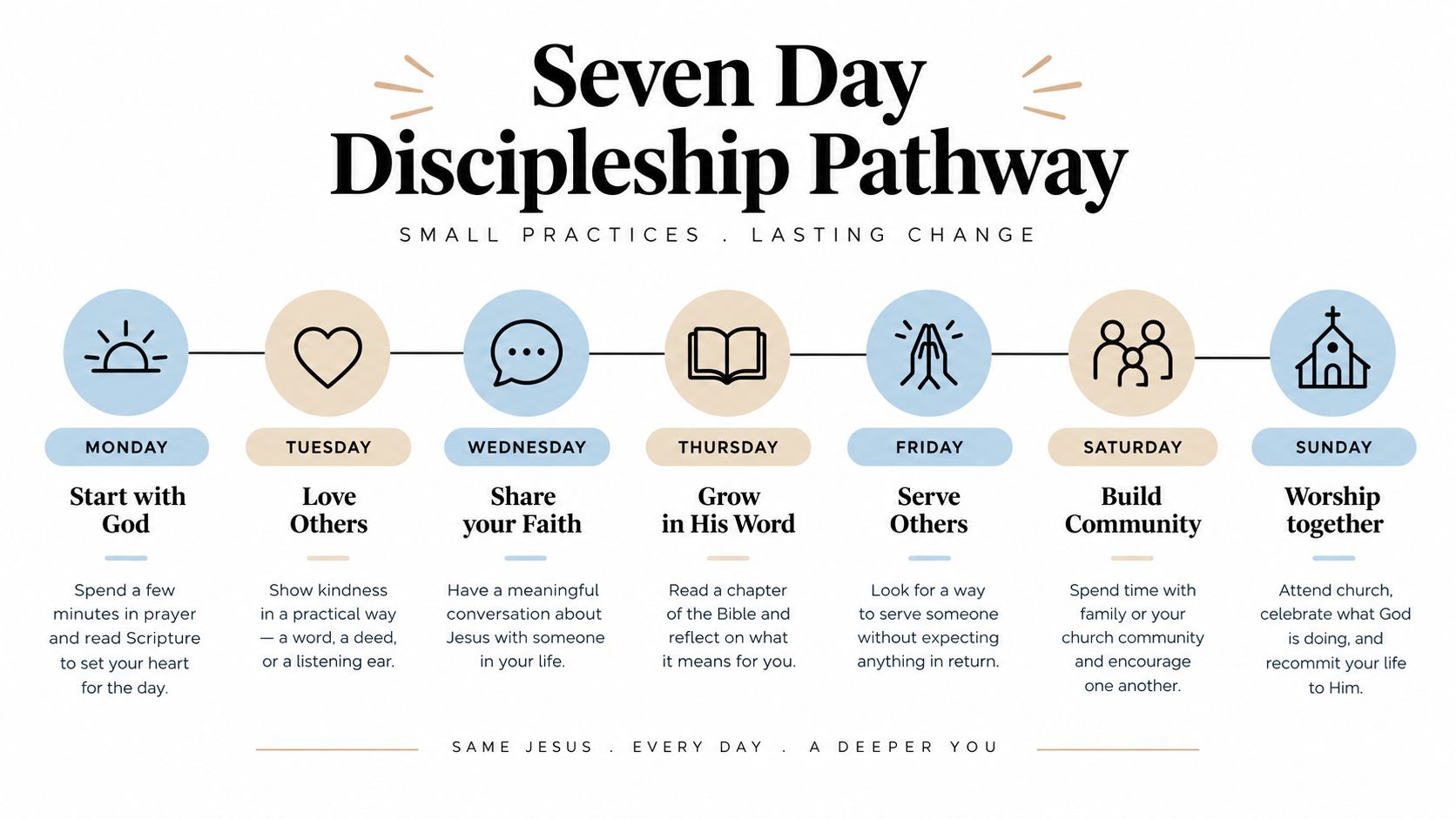
A sermon shouldn't have to disappear when the service ends. Give each point a weekday practice, reflection question, prayer prompt, and conversation starter. That extends the same biblical claim through the week without asking people to listen to the sermon again.
The American Bible Society's 2025 State of the Bible reporting places the U.S. Scripture-Engaged population at 20% and reports that Bible use rose from 38% to 41% (2025 report). That context makes follow-up worth planning, but a number alone doesn't tell a church what to do. The useful response is to make engagement concrete, communal, and connected to the passage.
For the Mark 5 outline, assign the points across the week:
- Monday, notice: Reread the scene with the woman. Ask, “Whom do I tend to overlook?” Pray for attention to someone's needs.
- Tuesday, listen: Make time to hear that person without rushing the conversation. Ask God for patience and compassion.
- Wednesday, discuss: Invite a family member or small group to consider why Jesus pauses in the crowd. Pray for people who feel unseen.
- Thursday, reflect: Reread Jairus's story. Ask, “Where do I need help trusting when circumstances worsen?” Name that fear in prayer.
- Friday, practice: Offer specific support to someone facing grief or uncertainty. Pray for wisdom to be present without offering easy answers.
- Saturday, share: Discuss the passage with a friend or family member. Ask which part of the story has stayed with them.
- Sunday, gather: Return to the passage in worship and carry the controlling sentence into the new week.
Application isn't behaviorism. The point isn't to turn each sermon into a task list or measure faith by completed activities. Practices should help people respond to Scripture in prayer, trust, and love, with room for pastoral care when someone's circumstances make a suggested practice difficult.
Keep the sermon manuscript, reflection prompts, group questions, and prayer practices together so leaders and participants can use them through the week. HolyJot is one option for organizing sermon resources and supporting Scripture engagement in private journals and church groups. If you're adapting a message for short-form sharing, sermon video clips for social media can be another way to direct people back to the passage and its weekday practices. For planning a longer sequence of messages, HolyJot's sermon series ideas for the new year offer a starting point for connecting sermons across a season.
Quick Reference Checklist and Common Questions
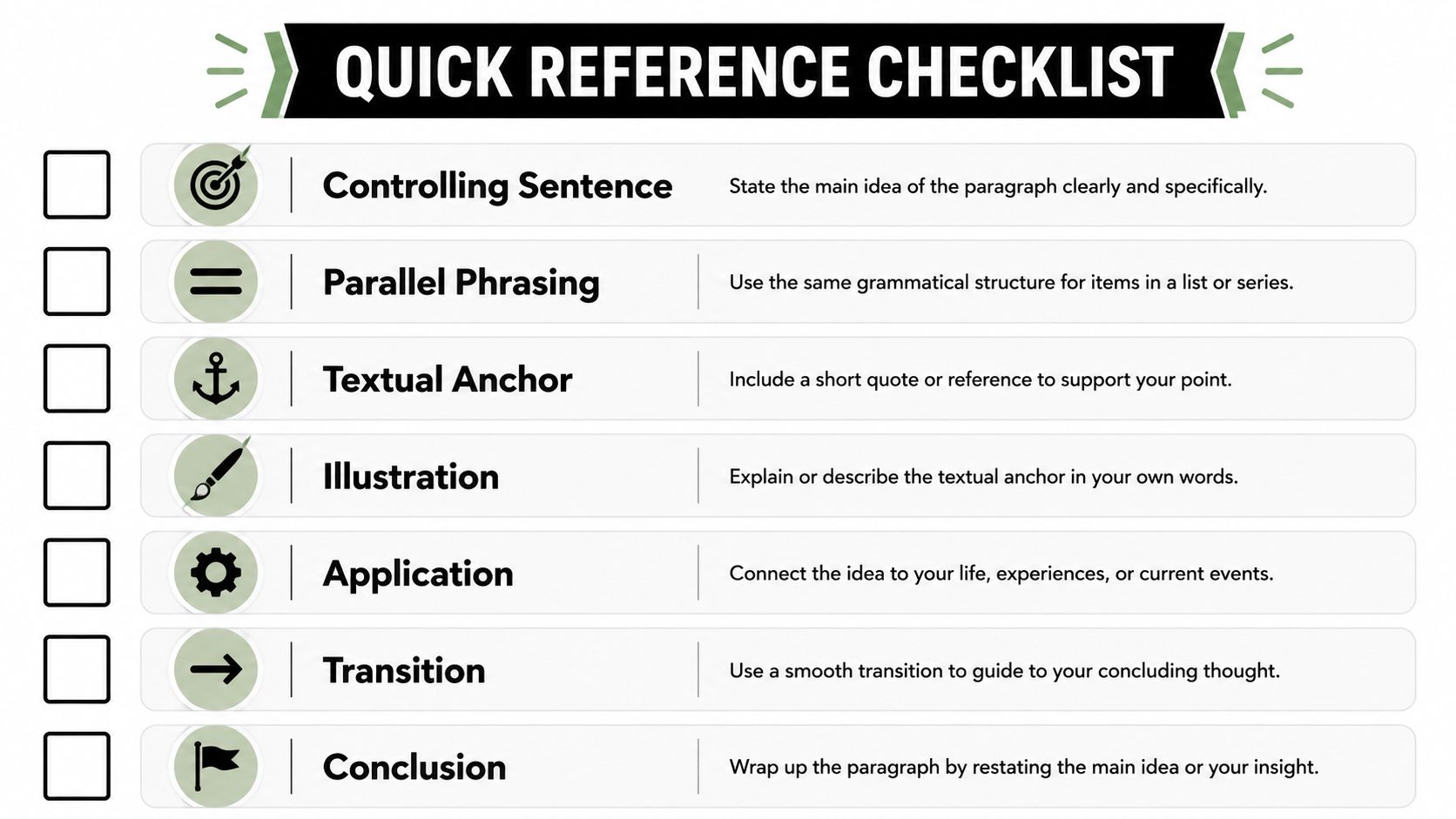
Before you preach, check the logic, not just the labels. A strong outline should make the passage's movement easier to follow and the central claim easier to remember. Use this list at your desk, then revise wherever the reasoning feels thin.
- Controlling sentence: Does one clear sentence state the passage's subject and assertion?
- Parallel phrasing: Do the point sentences share a grammatical shape and advance one idea?
- Textual anchor: Can you point to the passage detail that supports each claim?
- Illustration: Does one main illustration clarify the point without distracting from the text?
- Application: Have you named a concrete response rather than a vague aspiration?
- Transition: Does each transition explain why the next movement follows?
- Weekday pathway: Have you offered a practice, question, prayer, or discussion prompt that carries the message into daily life?
What if the passage has only two movements? Preach two. A clear two-part structure is better than padding the sermon with a third point that doesn't advance the passage's claim. Use the same mini-argument method for each movement.
What if the passage resists any outline? Don't force a tidy framework onto a text whose form calls for a different approach. Let the passage's genre and movement guide the sermon. You can still use a controlling sentence to hold the message together.
Does alliteration help? Sometimes. It can make parallel points easier to recall, but it can also lead you to distort the wording or meaning just to make the headings match. Write accurate points first; polish them only if the memorable phrasing remains faithful to the text.
How long should a three-point sermon run? There's no universal length. Plan around the service and the passage, then rehearse aloud. For a 30-minute message, use the timing guidance above as a starting rhythm, not a rigid quota.
HolyJot provides tools for organizing sermon notes, Scripture study, prayer prompts, and church-group resources, helping you carry a sermon's central idea beyond Sunday. Put your outline to work for the week and explore the available resources at HolyJot.