


How can Christians keep loving people who are difficult without pretending that harmful behavior is harmless? The familiar advice to “be patient” can sound simple until a friend repeatedly overshares, a church member presses the same painful button, or a spouse keeps repeating a damaging mistake. At that point, patience needs more than a warm slogan. It needs a biblical definition, practical habits, and wise boundaries.
The New Testament phrase bearing with one another describes a demanding form of love. It calls believers to remain engaged through ordinary relational strain, forgive grievances, and protect unity. It also requires enough wisdom to recognize when continued access, silence, or secrecy would enable harm. The path from Ephesians and Colossians to daily life is not passive tolerance. It is a disciplined way of holding steady, speaking truth, repairing relationships, and seeking safety.
Why Patience With People Feels Impossible
Anyone who has heard the same complaint for the tenth time knows how quickly patience thins. A friend dominates every conversation, a group member turns discussion into an argument, or someone close apologizes sincerely yet repeats the same behavior. Love may remain strong, while its practical demands become harder to discern.
Biblical patience is a faithful response that stays honest about what is happening. Frustration can reveal accumulated strain, not automatic spiritual failure. A boundary can protect a relationship rather than reject the person. The command to bear with one another therefore calls for active endurance under pressure, joined to truthful judgment.
This wisdom applies beyond church life. Guidance on handling workplace disagreements effectively highlights a useful practice: name the issue, listen carefully, and establish a constructive way forward. Conflict resolution does not require pretending that differences have disappeared. In the same way, Christian patience can hold together compassion, clarity, and responsible action.
A practical question: Am I bearing with this person, or am I merely avoiding an honest conversation?
Bearing with someone also involves mental and emotional health. Prayer may help, yet a person might also need accountability, counseling, rest, or protection. Resources on mental health and faith can help Christians consider spiritual practices without treating distress as a simple failure of faith.
The difficulty often lies in accumulation. Small irritations, unspoken assumptions, old wounds, and defensive reactions gather weight, like dust collecting in a room until movement becomes difficult. One disagreement may be manageable; repeated patterns can expose a deeper problem. Paul's command gives believers a way to remain committed to love while refusing to label every behavior acceptable.
The Meaning Behind the Greek Word Anéchomai
What does “bearing with” require when a relationship becomes difficult? The Greek verb behind the phrase is ἀνέχομαι, anéchomai. Lexical sources define it with words such as to bear with, endure, forbear, tolerate, and sustain oneself under difficulty. Its picture is active: a person holds firm under pressure rather than accepting an inconvenience. The lexical entry for anéchomai connects the verb with the effort required when relationships strain.
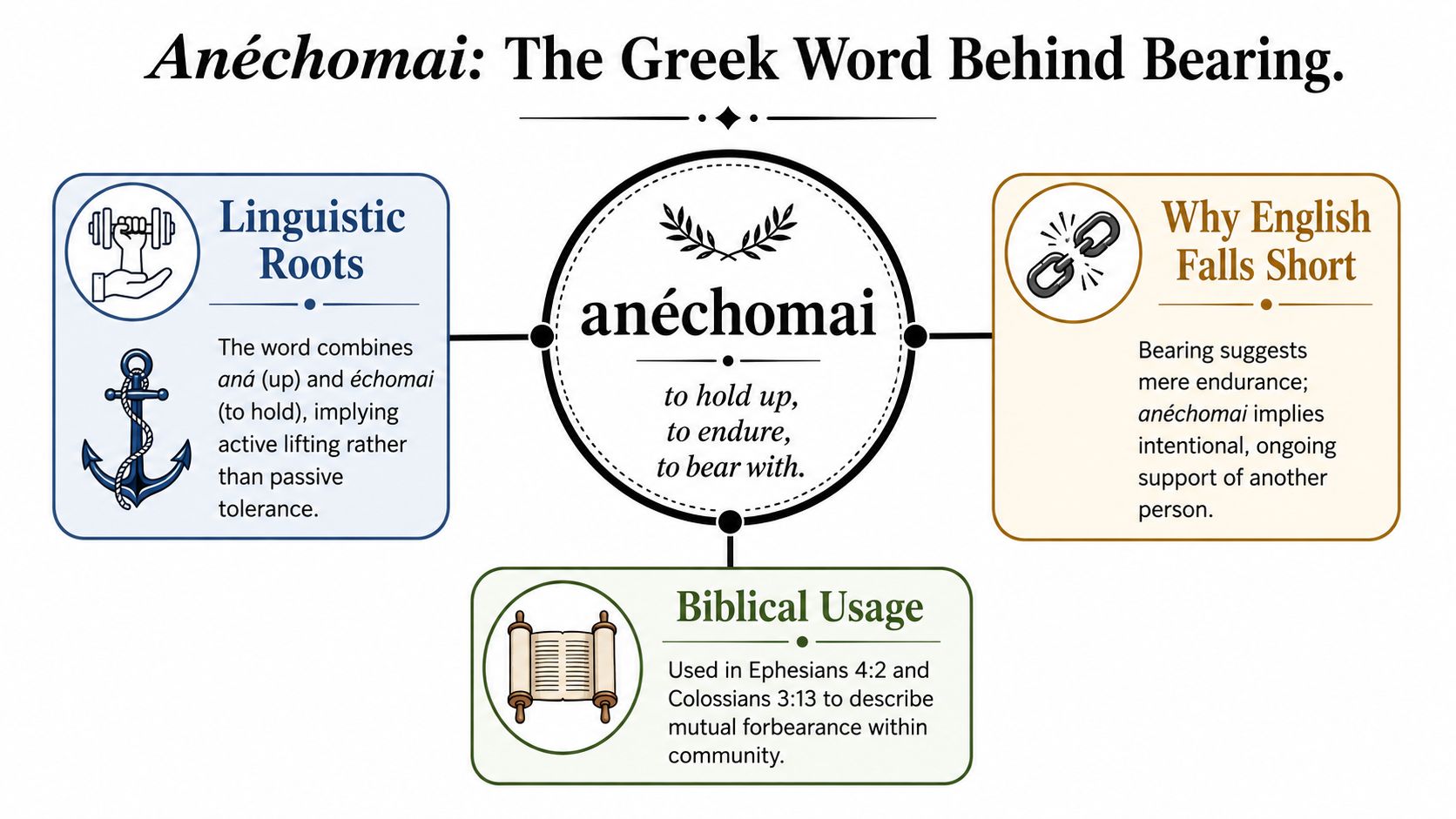
The English word “bearing” can suggest merely putting up with an inconvenience. Anéchomai carries greater intention. A person remains steady, resists retaliation, and continues to treat the other person as someone made for relationship, even while words or actions create real pressure.
A concordance records anéchomai as appearing 15 times in the New Testament, translated with terms including “bear,” “bearing,” “endure,” “forbear,” “suffer,” and “tolerate.” This range matters. The verb can describe ordinary interpersonal friction, but it can also address complaints, conflict, serious pressure, and difficult conduct.
What the verb pictures
A person bracing against a strong current knows the water is powerful. Remaining upright requires strength and judgment. In a relationship, that strength might look like listening before answering, refusing revenge, allowing time for maturity, or offering correction without contempt.
The command also carries mutual responsibility. Christian community is not built around one patient person endlessly carrying everyone else. Each person must learn to receive grace, restrain a harsh response, accept correction, and take part in repair. Bearing with one another is shared work.
| English Translation | What It Pictures | Typical Context |
|---|---|---|
| Bear or bearing | Remaining engaged under relational pressure | Community tension and personal weakness |
| Endure | Continuing through demanding circumstances | Hardship, criticism, or uncomfortable conduct |
| Forbear | Restraining retaliation or harsh response | Complaints, offenses, and conflict |
| Suffer or tolerate | Remaining present when behavior is difficult | Serious pressure or challenging situations |
This vocabulary gives the command its shape. Bearing with one another is active endurance guided by love. It does not erase discernment or require unlimited access. It asks what faithful strength looks like in the relationship as it exists, while leaving room to distinguish ordinary friction from conduct that causes harm.
The Pauline House Churches Behind the Command
Picture a Christian gathering in a home. People arrive with different histories, social positions, habits, and expectations. Some have Jewish backgrounds, others Gentile backgrounds. Some have power and resources, while others live with dependence or vulnerability. They share food, prayer, teaching, and physical space, yet they don't automatically share instincts about authority, worship, money, or daily conduct.
Paul's command would have sounded practical in that setting. A church could not preserve fellowship through personality matching. Members had to learn how to live as one body while carrying differences that did not disappear when they entered the room.

Ephesians places humility, gentleness, patience, and bearing with one another in love within its appeal for unity. Colossians connects the same verb with grievances and forgiveness. The instruction therefore addresses more than manners. It speaks to the repeated work of keeping a community from fragmenting when people disappoint one another.
The setting also helps us avoid a sentimental reading. These believers weren't asked to create unity by denying conflict. They were asked to exercise restraint, forgive, and refuse retaliation while they learned how to belong to one another. Unity required behavior, not merely agreement with a doctrine of unity.
Here is a short visual reminder of the communal setting behind the command:
Modern churches face different pressures, but the relational problem remains recognizable. A small group may include a forceful speaker, a quiet member, someone quick to take offense, and someone who rarely notices how their words land. Bearing with one another means creating enough humility and structure for these people to remain truthful and connected.
The command was never a decorative addition to Christian life. It was a survival skill for communities under strain. It helped believers distinguish between the inconvenience of difference and the deeper work of addressing wrongdoing without destroying one another.
Key New Testament Passages on Bearing With One Another
Ephesians joins endurance to love
Ephesians 4:2 presents a cluster of qualities: humility, gentleness, patience, and bearing with one another in love. The order matters. Humility keeps you from assuming that your interpretation is automatically superior. Gentleness controls the way you use strength. Patience gives the relationship time. Love directs the whole response toward the other person's good and the community's unity.
Bearing with another person without love can become cold tolerance. Love without patience can become controlling urgency. Paul holds the qualities together so that endurance remains relational rather than merely defensive.
Colossians adds forgiveness
Colossians 3:13 connects bearing with one another to forgiving grievances and measuring forgiveness against the Lord's forgiveness. The Colossians lexical context shows how closely the command is tied to complaints and interpersonal offense.
Forgiveness doesn't mean the offense was insignificant. It means the injured person refuses to make retaliation the organizing principle of the relationship. Forgiveness may involve grief, honest confrontation, and a changed pattern of contact. It isn't the same as declaring that trust has been restored.
Romans broadens the community
Romans 15:1–7 expands the picture by calling the strong to bear with the weaknesses of the weak rather than living only to please themselves. This passage adds responsibility. Mature believers don't use their strength to win every argument or display their freedom. They use it to support people who need time, care, and consideration.
That doesn't mean every concern deserves the same weight. It means a community should ask whether its strongest voices are making room for others to participate faithfully.
First Corinthians describes love's character
First Corinthians 13 gives language for the inner posture that makes forbearance possible. Love is patient and kind. It doesn't keep a ledger of wrongs or delight in another person's failure. These qualities don't remove the need for truth. They show us how to speak truth without turning another person's weakness into a source of personal superiority.
Taken together, these passages give a layered definition:
- Humility lowers the impulse to dominate.
- Gentleness governs the use of strength.
- Patience makes room for growth.
- Forbearance remains steady under strain.
- Forgiveness refuses retaliation.
- Love seeks the other person's good.
- Unity preserves fellowship without demanding identical personalities.
When Patience Becomes Enabling Harm
Patience has a limit when it starts protecting a destructive pattern instead of helping a person grow. A Christian may endure ordinary immaturity, awkward communication, or a sincere mistake. Abuse, coercive control, repeated manipulation, serious misconduct, and threats require a different response.
Language about keeping the peace can silence people who need protection. Biblical forbearance cannot require continued proximity, unlimited access, secrecy, or the suspension of accountability. Love may include distance, reporting, professional care, and firm boundaries.
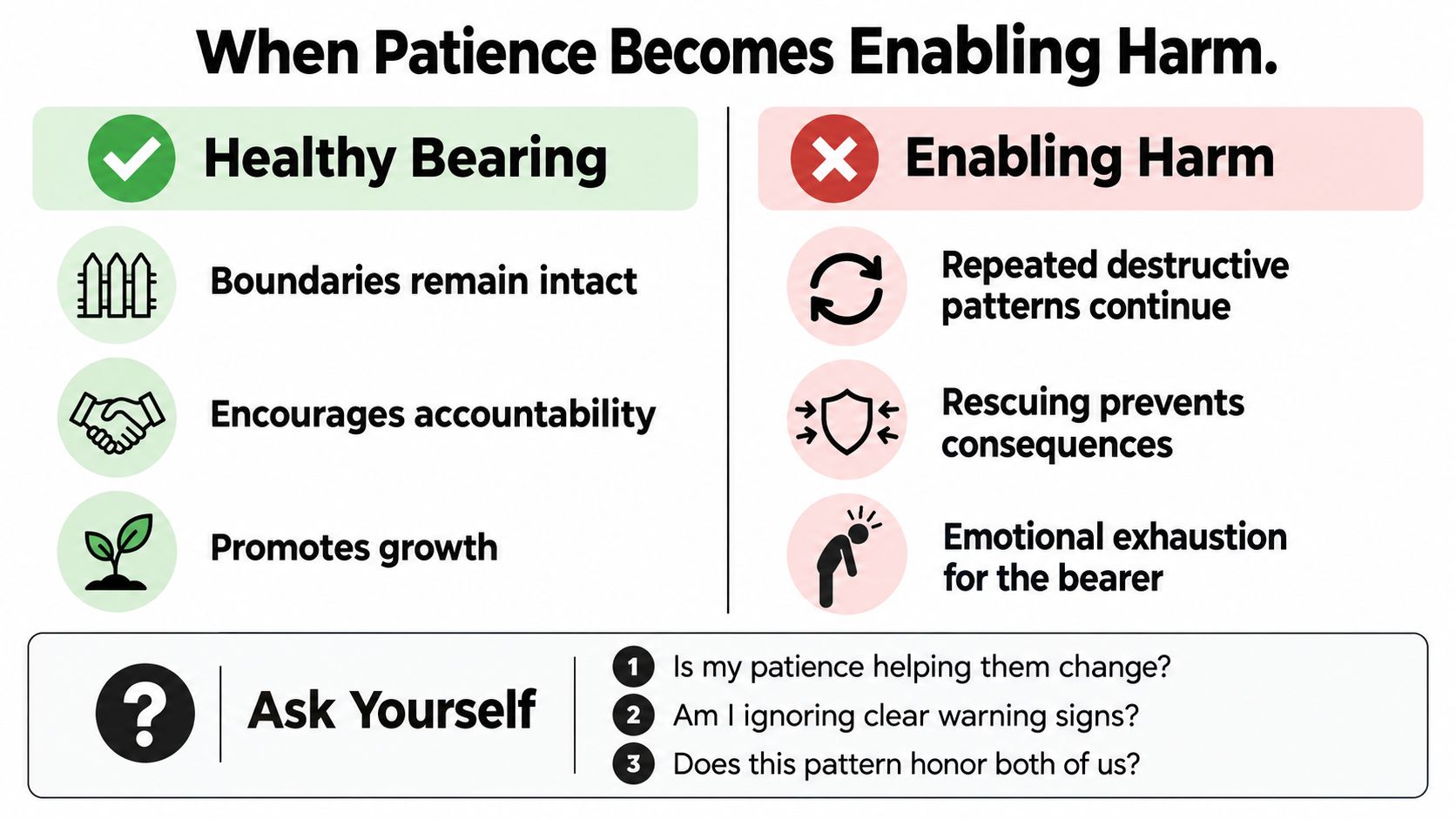
Use this decision guide when you aren't sure what faithfulness requires:
| Healthy Bearing With | Enabling Harm | Wise Next Step |
|---|---|---|
| A person acknowledges the problem and accepts correction | The person denies, blames, or repeats the pattern | Name the pattern and set a clear boundary |
| The relationship allows honest disagreement | Fear, secrecy, threats, or coercion control the relationship | Seek trusted support and prioritize safety |
| Patience encourages gradual growth | Rescuing removes every consequence | Stop covering the behavior and involve appropriate leaders |
| Forgiveness follows confession and changed direction | Forgiveness is demanded without repentance | Separate personal forgiveness from restored trust |
| Both people retain dignity and agency | One person carries the emotional and practical cost | Seek professional help or relevant authorities |
Forgiveness is not automatic reconciliation
Forgiveness can be a personal act of releasing revenge. Reconciliation requires more. It needs repentance, safety, accountability, and changed behavior. You may forgive someone and still refuse private meetings, protect children, document incidents, or end the relationship.
If a relationship repeatedly distorts your sense of reality or pressures you to abandon reasonable boundaries, learn about patterns described in narcissist relationships without using a label as a substitute for careful assessment. Trusted leaders, licensed professionals, and relevant authorities can help you decide what action is appropriate.
Safety principle: Patience should create space for responsible change, not provide cover for ongoing harm.
Ask yourself three questions. Is my patience helping this person change? Am I ignoring clear warning signs? Does this pattern honor both of us? If the answer points toward danger or coercion, bearing with someone may mean refusing to cooperate with the behavior.
Practicing This Command in Church and Small Groups
A church can preserve unity without demanding uniformity. Members may disagree about politics, worship preferences, doctrine, culture, generational expectations, disability, communication styles, or the meaning of a brief digital message. Bearing with one another doesn't require every disagreement to disappear. It requires the community to handle disagreement truthfully and constructively.
A small group can adopt a simple protocol:
- Name the actual dispute. Ask whether the conflict concerns a biblical conviction, a practical decision, a personal preference, or a misunderstanding.
- Paraphrase before responding. Each person should explain the other person's position fairly enough that the speaker recognizes it.
- Separate impact from intention. Someone may not have intended offense, yet the effect still deserves attention.
- Set discussion limits. Decide how long to continue, which topics need a leader, and what conduct ends the conversation.
- Choose the needed action. Some matters require a decision, while others require mutual permission to disagree.
- Repair after offense. A direct apology, a clarified expectation, or a follow-up conversation can prevent resentment from becoming the group's hidden culture.
Digital communication needs extra care because text messages omit tone and facial expression. Before assuming contempt, ask for clarification. Before sending a reactive reply, reread the message and consider whether a conversation would serve the relationship better.
A useful group rule is this: unity means shared commitment to Christ and one another, not identical reactions to every issue. That rule protects minority concerns from being dismissed while preventing every preference from becoming a test of faithfulness.
Church leaders can also model the practice publicly. They can acknowledge disagreement, explain decisions, invite correction, and protect members who need to raise difficult concerns. A resource such as small group Bible study can support discussion planning, but the deeper work remains spiritual and relational. People learn to bear with one another when leaders show them how truth, humility, and boundaries belong together.
Journaling Prompts and Discussion Questions
Use these prompts alone, with a family, or in a small group. Read the related passage slowly, write without trying to sound impressive, and identify one action that matches what you've discovered.
- Where am I being asked to practice humility? Read Ephesians 4:2. Name the situation where you most want to prove that you're right, then write what gentleness would change in your next conversation.
- Whose weakness am I finding hardest to bear? Read Romans 15:1–7. Ask whether the person needs patient support, honest correction, or a boundary.
- What grievance am I still carrying? Read Colossians 3:13. Separate forgiveness from the question of whether trust or access should be restored.
- What pattern deserves a clearer conversation? Write the observable behavior, its effect, and the boundary you need. Avoid labels and describe what happened.
- What does my community reward or punish? Consider whether your church or group makes room for questions, minority concerns, repentance, and repair.
- What will I practice this week? Choose one action: listen without interrupting, paraphrase another person's view, apologize directly, ask for help, document a concerning pattern, or step back from an unsafe situation.
A community shaped by this command won't be free of irritation or disagreement. It will become better at telling the truth without contempt, forgiving without pretending, correcting without humiliating, and setting limits without abandoning love.
HolyJot gives individuals and congregations a place to connect Scripture reading with private or shared journaling, prayer, and small-group discussion. Visit HolyJot to turn these prompts into an ongoing practice with people you trust.