


A surprising way to read “be filled with the Holy Spirit” is to begin by setting aside the search for a dramatic feeling. In Ephesians 5:18, Paul uses a command addressed to a community, in a form that presents filling as ongoing and received, not manufactured. The verses that follow connect it with worship, gratitude, mutual instruction, and submission, so the clearest evidence may appear in ordinary relationships rather than in an extraordinary moment.
The phrase still raises honest questions. Is Spirit-filling the same as conversion? Must someone ask for it? What if prayer produces no strong sensation? Christians answer these questions differently across traditions, especially concerning Spirit baptism and tongues. Yet Ephesians gives every believer a practical starting point: receive the Spirit's influence repeatedly, let Scripture shape your conduct, and test spiritual impressions by their fruit in community.
What It Means to Be Filled with the Holy Spirit
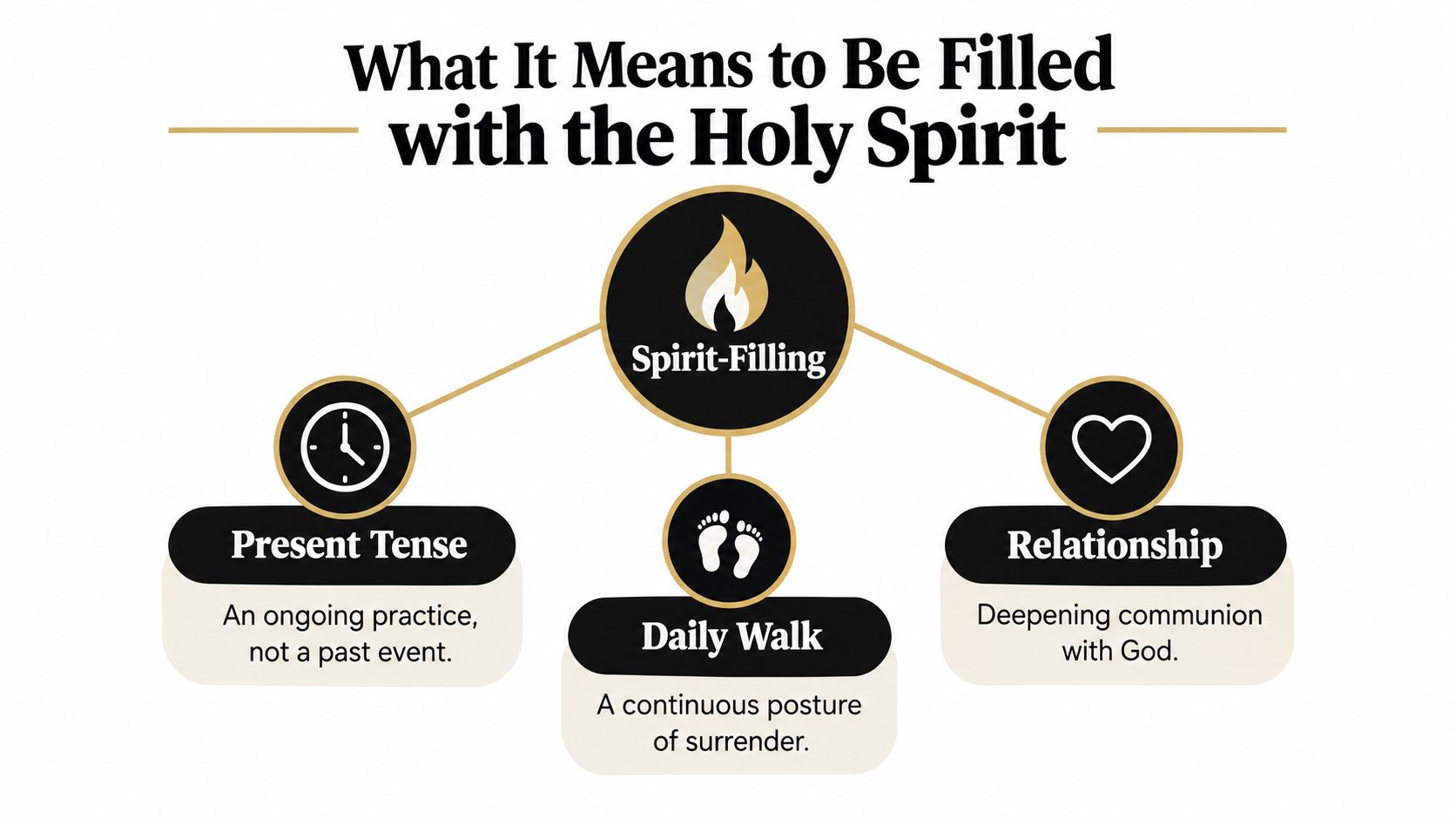
Being filled with the Holy Spirit is best understood as an ongoing posture of dependence and obedience, not a spiritual achievement you secure once and keep forever. Ephesians 5:18 gives the New Testament's clearest direct command on this theme, and the verses around it place the command inside ordinary Christian life.
Paul sets drunkenness beside Spirit-directed fullness. Wine can steer a person toward excess, while the Spirit leads believers toward worship, thanksgiving, wise speech, and changed relationships. The contrast is between competing influences.
A communal command
The verb translated “be filled” is πληρόω, or plēroō. The grammatical notes identify it as a second-person plural, present, passive imperative. In short, Paul addresses a group, gives a continuing instruction, and describes believers as receiving the action rather than producing it themselves.
That grammar corrects several common assumptions:
- Not merely private: The plural “you” points toward shared church life, not only an individual inner experience.
- Not only past: The present imperative supports an ongoing or repeated posture.
- Not self-generated: The passive voice reminds us that believers do not manufacture the Spirit's presence through effort or emotional intensity.
- Not a status symbol: The command leads to conduct that serves others rather than a badge of spiritual superiority.
A helpful way to connect this theme with broader Christian doctrine is to study with The Bible Seminary, especially if you want to connect biblical interpretation with daily practice.
What the phrase points toward
Ephesians 5:19 to 21 gives the first visible picture. Spirit-filled believers speak to one another with psalms, hymns, and spiritual songs. They sing and give thanks to God. They submit to one another. The passage describes a community whose worship reshapes speech, gratitude, and relationships.
That does not mean every believer expresses devotion in the same musical style or feels the same emotions. It means the Spirit's influence shows up in how people address God and how they treat one another.
The pattern is ordinary and testable. A church can hear it in prayer, see it in reconciliation, and notice it in the tone of everyday conversation. That makes Spirit-filling less like a private spiritual trophy and more like a repeated way of living that can be observed over time.
Reading Ephesians 5:18 in Its Original Language
Ephesians 5:18 becomes clearer when the grammar is read closely. Paul is not describing a rare spiritual summit or a private mystical moment. He gives a standing command to the church, and the wording points to an ongoing way of life.
The key verb
The Greek verb is πληρόω, transliterated plēroō. In the available grammatical notes, it is described as meaning “fill completely” or “fulfill,” and its form is second-person plural, present, passive imperative (the grammatical and translation notes for Ephesians 5).
Each part matters:
| Grammatical feature | Plain-language implication |
|---|---|
| Second-person plural | The command addresses a community |
| Present tense | The action is ongoing or recurring |
| Passive voice | Believers receive the filling rather than produce it |
| Imperative mood | Paul gives an instruction, not a suggestion |
The phrase ἐν πνεύματι, en pneumati, can be read as “with the Spirit” or “by means of the Spirit.” Either way, the center of gravity stays on God's action. The Spirit is not something Christians manufacture through intensity, technique, or performance. The language points to a life that receives God's influence with steady openness.
The contrast with wine
Paul sets the command beside a warning about drunkenness. The problem is not the existence of wine itself. The problem is the loss of judgment and the loss of self-control that come with excess. He redirects the human hunger for fullness toward the Spirit's rule.
That raises a plain diagnostic question: what is shaping my reactions, words, and choices? A person can feel calm and still be self-directed. A person can also feel emotionally stirred and still act without wisdom. Feeling alone does not prove the Spirit is leading.
The evidence appears in the next verses
Paul immediately shows what Spirit-filled life looks like. Ephesians 5:19–21 describes speech marked by psalms, hymns, and spiritual songs, gratitude offered to God, and mutual submission. The pattern is both upward and outward. Worship changes the way believers speak, and it changes the way they treat one another.
That is why close reading matters, especially in discussions shaped by textual criticism and the history of biblical wording. Care with grammar, context, and wording keeps readers from turning a short phrase into a slogan detached from the passage itself.
Spirit-filling, then, is not measured by spiritual excitement alone. It shows itself over time in worship, gratitude, speech, and shared life. That makes it a practice a church can notice, test, and discuss together, rather than a label people place on private experience.
Two New Testament Patterns for Spirit-Filling
Acts gives a concrete place to start. In Acts 4:31, believers pray, the place is shaken, and they are filled with the Holy Spirit so they speak the word boldly. That scene shows Spirit-filling in action before we name the pattern. The same book also shows prophetic speech and witness flowing from the Spirit's work, so the reader sees a repeated ministry pattern rather than a private feeling.
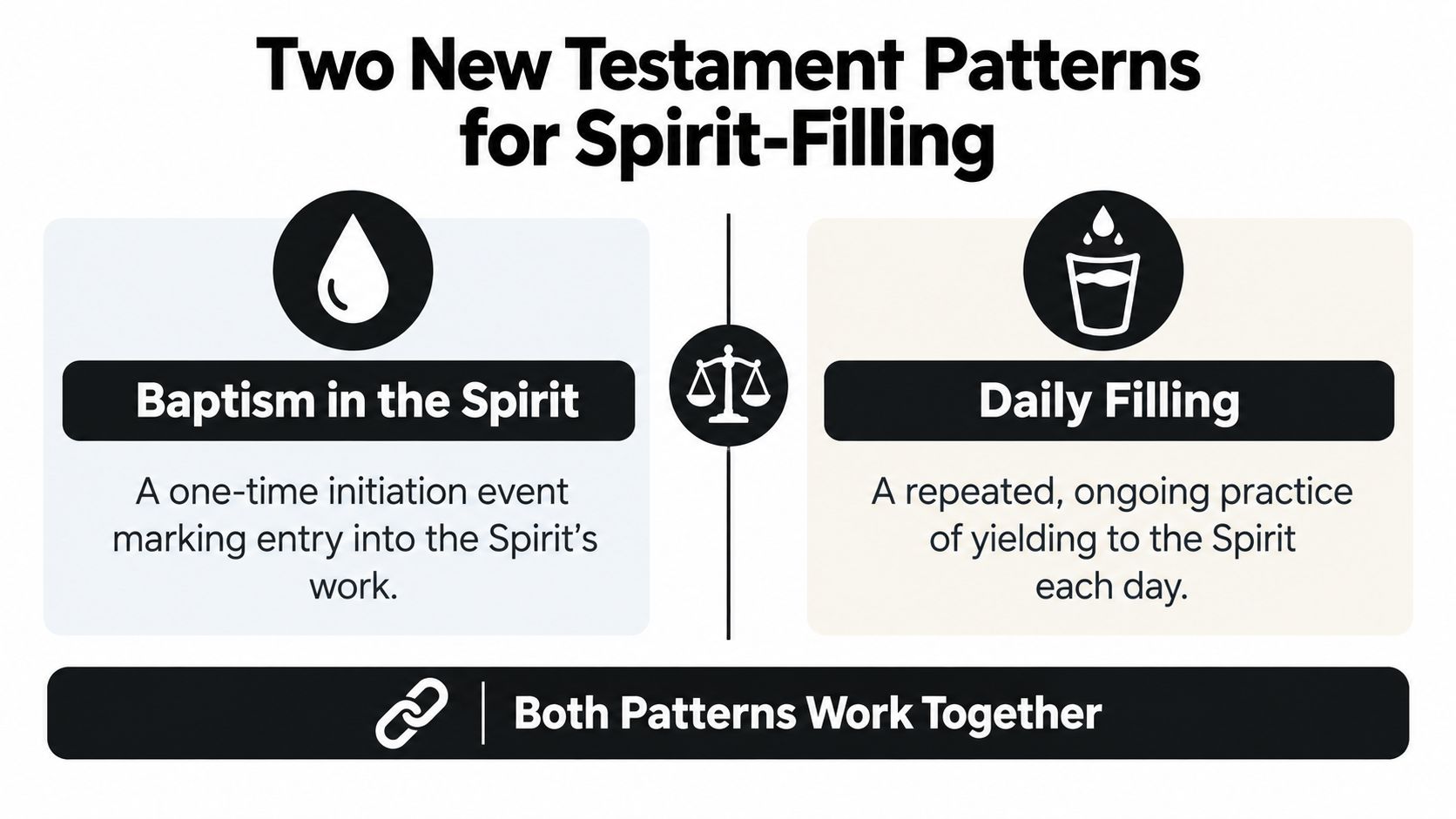
The New Testament uses related language for Spirit-filling, but it does not use it in exactly the same way every time. That helps explain why one Christian speaks of a decisive enabling encounter while another stresses daily formation. Both may be drawing on a genuine biblical pattern.
Luke frequently uses πίμπλημι, pimplēmi, in Acts for a decisive moment when the Spirit enables proclamation, witness, or prophetic speech. Paul uses πληρόω, plēroō, in Ephesians 5:18 for an ongoing communal filling. The comparison is summarized in this study of “filled with” and “full of” the Spirit in Acts and Ephesians.
Situational enabling
In Acts, Spirit-filling often appears at a particular ministry moment. A person receives courage or ability for proclamation, witness, or prophetic speech. The emphasis falls on what God enables someone to do in that situation.
A believer may need courage to speak truthfully in a difficult conversation, wisdom to explain the gospel, or strength to serve when fear would otherwise silence them. This does not reduce the experience to a passing mood. It describes divine help directed toward a concrete act of obedience.
Continuing formation
Ephesians places the emphasis differently. Paul's command addresses the community's ongoing life, and the surrounding instructions describe worship, gratitude, mutual submission, and ethical conduct. Here, filling relates to the gradual formation of character and relationships.
These patterns should not be forced into competition:
| Situational pattern | Continuing pattern |
|---|---|
| Enablement for a particular moment | Formation across ordinary life |
| Boldness, witness, or prophetic speech | Worship, gratitude, speech, and relationships |
| A visible ministry need | A sustained posture of dependence |
| Often described in Acts | Explicitly commanded in Ephesians |
Christians disagree about how Spirit baptism relates to conversion and later enabling for ministry. Some traditions connect Spirit baptism with initiation, while Pentecostal and charismatic traditions may expect a subsequent experience of the Spirit's enabling and may associate it with tongues. A careful reading can acknowledge those differences without making one emotional pattern the universal test of faithfulness.
The same disciple may need both forms of help. A person can receive courage for one conversation while also undergoing a slower reshaping of speech, habits, and relationships. Resources such as the armor of God in the Bible can help connect momentary spiritual resistance with the longer work of faithful formation.
How to Make Room for the Filling
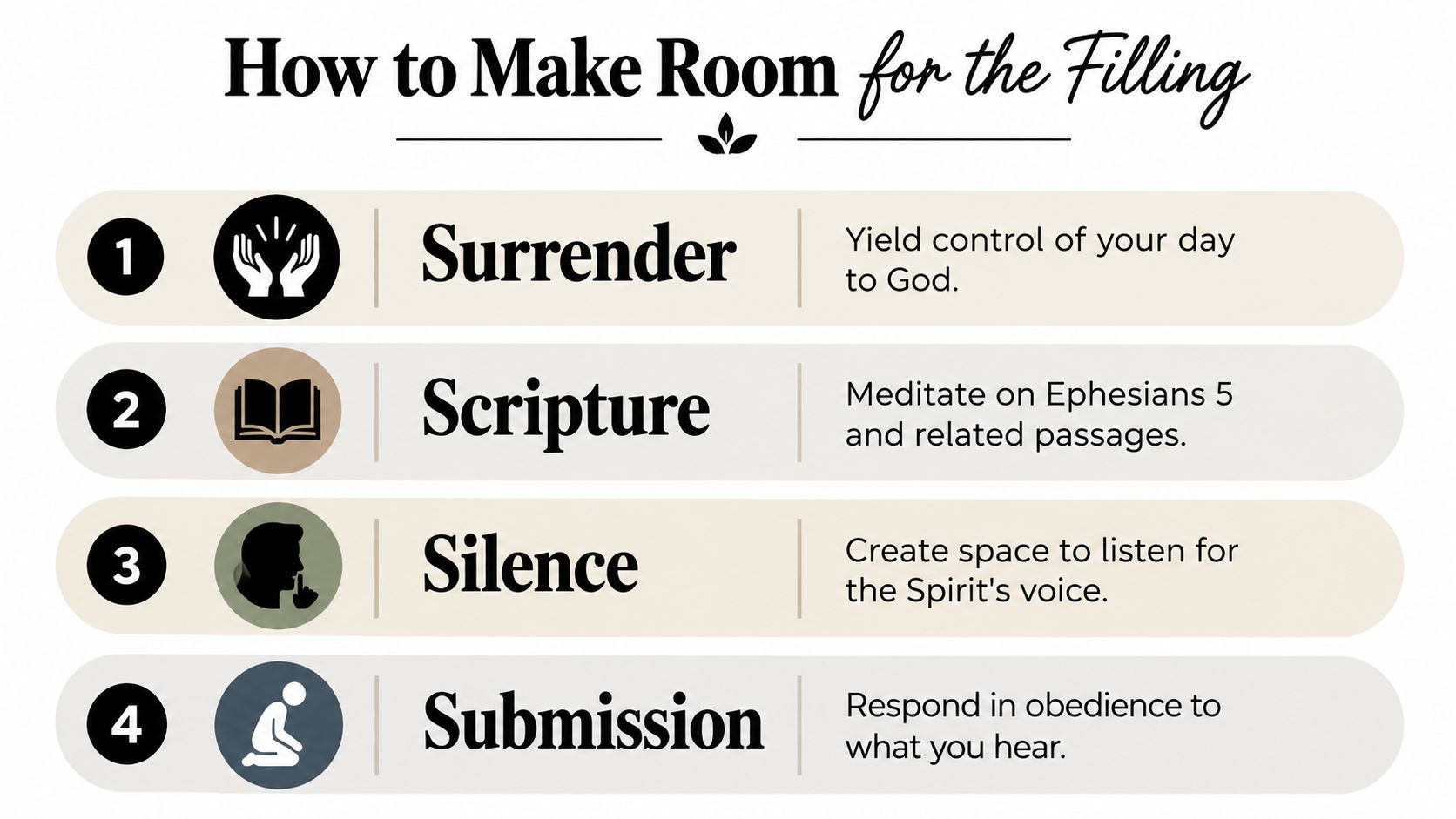
The grammar of Ephesians 5:18 doesn't give believers a mechanical formula. It does give a direction. Since filling is received rather than manufactured, the question isn't “How can I create a spiritual experience?” It's “Where am I resisting the Spirit's wise and holy direction?”
Four practices create room for that response. Think of them as rooms in a house, not switches in a machine.
Yieldedness
Start with one specific area rather than a vague promise to surrender everything. Perhaps you're controlling a conversation, nursing resentment, avoiding a needed apology, or protecting a habit you already know conflicts with Scripture.
Pray plainly: “Holy Spirit, show me where I'm resisting you, and give me grace to obey.” Then name the action that obedience requires. Yieldedness becomes concrete when it changes what you do next.
Scripture saturation
The Spirit doesn't lead people away from the character and teaching revealed in Scripture. Read Ephesians 5:15–21 slowly. Notice the contrast with drunkenness, the communal language, and the sequence of worship, thanksgiving, and submission.
Write one sentence from the passage in your own words. Ask how it challenges your current reaction. Scripture saturation isn't about collecting religious information. It's about allowing biblical truth to interrupt instinctive patterns.
Communal worship and prayer
The plural command matters. Speak with mature Christians who know you well enough to challenge your assumptions. Pray with a small group. Sing, listen, and give thanks with other believers, not only in private.
If you're preparing for baptism or helping someone do so, a practical baptism readiness checklist can support conversations about faith, commitment, and next steps. It shouldn't replace pastoral guidance, but it can help turn general intentions into honest questions.
Ongoing repentance
Respond quickly when Scripture or wise correction exposes sin. Repentance isn't self-condemnation, and it isn't an attempt to earn the Spirit's presence. It's a return to truth and obedience.
A simple evening review can ask:
- Where did I resist love, patience, or truth?
- What did I sense God inviting me to do?
- What repair or confession belongs tomorrow?
This continuing approach treats filling as discipleship rather than performance, a conclusion supported by the grammatical discussion of the verse (discussion of Ephesians 5:18 as a continuing command).
What Filling Looks Like and What It Doesn't
Many believers have been taught to look for dramatic proof. Tears, tingling, a powerful atmosphere, physical sensations, or tongues may be meaningful within particular Christian traditions, but Ephesians 5:18 doesn't present one outward manifestation as the universal certificate of Spirit-filling.
Nor should emotional experiences be mocked. A person may encounter God's comfort, conviction, or joy with powerful feeling. The mistake comes when intensity becomes the measuring stick and quieter obedience is treated as inferior.
Five tests for discernment
A spiritual impression or experience deserves careful testing. Ask whether it produces:
- Scriptural consistency: Does the guidance agree with the teaching and character of the Bible?
- Christlike character: Does it lead toward humility, truth, love, self-control, and service?
- Communal wisdom: Can mature believers examine it without fear or manipulation?
- Humility: Does the person remain teachable, or does the claim create superiority?
- Practical fruit: Does the decision improve speech, relationships, worship, gratitude, and obedience?
These tests protect against two opposite errors. One error dismisses every spiritual experience as unreliable. The other treats every strong impression as divine authority.
A practical rule: Don't ask only, “What did I feel?” Ask, “What did I do afterward, and what kind of person did that action form me to become?”
Some sincere Christians pray to be filled and feel nothing unusual. That absence of sensation doesn't prove spiritual failure. The command in Ephesians is about the Spirit's governing influence and its communal fruit, not about achieving a particular physical state.
Scholarly discussion also notes that Ephesians 5:18 does not explicitly instruct believers to ask for filling. Some interpretations therefore emphasize yieldedness, divine enablement, and obedience rather than treating filling as a substance that someone acquires (scholarly discussion of asking, yielding, and Spirit-filling). Christians can continue praying for God's help while avoiding the fear that an unanswered request means God has rejected them.
Journaling Prompts and Sample Prayers
A journal can help separate a powerful moment from a faithful pattern. Record both your inner experience and your outward response. You may feel peace and still need to apologize. You may feel dry and still choose truth, patience, or service.
Scripture-linked prompts
Use these prompts privately or with a trusted group:
- Ephesians 5:15–16: Where am I using my time wisely, and where am I drifting?
- Ephesians 5:18: What influence is shaping my reactions today?
- Ephesians 5:19: How can my words strengthen another believer?
- Ephesians 5:20: What specific gift can I thank God for instead of overlooking it?
- Ephesians 5:21: Where do I need to practice humility or receive correction?
- Acts and the pattern of witness: What act of courage, wisdom, testimony, or service may God be asking of me?
- Review: What did I feel, what did I do, and what fruit appeared later?
A simple weekly pattern keeps reflection connected to action:
| Day | Scripture Focus | Journal Prompt | Action Step |
|---|---|---|---|
| Day 1 | Ephesians 5:15–18 | What currently governs me? | Name one area to yield |
| Day 2 | Ephesians 5:19 | How have my words affected others? | Encourage one person |
| Day 3 | Ephesians 5:20 | What am I taking for granted? | Give specific thanks |
| Day 4 | Ephesians 5:21 | Where is humility difficult? | Receive or seek wise counsel |
| Day 5 | Acts and witness | Where do I need courage? | Take one truthful step |
| Day 6 | Ephesians 5:18 | What changed after prayer? | Review action, not only feeling |
| Day 7 | Ephesians 5:19–21 | What fruit is emerging? | Share one observation with the group |
For more structured reflection, use prayer journal prompts alongside your Bible reading.
Two short prayers
For spiritual dryness
“Holy Spirit, I come without a dramatic feeling or a polished answer. Show me where I'm resisting God, renew my desire for Scripture, and help me obey the next clear command. Form your fruit in my speech, relationships, and choices. Amen.”
For a small group
“Holy Spirit, guide our conversation toward truth, humility, and love. Give us wisdom to test our impressions by Scripture, courage to receive correction, and grace to practice what we learn together. Amen.”
A private, verse-linked journal can preserve prayers, observations, and later outcomes. Over time, that record helps you notice growth without reducing the Spirit's work to a score.
A One-Page Summary and Small Group Guide
Core truth: To be filled with the Holy Spirit is to receive and yield to the Spirit's continuing influence. Ephesians 5:18 addresses a community with an ongoing command, and verses 19–21 show the result in worship, gratitude, speech, and mutual submission.
The 60-second self-check
Pause and ask:
- What is governing my reactions today?
- What does Scripture clearly require in this situation?
- Am I resisting a specific act of obedience?
- Who can help me test my interpretation?
- What fruit should become visible in my conduct?
Small group discussion
- Why might Paul use a plural command rather than addressing only an isolated individual?
- Which evidence of Spirit-shaped life in Ephesians 5:19–21 is easiest for your group to practice?
- How can your group distinguish biblical guidance from personal desire?
- What action will each person take before the next meeting, and how will the group revisit it?
A church group can also turn a biblical passage into a short visual teaching resource with a Bible story video maker, provided the finished material remains faithful to the text and doesn't replace discussion or pastoral care.
Three common questions
Is Spirit-filling the same as salvation?
Christians answer the relationship between conversion, indwelling, baptism, and filling differently. Ephesians 5:18 itself gives a continuing command to the Christian community, so it shouldn't be reduced to a single formula that erases every theological distinction.
Should I keep asking if I don't feel different?
You can keep praying for God's help, but don't use emotional intensity as the only evidence. Continue yielding, reading Scripture, receiving wise counsel, and watching for changes in speech, gratitude, relationships, courage, and obedience.
What if someone says God told them something specific?
Listen respectfully, then test the claim. Ask whether it agrees with Scripture, reflects Christlike character, welcomes communal discernment, produces humility, and bears good practical fruit. No private impression should be used to control or silence other people.
The most useful measure is faithful direction over time. A dramatic moment may matter, but Ephesians points believers toward a life that keeps receiving the Spirit's influence in ordinary community.
HolyJot lets you connect Bible verses with private journal entries, prayers, guided reflections, and small-group Community Hubs, making it practical to review both what you sensed and how you responded. Visit HolyJot to begin a Scripture-linked practice for discerning and recording Spirit-shaped growth.