


You finally have a quiet moment. The children are occupied, your inbox is under control, and the Bible is open beside your coffee. Then someone needs help, an appointment runs late, or fatigue wins. By evening, the reading plan remains untouched, and the missed day feels larger than it should.
A sustainable Bible reading plan for women has to account for real life. Work, caregiving, household responsibilities, illness, changing schedules, and emotional exhaustion can all interrupt a routine. The answer isn't a more demanding schedule. It's a flexible rhythm that helps you return to Scripture without shame.
Finding Your Footing in Daily Scripture
A fresh start often begins after inconsistency. You may have downloaded a plan, completed a few readings, missed several days, and stopped opening it. That pattern doesn't mean you lack faith or discipline. It may mean the plan was designed for an uninterrupted life you don't have.

Consider two readers. One wants to rebuild a neglected habit and can protect a few minutes before work. Another has a demanding job, children, and an elderly parent to care for. Giving both women the same lengthy daily assignment may sound fair, but it ignores their different starting points.
Start with an honest baseline
Before choosing a plan, ask:
- Time: When can you usually find a few uninterrupted minutes?
- Energy: Are you more attentive in the morning, during lunch, or at night?
- Purpose: Do you need comfort, biblical foundations, a focused study, or a way to read the larger story?
- Support: Will you read alone, with a friend, or through a church group?
Your answers should shape the plan, not the other way around. A daily Scripture reading guide can give you structure, but structure works best when it serves your actual rhythm.
Practical rule: Choose the smallest practice you can repeat during a difficult week, then build from there.
Begin with a short passage, one observation, and a brief prayer. If you have more time, continue. If the day collapses, you've still kept the connection alive. The first goal isn't finishing a schedule. It's learning how to return.
Understanding Women's Engagement with the Word
A woman can value Scripture greatly and still struggle to read consistently. A full-time job, children, caregiving, shift work, or simple exhaustion can make a fixed devotional routine difficult to sustain. The right response is a practice that adapts without losing its purpose.
Women have historically reported stronger Bible-reading participation than men in major U.S. surveys. Gallup reported in 2002 that 43% of women read the Bible daily or weekly, compared with 29% of men, a difference of 14 percentage points (Gallup's religion and gender analysis). The same report found that 18% of women participated in a Bible study group, compared with 10% of men. These findings point to two useful forms of engagement, personal reading and shared study. A women-focused approach can make room for both, without assuming that every reader has the same availability or support.
Desire doesn't remove friction
Barna's 2017 U.S. research found that 68% of women desired more frequent Bible reading, compared with 54% of men (Barna's Bible reading research). Wanting more time in Scripture does not guarantee a workable routine. A caregiver may have no dependable morning, a shift worker may sleep during conventional reading hours, and a mother may reach the end of the day with little attention left.
Build around flexible participation. Use a short passage when time is limited, add study questions when focus is available, and stop at a clear point before an interruption arrives. Audio reading can help during a commute or household task, while a written reflection may work better during a quiet break.
A thoughtful online Bible study for women should welcome eagerness, uncertainty, questions, and difficult emotions. It should offer structure without turning missed days into failure. Small, repeatable choices give women room to keep returning through changing seasons.
Building a Plan That Fits Your Season
A useful plan begins with constraints. Decide what you can offer consistently, then choose content that fits inside that boundary. A caregiver, shift worker, or mother with competing responsibilities may need a rhythm that flexes rather than a fixed appointment. The practical question is how to turn a desire for more Scripture into a repeatable practice.
Set the reading container first
Choose a core session length before choosing a book or theme.
- Choose a minimum. This might be one short passage and one prayer.
- Add an optional layer. Include context, cross-references, or a second passage when time allows.
- Select a pause point. End at a natural verse or paragraph so an interruption does not create confusion.
- Choose a recovery rule. Decide in advance whether you will resume where you stopped or use the current day's reading.
This framework guards against choosing an ambitious schedule because it sounds spiritually impressive. A plan that leaves you discouraged after one missed day is not serving your formation. Modular reading gives you a way to continue without pretending every day offers the same attention or energy.
Your topic can reflect your present season. Study the Psalms during grief, the Gospels when you want to focus on Jesus, or a biblical character when you need to examine courage, friendship, or purpose. Choose a translation you understand, then use a more literal or study-oriented resource when deeper comparison would help.
Make the habit visible
Attach reading to an existing cue, such as breakfast, a commute, school drop-off, or the first few minutes after lunch. Keep the Bible and journal where you will see them. If your routine changes often, create several acceptable windows instead of insisting on one perfect appointment.
Practical discipleship includes ordinary care. Resources about simple self-care that fits your schedule can help you treat rest, nourishment, and boundaries as part of a sustainable rhythm rather than as evidence of weak commitment.
A longer structure, such as a three-year Bible reading plan, may suit readers who prefer slower progress and more room for reflection. The right pace keeps Scripture present without making completion the measure of faithfulness. In a demanding season, returning regularly matters more than forcing a schedule you cannot sustain.
Exploring Different Reading Pathways
The best pathway depends on what you need from Scripture right now. A chronological plan can help you follow the Bible's unfolding story. A thematic plan can address a focused concern. A devotional format can create a dependable daily meeting point.
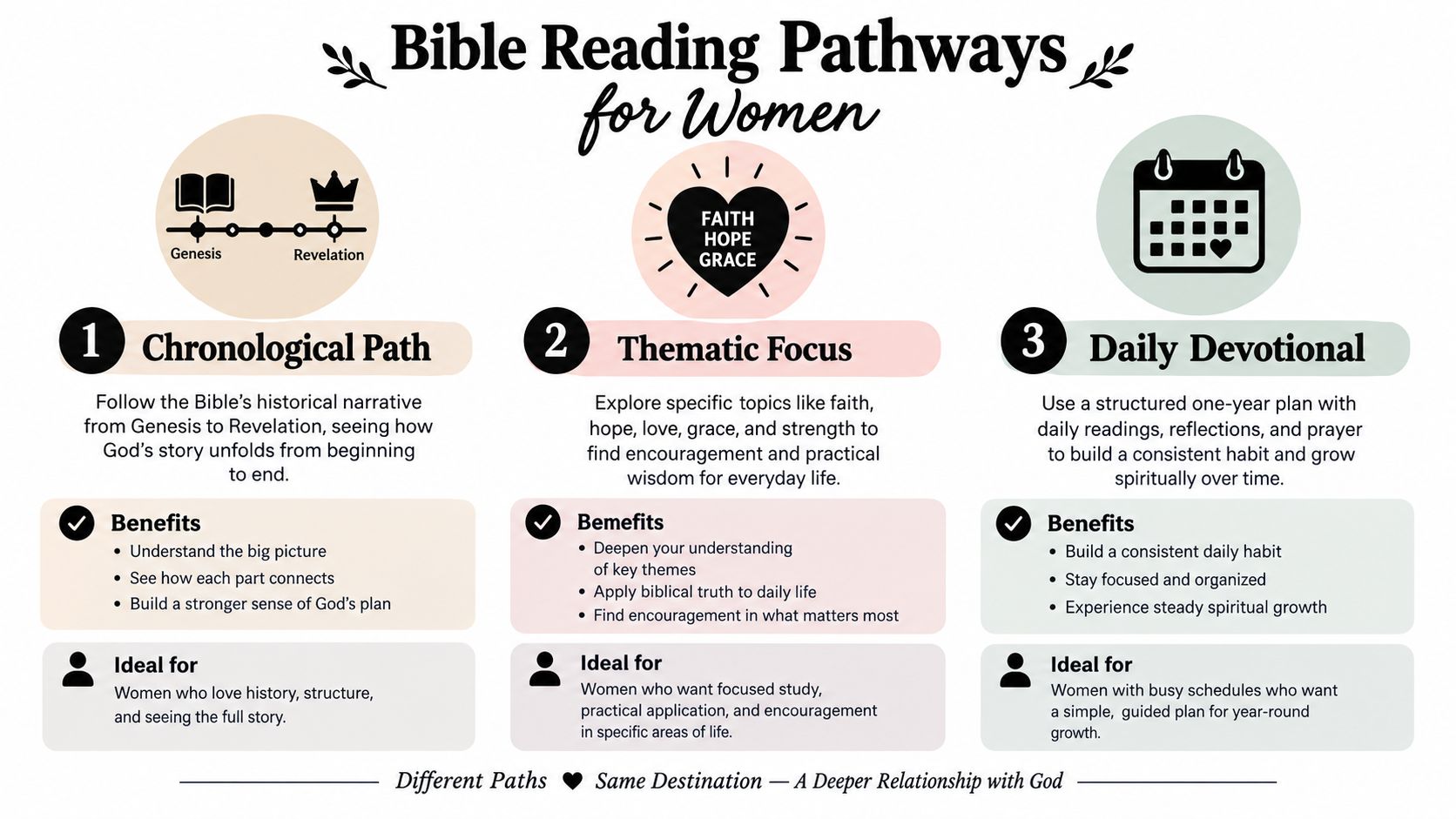
Compare the main options
| Pathway | What it does well | Trade-off | Good fit for |
|---|---|---|---|
| Chronological reading | Follows the historical movement of biblical events | Some passages may require extra context | Readers who want the larger narrative |
| Thematic study | Concentrates on subjects such as faith, hope, grace, identity, or courage | Can separate passages from their surrounding books | Readers facing a specific question or season |
| Daily devotional | Provides a predictable reading, reflection, and prayer pattern | May offer less sustained literary context | Readers rebuilding a daily habit |
Short daily passages lower the entry barrier, especially when time is limited. Longer weekend readings can suit someone who prefers fewer interruptions and more extended concentration. Neither format is automatically more mature. Depth comes from attentive reading, honest reflection, and returning to the text.
Match the tool to the pathway
Use a print Bible if screens distract you. Use audio when driving or doing household tasks, while remembering that listening and close reading serve different purposes. A study Bible, trusted commentary, or guided digital platform can help when a passage raises historical or theological questions.
HolyJot is one option for combining a full online Bible, guided study plans, verse-linked journaling, private locked notes, and FaithAI support for Scripture-grounded context and prayer guidance. A tool can reduce friction, but it can't replace discernment, prayer, or the wisdom of a trusted church community.
Choose one pathway for a defined season, then review it. If a chronological schedule leaves you rushing, slow it down. If a devotional format feels disconnected from context, add background reading. Your plan should guide attention, not control your conscience.
Deepening Your Experience Through Journaling
Reading gives you words to consider. Journaling helps you notice what you understood, what you're questioning, and how the passage meets your life. The practice doesn't require beautiful handwriting or lengthy entries. A few precise lines can turn passive reading into active reflection.

Use prompts that move beyond summary
Instead of copying the passage, ask questions that help you engage with it:
- Observation: What happens, and which words or actions receive emphasis?
- Context: Who is speaking, to whom, and what problem or promise shapes the passage?
- Interpretation: What does this text communicate in its own setting?
- Response: What might faithful action look like today?
- Prayer: What do you want to bring openly before God?
Keep interpretation separate from application. A difficult passage deserves careful attention before you turn it into a personal slogan. If you're unsure, record the question rather than forcing certainty.
A helpful journal entry might include one sentence about the text, one question, one connection to your circumstances, and a short prayer. That format works on a busy day and leaves a clear trail for later review.
Protect vulnerable reflections
Women may write about grief, marriage, abuse, anxiety, infertility, parenting, or conflict. Those notes deserve privacy. A locked digital journal can make it easier to record openly while keeping reflections searchable and available across devices. It can also help you notice recurring prayers and themes over time.
FaithAI or another study assistant should be treated as a research aid, not as a pastor or final authority. Check explanations against the biblical text, your church's teaching, and qualified human guidance, especially when the subject involves trauma, abuse, or major life decisions.
A short video can also support a reflective routine when you need a guided starting point.
Integrating Community and Family Devotion
Private reading builds attention, while community adds perspective and encouragement. Shared engagement can make returning to Scripture easier, especially for women balancing work, caregiving, household responsibilities, and limited quiet time.
Build a discussion that welcomes different readers
A small group does not need to cover every detail. Choose one passage and ask:
- What stood out to you?
- What felt difficult or unclear?
- How might this shape prayer or action this week?
Let members pass. No one should have to disclose private experiences to prove participation. A healthy group offers accountability without turning attendance, reading speed, or emotional openness into a spiritual test. It should also leave room for different seasons. Some members may arrive prepared, while others may have read only a few verses during a demanding day.
If you lead, send the passage early and state the expected preparation plainly. Offer an audio option and a short summary for anyone coming from work or caregiving. Keep disagreement focused on the text and its interpretation, not on a person's character. A short, consistent conversation often serves a busy group better than a rigid schedule.
Adapt the plan at home
Family devotion works best when it matches the youngest participant's capacity. Read a short passage, explain one idea in ordinary language, and invite each person to name something they are thankful for or concerned about. Older children can read aloud or ask questions. Adults can continue privately when family discussion cannot provide enough depth.
Keep the household rhythm flexible. A missed evening does not need a makeup session that creates more pressure. Resume at the next natural opportunity, or use a brief prayer when reading time disappears. Shared devotion should strengthen connection, not become another task competing with meals, homework, work, and rest. Small, repeatable practices give families a way to participate without requiring every day to look the same.
Sustaining Your Practice Over Time
Motivation changes. Your schedule changes with it. A plan that worked during a quiet season may need shorter readings during illness, travel, a demanding project, or family upheaval.
The most resilient readers don't treat interruption as evidence that the practice failed. They create a return path.
Use a gentle restart protocol
When you miss days, avoid trying to repay the entire backlog. Choose one of these responses:
- Resume: Continue with the next passage and leave the missed readings for later.
- Review: Read a brief summary, then join the current portion.
- Restart: Begin again if the opening material is essential to your purpose.
- Pause: Mark the season truthfully and set a date to return.
A streak can encourage consistency, but it shouldn't become the spiritual objective. Track what helps you understand and respond to Scripture, not just whether you opened an app. One thoughtful entry may be more formative than a rushed attempt to protect a number.
Review the plan as life develops
Set aside occasional time to ask whether the current structure still fits. Are the readings too long? Is the subject still relevant? Do you need more context, more silence, a group conversation, or a different translation? Make one adjustment at a time so you can tell what helps.
Faithfulness isn't flawless attendance. It's the practiced willingness to return to God's Word with honesty and hope.
The aim of a Bible reading plan for women isn't to produce a perfect record. It's to cultivate a durable relationship with Scripture through ordinary days, disrupted days, and seasons when five attentive minutes are all you can offer. Start small, read carefully, write openly, and give yourself permission to continue without carrying yesterday's failure into today.
HolyJot brings together Bible reading, guided plans, private journaling, verse-linked notes, and Scripture-grounded FaithAI support for women who want a more flexible daily practice. Visit HolyJot to choose a plan and create a reading rhythm that can grow with your real life.