


You may be carrying a loss that other people can't see. Perhaps a relationship ended, a familiar dream collapsed, or grief has settled into ordinary routines so that even prayer feels difficult. In those moments, “beauty for ashes” can sound either like a lifeline or like a slogan that asks you to smile before you're ready.
Isaiah 61:3 offers something sturdier than a slogan. The verse speaks to people who know mourning, shame, weariness, and communal ruin. Its promise of restoration doesn't erase the reality of ashes. It announces that ashes won't be the final word.
Finding Hope in Deep Grief
A woman wakes before sunrise and reaches for her phone, briefly forgetting that the message she used to expect will never arrive. A man drives past a former workplace and feels the old failure return before he reaches the next traffic light. Someone else has prayed for relief from trauma for years and wonders whether continuing to hope means denying how much still hurts.
These experiences don't fit neatly into a testimony with a clear ending. Grief can remain present even when faith remains strong. Scripture makes room for that tension. The biblical witness includes lament, tears, waiting, confession, silence, and questions that receive no immediate answer.
Some losses also go unrecognized by the surrounding community. A broken engagement, infertility, estrangement, job loss, or a private trauma may not receive the rituals and support people need. The pastoral and psychological realities behind grief that goes unacknowledged can help explain why a person may feel isolated even when others believe they've “moved on.”

A faithful response to suffering doesn't require pretending that suffering is small.
Isaiah's promise matters because it addresses people in a recognizable human condition. The phrase “beauty for ashes” comes from Isaiah 61:3, where ashes represent visible grief and repentance, while an ornate head covering represents joy, festivity, and honor. The contrast is public and embodied. God's restoration reaches the place where sorrow has marked a person's identity.
That hope doesn't mean you must rush through mourning. You might begin with a simple prayer during difficult times: “God, I'm still here, and I need you to meet me here.” Such honesty isn't a failure of faith. It's often the first truthful step toward healing.
Understanding the Biblical Context of Isaiah 61 - 3
Isaiah 61:3 belongs to a prophetic announcement of restoration. The passage speaks to people associated with Zion who have experienced devastation, mourning, and humiliation. Its vision reaches beyond private emotional comfort to include the rebuilding of a people and the renewal of a public community.
The verse promises “beauty for ashes, the oil of joy for mourning, the garment of praise for the spirit of heaviness,” as recorded in the text and historical discussion of the phrase. Each image answers a condition that has become visible in the life of the afflicted community.
The passage follows a clear movement
It names the wounded. The surrounding language focuses on people who are brokenhearted, captive, grieving, and burdened. The promise begins by recognizing their condition rather than ignoring it.
It announces an exchange. Ashes give way to beauty, mourning gives way to joy, and heaviness gives way to praise. The language describes God acting upon realities that human beings cannot talk themselves out of.
It restores communal identity. The recipients are not merely made calmer individuals. They become people associated with righteousness, planting, rebuilding, and visible renewal. Restoration has social and covenant dimensions.
This context guards against reducing the phrase to “turn your pain into purpose.” That application may express a sincere hope, but Isaiah's original image is larger. It concerns a people whose public life has been marked by loss and whose dignity needs to be restored before the community.
Ashes had a recognizable place in ancient mourning and repentance. They could be placed on the head, making distress visible to others. A head adornment, by contrast, signaled honor and festivity. The prophetic image therefore carries a social meaning: the person once recognized through grief is now recognized through dignity.
The promise remains personal, but it isn't merely private self-help. Isaiah 61 connects individual sorrow with the restoration of God's people. That connection gives “beauty for ashes” theological weight. God doesn't only soothe hidden feelings. He renews belonging, vocation, worship, and public standing.
The Hebrew Imagery and Theological Meaning
The central Hebrew image becomes clearer when we slow down over the nouns. Many commentators understand “beauty” in Isaiah 61:3 as pe'er, a word that can refer to a headdress, turban, or diadem. “Ashes” points to the literal material associated with mourning or penitence. The verse is therefore not describing a vague exchange between bad feelings and good feelings. It pictures a change in the visible signs a grieving person carries.
The commentary on Isaiah 61:3 explains this interpretation as a reversal from public lament to honor. The head that carried ashes receives a sign of dignity. That distinction helps us read the verse with greater precision.
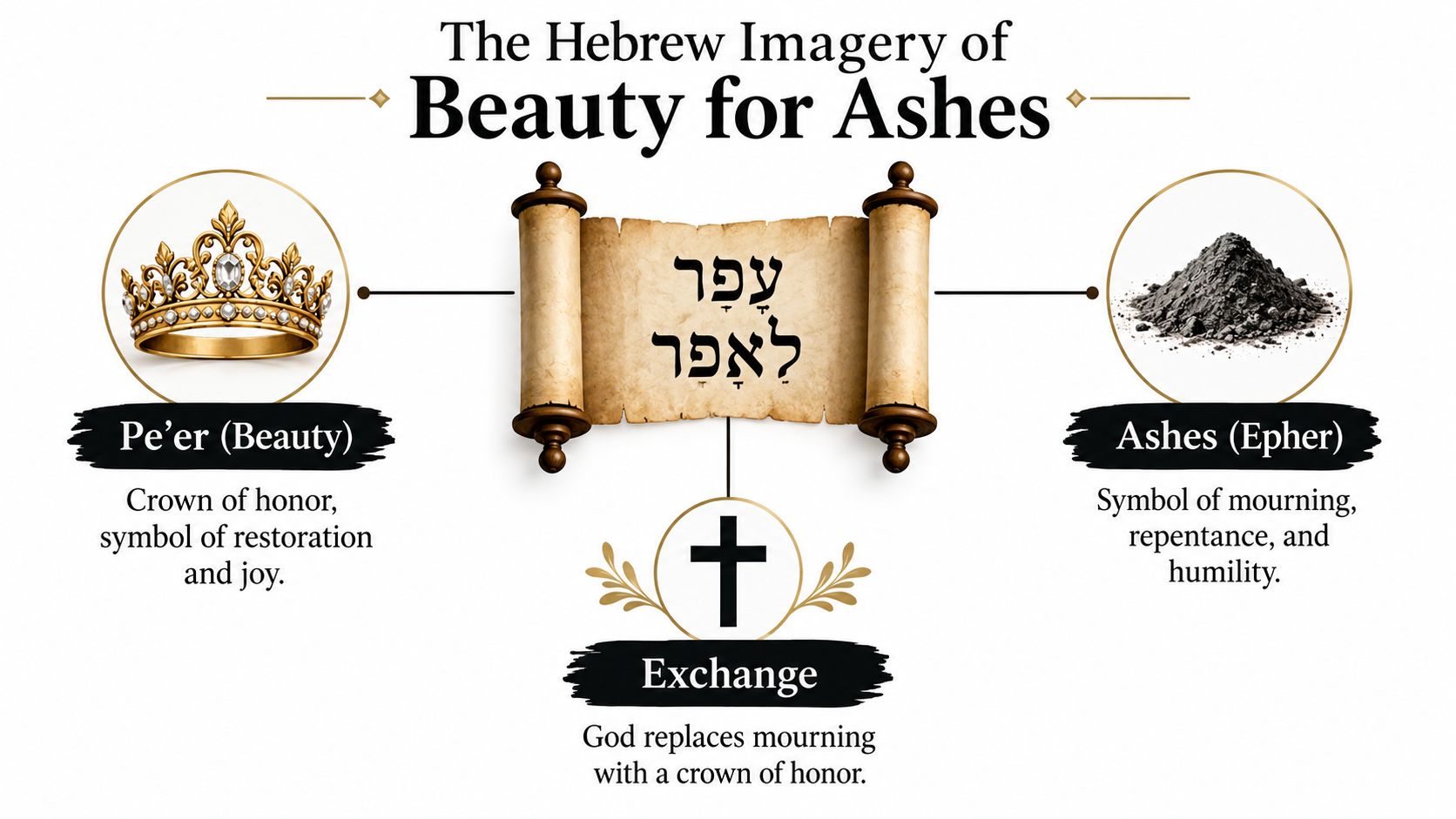
Three dimensions of restoration
Isaiah uses a threefold parallelism:
| Condition | Gift | Area touched |
|---|---|---|
| Ashes | Beauty or a headdress | Public identity |
| Mourning | The oil of joy | Inner affect |
| Spirit of heaviness | A garment of praise | Worship and communal expression |
The pattern moves from the outside in and then back into public life. The first exchange concerns what others can see. The second addresses emotional experience. The third concerns the way a person participates in praise and community.
That structure suggests complete restoration. God's work isn't limited to changing a person's mood. He addresses shame, sorrow, identity, worship, and belonging. The image of a garment also matters because clothing can signal status and readiness. Praise becomes something the restored person wears and expresses, not merely an idea held privately.
The phrase “for” describes replacement or exchange, but it shouldn't be treated as a mechanical formula. Scripture doesn't promise that every painful circumstance will be reversed in the same visible way or on the same timetable. It does declare that mourning and shame don't define the final identity of God's people.
For personal study, tools such as a concordance guide can help readers compare translations and investigate repeated biblical terms. The purpose isn't to turn devotion into a vocabulary exercise. It's to let the concrete image correct shallow interpretations.
“Beauty for ashes” means that God gives honor where grief has publicly marked a person, joy where mourning has taken root, and praise where heaviness has restricted participation. The promise is both tender and substantial. It speaks to the whole person and to the community that must learn to recognize the restored dignity of those who have suffered.
Common Misconceptions About Divine Restoration
The most damaging interpretation of “beauty for ashes” is often the shortest: God will remove your pain immediately, so you should act happy now. Isaiah 61:3 doesn't authorize that pressure. A promise of restoration isn't a command to deny the present.
Grief has its own pace. Trauma can affect memory, sleep, trust, the body, relationships, and the ability to feel safe. Depression and anxiety may require sustained care rather than a single spiritual insight. The World Health Organization reported in 2025 that more than 1 billion people live with mental health conditions, and that depression and anxiety cost the global economy about US$1 trillion each year in lost productivity, as summarized in the discussion of long-term suffering and faith at Jane Johnson's treatment of the topic.
Those figures don't replace theology. They remind Christian readers that emotional and psychological suffering is widespread and complex. Faithful care may include prayer, lament, pastoral support, medical treatment, counseling, trusted relationships, safety planning, and patient recovery.
What the verse does not mean
It doesn't mean your loss was insignificant. God's promise to restore doesn't require you to call the ashes beautiful. Ashes are ashes. Naming them accurately can be an act of truth.
It doesn't mean every question has an immediate answer. Restoration may begin with companionship, stability, or the ability to tell the story without shame.
It doesn't mean professional help shows weak faith. A pastor can offer spiritual care, while a qualified mental-health professional can address clinical needs. These forms of care can work together.
It doesn't mean other people get to set your healing deadline. A friend may intend to encourage you by quoting Isaiah 61:3, but encouragement becomes harmful when it silences lament.
Even conversations about death and memorial practices can carry confusion, so readers may benefit from resources such as misconceptions about cremation debunked. The broader lesson is simple: biblical imagery should be handled carefully, especially when people are grieving.
Hope is not forced cheerfulness. Hope is trust that grief, however real, does not own the final word.
A church that understands this passage won't demand premature positivity. It will sit with the mourner, tell the truth, offer practical care, and leave room for restoration to unfold.
Practical Applications for Personal Faith
A passage becomes spiritually formative when it gives you language for the life you're living. Isaiah 61:3 can guide prayer and reflection without turning grief into a project that must be completed.

Start with a restoration journal. Divide each entry into two movements, honesty and attention. First, describe the ashes without editing yourself for religious respectability. Then record where you noticed support, endurance, wisdom, beauty, or a small opening toward life.
Useful prompts include:
- Name the ashes: What loss, shame, fear, or exhaustion am I carrying today?
- Describe the public mark: Where has this suffering changed how I see myself or how I believe others see me?
- Receive dignity carefully: What would it mean to believe that God's view of me isn't identical to my worst moment?
- Notice gradual grace: What helped me remain present today, even if I didn't feel joyful?
- Ask for companionship: Who can listen without correcting, minimizing, or rushing me?
The phrase can also shape a short prayer. Begin with the truth: “God, these are my ashes.” Continue with a request that reflects the text: “Meet me in mourning, protect me from shame, and teach me to receive dignity without pretending I'm finished healing.” End by naming one person or source of care you can accept.
Set aside the expectation that every entry must contain a breakthrough. Some days, the faithful entry may be a single sentence. A journal can hold unanswered questions alongside gratitude, anger alongside trust, and painful memories alongside signs of safety.
Watch the accompanying reflection here:
If writing increases distress, pause and reach out to a trusted person or qualified professional. Spiritual reflection should support honest engagement with life, not force you to revisit painful material without care or support.
Using the Passage in Community and Church
A small group can mishandle Isaiah 61:3 by turning every testimony into a success story. A wiser group allows members to speak about ongoing grief, partial healing, unanswered prayer, and the practical help they've received.
Leaders can begin by reading the verse slowly and asking one question at a time: What do ashes communicate? What might a crown or headdress communicate? Which parts of the verse describe public identity, inner feeling, and communal worship? These questions keep the conversation connected to the text before inviting personal application.
Practices that make room for honest hope
A group might write a communal lament, using plain language rather than polished religious phrases. Members can name losses affecting families, neighborhoods, and the church, then sit in silence before offering prayers of trust. Another meeting might focus on “slow restoration,” inviting people to share a change that was real but not dramatic, such as accepting help, sleeping more peacefully, reconnecting with worship, or setting a needed boundary.
Leaders should establish clear boundaries. No one should be required to disclose trauma, explain a private loss, or accept advice. The group should know when to refer someone to pastoral or professional care, especially when a person may be unsafe or unable to function.
The history of ashes can enrich church practice. Jewish and broader Near Eastern mourning customs used ashes as visible signs of distress, and Christian writers preserved that symbolism in their explanations of Isaiah 61:3. Ash Wednesday later gave repentance and mortality a prominent place in Western Christian worship, while the phrase continued into hymnody. Historical notes on “Beauty for Ashes” record that Grant Colfax Tullar's hymn with that title had been copyrighted and published by 1948.
A pastor preparing a study can use a group Bible study guide to organize questions, readings, prayer, and follow-up. The central pastoral posture remains more important than the format: don't rush people from ashes to celebration. Walk with them until hope becomes honest.