

If Christian hope were only about leaving earth for heaven, why does Scripture promise a new earth?
That question exposes a gap between familiar pictures of eternity and the Bible's own language. To understand a new heaven and a new earth, we need to distinguish what Isaiah's promise meant to a displaced people, what John describes in Revelation, and how believers should live while they wait. Those questions belong together, but they aren't interchangeable.
Where the Phrase Appears in Scripture
The phrase appears in Isaiah, returns in the closing promise of his book, and receives fresh expression in the New Testament. Start with the passages themselves rather than a theory about the end of the world.
Key passages containing the phrase
| Passage | Book | Key wording | Setting or focus |
|---|---|---|---|
| Isaiah 65:17 | Isaiah | I create new heavens and a new earth | Restored Jerusalem after exile |
| Isaiah 66:22 | Isaiah | The new heavens and the new earth which I will make shall remain before me | Closing oracle on worship and Jerusalem |
| 2 Peter 3:13 | 2 Peter | We wait for new heavens and a new earth, where righteousness dwells | Final judgment and righteousness |
| Revelation 21:1 | Revelation | I saw a new heaven and a new earth; the first heaven and the first earth had passed away | New Jerusalem and God dwelling with humanity |
The table gives the key wording without prescribing a particular Bible translation. When studying closely, keep your chosen translation open and read the surrounding paragraphs.
Isaiah supplies the earliest explicit biblical formulation. The New Testament writers don't introduce an unrelated destination; they take up an existing promise and develop it within their proclamation of God's purposes.
Reading beyond the familiar phrase
Apply these reading checks before deciding what a passage means:
- Who is speaking? Distinguish God's declaration through a prophet, an apostolic encouragement, and a visionary narrator describing what he sees.
- What is being promised? Look for the actual object of hope: restored Jerusalem, enduring worship, righteousness, or God's presence among humanity.
- What surrounds the promise? Houses and vineyards create a different immediate context from judgment or the disappearance of death. Those details deserve attention rather than being treated as background decoration.
The wording alone doesn't answer every question. Heaven can evoke God's dwelling for a modern reader, while the paired language of heavens and earth directs attention to creation as a whole. Don't assume that every use describes the intermediate state between death and resurrection.
Reading habit: Before asking where you will be, ask what God says he will do.
Also notice the changing viewpoint. Isaiah announces God's creative action; Peter describes expectant waiting; John reports a vision. These aren't competing camera angles so much as distinct forms of testimony.
The phrase is a cross-reference thread, not an isolated verse. Read its full movement from Isaiah to Revelation before turning it into a complete account of eternity.
Isaiah's Original Setting in Exile and Restoration
For people who have lost their homes, restoration isn't an abstract idea. It means somewhere to live, work that isn't stolen, children who are safe, and a community able to worship without fear.
The historical backdrop includes Assyria's conquest of the northern kingdom in 722 BC and the later Babylonian exile; Ministry Magazine's discussion of the New Jerusalems places Isaiah's ministry at approximately 745–686 BC, while acknowledging debate over substantial post-exilic material in the book's closing chapters.
That distinction matters. Dating the prophet's ministry doesn't settle when every passage reached its final form or precisely which audience first received its present wording.
A home restored, not merely rebuilt
Suppose a family returns to a burned house. A promise of a new home concerns more than replacement walls: it concerns shared meals, security, familiar relationships, and the possibility of a future.
Isaiah's creation language has that kind of human depth. Jerusalem's renewal appears alongside houses, vineyards, children, labor, and lifespan. God's promise addresses a community whose ordinary life has been disrupted.
The biblical theme explored in beauty for ashes offers a useful companion reflection: restoration answers real devastation rather than pretending devastation never happened.
- A historical-restoration reading understands the language chiefly as a sweeping description of Judah's renewal after exile.
- A future-renewal reading sees the promised transformation reaching beyond what a historical return and rebuilding could accomplish.
Both readings take Israel's history seriously. Their disagreement concerns the promise's ultimate reach, not whether exile and restoration matter.
Don't make the promise less concrete by making it sound more spiritual.
A restored community needs justice, fruitful labor, and faithful worship, not merely encouraging feelings. Isaiah's language gives hope a public and communal shape.
For devotional reading, that means naming the loss before announcing the restoration. A passage addressed to wounded people shouldn't become a shortcut around grief. Its comfort comes from God's commitment to a renewed life together, not from minimizing what his people have suffered.
How the Promise Travels from Isaiah to Revelation
Isaiah's language continued to matter because later readers recognized that the problem wasn't only ruined buildings. Human violence, unrighteousness, and alienation from God also required an answer.
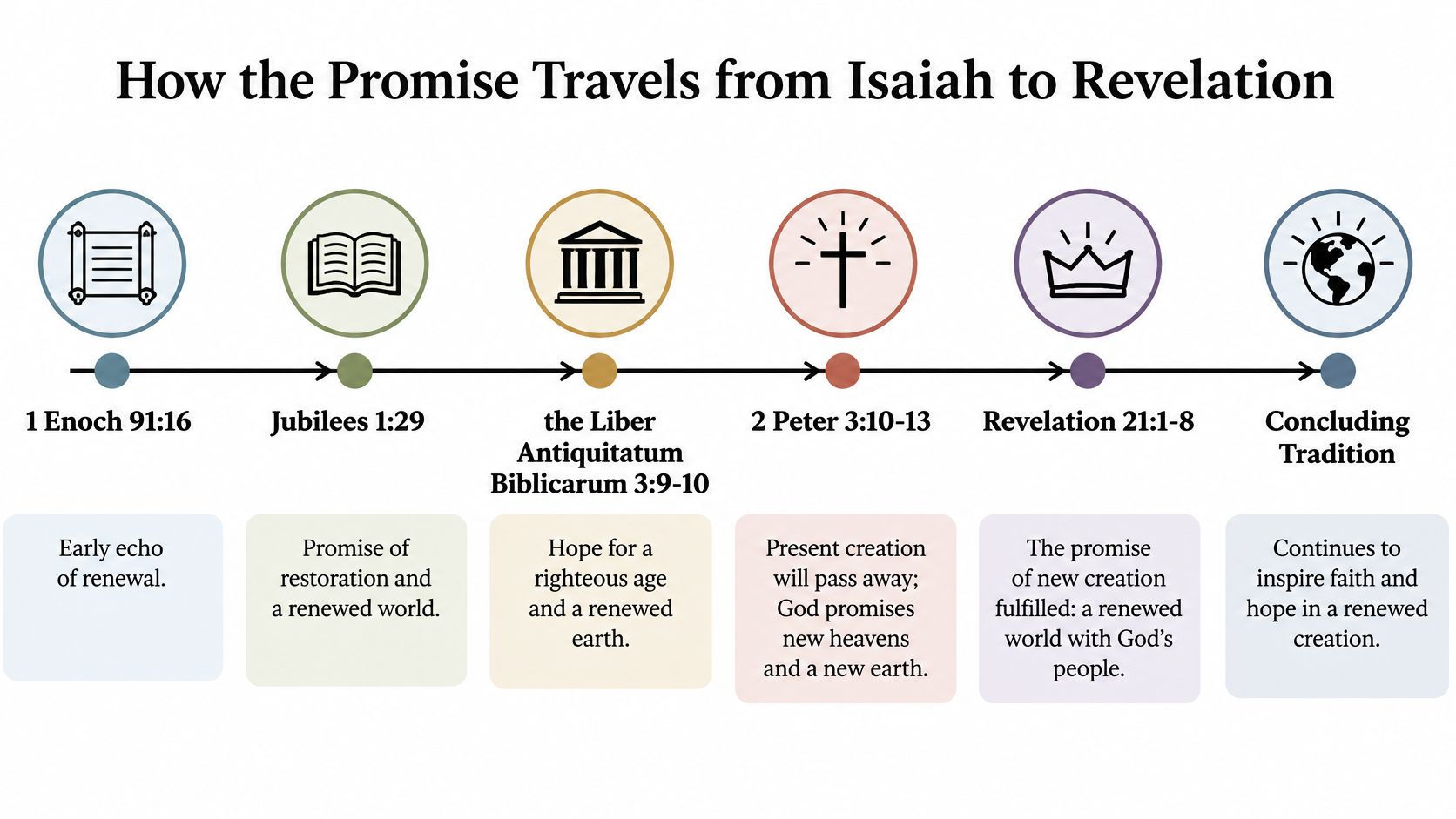
A Harding School of Theology reception-history study traces Isaiah's promise through at least six later sources or traditions, including Jewish writings, New Testament texts, and Justin Martyr, and associates Revelation with the late first century AD.
The sequence below follows that reception trail; it shouldn't be mistaken for a securely dated chronology of every work's composition.
Milestones in the promise's reception
- 1 Enoch 91:16 places renewed creation within Jewish apocalyptic expectation, where God's decisive intervention answers the world's disorder.
- Jubilees 1:29 connects renewal with the restoration of God's people. Its setting is a Jewish retelling of sacred history, not a Christian description of heaven.
- Liber Antiquitatum Biblicarum 3:9–10 belongs to another Jewish retelling of biblical history, carrying the expectation of divine renewal beyond Isaiah's immediate setting.
- 2 Peter 3:10–13 brings judgment and the promised dwelling of righteousness together. Waiting for God's future has ethical consequences.
- Revelation 21:1–8 places the new creation beside the descending New Jerusalem and God dwelling with humanity.
- Justin Martyr's Dialogue with Trypho 80–81 shows the promise entering Christian debate about resurrection and future life, in conversation with Jewish interpretation.
These are related witnesses, not interchangeable statements of a single detailed system. Later Christian reception also shouldn't be treated as proof that Isaiah originally meant every feature later readers discussed.
The visual sequence helps keep the witnesses distinct.
What John emphasizes
John doesn't merely repeat Isaiah's sentence. He describes the former order passing away, the holy city descending, and divine presence becoming the center of human life.
The direction is significant: the city comes down. A Revelation study guide can help readers follow that movement within the book's larger visionary narrative rather than extracting it as a standalone prediction.
Across this reception history, the dominant emphasis is renewal rather than escape from physical existence. That gives Christians reason to connect this promise with resurrection, justice, and creation's future, while remaining attentive to the different purposes of each witness.
What the Word New Really Means
Does God discard the present cosmos, or transform it so completely that its life can rightly be called new?
A simple answer about a future planet skips the central interpretive problem. Christians may agree that God defeats evil while disagreeing about how the world that follows relates to the world we inhabit.
J. Richard Middleton's A New Heaven and a New Earth provides a sustained theological treatment of cosmic redemption and the relationship between future hope and earthly life.
Four readings of new compared
These readings overlap. Future cosmic renewal names the scope of transformation, while transformed continuity describes how that future might relate to present creation.
| View | What new suggests | Texts to compare | Practical emphasis |
|---|---|---|---|
| Post-exilic restoration | Renewed Jerusalem and community after exile | Isaiah 65:17–25; Isaiah 66:22 | Justice, worship, and communal life |
| Future cosmic renewal | Creation itself made new through judgment | 2 Peter 3:10–13; Revelation 21:1 | Creation hope and bodily resurrection |
| Transformed continuity | The present cosmos renewed rather than discarded | Revelation 21:1; 2 Peter 3:7–10; Isaiah 65:17 | Creation care grounded in redemption |
| Symbolic covenant restoration | God's people fully restored in covenant presence | Revelation 21:3; Isaiah 65:17–25 | Relationship with God and neighbor |
A replacement reading gives stronger weight to the former order passing away. A continuity reading gives stronger weight to God's redemption of what he created. Neither position should be established by the English adjective alone.
Comparing Greek vocabulary can clarify a passage, but a word study isn't a cosmological diagram. Literary context, prophetic imagery, and the relationship among the passages still matter.
When interpretation affects conduct
Suppose a believer reasons that a world destined for replacement is disposable. That conclusion doesn't follow: God's authority over present creation still makes careless destruction a moral issue.
Another believer sees environmental stewardship as consistent with transformed continuity. That connection can encourage faithful care, but it doesn't mean human conservation efforts produce God's final renewal.
- Avoid withdrawal. Future divine action isn't permission to neglect a polluted stream, an exploited worker, or an isolated neighbor.
- Avoid overclaiming. Neither a recycling program nor a political platform can be identified without qualification as the arrival of the new creation.
Christians across these readings can responsibly affirm a relationship to God's creation, a decisive break with evil through judgment, and uncertainty about the precise mechanics. They needn't agree on the degree of material continuity to agree that God won't preserve injustice as the permanent condition of his world.
Hope calls for fidelity, not a technical blueprint.
A Four-Level Checklist for Reading the Passage Honestly
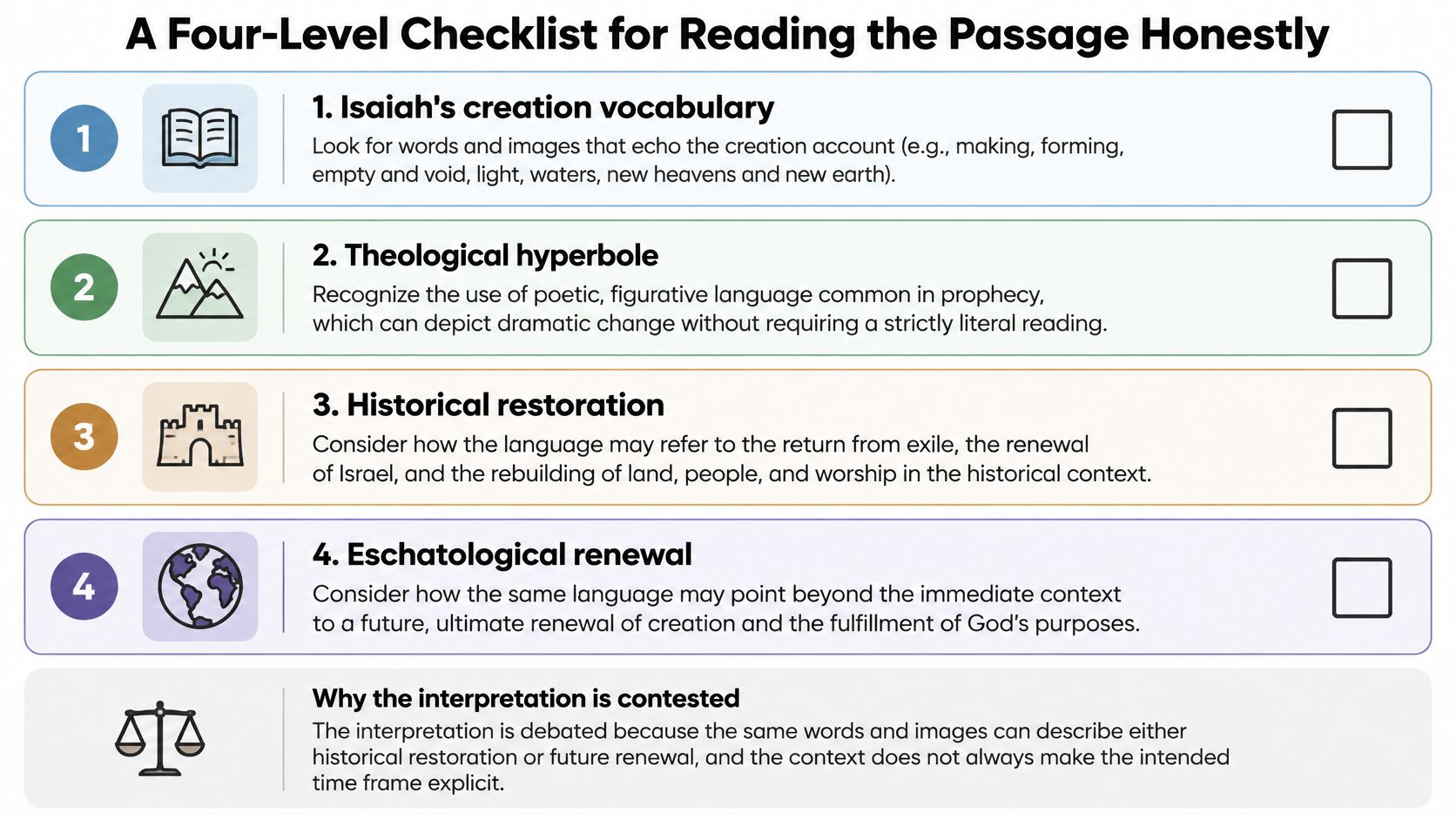
Why do careful readers disagree? Isaiah combines language that sounds cosmic with details that sound like ordinary communal restoration.
A peer-reviewed analysis in the Journal of Asia Adventist Seminary argues that the creation vocabulary can function as theological hyperbole for Judah's restoration. Other interpreters understand its reach as ultimately eschatological, meaning concerned with God's final future.
Keep different kinds of claims distinct
Textual observation
Ask what the words describe. Record the speaker, actions, places, and promised conditions. A warning sign is an explanation that adds a mechanism the passage never names.Historical-context explanation
Ask who first heard the promise and why it mattered. Be cautious when a teacher moves straight from Jerusalem to a modern concern without explaining the original audience.Canonical development
Ask how later biblical writers receive and reshape earlier language. A weak claim treats Isaiah and Revelation as though they share an identical setting, genre, and immediate purpose.Doctrinal conclusion
Ask what theological judgment follows and which interpretive steps support it. A conclusion becomes misleading when a tradition's preferred model is presented as an uncontested quotation from Scripture.
This visual reminder highlights the interpretive tensions behind the workflow.
Compare without flattening
Use a notebook or document with headings for shared themes and meaningful differences. Compare Isaiah's closing chapters with Revelation's concluding vision and Peter's promise, recording genre, audience, historical setting, and promised outcome.
The practical method in how to cross-reference the Bible helps keep connections tied to context rather than matching words alone.
Teaching safeguard: Label an inference as an inference, even when you find it persuasive.
A small-group leader or AI-generated study guide can mislead without making up a verse. Presenting physical replacement, material renewal, or covenant restoration as the only available reading conceals the reasoning readers need to evaluate.
What Life in the New Creation Might Be Like
A child asks whether people will work in heaven. A parent wonders whether family relationships will remain recognizable. Someone grieving an animal asks whether animals belong in God's future.
These aren't distractions from theology. They're questions about whether the things we love have lasting significance.
Family conversation can make room for curiosity without demanding an immediate answer.

What we can say and what we infer
The biblical vision joins God's presence with restored human life and creation. The Christian Scholar's Review essay on theological foundations for creation care connects this cosmic hope with humanity's vocation to cultivate and care for the world.
That gives stronger grounds for embodied, relational hope than for an existence reduced to floating in clouds. Yet it doesn't provide a schedule of future activities.
- Biblical claims include God dwelling with humanity and the removal of death, mourning, and pain in John's vision.
- Theological inferences include proposals about familiar occupations, cultural achievements, particular animals, and the workings of memory. Some may fit the larger biblical account, but fitting isn't the same as being explicitly promised.
The new earth isn't merely heaven moved downstairs, as though only the location changes. Nor is it a label for a better society that human beings can organize.
For a family discussion, the video can serve as a conversation starter rather than a substitute for reading.
Hope alongside grief
Ask which losses restoration would answer. Someone mourning a spouse may name companionship; someone living with illness may name bodily freedom. Naming the longing doesn't require pretending to know every detail of its fulfillment.
Then ask how present vocation might anticipate renewed creation. A nurse tending a patient, a gardener restoring exhausted soil, or a teacher helping a frightened child can practice care consistent with Christian hope.
These acts don't eliminate sorrow or manufacture eternity. They let a believer grieve while refusing the conclusion that faithful love is pointless.
Sermon and Devotional Outlines to Use This Week
Teaching this promise well requires more than describing a beautiful future. Help listeners name what God opposes, what he promises, and what a faithful response looks like before the next gathering.
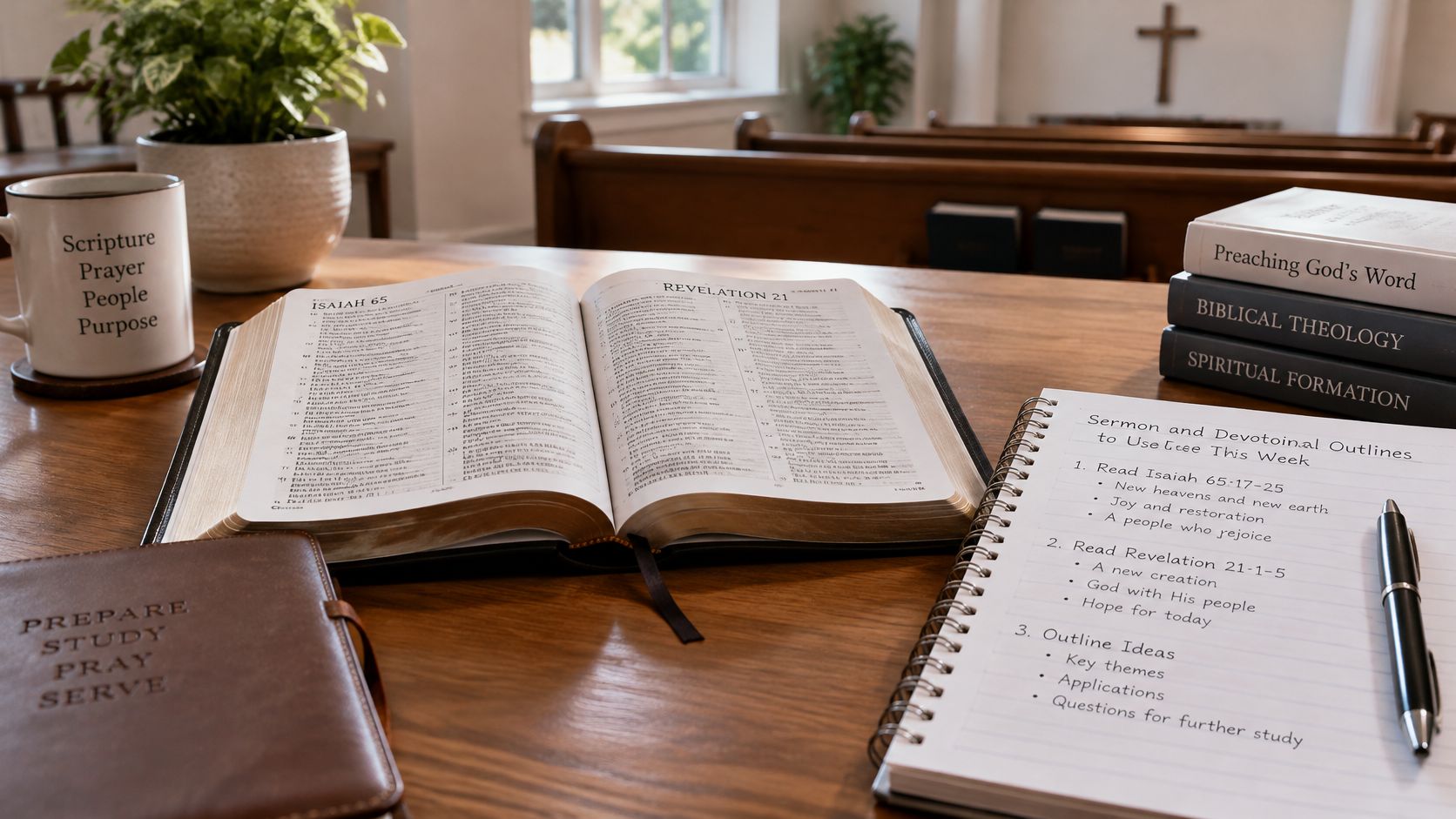
Keep a Bible and a page of notes together so applications remain connected to the passages.
A sermon on restoration and divine presence
For example, plan a 25–35-minute sermon using this sequence. Treat that as a suggested speaking window, not a requirement for faithful exposition.
Read Isaiah's restoration promise.
Name the losses associated with exile: home, security, fruitful labor, and communal worship. Let listeners hear why houses and vineyards belong in a theological promise.Read John's new-creation vision.
Identify what God makes new and what no longer governs human life. Distinguish what John sees from your explanation of how it will happen.Connect the passages through divine presence.
Make God's dwelling with his people the center of the sermon, rather than inviting the congregation to speculate about geography. Explain how the later vision develops the earlier promise without erasing its original audience.Apply the promise locally.
Name a present loss with pastoral care, such as bereavement or displacement. Invite a corresponding act of faithful work: prepare a meal, help someone move, visit a grieving household, or repair something a neighbor can't manage alone.
Avoid promising that a present act of kindness will resolve someone's suffering. Its purpose is faithful love, not a demonstration that grief has already ended.
A devotional for individuals or families
For a hypothetical 10–15-minute devotional, keep the reading short enough to allow honest response.
- Read Peter's promise of righteousness. Listen for what kind of future believers await, not only where that future occurs.
- Name a hope. Write a sentence about the promised absence of wrongdoing or the possibility of life ordered rightly before God.
- Pray about a present loss. Use ordinary words. A child can speak while an adult writes, and silence can be an acceptable response.
- Choose a concrete act. Care for creation or a neighbor through a task you can complete, then discuss why it fits the hope you named.
Keep the interpretive labels visible in teaching notes so observation, contextual explanation, canonical connection, and doctrinal judgment don't become indistinguishable.
Begin Your Study of the New Creation Passages
Read Isaiah 65:17–25, Isaiah 66:22, 2 Peter 3:10–13, and Revelation 21:1–8 in that order across the coming week, taking a passage per study session. Begin with an open Bible and a notebook rather than a need to settle every disputed question.
Leave a clear written trail
End each session with brief notes under these headings:
- Text: State what the words say without adding an explanation.
- Context: Identify the original hearers and the concern being addressed.
- Connection: Note a relationship to the next passage in the sequence.
- Conclusion: Write a doctrinal judgment and mark it confident or tentative.
Keep a running journal with columns for loss and hope. At the end of the week, review whether you've allowed both suffering and God's promise to remain concrete.
If you'd like a broader framework, our Story of the Bible plan explores Scripture as a unified redemptive story, from Creation through Christ's sacrifice to his triumphant return. That wider perspective can help you resist building an entire theology from a familiar phrase.
Faithful reading doesn't require certainty about every detail. It requires patience with the text, honesty about your conclusions, and willingness to let promised righteousness shape present obedience.
HolyJot provides daily or weekly Scripture-based writing prompts to support reflection, prayer, and a continuing record of your study. Visit HolyJot to begin journaling through these passages and connect the hope of new creation with the losses, responsibilities, and prayers of this week.