

Apple of his eye names the pupil, the guarded center of the eye, and means a person or people treated as precious and actively protected, not a piece of fruit and not romance alone.
The familiar advice to read this phrase as reassurance that you're loved stops too soon. Love belongs in the meaning, but the biblical picture asks a harder question: What does care look like when someone precious is exposed to harm?
At the kitchen table, that question changes both prayer and journaling. Instead of writing only about feeling special, you can ask for shelter, notice a vulnerable neighbor, or examine what your church does to protect people.
What Apple of His Eye Actually Means
In everyday English, someone's apple of the eye is a person cherished above all others. A grandparent might use it for a beloved grandchild. That affectionate meaning grows from the older picture of the pupil; it doesn't replace the picture.
So start with an eye, not a fruit bowl. The pupil is the dark opening at the center of the eye. When something comes toward your face, you don't pause to decide whether your sight deserves protection. You blink, turn away, or raise a hand.
Affection that does something
Say a child kicks sand while you're sitting nearby. Your eyelids close before you've worked out what happened. The biblical metaphor draws on that kind of immediate guarding, not merely the warm feeling you have toward something attractive.
There's also a smaller picture within the larger one. Look closely into another person's eye and you may see a tiny reflection of yourself. The Hebrew imagery of a little person in the eye connects nearness with the delicate place being guarded.
A person, or a whole people, treated as exceptionally precious, watched over, and defended.
That sentence keeps affection and action together. Being precious explains the care; being exposed explains the need for vigilance.
Read the person and the setting
Older English could use apple for the pupil, which explains why the familiar wording can confuse a modern reader. You don't need to find a spiritual meaning for the fruit's sweetness, color, or seeds. Those details aren't doing the work in this expression.
You also need to ask whom the passage describes. In Deuteronomy, Jacob or Israel can appear as a single person even while the subject is a people. Before turning the phrase into a private promise, notice who receives protection, who asks for it, and who is told to guard something.
Those questions keep the everyday meaning connected to its biblical foundation.
Five Bible Passages Side by Side
| Passage | Setting | Hebrew image | Emphasis |
|---|---|---|---|
| Deuteronomy 32:10 | Israel in the wilderness | Ke'ishon eno, pupil or little man | God guarding a people personified as one |
| Psalm 17:8 | A personal prayer for refuge | Pupil or apple of the eye | Ask to be kept and hidden |
| Proverbs 7:2 | A father teaching a son | Pupil or apple of the eye | Guard teaching as carefully as sight |
| Lamentations 2:18 | Zion weeping after ruin | Apple or pupil of the eye | Tears that do not stop |
| Zechariah 2:8 | A warning about God's people | Pupil, with different Hebrew wording from Deuteronomy | Harm to the people is harm to God |
These five associated passages, with their related but nonuniform Hebrew expressions, are discussed in Thomas McDaniel's study of the eye idiom.
Notice who does the guarding
Deuteronomy places the image in the wilderness, where Israel needs guidance and preservation. God isn't admiring a people from a safe distance. The setting makes the guarding concrete: a people without secure surroundings depend on care beyond their own resources.
In the psalm, the speaker asks for refuge. The eye image stands beside the sheltering image of wings, making this a prayer to be kept rather than a declaration of superior importance. A journal entry shaped by this passage can begin with need instead of confidence.
Proverbs changes the direction of the action. The learner must guard instruction, rather than only receive protection. Reading the phrase here should lead to a practical question: What would change if I treated wise teaching as something I couldn't afford to neglect?
Let grief remain grief
Lamentations places the eye within a scene of tears after devastation. Don't force this use into a cheerful message about being someone's favorite. The bodily image belongs to sustained lament, where grief needs expression rather than a quick explanation.
Zechariah addresses hostility against God's people. The warning concerns what aggressors do to a community and how seriously God regards it. Its force is public and communal, not merely a private assurance that a person matters.
Reading rule: Keep the verb beside the image. Guarding, asking, keeping instruction, weeping, and touching don't all say the same thing.
The Hebrew vocabulary isn't identical across these passages. Related terms can suggest pupil, little man, baby, or gate of the eye, so a shared English phrase doesn't prove that every underlying word is the same.
Zechariah's verse numbering also differs between Hebrew and English editions. Check your edition before copying a reference, especially when comparing a commentary with an English Bible.
Choose the passage that matches your question: personal prayer, teaching, grief, or the identity of God's people. Then read the surrounding paragraph. A guide to how to cross-reference the Bible can help you compare the passages without flattening their differences.
How Apple Came to Mean the Pupil
The phrase apple of his eye did not begin as a fruit image or a romantic expression. Its history points first to the pupil, the exposed center of the eye that a person instinctively protects.
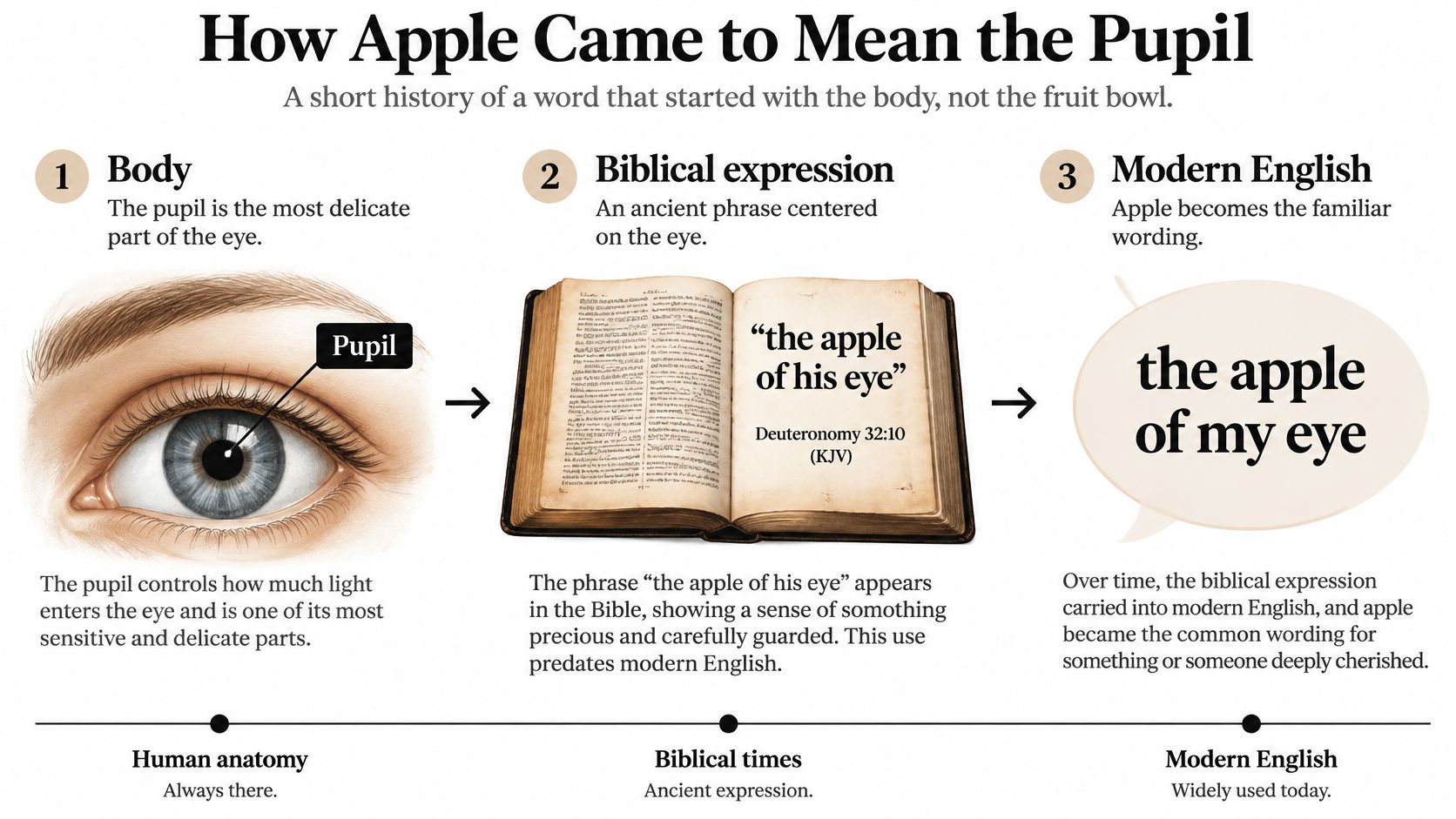
The ancient image came first
Merriam-Webster's explanation of the expression describes it as appearing across several Old Testament books, explains the Hebrew phrase as “little man of his eye,” and traces its recorded English history to Wycliffe's 1382 Bible, before the King James Bible of 1611.
The “little man” refers to the tiny reflection visible in someone's pupil. That reflection helps explain the image's intimacy, but the pupil's vulnerability gives the expression its force: what is precious is watched over and guarded.
English kept a word whose familiar meaning changed
Wycliffe's spelling, “apple of his iye,” may look unusual today. In older English, apple could refer to the pupil, so the word fit the image rather than naming fruit.
The King James wording helped keep the expression familiar to readers. Today, apple often brings fruit to mind first, so knowing its older sense makes the verse easier to picture.
Use history to avoid invented symbolism
A dictionary can help distinguish a word's older meaning in an expression from its familiar meaning today. The guide to choosing a Bible dictionary offers a starting point for that kind of study.
The image's everyday sense of being cherished grows from this picture of watchful protection. It speaks of care for what is exposed and precious, rather than admiration or romantic preference alone.
Why Translations Say Apple or Pupil
| Tradition | Wording | What it names |
|---|---|---|
| Hebrew, Deuteronomy | Ke'ishon eno | Pupil or little man of his eye |
| Hebrew, Zechariah | A different word from Deuteronomy | Pupil or a related eye image |
| Greek, Zechariah | Korē | Maiden or daughter; pupil when used of the eye |
| Latin Vulgate | Pupillam oculi eius or pupilla oculi | The pupil of his eye |
| Wycliffe's English | Apple of his iye | Pupil, using older English apple |
| Traditional English | Apple of his eye | The familiar wording preserved in church use |
| Several modern English versions | Pupil of his eye | The anatomical sense made explicit |
Don't read the table as a ranking of Bibles. It distinguishes language traditions and the different ways translators make an old image understandable.
Familiar wording or immediate clarity
Apple preserves the traditional expression; pupil identifies the body part directly. A reader who knows the idiom may hear its emotional force immediately. A reader encountering it for the first time may understand the metaphor more quickly when the translation says pupil.
Neither reader needs to assume that the other wording is wrong. The useful question is whether the English helps you recognize what is being guarded.
The comparison below keeps those translation choices in view.
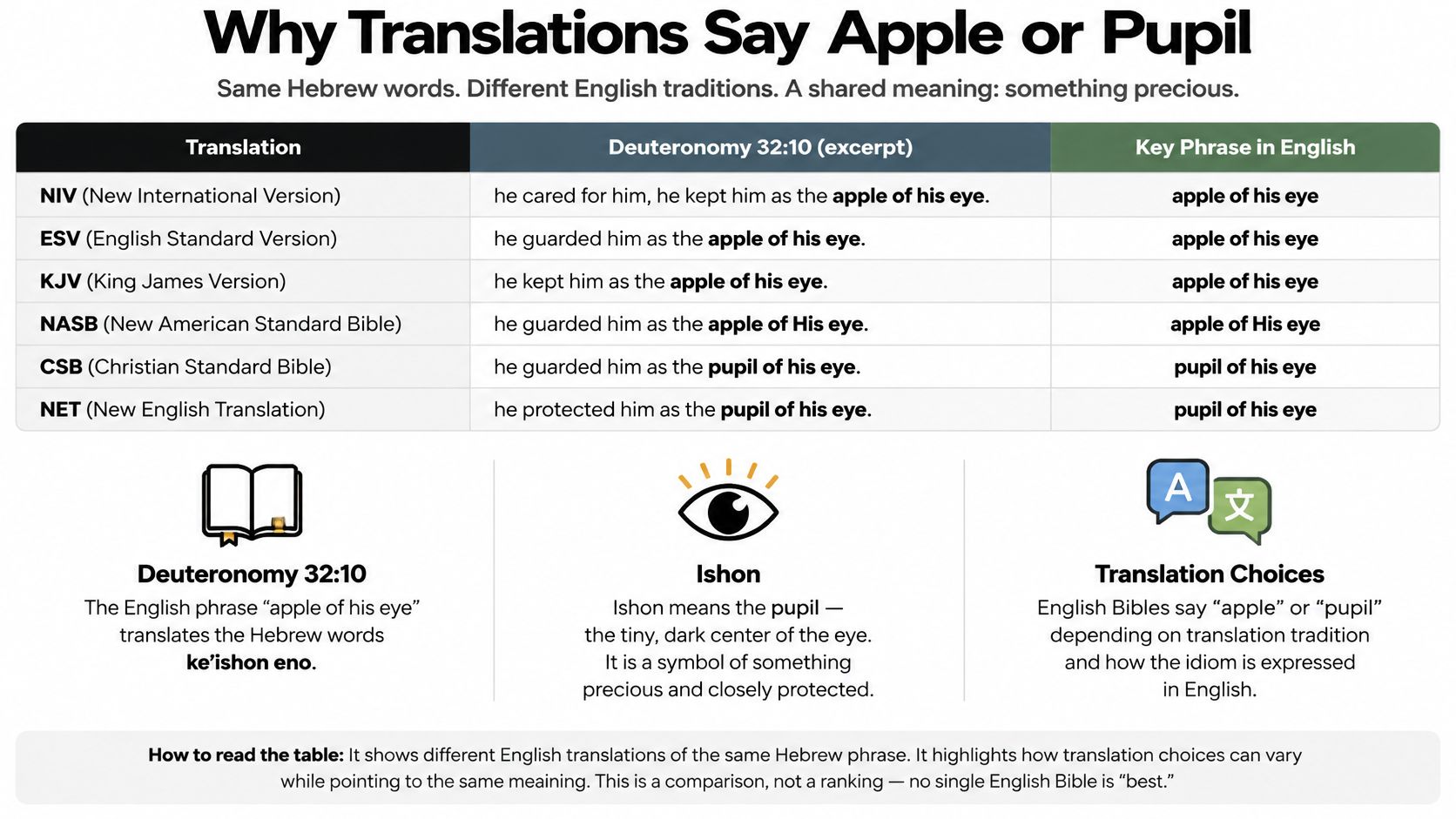
For Deuteronomy 32:10, Ibn Ezra's commentary on Sefaria connects the pupil image with God's protection of Israel from enemies and ambushes, while treating bodily language for God as analogy.
That's an interpretation of God's care, not a description of divine anatomy. Scripture uses a familiar human experience to help readers understand protection they can't otherwise picture directly.
Compare the whole sentence
When you compare translations, copy the action as well as the disputed word. Notice who finds, surrounds, instructs, guards, asks, or keeps. A notebook filled only with isolated nouns can miss the movement of the verse.
Also distinguish the protected person from the protector. A pronoun referring to Jacob or Israel doesn't automatically turn the passage into an account of an unnamed private individual. Read the subject through the surrounding lines before writing a personal application.
- Keep the image: Write pupil beside apple if the traditional wording distracts you.
- Keep the action: Underline the verb that tells you what someone does.
- Keep the context: Name the people or speaker before describing what the passage means for you.
If you're deciding which Bible to use regularly, choosing a Bible version to read involves more than finding your preferred rendering of a single phrase.
For journaling, translation comparison should sharpen attention rather than become a contest. Ask what each wording helps you notice, then return to the verse's actual claim.
Zechariah 2:8 and the Limits of the Image
“He that toucheth you toucheth the apple of his eye” is the warning in Zechariah 2:8, explained in the Commentary Critical and Explanatory on the Whole Bible as an image of how seriously God regards hostile treatment of his people.
The pupil is the aperture through which light reaches the retina. You don't need a detailed anatomy lesson to feel the force of threatening an eye: the response is immediate because the danger is intimate.
The diagram makes that relationship between vulnerability and protection visible.
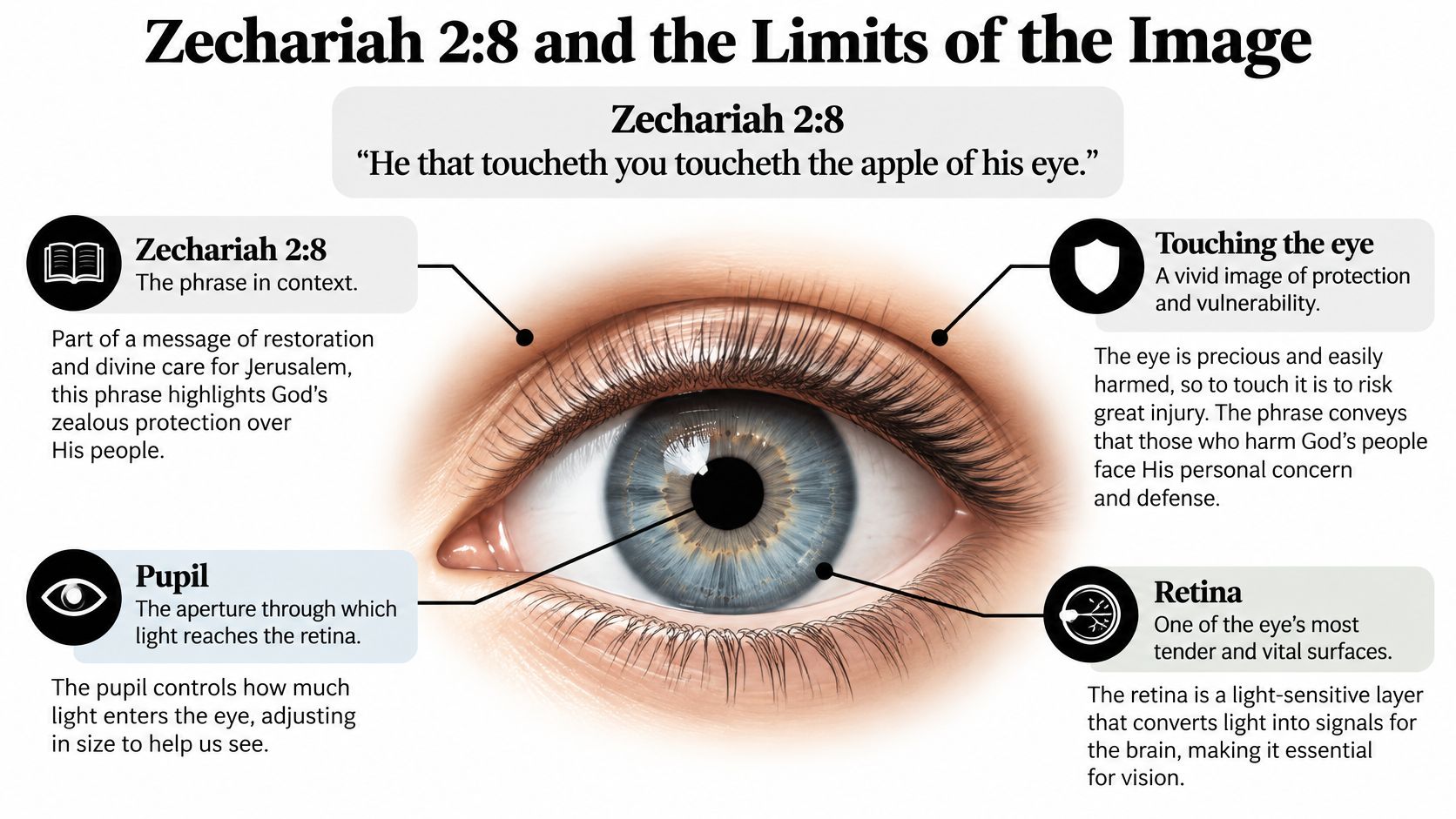
Harm to the people matters to the protector
Zechariah's warning brings an attack on the community close to God himself. The aggressor doesn't get to treat the people as insignificant or their suffering as something God regards from a distance.
That is stronger than a compliment. The image joins belonging with accountability: how people treat those under God's care matters.
It also challenges a comfortable devotional habit. If we enjoy the phrase only because it makes us feel favored, we can overlook the person beside us who needs someone to act.
Put the image to work without overclaiming
Personal prayer can ask for shelter. The psalm's request gives you words when you're afraid, threatened, or exhausted. You don't have to pretend you're safe before asking God to keep you, and you don't have to claim that faithful people never suffer.
Moral attention can protect instruction. The proverb asks the learner to treat teaching as something worth guarding. A concrete response might be keeping a difficult command visible in your journal, then examining the choice where you're most tempted to ignore it.
Church care needs procedures as well as affection. Leaders can apply the protective principle through clear safeguarding policies, confidential reporting routes, and prompt responses to abuse. These are applications of the image, not administrative instructions hidden inside the verse.
Say a congregation calls itself a caring family, but a member doesn't know where to report misconduct. The next faithful step isn't another affectionate slogan. Leaders need a clear reporting route, a person responsible for responding, and a way to raise concerns outside the authority of the person accused.
Protection should make it easier for a vulnerable person to seek help, not harder for that person to question a leader.
Keep the limits visible
The national setting matters. Sefaria's translation notes on Deuteronomy identify the singular “him” while explaining Jacob or Israel as a nation personified.
That distinction doesn't forbid personal prayer. It prevents you from replacing the passage's people and history with yourself.
- Not fruit symbolism: The expression doesn't ask you to interpret an apple's shape or sweetness.
- Not divine anatomy: Human bodily language offers an analogy for God's care.
- Not automatic individualization: A singular pronoun can describe a whole people.
- Not institutional immunity: A church's program, opinion, or preferred leader doesn't gain divine protection merely because someone attaches this phrase to it.
A leader must never use the warning to silence a report of harm. Accountability is consistent with protecting a community; shielding misconduct isn't.
The pupil is precious because it is exposed, so care shows up as defense of the vulnerable, not as special status.
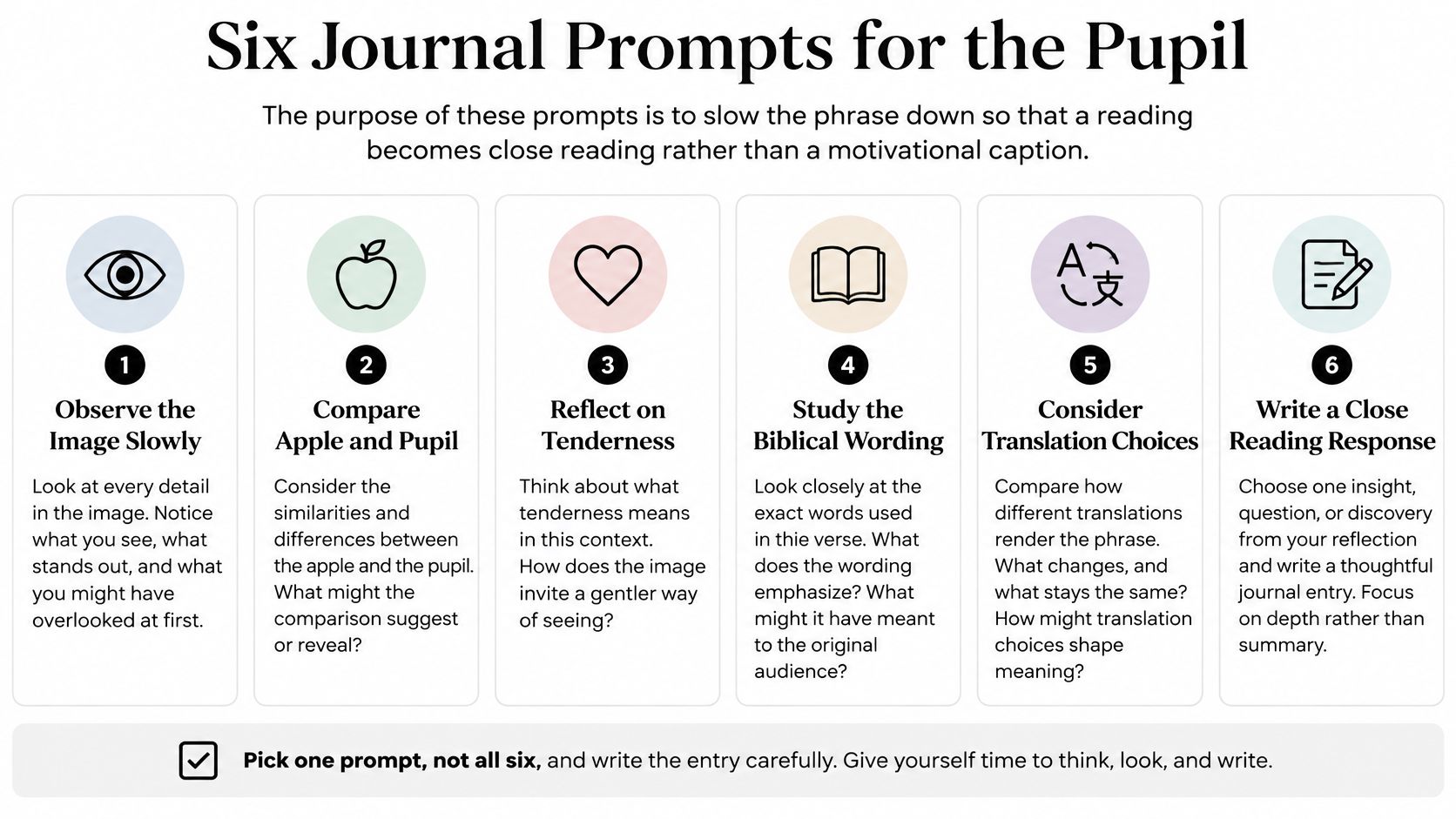
Six Journal Prompts for the Pupil Image
Compare the wording. Copy the wilderness passage from your usual Bible, then from a translation that uses pupil. Circle what changes and underline what stays the same. Does the unfamiliar wording help you see an action you previously passed over?
Name the guarding you need. Where do you need protection this week rather than a compliment? Write about a concrete concern, such as a difficult conversation, a temptation, or a responsibility you can't manage alone. Connect your request to the verse rather than treating it as a promise of an easy outcome.
Notice someone exposed. Who near you lacks support, privacy, safety, or a trustworthy listener? Choose a specific act of care that fits your responsibility. You might accompany someone to a difficult meeting, listen without spreading their story, or help them find an appropriate reporting route.
Separate reassurance from covenant identity. Read the wilderness song around the eye image. Write a sentence naming whom the passage describes, then another explaining your personal response. Let those sentences remain distinct: you can receive encouragement without making yourself the original subject.
Pray the psalm sincerely. Put its request for keeping and shelter into your own words. Name what frightens you without claiming that nothing painful can happen. Leave room for practical help, wise action, and the support of other people.
Guard a teaching you've treated casually. Read the proverb's instruction to preserve teaching as carefully as sight. Name a command you've been sidestepping and a habit that would help you practice it. Be concrete: if the issue is careless speech, write what you'll do before passing along someone else's story.
Choose a prompt rather than finishing a checklist
Pick a prompt, not the whole list, and keep your response beside its verse. The purpose is to slow a familiar saying into close reading, not to produce a polished devotional caption.
The American Bible Society's Scripture-engagement release offers a useful distinction here: using the Bible and engaging with it aren't interchangeable. For this exercise, staying with the wording matters more than filling a page.
Keep this visual nearby if you want a reminder of the questions.
Tomorrow's step: Return to a question the word pupil left unanswered, and reread the surrounding passage before answering it.
You may discover that your question concerns comfort, responsibility, or the difference between your own circumstances and Israel's story. Leave that question open long enough for the actual words of Scripture to shape your response.
At HolyJot, we help you explore Scripture verse by verse with thoughtful prompts and deeper insights supported by AI. Visit HolyJot to journal beside these passages and consider both the comfort of being guarded and the responsibility to care for someone exposed.