

Approximately two-thirds of U.S. congregations held events in which children memorized or recited Bible verses, according to the 2014 Bible in American Life report. That's a lot of opportunities to practice, but a confident recital at church doesn't tell you what a child will remember later or understand.
For Scripture memory for kids, start with a smaller, more useful goal: choose a verse the child can understand, teach it in manageable phrases, and ask for it later without the page. Match the practice to the child's reading and language, then check both the words and their meaning. A warm, repeatable routine matters more than a fast-moving verse list.
Memory Methods That Match Your Child's Age
A flashcard habit assumes children already understand the words and the Bible story behind them. Yet 72% of children aged 8–15 surveyed in Great Britain had never read, seen, or heard Daniel in the lions' den, according to the 2014 YouGov study commissioned by the Bible Society.
Begin with familiarity, not a test. Read the surrounding passage, explain who's speaking, and connect unfamiliar words to something your child knows. A child who can pronounce mercy may still need an example of showing kindness when someone has done wrong.
Choose a starting row, not a deadline
Use this table as a suggested household trial, not a set of proven age cutoffs. The session lengths and paces are starting options to adjust downward, not targets children must meet.
Scripture memory methods by age and need
| Group | Session | Chunk size | New-verse pace | Method | Mastery check |
|---|---|---|---|---|---|
| Ages 3–5 | Try 5–8 minutes | 2–3 words | Try 1 verse every 2–3 weeks | Song, gesture, call-and-response | Recalls the words later without the tune |
| Ages 6–8 | Try 8–12 minutes | 3–5 words | Try 1 verse per week | Read aloud, then cover and recall | Use the delayed-wording target below |
| Ages 9–12 | Try 10–15 minutes | Full clauses | Consider 1–2 verses per week only when ready | Silent read, first letters, explain | Delayed recall, plus a paraphrase and real-life example |
| Tweens | Try 10–15 minutes, opt-in | One clause at a time | Try 1 verse every 1–2 weeks | Private recall and a chosen verse | Delayed recall without a public performance |
| Early readers, multilingual, or language difficulties | Shorter than the age-band session | Try 2–4 words, audio first | Slower than the age row | Caregiver audio, picture map, assisted reading | Can say the meaning in the home language before a new verse |
Circle one row and ignore faster paces. Stop while the child can still participate willingly. If the suggested session feels long, teach a smaller phrase rather than filling the remaining time with repetition.
The tween row offers a choice of approach, not a separate developmental category. A child who overlaps with the older elementary group may prefer choosing a verse and practicing privately rather than using a classroom game.
Let reading and language override age
Listen before handing over a card. Can the child follow the sentence when you read it aloud? Can they explain its central idea in their own words? If listening comprehension is stronger than reading, let listening lead.
For a multilingual family, explain meaning in the language the child understands best while keeping the memorized wording consistent. Don't mistake searching for an English word for a lack of biblical understanding.
Practical rule: Make the task smaller before making the encouragement louder.
Fit the verse into an existing family practice rather than adding another lesson to an overloaded evening. The family Bible study guide can help you connect memory work with reading and conversation, so the verse belongs to a passage rather than floating alone on a card.
How to Run One Verse Across a Week
- Choose a short verse and keep one translation. As a practical starting choice, look for wording that fits comfortably into a short spoken sentence. Don't change versions midway because a song uses different words.
- Explain before drilling. Describe the meaning in child-sized language. Ask the child to tell you what they think it means before correcting or adding detail.
- Read aloud together. Model the wording clearly, then invite the child to join. Check unfamiliar pronunciation without turning the reading into a spelling lesson.
- Divide by meaning. Mark natural phrase boundaries. Keep words that belong together in the same chunk rather than cutting the sentence at arbitrary intervals.
- Cover and ask. Hide a phrase and invite the child to say it from memory. If they're stuck, show the phrase, read it together, and try again.
- Return after a delay. Begin with an achievable gap, then lengthen it when the child can retrieve the words accurately.
- Record the delayed attempt. Write down what the child recalled before help, not the improved recital after you supplied missing words.
- Wait before adding more. Use stable delayed recall and a meaning check as permission to introduce another verse.
This weekly flow gives the routine a visible shape.
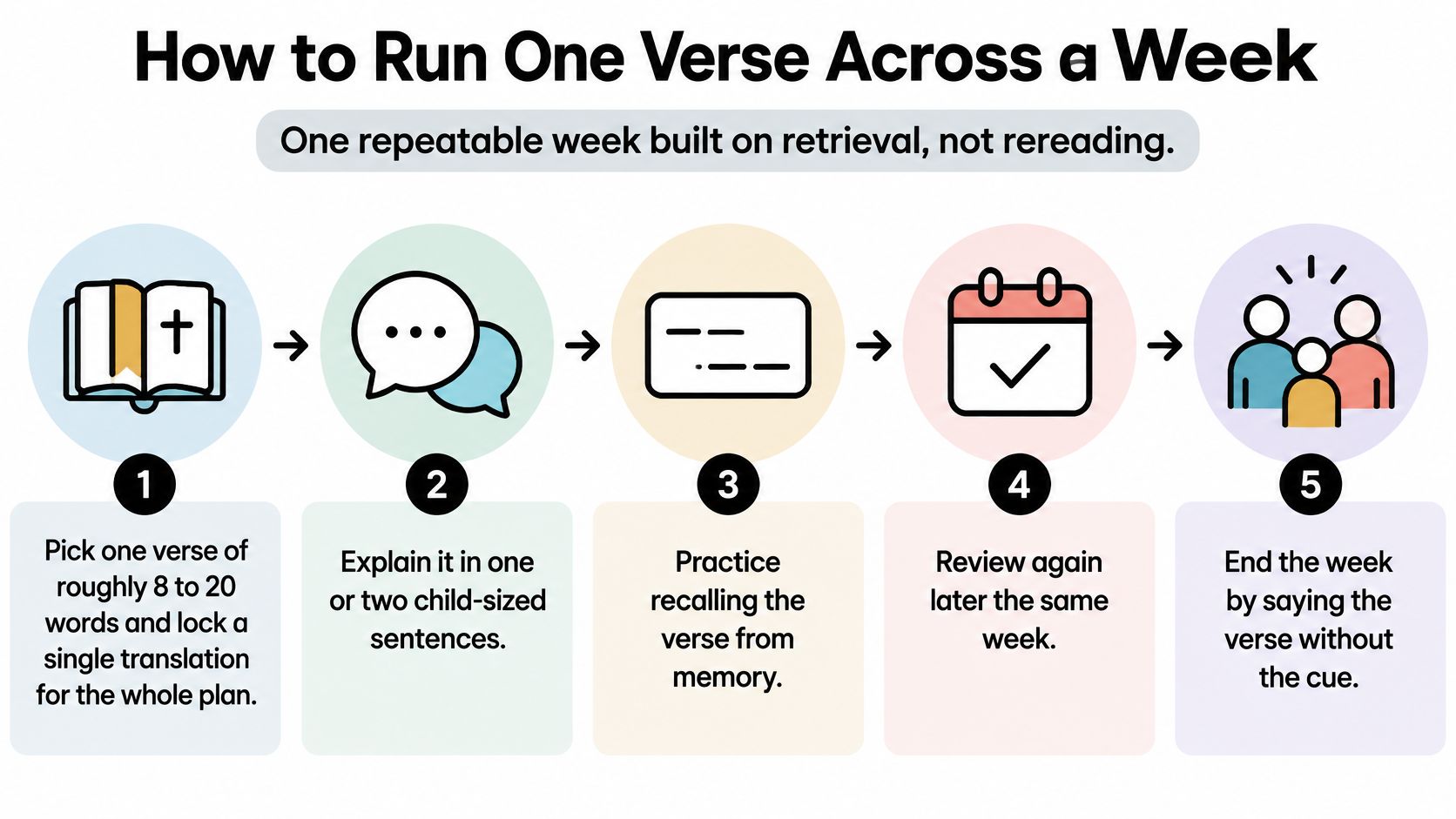
Put retrieval on the calendar
A preschool word-learning study published in the Journal of Speech, Language, and Hearing Research found that shorter early retrieval gaps supported initial recall, while expanding and equally spaced schedules converged by final testing. That supports beginning with success and widening the gap, rather than making the first attempt unnecessarily difficult.
Here's a sample schedule, not a research-prescribed calendar:
| When | What to do |
|---|---|
| Monday, introduction | Explain, read, chunk, and try covered recall |
| About 10 minutes later | Ask again without displaying the wording |
| Tuesday, day 1 | Run a brief delayed check |
| Thursday, day 3 | Retrieve again, then repair missing phrases |
| Saturday | Review older verses |
| Sunday | Offer an optional family or class recital |
| Following Monday, day 7 | Check without a warm-up |
| Monday after that, day 14 | Check longer-term recall |
For household tracking, about 80–90% correct wording across two consecutive delayed checks is a suggested implementation target, not a clinical cutoff or a result established by that study. If your child needs a prompt to begin, record that too. A prompted success is useful practice, but it isn't the same as independent recall.
For preschoolers or children with language difficulties, keep early gaps shorter and pair spoken wording with visible text. Don't stretch the delay merely because the calendar says it's time.
Use the same routine in a group
A leader can model a phrase, invite the group to repeat it, then ask a willing volunteer to try independently. Keep a private record for each child because a strong group response can hide an individual child's uncertainty.
This video offers another demonstration to consider alongside your routine.
Reading repeatedly before church is still practice. Mastery requires a later attempt without the wording in view.
Starter Verses for Preschool Through Tweens
Choose from a short starter set rather than searching until you find the perfect verse. Keep the same translation throughout, and read each passage in context before deciding how much to teach.
These are teaching suggestions, not claims that a particular verse suits every child of a given age. Sentence length and punctuation differ between translations, so use natural clauses rather than forcing an exact word count.
Starter memory verses by age band
| Age band | Reference | Why it fits | How to teach it |
|---|---|---|---|
| Ages 3–5 | Psalm 56:3 | Fear is a feeling they already name | Use short phrases, sung first |
| Ages 3–5 | Psalm 118:24 | A joyful central idea | Begin with the opening thought in small phrases |
| Ages 3–5 | 1 John 4:19 | Introduces God's love and our response | Sing short, meaningful phrases |
| Ages 3–5 | Genesis 1:1 | Introduces the Bible's beginning | Audio first, then small phrases |
| Ages 6–8 | John 3:16 | Important, but long when taught whole | Opening phrase first, remaining clauses later |
| Ages 6–8 | Philippians 4:13 | Personal wording with important context | Divide into natural short phrases |
| Ages 6–8 | Proverbs 3:5 | Introduces trusting God | Opening thought first, then the remaining clause |
| Ages 6–8 | Psalm 119:105 | Offers a concrete image | Separate the lamp and path imagery |
| Ages 9–12 | Joshua 1:9 | Connects courage with God's presence | Teach the command and its reason separately |
| Ages 9–12 | Ephesians 4:32 | Kindness they can practice today | Build clause by clause toward the whole sentence |
| Ages 9–12 | Micah 6:8 | Names justice, mercy, and humility | Give each idea its own phrase |
| Ages 9–12 | Colossians 3:23 | Connects with school and chores | Join full clauses into the whole sentence |
| Tweens | Psalm 119:11 | Explains a purpose for remembering Scripture | Learn by clause, then discuss the whole |
| Tweens | Romans 8:28 | Opens important questions about suffering | Build toward the sentence with a meaning conversation |
| Tweens | 2 Timothy 1:7 | Invites discussion of fear and faithful action | Learn clauses, then connect their meaning |
| Tweens | Matthew 7:12 | Gives a practical way to consider others | Learn the sentence, then apply it to a situation |
Teach the thought without distorting it
For a longer verse, begin with a complete thought rather than an isolated string of words. With Joshua 1:9, for example, teach the instruction about courage and then connect it to the reason given in the passage. Add the remaining wording only when the first portion is secure.
A memorized excerpt is still an excerpt. Mark it clearly on the card and tracker so nobody mistakes a partial verse for the full text.
Take care with familiar passages. Philippians 4:13 shouldn't become a promise that a child will win every competition, and Romans 8:28 shouldn't become a quick explanation for someone's pain. Read the surrounding passage and leave room for questions.
Swap thoughtfully
If a verse frightens or confuses a particular child, choose another from the same band while you work through the question. You're selecting a teaching starting point, not avoiding every difficult biblical subject.
For mixed readers, share the spoken verse together and let fluent readers add written first-letter cues privately. Choose a small set for the coming months, not a year-long assignment before you've learned what your group needs.
Games That Still Require Real Recall
A useful memory game makes the next independent attempt possible. It doesn't merely keep children busy with verse-shaped materials.
Choose an activity that fits the child, then finish by removing its support. These visual examples can help you vary practice without making speed the goal.
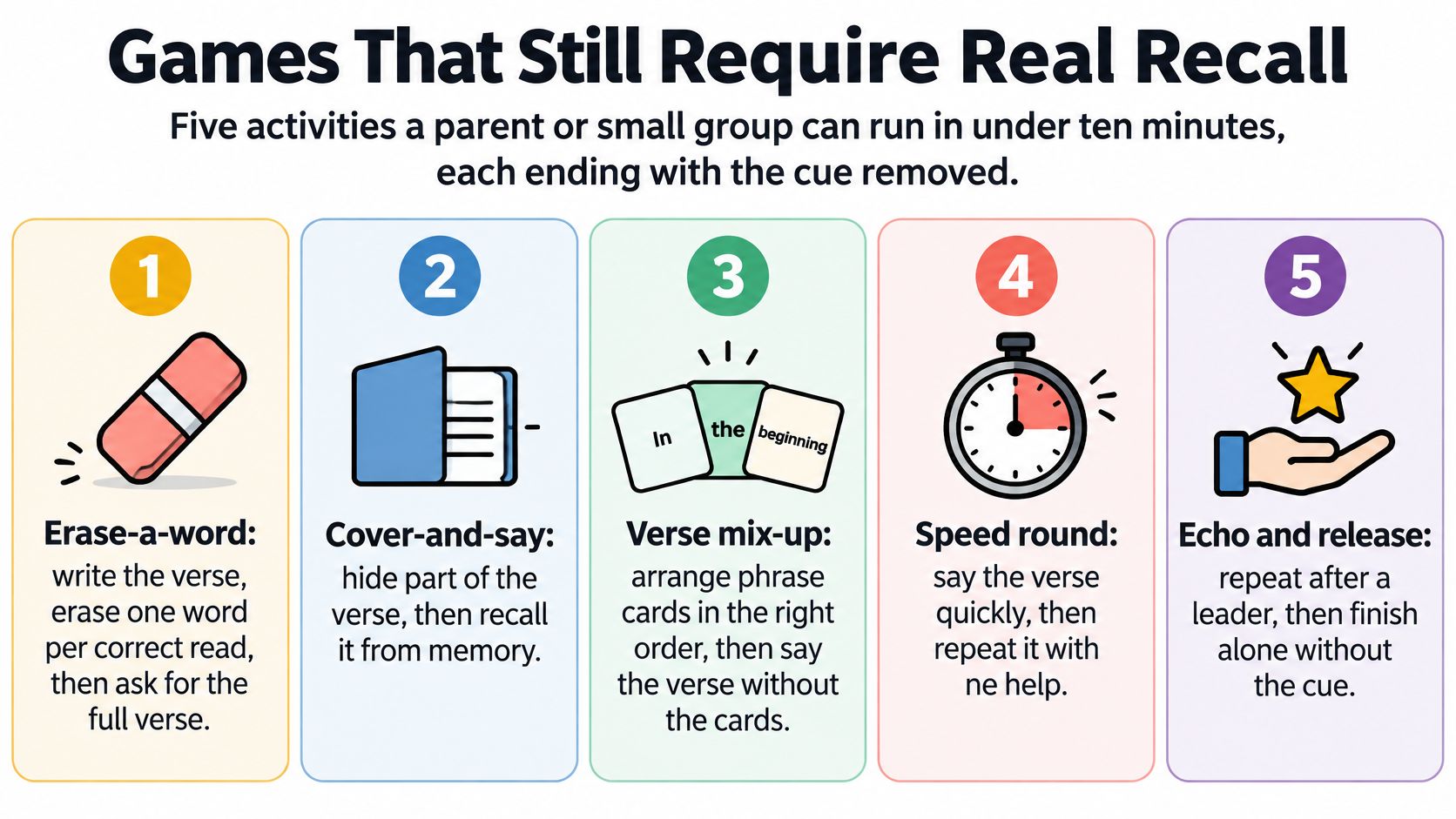
Make the last turn independent
- Erase-a-word. Write the verse on a whiteboard. Let the child erase a word after a successful reading, then continue until the board is blank. Ask for the whole passage without pointing at the former word positions.
- Finish-the-phrase. Say the opening chunk and pause for the child to supply what comes next. Close the page before their turn. Eventually, invite them to begin without your opening line.
- First-letter strip. Once the wording is familiar, write its initials on a narrow card. Use the strip to repair a difficult spot, then hide it for the final attempt.
- Gesture story. Let a younger child choose a meaningful motion for each phrase. After practicing with movements, invite a quiet-hands recital so you can hear what they remember without the physical sequence.
- Call-and-response. The leader says a line and the class responds. Offer a willing child the chance to say the connected lines alone, without classmates supplying the next words.
Don't interrupt every minor slip. Let the child finish, name what they remembered, and repair the specific phrase that needs attention. Otherwise, you risk practicing adult correction more than child retrieval.
Use songs as scaffolding
A Christian kindergarten comparison documented by ERIC taught verses over 12 weeks and reported significantly better long-term retention for song-learned verses on an assessment six weeks after the final verse. That supports melody as an aid in that setting, not a universal success rate or proof that singing alone produces durable learning.
Explain the verse, model pronunciation, and sing it together. Leave out words for the child to supply, then gradually remove melody, gestures, and displayed text.
A song can help a child learn the words. A spoken attempt helps you find out what they can retrieve without the song.
After recall, ask for a paraphrase or a situation where the verse could matter. Keep that response separate from wording accuracy: a child may understand the idea while still forgetting a phrase.
Use card-sorting and recognition quizzes as extra practice, not substitutes for saying the words independently. For broader group activities, adapt ideas from these youth ministry games for small groups, keeping participation voluntary and avoiding timed recitation contests.
Fixes When Kids Freeze or Only Recite
Your child can say the verse beautifully, but when you ask what it means, they shrug. That isn't a reason to assign more repetitions of the same words. It's a reason to change the task.
Treat the following causes as working possibilities, not diagnoses. Notice what happens before the difficulty, change the support, and watch whether participation becomes easier.
Scripture memory problems and what to change
| What you see | Likely cause | Change this week |
|---|---|---|
| Perfect in the session, blank the next day | Immediate repetition treated as mastery | Return to spaced checks and add nothing new |
| Says it only with the song, motions, or card | Recall may be tied to a cue | Fade that cue before asking independently |
| Mixes two wordings of the same verse | Translation interference | Keep a single translation for that verse |
| Reads it correctly but cannot say it from memory | Reading practice without enough retrieval | Close the page and prompt a phrase at a time |
| Recites the words and cannot explain or use them | Meaning hasn't received enough attention | Ask for a paraphrase and a real-life example before advancing |
| Early reader struggles while peers move ahead | Method may exceed current reading or language skills | Add audio and pictures, shorten chunks, and slow down |
| Freezes, cries, or refuses to recite | Pressure or discomfort with public performance | Offer private, opt-in practice and stop the public moment |
| Argues with or fears the verse | A difficult question, not necessarily a memory problem | Respond without shame, pause the verse, and offer another |
Separate reading difficulty from understanding
A 2025 Indonesian elementary-school study found that retention and accuracy were strongest when memorization methods matched students' reading proficiency, with engagement differing according to tone and technique. That's a reason to adjust the method rather than interpret slower reading as weaker commitment.
Try saying the verse while the child listens without a card. Then ask them to explain the idea or choose a picture that represents it. If they understand orally but stumble over the print, give reading support rather than a harder memory assignment.
For a multilingual child, invite the explanation in their strongest language. For a child who finds handwriting demanding, let an adult record the paraphrase. Neither adjustment removes the thinking you're asking them to do.
Replace performance with a conversation
If a child recites Ephesians 4:32 but can't explain kindness, offer a concrete scenario: a classmate spills a pencil case and everyone walks past. Ask what a kind response could look like, then let the child connect that action to the verse.
Don't require the adult's exact explanation. Listen for the central idea, correct a misunderstanding gently, and acknowledge an imperfect but thoughtful answer.
When a child freezes, use a calm response such as:
Forgetting is part of learning. Would you like the first phrase, or would you rather stop for today?
If the child wants to stop, stop. Don't offer that choice and then negotiate until they perform.
A child who questions a verse needs a different conversation from a child who forgets it. Ask what troubles them before deciding whether the wording, context, or subject needs attention. Resume the usual pace only when the current task is manageable, understood, and calm.
Track One Verse and Begin This Week
Keep a private tracker with a row for each verse. Put the reference, translation, start date, delayed checks, and meaning result across that row; use this field guide to decide what belongs in each space.
Verse tracker template
| Field | What to record | Rule |
|---|---|---|
| Verse reference | Book, chapter, and verse | Write once; identify any excerpt |
| Translation | Name of the chosen translation | Don't switch wording for this verse |
| Date started | Date first taught | Mark as day 0 |
| Day 1 check | Percent correct wording | Record delayed accuracy before help |
| Day 3 check | Percent correct wording | Record delayed accuracy before help |
| Day 7 check | Percent correct wording | Record delayed accuracy before help |
| Day 14 check | Percent correct wording | Record delayed accuracy before help |
| Paraphrase | Yes or no | Check meaning before adding another verse |
| Weekly stack | Yes or no | As a trial, keep four to six current verses |
The review dates and stack size are suggested organizing choices, not validated requirements. If calculating wording accuracy becomes burdensome, note the exact missing phrase and whether a prompt was needed. Keep the record useful rather than elaborate.
Keep progress private
Once a verse meets your delayed-recall target, move it to an occasional review pile rather than abandoning it. A monthly reminder is a practical option to try. These Bible verse organization ideas can help you separate current practice from longer-term review.
Count a miss as information, not a failed child. Never post scores, rank children, or use a public recital as the grade.
PursueGod's guidance for helping children memorize Scripture encourages making space for hard questions about God and the Bible. Build that permission into the routine rather than waiting until a child becomes distressed.
Answer doubt honestly
Listen first. Give a brief, honest response, admit what you don't know, and ask whether the child wants to keep working with that passage.
You might respond along these lines:
That's a serious question. I don't know the whole answer, and we can explore it together. Would you like to keep this verse or choose another while we talk?
For optional support, our Bible reader lets families read, listen to, and journal directly from a verse. Journal entries can have Scripture attached from six translations, and we provide daily or weekly Scripture-based writing prompts. Choose a consistent wording for practice and use a freestyle note to capture the child's explanation.
Begin with a manageable verse and schedule the first delayed attempt. Add another only when the record shows independent recall and the child can explain the thought.
HolyJot offers verse-linked journaling and a Bible reader where you can read, listen, and reflect together. Visit HolyJot to open your chosen passage and record your child's own explanation, keeping understanding alongside the words they're learning.