


On Sunday morning, the welcome team is short two people, the children's check-in volunteer has texted that she can't come, and three ministry leaders are asking whether next month's schedule is finished. Someone is carrying coffee urns, answering questions at the door, and trying to remember which new volunteer still needs safeguarding paperwork. By the time the service begins, the coordinator has filled the gaps, but nobody has addressed why those gaps keep appearing.
That's the common misunderstanding behind volunteer coordinator roles and responsibilities. The coordinator is far more than the person who fills shifts. They manage capacity, reduce operational risk, protect volunteers from unsustainable expectations, and connect service needs with people who can meet them. In a church, that work may be carried out by a pastor's spouse, an administrator, a ministry leader, or a retired member without a formal title. The title may be missing, but the responsibility is real.
Why the Volunteer Coordinator Role Matters More Than the Job Title Suggests
A church can survive an occasional absence. It struggles when every absence becomes an emergency and the same dependable people keep absorbing the work. Reactive scheduling creates a cycle of overuse, fatigue, resentment, and further absences.
The coordinator's job is to interrupt that cycle before Sunday morning. That means understanding which ministries need reliable coverage, which roles carry safeguarding or safety implications, and where the congregation has more capacity than the current sign-up process reveals.
The hidden management function
A capable coordinator protects several things at once:
- Service continuity: Worship, hospitality, youth activities, pastoral care, and events need enough trained people to operate safely and predictably.
- Volunteer wellbeing: A person who always says yes may still be close to burnout. Good coordination includes boundaries, rotation, backup coverage, and permission to step back.
- Safeguarding: Roles involving children, vulnerable adults, money, transportation, or private communication need clearer controls than a casual event task.
- Organizational memory: Volunteer contact information, training, certifications, assignments, hours, attendance, and retention shouldn't live only in individual inboxes or text threads.
- Leadership reporting: Pastors, trustees, and ministry leaders need to know whether volunteer activity supports the church's actual mission and program outcomes.
A detailed overview of the volunteer coordinator function describes the role as a complete lifecycle that includes needs assessment, role design, recruitment, screening, orientation, scheduling, supervision, records, risk management, and recognition. That scope matters because a weakness at one stage usually appears later as a scheduling problem.
A coordinator who only recruits may bring in people for roles that haven't been defined properly. A coordinator who only schedules may place untrained people into sensitive assignments. A coordinator who only recognizes volunteers may thank them for work that was poorly designed from the start.
Practical rule: Treat every recurring volunteer need as an operational process, not as a favor you hope a reliable person will keep doing.
In smaller churches, the first improvement usually isn't buying software or creating a large committee. It's naming the responsibility, giving it decision-making authority, and creating one dependable place for role details and volunteer records. Once someone can see the whole system, the church can distinguish a genuine capacity shortage from a communication failure, an unclear role, or a schedule built around unrealistic assumptions.
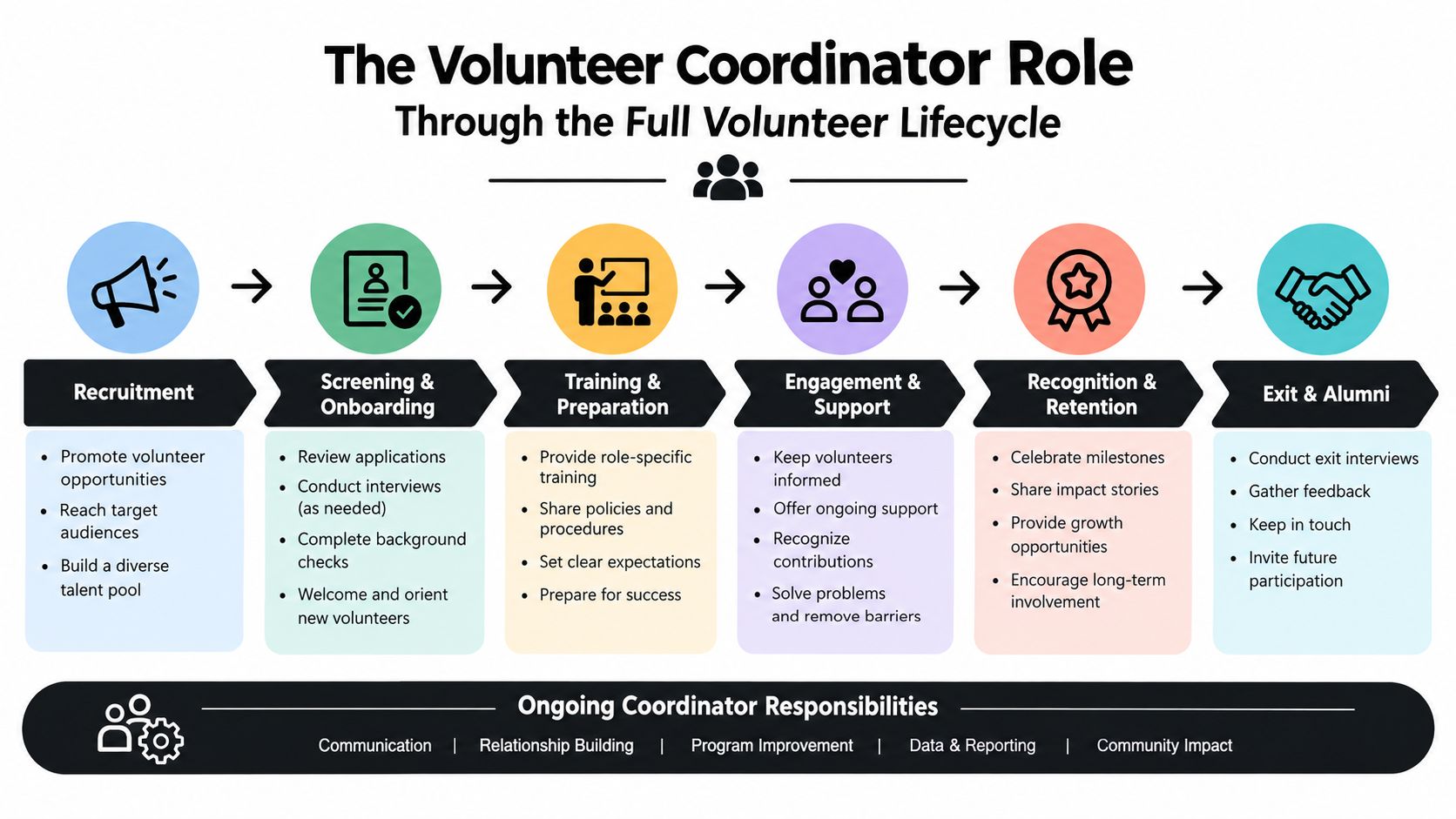
The Volunteer Coordinator Role Through the Full Volunteer Lifecycle
The strongest way to define the role is to follow a volunteer from the first conversation to the point where they leave, pause, or return. The coordinator's value sits between these stages. They make sure a person doesn't disappear between recruitment and onboarding, or between a first assignment and meaningful support.
Start with needs, not names
Begin by auditing ministry needs. Ask which roles are essential, which are optional, which have adequate coverage, and which are operating only because one person carries them alone. A Sunday greeter, children's helper, finance assistant, worship technician, meal organizer, and pastoral visitor may all require different levels of preparation and continuity.
Then write the role before recruiting for it. State the task, expected availability, physical or emotional demands, required skills, supervision, and a clear way to stop serving. “Help with children's ministry” is too vague. “Welcome families, follow check-in procedures, and assist the room leader during the service” gives a prospective volunteer something they can assess accurately.
Move people through a consistent path
Recruitment can draw from announcements, personal invitations, ministry events, small groups, community relationships, and people who already express interest. Personal invitations work well in congregations, but they shouldn't become the only source. If recruitment depends on one leader's memory, the church will repeatedly overlook people who could serve in less visible ways.
Screening should match the role. Children's and youth assignments may require background checks and safeguarding procedures. Finance-related work may call for references, clear access rules, and separation of duties. The coordinator should document what was checked and who approved the placement.
Onboarding can remain simple without being casual. A new greeter might complete an orientation, review the code of conduct, and shadow an experienced person for two Sundays. A kitchen volunteer may need equipment and food-safety guidance. A pastoral-care volunteer needs clarity about confidentiality, escalation, and when a concern belongs with a pastor rather than with the volunteer.
Scheduling then turns availability into a workable rotation. Set rules for swaps, late cancellations, absences, and backup coverage before the first problem occurs. Supervision continues after placement through check-ins, observation, issue resolution, and feedback. Recognition should include appreciation, but it should also include useful feedback about what's working and what needs to change.
For a broader comparison of coordination in a different mission-driven environment, this political campaign role guide is a useful reminder that recruitment, communication, assignment, and follow-up are connected activities rather than isolated tasks.
A church can begin with a shared spreadsheet, provided it has named owners, consistent fields, and controlled access. The same discipline should support planning a church event, because event volunteers often need a faster, more flexible workflow than recurring ministry teams.
Formal Roles and Flexible Service Side by Side
There isn't one correct volunteer model for every congregation. A formal program creates consistency, but it also requires administration. A flexible model lowers the barrier to participation, but it can leave coverage and accountability unclear.
A formal program model fits roles that repeat, affect vulnerable people, require training, or create operational dependence. It uses written role descriptions, vetted rosters, documented onboarding, scheduled rotations, and periodic reviews. Children's ministry, transportation, finance, pastoral care, and technical production usually benefit from this structure.
A flexible service model fits one-off events, hospitality, setup, meal delivery, short administrative tasks, and family participation. It may use a sign-up sheet, a simple expression of interest, word-of-mouth invitations, or a group message. That approach can work well when the task is low risk and the church needs participation without asking people to make an ongoing commitment.
The informal model also matters because formal systems tend to count only what enters the database. United Nations Volunteers describes informal volunteering as mutual aid, peer support, and community self-help, and reports that it outpaces formal, organization-based volunteering globally by roughly two to one. A church that measures only scheduled shifts may miss prayer support, crisis response, meal coordination, rides, peer care, and family-led service.
A hybrid approach is often the most practical. Use formal controls where safeguarding, finances, driving, or confidential information are involved. Use flexible pathways for hospitality, event setup, neighborhood projects, and short tasks. Record informal contribution without forcing every helper through the same process as a children's ministry leader.
| Dimension | Formal Program Model | Flexible Service Model |
|---|---|---|
| Best fit | Recurring, sensitive, or skill-dependent roles | One-time, seasonal, family-friendly, or low-risk tasks |
| Entry process | Application, screening, orientation, and role approval | Simple sign-up or personal invitation |
| Scheduling | Planned rotations with backup and swap procedures | Event-based coordination and short-notice availability |
| Consistency | Higher consistency across weeks and leaders | More variation in attendance and execution |
| Risk control | Stronger documentation and role boundaries | Requires clear limits on what the volunteer may do |
| Volunteer experience | Predictable for people who want structure | Accessible for people with changing availability |
| Coordinator workload | More administration before placement | More real-time coordination around each event |
The trade-off is not formal versus careless. It's control versus accessibility, and the right balance depends on the task. Flexible service shouldn't become an excuse to skip basic safeguarding. Formal coordination shouldn't turn every act of help into an application process that discourages participation.
A Realistic Week in the Life of a Part-Time Coordinator
A part-time coordinator's week rarely consists of neat blocks marked “recruitment,” “scheduling,” and “reporting.” The work arrives through interruptions. A volunteer replies late, a ministry leader changes the room assignment, a background check needs follow-up, and an event requires supplies that nobody ordered.
Monday is for closing the loop on the previous Sunday. Review attendance, no-shows, substitutions, incidents, and unresolved questions while details are still fresh. Triage the inbox and text messages, then separate genuine risks from routine requests. A short recap with ministry leaders prevents the coordinator from carrying every issue alone.
Tuesday is usually the best day for planning. Review upcoming needs, contact prospective volunteers, update role records, and check in with team leads. If a ministry has repeated gaps, don't just send more reminders. Ask whether the role is unclear, badly timed, too demanding, or assigned to the wrong type of volunteer.
The work that expands to fill the week
Midweek may include onboarding calls, reference follow-up, a shadow shift, equipment checks, supply collection, and conversations with people who want to serve but can't commit to a recurring schedule. Those conversations are valuable. They often reveal flexible capacity that a standard roster would miss.
Thursday is the point for locking the next schedule, confirming leaders, checking backups, and resolving conflicts while there's still time to adjust. Friday is for concise communications. Send the final assignments, arrival instructions, contact details, and escalation route. Avoid burying critical information in a long group thread.
Sunday is not merely execution. The coordinator watches how the system behaves. Are volunteers arriving unsure of where to go? Is one person answering every question? Does the backup plan work? Are families being asked to serve in ways that conflict with their responsibilities?
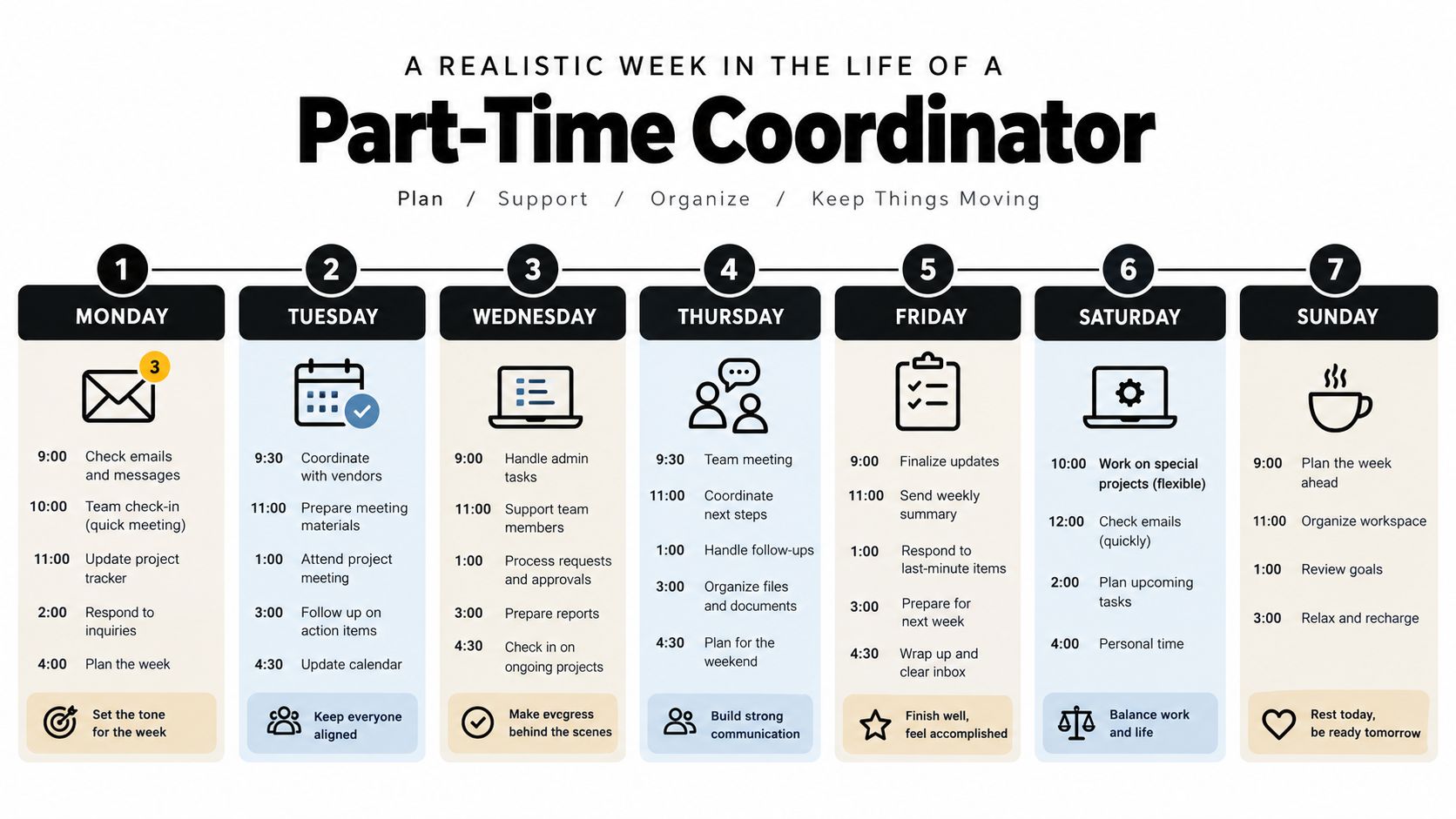
The exact rhythm will vary. Some congregations plan around a two-week cycle, while others have separate schedules for worship, children, and events. The useful principle is to reserve time for recruitment, records, communication, supervision, and improvement, rather than allowing last-minute substitutions to consume every available hour.
Sample Job Description and KPIs a Coordinator Can Actually Use
A small church doesn't need a corporate-sounding job description. It needs a document that answers who owns the work, what authority they have, and how leaders will know whether the program is functioning.
A practical role description
Position: Church Volunteer Coordinator
Reports to: Pastor, church administrator, or designated ministry leader
Status: Paid, part-time, or volunteer assignment, with agreed responsibilities and review points
Purpose: Coordinate the recruitment, screening, onboarding, scheduling, support, records, and recognition of volunteers across approved church ministries.
Core duties include:
- Assess needs: Maintain a current view of required roles, coverage, vacancies, and backup capacity.
- Design roles: Write clear descriptions with time expectations, duties, boundaries, training, and exit procedures.
- Recruit and screen: Invite suitable people, manage expressions of interest, and coordinate role-appropriate checks.
- Onboard: Deliver orientation, confirm training, arrange shadowing, and document readiness.
- Schedule: Publish assignments, manage swaps, and communicate changes through one agreed channel.
- Support: Conduct check-ins, respond to concerns, escalate safeguarding matters, and help leaders resolve conflict.
- Report: Maintain records and provide concise updates on participation, coverage, training, and recurring risks.
- Improve: Review feedback, no-show patterns, role difficulty, and reasons for withdrawal.
The role calls for organization, discretion, clear communication, comfort with basic records, and the judgment to say that a ministry plan exceeds available capacity. A coordinator also needs enough authority to pause an assignment when screening or training is incomplete.
Use measures that improve decisions
A KPI should help someone decide what to change. It shouldn't turn unpaid service into a production quota. Paid coordinators can carry a more regular reporting rhythm, while unpaid coordinators need a lighter scorecard that supports the work without creating another burden.
| KPI | Why It Matters | Target Range | Cadence |
|---|---|---|---|
| Assignment coverage | Shows whether essential roles are staffed before the service or event | Set a locally realistic coverage standard for each ministry | Each service or event |
| Volunteer retention | Identifies whether people continue in roles that fit their capacity | Compare with the church's own prior period | Quarterly |
| Onboarding completion | Confirms that new volunteers are prepared before placement | All required steps complete before sensitive assignments | Each new volunteer |
| Training completion | Reveals gaps in safeguarding, safety, and role competence | Full completion for required training | Monthly or by role cycle |
| No-show and late-cancellation pattern | Distinguishes isolated events from role or communication problems | Review trends rather than punishing individual cases | Each service, summarized regularly |
| Event coverage | Tests whether one-off projects have enough people and backups | Define coverage before opening sign-ups | Per event |
| Reasons for withdrawal | Shows whether people leave because of time, role design, support, or personal change | Track themes without treating every departure as failure | At exit |
For context on the wider administrative function that often surrounds this role, this guide to what family support workers do illustrates why people-facing coordination often combines relationship work, records, boundaries, and practical follow-through. Church leaders can also clarify ownership by documenting how the role fits within church administration.
Onboarding and Training That Protects Both Volunteers and the Organization
A volunteer shouldn't discover the actual requirements of a role after arriving for the first assignment. The church should make the path clear before placement, especially when the work involves children, youth, vulnerable adults, money, transportation, private communication, or physical safety.
Build the path before the first shift
Start with an application or expression of interest that captures contact details, availability, relevant experience, and the type of service the person wants to explore. An informal helper may need a short conversation rather than a full form, but the coordinator should still record enough information to know where the person is serving.
Use references or background screening where the role requires it. The exact process depends on local law, church policy, insurer requirements, and the nature of the assignment. Don't use a single screening standard for every task, but don't let urgency erase the standard for a sensitive role.
An interview can be brief and practical. Ask what the volunteer understands about the role, what availability they can realistically offer, what situations might make them uncomfortable, and whom they would contact if a concern arose. A shadow shift then tests whether the written role matches the actual environment.
Train in layers
Organizational orientation covers the mission, safeguarding policy, code of conduct, confidentiality, emergency procedures, and boundaries.
Role competence covers the actual task. A check-in volunteer needs the relevant process and equipment guidance. A worship technician needs practical instruction. A pastoral-care volunteer needs clear escalation boundaries rather than vague encouragement to “use good judgment.”
Contextual competence explains how this church operates. Volunteers need to know where supplies are kept, who makes decisions, how to report an incident, how to request a swap, and who will answer a question on Sunday morning.
Documentation isn't bureaucracy for its own sake. It protects the volunteer by clarifying expectations and protects the church by showing that placement, training, and supervision were handled deliberately. Family-friendly and micro-volunteer roles can use a lighter onboarding path, but they still need basic conduct, safety, and safeguarding guidance.
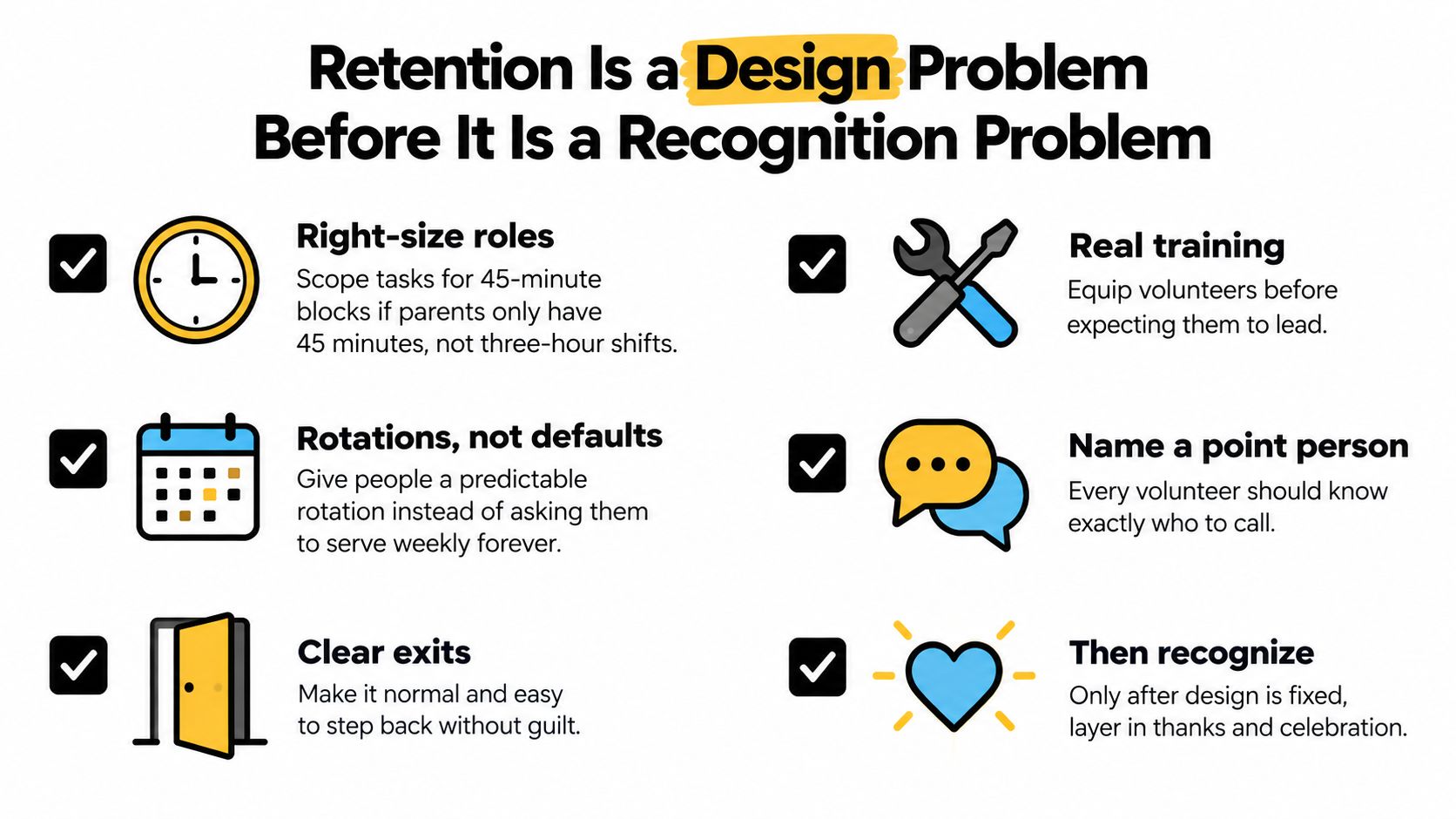
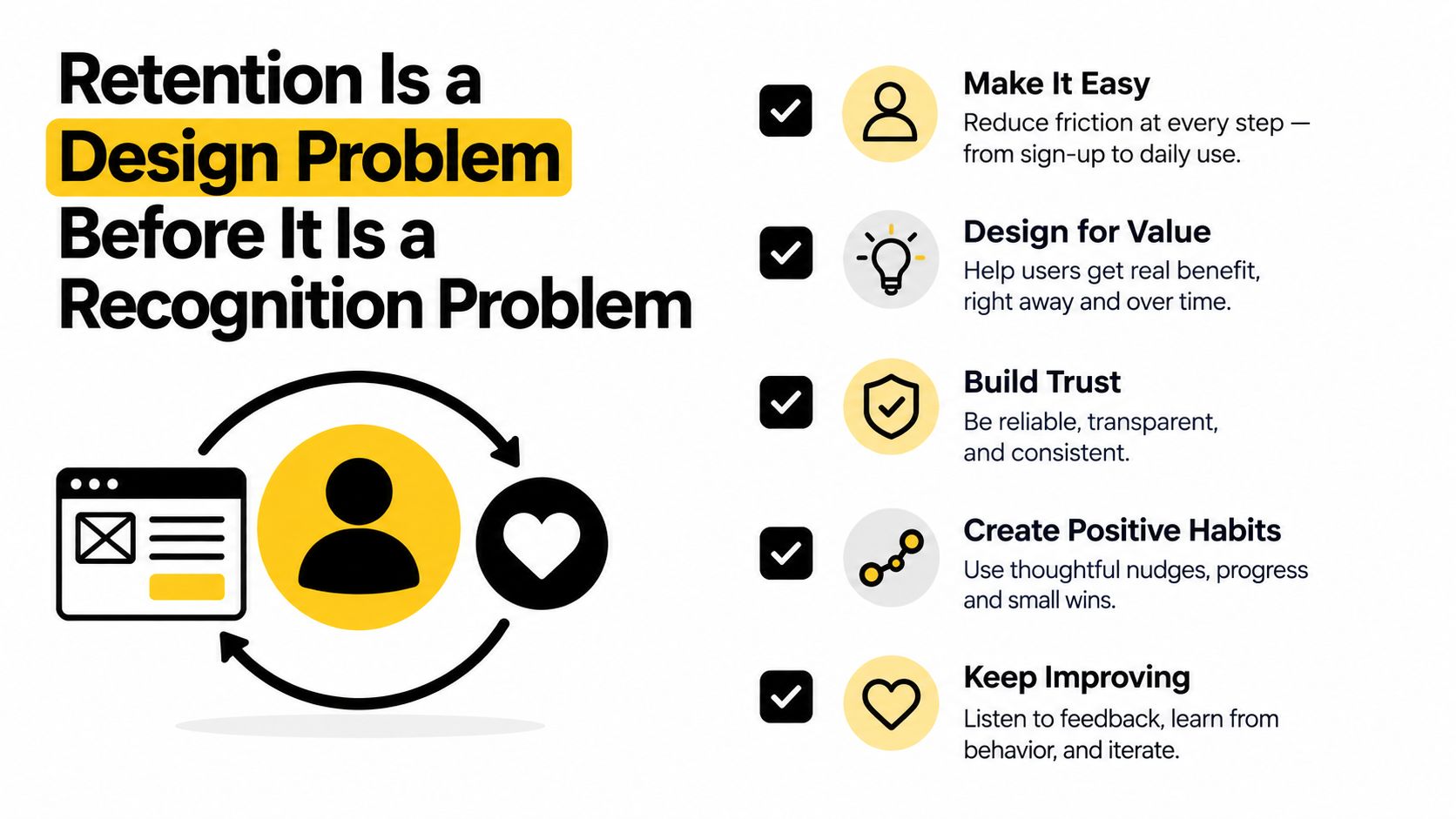
Retention Is a Design Problem Before It Is a Recognition Problem
A coordinator manages capacity and risk, not only the next empty shift. Retention starts with a role that fits the volunteer's time, abilities, family responsibilities, and comfort level.
A thank-you note can strengthen a good experience. It cannot repair a role that takes longer than promised, has no backup, or leaves the volunteer unsure what success looks like. In a smaller congregation, one poorly designed assignment can also place the same dependable person under repeated pressure.
Participation patterns make this more important. Industry reporting from Blackbaud's 2025 YourCause CSR review describes increased volunteering participation alongside a decline in average volunteer hours per participant. More people may be willing to help, but fewer can carry large, open-ended commitments, so coordinators should design shorter, bounded roles by default.
Find the friction before offering more praise
Use three practical checks:
- Exit conversation: Ask what caused the person to reduce or stop serving, whether the role matched its description, what became difficult, and whether another format would work.
- Role-duration audit: Compare the promised commitment with the actual time required, including travel, preparation, cleanup, and follow-up.
- Sunday shadowing: Stand beside the volunteer during the assignment. Watch for missing supplies, unclear handoffs, repeated questions, and tasks that depend on one experienced person.
Then redesign the work. Split a long responsibility into shorter blocks. Create a family-friendly track where a parent and teenager can serve together within appropriate boundaries. Offer micro-tasks during brief windows, such as preparing name tags, confirming supplies, or making reminder calls. Rotate emotionally demanding or high-pressure assignments so the most dependable person does not become the permanent default.
A coordinator should track more than attendance. Cancellations, time-to-fill, repeat participation, role difficulty, accessibility needs, and reasons for withdrawal can expose problems that a thank-you gathering will miss. Informal helpers also deserve attention, including people who set up rooms, deliver items, pray with others, or respond when a need arises. A volunteer may still care greatly about the church while the role no longer fits the current season.
Recognition belongs in the program. Thank people specifically, celebrate contribution without creating competition, and explain what their work made possible. Design the role well first; appreciation then amplifies work that was worth doing in the first place.
Getting Started as a New Volunteer Coordinator
A new coordinator doesn't need to rebuild every ministry at once. The first objective is visibility. The second is control of the highest risks. The third is a workflow that leaders and volunteers can maintain.
Days 1 through 30
Map every existing volunteer role, including roles nobody has formally named. Ask ministry leaders who serves, who covers absences, what training exists, and where records are stored. Speak with informal helpers who deliver meals, provide rides, pray with people, organize rooms, respond to crises, or help families outside the scheduled program.
Create one basic database or spreadsheet with names, contact details, ministry, role, availability, screening status, training completion, placement history, attendance, and notes that the church is authorized to retain. Don't copy sensitive information into an uncontrolled group chat. Identify assignments that require screening or policy review, then begin the appropriate checks.
Stand beside volunteers during actual service. The coordinator's assumptions will be less useful than what people experience at the door, in the classroom, in the kitchen, and during cleanup.
Days 31 through 60
Publish a small set of clear role descriptions. Start with roles that have recurring gaps or create the greatest operational risk. State the task, time commitment, training, supervisor, backup process, and exit route.
Run a short onboarding session and introduce one communication workflow. A shared spreadsheet can be enough while the program is small, but repeated schedule changes, scattered records, and group-thread confusion are signs that the church needs a more purpose-built coordination system. A platform such as HolyJot can replace disconnected scheduling, directory, event, and volunteer records with a more consistent church workflow.
Days 61 through 90
Pilot a recognition rhythm that fits the congregation. It might be a personal message after a first assignment, a monthly ministry update, or a brief public thank-you that doesn't embarrass people who prefer privacy.
Review coverage, cancellations, onboarding completion, training, and volunteer feedback from the first operating period. Don't treat every no-show as a character problem. Look for patterns by role, time, communication method, and workload. Adjust the design, then document the decision so the next coordinator isn't forced to rediscover it.
The role becomes sustainable when operations, safeguarding, relationships, and records support one another. Start with the people already serving, make the work visible, and improve one recurring workflow at a time.
HolyJot gives churches a practical way to manage member roles, groups, events, attendance, volunteer coordination, and real-time reporting in one church-focused platform. Visit HolyJot to replace scattered schedules and message threads with a clearer system for matching people, protecting volunteers, and keeping ministry work moving.