


You're probably here because the one-year plan didn't stick. You started strong in January, hit a dense stretch, missed a few days, and then the whole thing died under the weight of catch-up guilt. That's normal. It's also why I usually recommend a 3 year Bible reading plan to people who want to finish the Bible instead of merely announcing that they will.
A slower plan isn't a lesser plan. It's often the wiser one. If you want Scripture to shape your mind, your prayers, and your actual habits, you need a pace you can carry through travel, stress, grief, busy seasons, and ordinary fatigue. The battle isn't starting. It's staying with the text long enough for the text to stay with you.
Why a 3 Year Bible Reading Plan Works When One-Year Plans Fail
You miss four days in March. Then eight more during travel, sickness, exams, a new baby, or a hard work stretch. In a one-year plan, that gap starts to feel fatal. In a three-year plan, it is an interruption, not a collapse.
That difference matters more than enthusiasm.
A three-year plan works because it gives ordinary Christians a reading pace they can keep after January optimism wears off. It lowers the daily load, but it also lowers the panic. You are far less likely to skim, stack readings, or quit when the schedule leaves room for real life and real attention.
One published overview of long-range Bible schedules describes a “three-year guided tour” that often assigns one chapter per day and notes broader reading-plan habits across age groups (MWTB Bible reading plans). The main takeaway is simple. Admiration for Bible reading is common. Finishing a plan requires a format built for uneven weeks, not ideal ones.
What the slower pace gives you
A good three-year plan gives you margin where one-year plans usually create strain.
- You can stay with difficult books instead of racing through them for the sake of the checkbox.
- You can absorb connections between passages because you are not trying to outrun the calendar.
- You can pray from the reading instead of treating prayer as a separate task.
- You can journal with transparency because the plan leaves enough time to respond, not just consume.
That last point is where many readers either mature or stall. Reading alone is not enough for three years. You need a response habit that keeps the text from sliding past you. Write one clear sentence after each reading. Record one question, one conviction, and one prayer. Use a FaithAI prompt to press the passage into daily life, especially in the second half of the plan when novelty is gone and discipline has to carry the weight.
Here is the rule I give people. A plan you can resume beats a plan you keep restarting.
Why people actually finish
Finishing the Bible in three years has less to do with intensity and more to do with recovery. The first half of a long plan gets plenty of attention. The second half is where readers disappear. They hit Leviticus fatigue, prophetic density, schedule disruption, or plain boredom. Then they assume they are behind beyond repair.
That is the mistake.
The right plan expects missed days. It expects dry weeks. It expects seasons when your best reading day is ten focused minutes with a notebook and an honest prayer. If your schedule includes a clear way to restart, and your reading is paired with simple journaling prompts, you have a far better chance of finishing the whole Bible instead of repeatedly beginning it.
Ask these questions before you choose any plan:
- What pace will I still keep in a hard month?
- What is my restart rule after missed days?
- What will I write so the reading turns into reflection, confession, and prayer?
Answer those well, and a three-year plan stops being a long schedule on paper. It becomes a durable path to finishing Scripture with attention.
How a 3 Year Bible Reading Plan Is Structured
By month four, the question changes. You stop asking, “Can I start this plan?” and start asking, “What kind of structure will still work when I miss a week?”
That question decides whether you finish.
A workable three-year plan is built for ordinary life, not ideal weeks. It spreads the Bible over a long enough span to slow your pace, lower daily pressure, and leave room for interruptions without wrecking the whole schedule. The frame is simple. A set number of readings, arranged across three years, with enough order that you always know what to read next and enough margin that a bad week does not force a full restart.
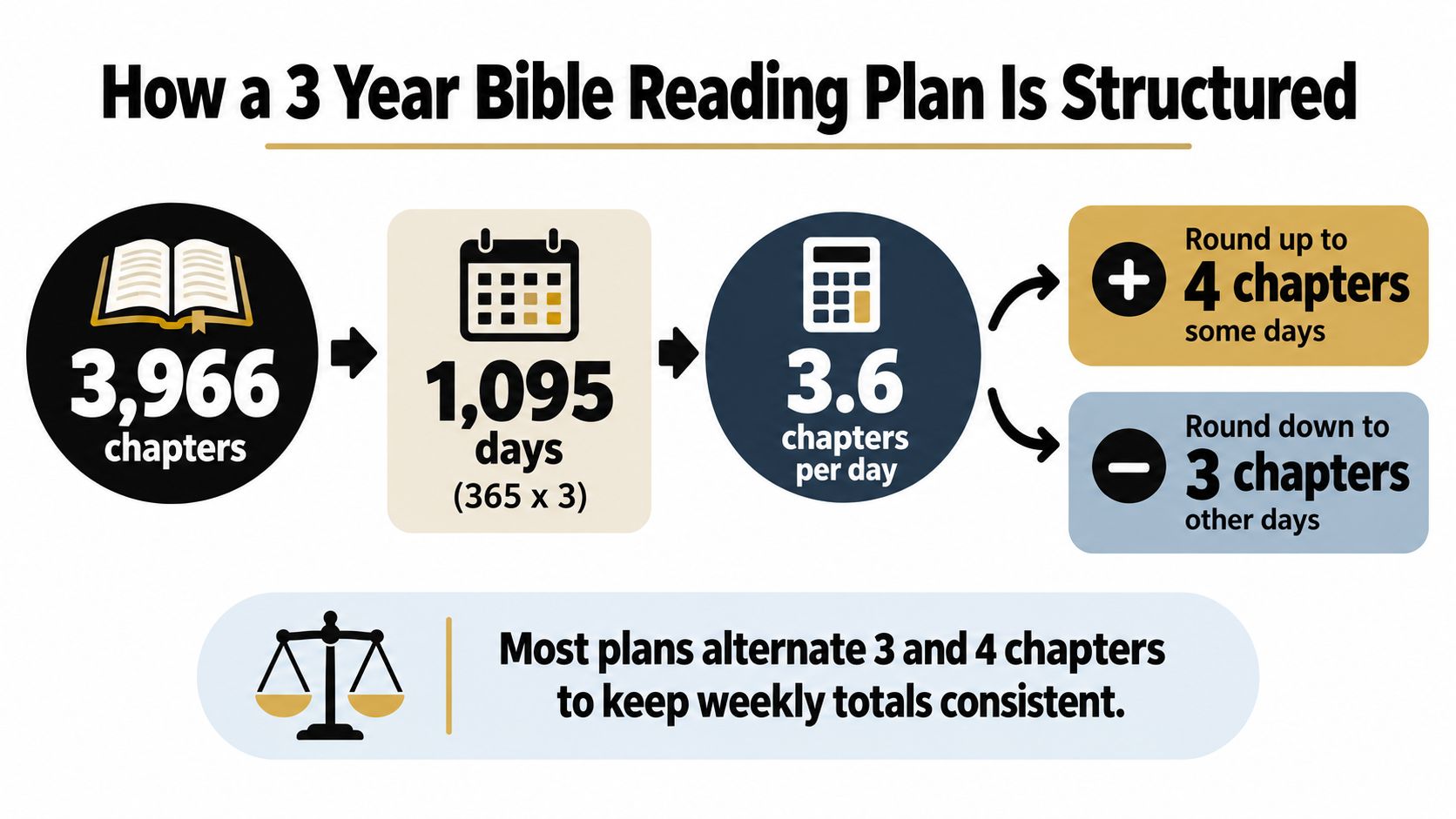
The schedule usually rotates genres
The best structures keep you from getting buried in one kind of material for too long. If a plan parks you in long stretches of law, prophecy, or genealogy with no change of pace, expect a drop-off.
A steadier design rotates genres through the week. Some plans do that by pairing Old Testament readings with New Testament readings and Psalms on a regular cadence, including a five-day format used by Lakewood's 3-year plan. That works because it keeps story, doctrine, prayer, and worship in front of you at the same time. Variety is not a gimmick. It is a retention tool.
It also gives you better journal material. One narrative passage, one teaching passage, and one prayer passage produce stronger reflection than three chapters from the same dense section. Use that on purpose. After each day's reading, write one sentence on what God is revealing, one sentence on what needs repentance or obedience, and one sentence of prayer. Then run a FaithAI prompt on the part that resisted you most. That habit matters even more in year two and year three, when finishing depends less on novelty and more on honest engagement.
The three-column concept is practical
Some plans use a three-column format. You read one column per year and finish in three years. Read two columns a day and you shorten the timeline. Read all three and you have a one-year pace, as shown in the Navigators three-year plan PDF.
I recommend this structure for one reason. It handles disruption well.
A printed schedule that can stretch or compress without being rewritten gives you options when life gets messy. Miss several days. You can make them up selectively, combine shorter readings, or use a catch-up week without losing your place. That flexibility solves the second-half problem better than rigid date boxes do.
Another benefit is easy visibility. You can see the whole plan at once, spot heavier stretches before they hit, and decide in advance how you will journal them. Mark likely slowdown sections early. Pentateuch laws. Major prophets. Long wisdom stretches. Then attach a FaithAI prompt to those weeks before motivation dips. Readers who finish long plans do not only schedule readings. They pre-decide how they will reflect, recover, and resume.
Canonical and Chronological Layouts Compared
You feel the difference by February.
A reader on a canonical plan knows exactly where to turn and rarely loses the thread of the book itself. A reader on a chronological plan starts seeing connections that are easy to miss, such as prophets speaking into specific kings' reigns or psalms read near the events that likely shaped them. Both approaches work. They fail for different reasons.
A canonical layout follows the Bible in its standard book order. A chronological layout reorders readings by the sequence of events and, at times, by likely historical setting. The question is not which one sounds smarter. The question is which one you will still follow in year two, after missed days, travel, illness, and the long middle stretch where motivation drops.
Canonical vs Chronological Layout
| Feature | Canonical Layout | Chronological Layout |
|---|---|---|
| Reading order | Follows the standard order of biblical books | Rearranges books and passages by historical sequence |
| Best fit | Readers who want straightforward reference and familiar order | Readers who want events, psalms, and prophets tied to historical setting |
| Feel | Stable and easy to track in any printed Bible | Narrative-rich and often more immersive |
| Study advantage | Easier for book-by-book notes and church alignment | Helps clarify timing and context |
| Main caution | Can leave prophets feeling detached from the history around them | Can frustrate readers who expect the Bible's table-of-contents order |
My recommendation is simple. Start canonical if this is your first serious full-Bible plan or if you are reading with a church, family, or small group. It creates less friction. Sermon texts, Bible study references, and your own notes stay easy to find. That matters more over three years than people admit.
Choose chronological if context is the main reason you read. It keeps narrative momentum high, especially in historical books, and it helps the Old Testament feel less fragmented. It also asks more of you. If you miss a week, catching up can feel mentally messy because the readings are built around sequence, not just book order.
That second-half problem matters here. Canonical plans are usually easier to resume after disruption. Chronological plans are often more engaging early and harder to re-enter cleanly after a long gap. If you know your pattern is to stop, restart, and lose confidence, pick the layout that makes re-entry obvious.
Here is the practical middle road I give people. Use a canonical base plan and add brief journal prompts that recover historical context instead of forcing a full chronological system. A FaithAI prompt can do that work fast: What is happening in Israel or the early church during this passage? Another useful one is: What would this text have sounded like to its first hearers? You keep the stability of canonical order and still train yourself to read with context.
Do not choose a layout because it feels advanced. Choose the one you can finish. Then label your journal the same way on day one, canonical or chronological, so your notes, catch-up decisions, and reflection prompts all stay aligned.
The Three-Column Format at a Glance
The three-column approach is useful because it keeps your options open without forcing you to learn a new system. Think of it as one framework with three reading personalities.
Three-Column Reading Format Comparison
| Column | Contents | Best For | Combine or Compress |
|---|---|---|---|
| Canonical | Old and New Testament in familiar book order, with Psalms and Proverbs woven in | Readers who want editorial flow and easier reference | Pair it with selective chronological substitutions for dated prophets |
| Chronological | Readings arranged by historical sequence, with connected passages grouped by timeframe | Readers who think in storyline and historical movement | Keep most of the plan intact, but return to canonical order if confusion builds |
| Thematic | Readings grouped around recurring biblical threads such as covenant, kingdom, wisdom, exile, and restoration | Teachers, preachers, and small-group leaders | Useful as a secondary track rather than a first full-Bible pass |
My recommendation is blunt. If this is your first serious long-form plan, start with canonical or chronological, not thematic. A thematic column can sharpen your study, but it can also detach passages from the larger storyline if you don't already know the canon well.
If you want a hybrid, keep the base plan canonical and swap in dated prophetic readings where appropriate. That gives you historical texture without making the whole schedule harder to follow.
If you need to compress late in the cycle, tighten the wisdom slot rather than overloading every category at once. That keeps the plan readable.
Year-by-Year Progression Through the Whole Bible
Readers do better when they know the shape of the road ahead. A three-year plan feels less abstract when you can see where each year is taking you.
This visual gives the big picture:
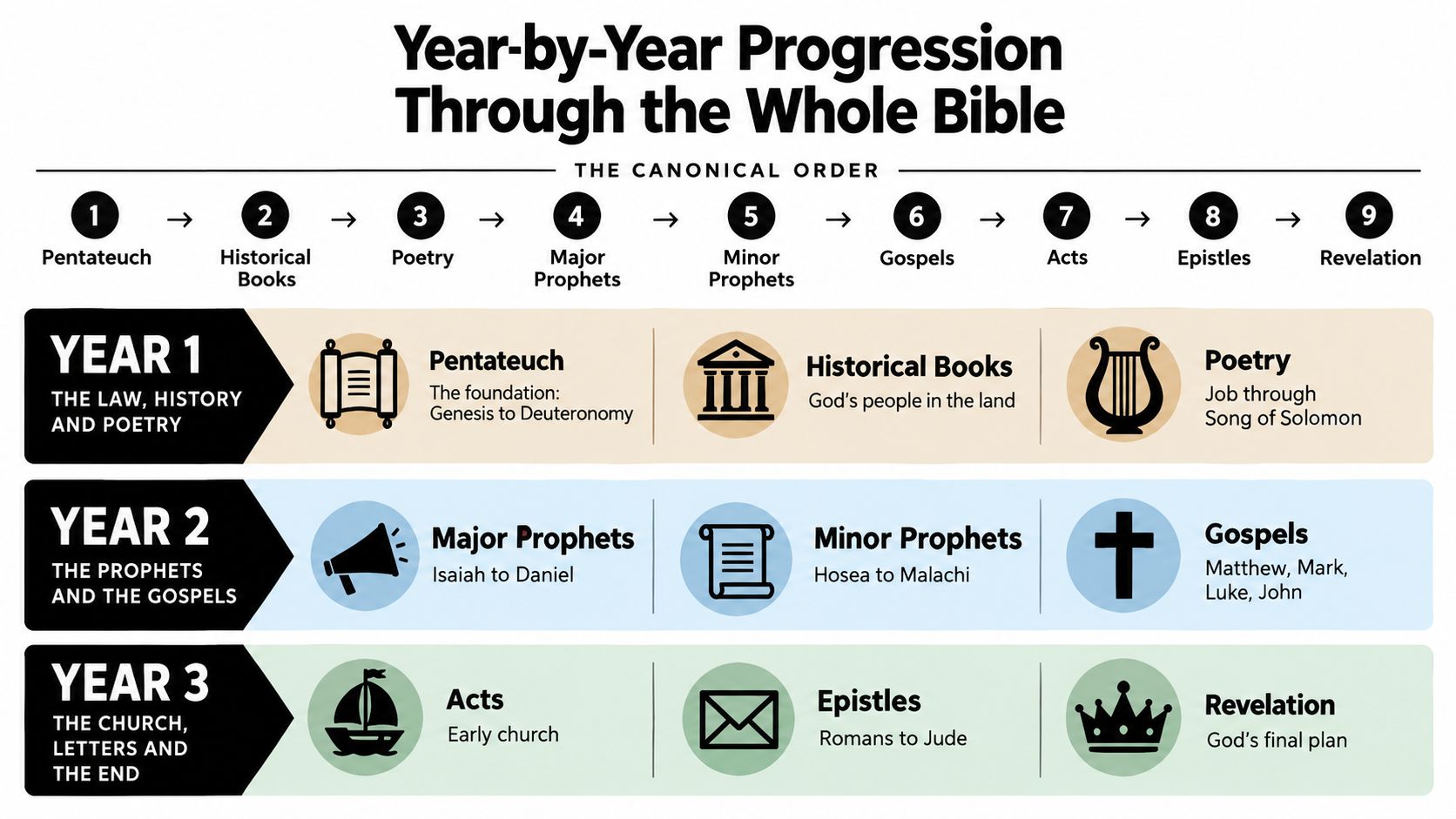
Year one builds the frame
Year one should ground you in the foundational story. You need creation, covenant, exodus, law, wilderness, conquest, judges, kings, and return. Without that frame, later books feel detached.
Readers should pay attention to major turning points:
- Joshua and covenant renewal
- The rise and fracture of the monarchy
- The long decline toward exile
- The first movements toward restoration
Year two deepens interpretation
Once the historical backbone is in place, wisdom literature and the prophets stop sounding like disconnected fragments. They begin to sound like voices speaking into a real national and covenant crisis.
A slower second year helps because the prophets need time. You can't rush Isaiah, Jeremiah, or Ezekiel and expect much more than page exposure.
The prophets make more sense once the historical books have given you names, places, kings, failures, and consequences.
Year three completes the Christian witness
By the third year, the Gospels and the rest of the New Testament land differently. You hear Jesus against the full background of promise, rebellion, judgment, and hope. Acts then reads like the public spread of what the Old Testament anticipated and the Gospels announced.
Key inflection points matter here too:
- The Sermon on the Mount
- The expansion of the church in Acts
- The shape of life in the epistles
- Revelation's final vision of judgment, endurance, and restoration
That progression is intentional. Narrative first. Interpretation second. Fulfillment and witness third. That's a wise discipleship order.
A Sample Week From the 3 Year Plan
By month four, many readers hit the same wall. They are not confused about why Bible reading matters. They are tired, a few days behind, and starting to wonder what this plan feels like on a Tuesday morning when work is heavy and attention is thin.
A workable three-year plan has to answer that question. It needs a weekly shape you can repeat, recover, and still finish.
Here is a sample week built on a five-day reading rhythm with two open days. That pattern works because it leaves room for missed days before missed days turn into abandonment.
One realistic week
Monday
Genesis 31, Psalm 14, Proverbs 3Tuesday
Genesis 32, Psalm 15, Proverbs 4Wednesday
Genesis 33, Psalm 16, Proverbs 5Thursday
Genesis 34, Psalm 17, Proverbs 6Friday
Genesis 35, Psalm 18, Proverbs 7Saturday
Review, journaling, catch-up, or restSunday
Prayer, a single Psalm, or complete rest
Why this week holds up
The strength of this format is its predictability. You know what kind of effort the day requires before you sit down. That matters in year one, and it matters even more in year two and year three when enthusiasm is lower and routine has to carry the load.
It also solves the second-half problem early. If you miss Thursday, you still have space to recover without blowing up the whole week. That is the kind of structure people finish.
The reading mix helps too. Genesis keeps the narrative moving. Psalms train prayer and honesty. Proverbs gives you a compact wisdom target for reflection. You are not only covering ground. You are reading across genres in a way that keeps the habit from going flat.
Add one journal prompt to each day
Do not read this week as raw intake only. Attach one short prompt to each day so the plan forms attention, confession, and obedience.
Monday, Genesis 31, Psalm 14, Proverbs 3
FaithAI prompt: Where am I tempted to rely on my own reading discipline instead of trusting God with a steady, teachable heart?Tuesday, Genesis 32, Psalm 15, Proverbs 4
FaithAI prompt: What is God confronting in my identity right now, and what needs to change before I move forward?Wednesday, Genesis 33, Psalm 16, Proverbs 5
FaithAI prompt: Where do reconciliation, gratitude, and private integrity need attention in my life this week?Thursday, Genesis 34, Psalm 17, Proverbs 6
FaithAI prompt: What sins do I excuse because they are familiar, and what does honest repentance require?Friday, Genesis 35, Psalm 18, Proverbs 7
FaithAI prompt: What would wholehearted obedience look like before this week ends?
Saturday is where long-term readers either stabilize or drift. Use it well. Write a five-sentence summary of the week, note one repeated theme, and decide what you will do if next week gets interrupted.
That is what a good sample week should show. The plan is readable, recoverable, and strong enough to carry real life for three years.
Pacing Tips That Actually Sustain Three Years
Pacing decides whether you finish. Not desire. Not sincerity. Pacing.
Many published plans already point in the right direction by using a lighter cadence. One expert-level pattern uses one chapter per day, sometimes combining short chapters, specifically to keep the reading load even and manageable across the calendar while alternating Old and New Testament material (three-year chapter-a-day plan PDF). That instinct is correct. Smaller units keep readers in the plan long enough to benefit from it.
Use this pacing visual as a practical checklist:
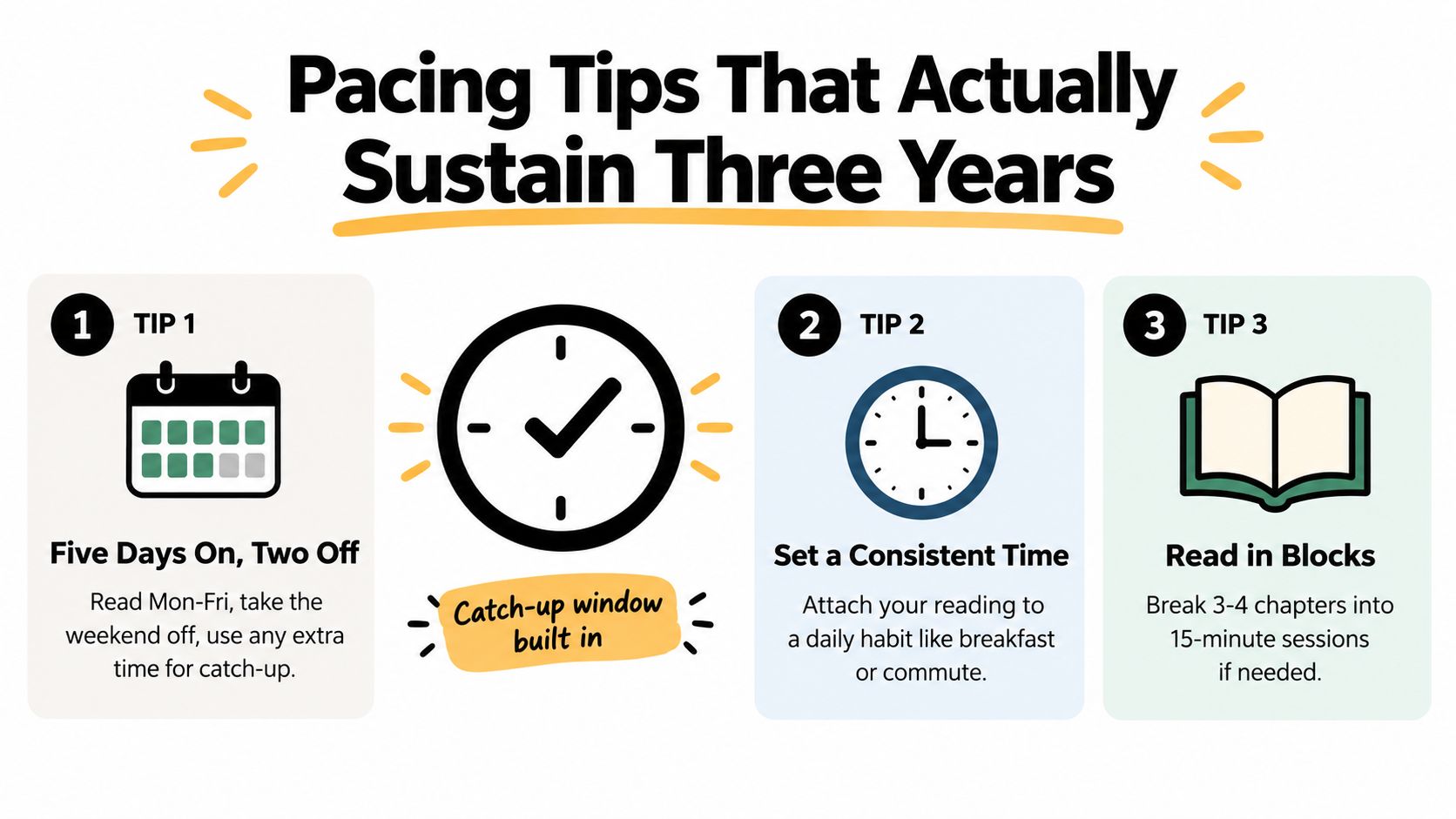
The rhythm I recommend
If you want this plan to survive real life, follow these rules:
- Use five reading days. A Monday-to-Friday rhythm with two buffer days works better than pretending you'll execute perfectly every day for years.
- Keep one light touch on rest days. Read a Psalm or a proverb if you want continuity without pressure.
- Combine tiny books intelligently. Jude, Philemon, and Obadiah don't need their own dramatic treatment. Pair them when needed.
- Pick a fixed time slot. Morning chair, lunch break, commute audio, or bedtime desk. Choose one and defend it.
A practical companion for building that rhythm is this daily Scripture reading guide, especially if your main challenge is turning good intentions into a repeated daily slot.
Devotional pace is not study pace
Don't confuse reading with deep study. On some days you'll read the assigned chapters and move on. On other days one paragraph will stop you. Both are fine.
What ruins people is the false guilt that follows a missed day. Missing a day is a scheduling problem. It is not a spiritual identity crisis. Treat it like an interrupted rhythm, not a moral collapse.
Choose the time of day before you choose the translation. Time habits outlast translation preferences.
Recovering After Missed Days Without Losing the Plan
This is the section most plans ignore, and it's the section most readers need.
Publicly available three-year plans usually explain the schedule itself, but they rarely tell you how to recover after missed days, burnout, travel, illness, or re-entry after a gap. That gap matters because newer Bible readers need long-horizon habit design, not just another chart. The same source noting this recovery gap also points to renewed engagement among younger adults, with American Bible Society reporting Scripture Engaged adults rose from 47 million to more than 52 million in 2025, with Gen Z and Millennials showing the largest gains (3 Year Bible recovery gap discussion). More readers entering long-form reading means more readers will eventually ask, “What do I do now that I'm behind?”
Here's the answer. Do not start over. Starting over is the enemy of long plans.
Use this recovery visual when you lose your place:
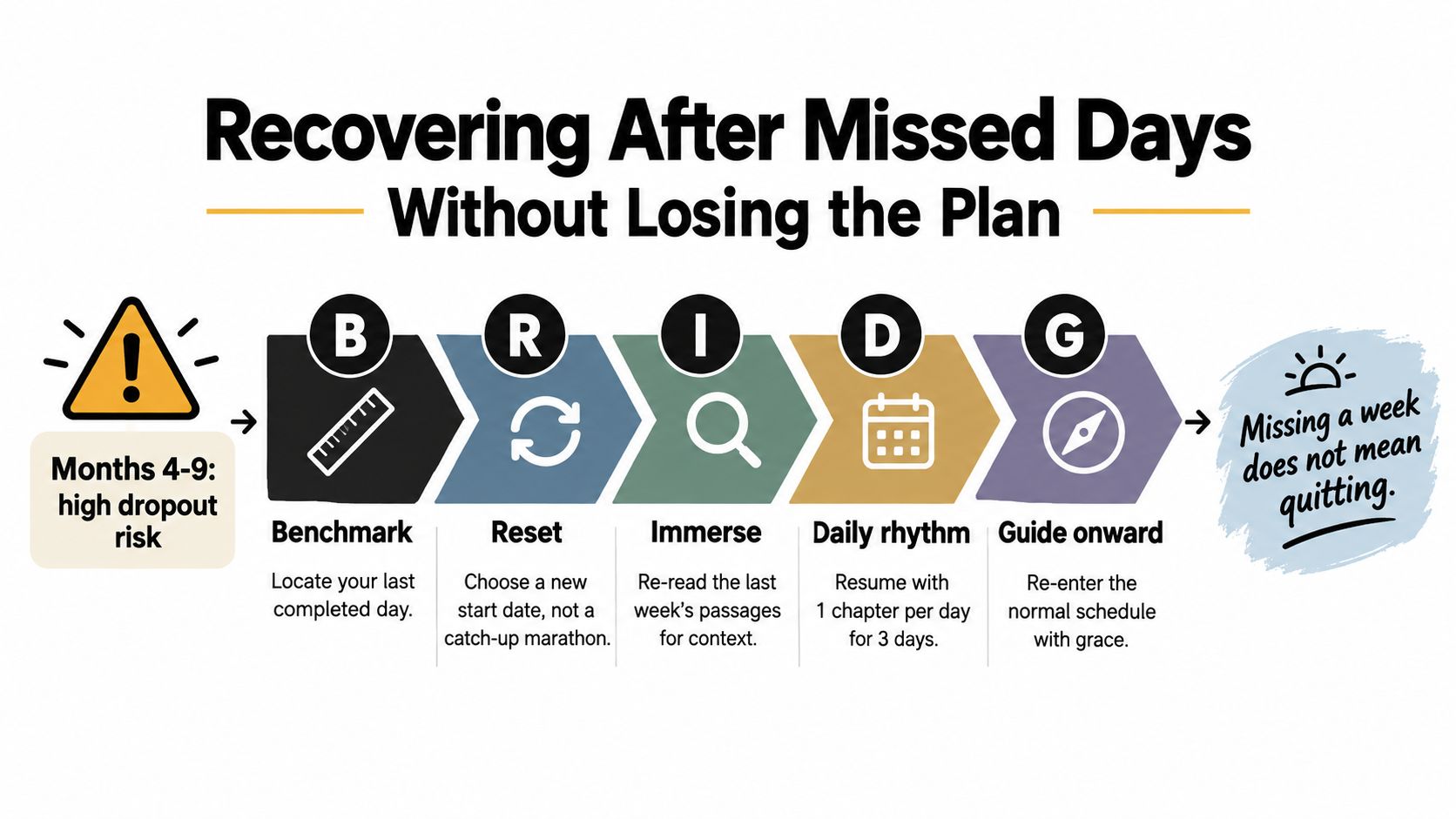
The BRIDGE method
I use a practical recovery method I call BRIDGE:
- Benchmark the gap. Find the last completed day.
- Reduce to one chapter. Re-enter with a smaller unit if your mind is fried.
- Integrate rest days. Use the built-in buffer before adding more load.
- Double up only when the gap is short. A small backlog can be compressed. A large one usually can't.
- Glide forward. Resume the current plan without rereading what you already finished.
The infographic uses a slightly different wording pattern, but the principle is the same. Recovery should lower friction, not punish you.
Three real interruption scenarios
Missed weekend
Don't panic. Fold those readings into the next few sessions or use your buffer days. This is not a crisis.
Two-week illness
Shrink the load for a few days. Read one chapter daily, regain rhythm, then add the other assigned passages back.
Six-week life crisis
Do not attempt a heroic catch-up marathon. Mark your last completed day, choose a restart date, and move forward from the present schedule. If you need to leave some uncompleted boxes behind, leave them behind.
Restart logic sounds humble, but it usually kills momentum. Re-entry logic finishes plans.
One rule governs all of this. Never reread chapters you already completed just because your calendar slipped. That rewards the wrong behavior and stretches a three-year plan into something indefinite.
Calendar, CSV, and Printable Downloads Compared
Format matters more than people think. Readers often abandon a solid plan because they chose the wrong delivery method.
Pick the format that matches the way you already live. Don't choose a system that requires you to become a different kind of person overnight.
3 Year Bible Reading Plan Download Formats
| Format | Best For | Main Weakness | Recommended Phase |
|---|---|---|---|
| Calendar | Readers who rely on phone reminders and scheduled blocks | Notifications pile up and become wallpaper | Start here if you need external prompts |
| CSV | Spreadsheet-minded readers who want filters, formulas, and custom tracking | Easy to set up and then ignore | Use after the habit has stabilized |
| Printable PDF | Paper-Bible readers and journal-first users | Fails when the sheet isn't visible or accessible | Strong for travel, retreats, and device-light seasons |
My recommendation
Start with a calendar format for the first stretch if your biggest problem is forgetting. Put the reading where your day already looks.
Move to a spreadsheet once the rhythm is established and you want better tracking or custom notes. If you're deciding between tools, this review of a Bible reading plan app can help you think through digital options without overcomplicating the choice.
Use printable PDFs when you're in a season that benefits from reduced screen use. Kitchen table, paper Bible, notebook, pen. That setup still works.
Tracking Progress and Journaling in HolyJot
Reading the text is the first half. Reflection is the second half. If you don't write anything down across three years, you'll remember less than you think.
A tool can serve the habit without taking over the habit. HolyJot supports Bible journaling, verse-linked notes, streak tracking, and guided study plans with FaithAI. That matters because a long plan needs more than boxes to check. It needs a way to retrieve what God showed you six months ago when a passage comes around again in a sermon, a conversation, or a hard season.
Four habits that make tracking useful
Start with these practices:
- Turn on visible streak tracking. A missed day should show up quickly before it becomes a missing week.
- Tag each entry consistently. Use a reading label tied to year, week, or date so your notes stay searchable.
- Write short entries. Three to five sentences is enough if they are anchored to an actual verse.
- Link notes to verses. General reflections disappear. Verse-linked notes stay usable.
What to write each day
Don't write a diary entry about your mood and call it journaling. Write something tied to the passage.
A workable pattern is this:
- One sentence on the main movement of the text
- One verse that caught you
- One observation about God, sin, obedience, hope, or prayer
- One concrete response for the day
That's enough to build a meaningful record over a long reading cycle.
Why checkboxes aren't enough
Checkboxes tell you that you were present. They don't tell you what you saw.
The point of tracking is not to prove that you finished on schedule. The point is to create retrievable insight. Across a three-year plan, that's what turns repetition into formation. When notes are linked to specific verses, old entries become usable later for prayer, teaching, counseling, and personal review.
FaithAI Study Prompts Linked to Each Reading
Most readers need a repeatable prompt set, not endless novelty. If your questions change every day, your habit will weaken. Use the same sequence until it becomes second nature.
I recommend three prompt types for each day's reading. They move in order from understanding to connection to response. That order matters.
Prompt one for context
Start with context questions that force you to read responsibly:
- Who is speaking or writing in this passage?
- Who originally received it?
- What covenant, setting, conflict, or historical moment shapes the meaning?
- What would this text have sounded like to its first hearers?
This is especially useful in places where readers get lost fast, such as Genesis narratives, prophetic warnings, or Paul's argument-heavy letters.
Prompt two for cross-reference
Next, ask for connections inside the canon:
- What earlier passage does this reading echo or fulfill?
- What theme repeats here that I've already seen in this plan?
- Which psalm, prophet, gospel, or epistle sheds light on this chapter?
A practical support for that kind of daily study rhythm is this guide to daily Bible study tools, especially if you want to move beyond isolated chapter reading.
Prompt three for prayer
End by turning the reading into prayer. Keep it concrete.
Try prompts like these:
- Turn today's reading into a four-line prayer of confession, trust, or praise.
- Pray one attribute of God from the passage back to Him.
- Ask for one act of obedience that fits the text, not just your mood.
Read for meaning first, then for connections, then for prayer. That sequence keeps the text in charge.
If you want a daily template, use this simple pattern in the same order every time:
Context
“Who wrote this, to whom, and what situation frames it?”Cross-reference
“What earlier or later passage most clearly connects to this text?”Prayer
“Write a brief prayer using the language and burden of today's reading.”
That's enough structure to keep your reading active without turning every session into a seminar.
Quick-Reference Summary for Your First Week
If you need one page to start tomorrow, use this.
Your working rules
Daily unit
Read a small, consistent set of passages. In many plans that means one Old Testament chapter, one New Testament chapter, and one Psalm or wisdom reading across the active reading days.Weekly rhythm
Use five reading days and two buffer days. Reserve the buffer for catch-up, journaling, or rest.Recovery rule
Never skip backward into restart mode. If you miss a short stretch, compress modestly. If you miss a long stretch, re-enter calmly and move forward.Format choice
Use calendar if you need reminders, CSV if you think in rows and filters, and printable PDF if your Bible time is mostly offline.First FaithAI prompt to try
On your first reading day, ask: Who wrote this passage, who first received it, and what setting helps me hear it correctly?
What to do this week
Keep the first week boring on purpose. Same time. Same chair. Same notebook. Same prompt order.
Don't optimize endlessly. Don't redesign the plan after three days. Don't measure the value of the week by how dramatic it felt. Measure it by whether you showed up, read carefully, wrote something honest, and came back the next day.
That's how people finish a 3 year Bible reading plan.
If you want one place to read, journal, track progress, and attach Scripture-grounded prompts to your daily plan, HolyJot gives you that workflow without forcing you into a one-size-fits-all schedule. Use it to keep your readings, verse-linked notes, and recovery after missed days in the same place so this plan becomes a lived habit instead of another abandoned document.