


You're reading a familiar Bible passage on your phone, and one phrase catches your attention. You tap a related verse, then another, and soon you've opened a string of passages but aren't sure how they connect to the one you started with. Learning how to cross-reference the Bible means more than finding links. It means weighing them carefully, reading each passage in context, and returning to your original question with a clearer understanding.
What Cross Referencing the Bible Actually Means
Bible cross-referencing is the practice of comparing one passage with related passages elsewhere in Scripture. A link might point to a direct quotation, a parallel account, a shared theme, or an idea that helps illuminate the passage you're studying. The aim isn't to collect as many references as possible. It's to see what a connection contributes.
A citation such as Romans 5:8 gives you a book, chapter, and verse: Romans is the book, 5 the chapter, and 8 the verse. That familiar address system developed centuries after the biblical texts were written. Stephen Langton developed chapter divisions around 1205, and Robert Estienne introduced the prevailing New Testament verse system in his 1551 Greek-Latin Testament (history of Bible chapters and verses). The original manuscripts didn't contain the chapter-and-verse divisions readers use today.
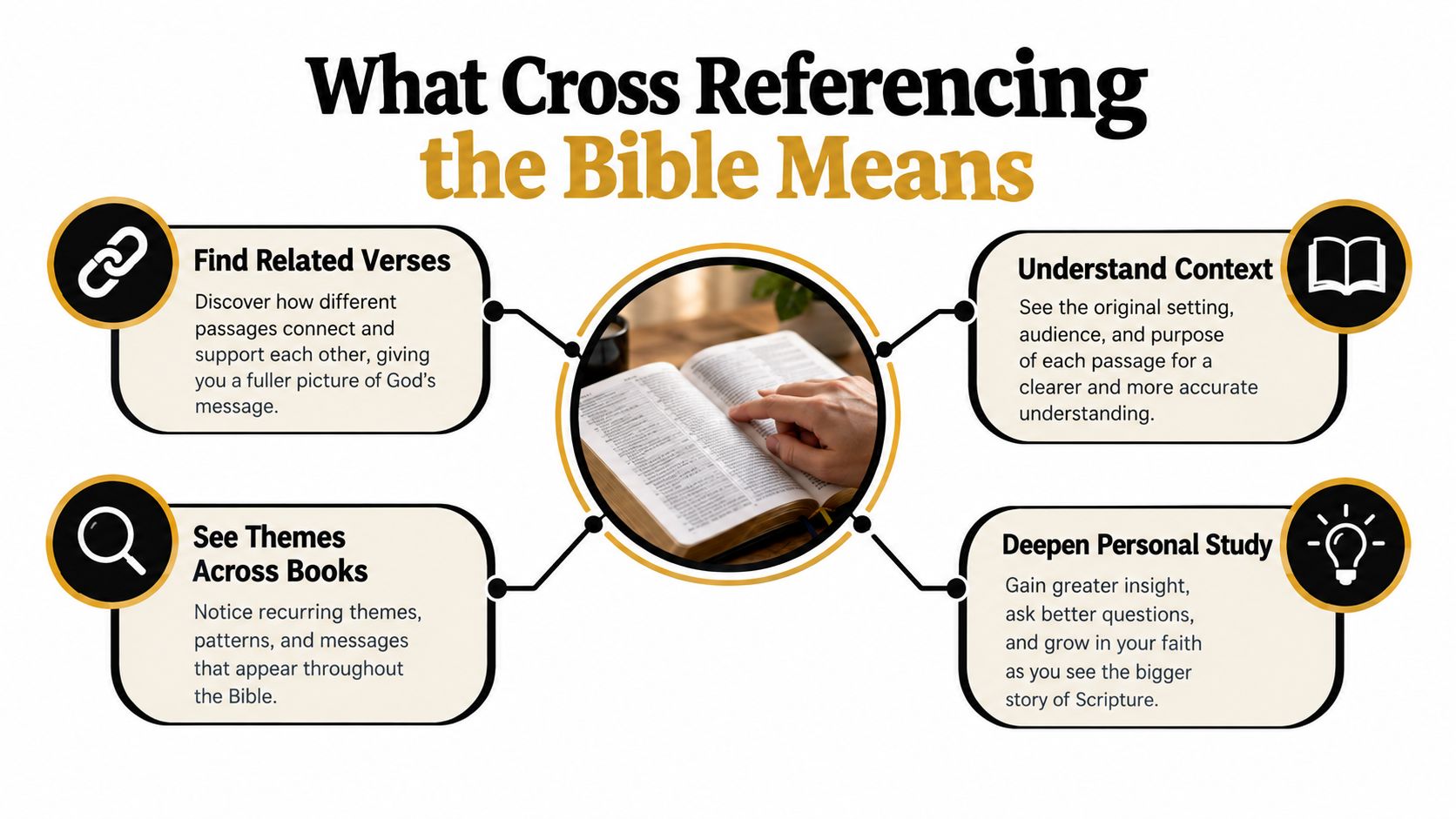
Think of those numbers as a shared coordinate system, not as inspired boundaries within the original text. They make it possible for people using different editions to locate the same passage, but a chapter break can fall in the middle of a thought, and a verse can make more sense when read alongside its neighbors.
At the kitchen table, start with the passage that raised your question. Read the surrounding paragraph first, then follow a link only if it helps you understand the passage's wording, argument, background, or theme. A useful cross-reference doesn't replace the text you began with. It helps you read that text more attentively.
Traditional Methods for Finding Cross References
Print tools can make their reasoning easier to see because you can inspect the notes, headings, and editorial choices on the page. Try them with Romans 5:8, which describes God's love in relation to Christ's death for sinners. Begin by asking a focused question, such as, “Where else does Scripture connect God's love with Christ's saving work?”
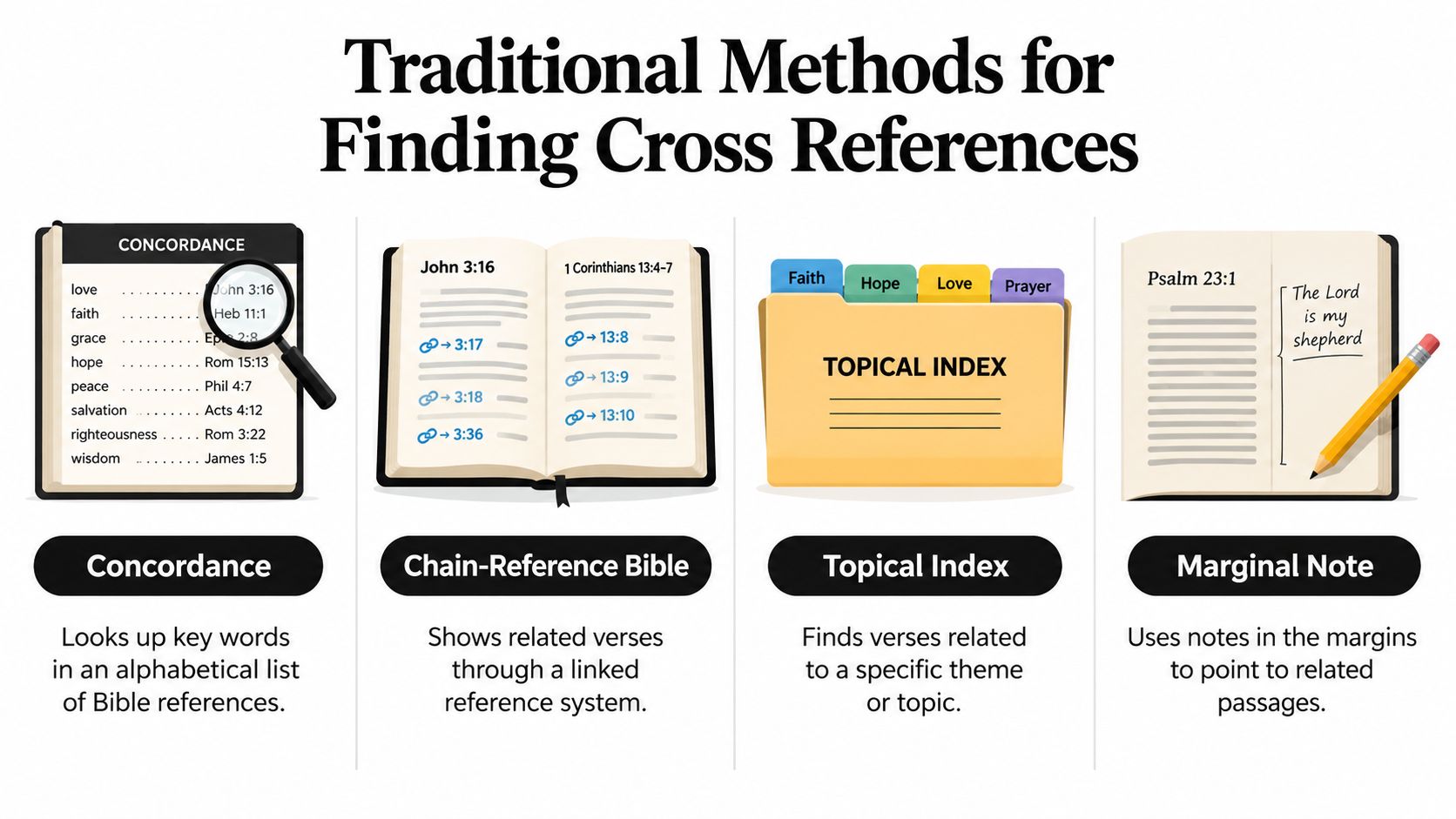
- Use a concordance to search a word. A concordance lists places where a translation uses a particular word. Look up “love” or “sinners,” then check the surrounding passages rather than assuming every result makes the same point. A concordance walkthrough can help if you're unsure how to move from a word list to contextual reading.
- Check the cross-references in your Bible. In an edition with a center column or linked references, start at Romans 5:8 and inspect the passages listed beside it. A chain-reference Bible can group passages around a topic, while a cross-reference edition may point you to a quotation or related wording.
- Read study Bible notes and footnotes. These can explain why an editor connected two passages or flag a textual detail. Treat the note as a study aid, not as part of the biblical passage itself.
- Consult a large reference work. The Treasury of Scripture Knowledge, compiled around 1830 by Samuel Bagster from earlier works by John Canne and others, was described as containing approximately 500,000 Scripture references and parallel passages (history of the Treasury). Its breadth is useful, but a large list still needs careful checking.
For any of these tools, write down what you want to learn before looking up references. If the question is about God's love, a result that merely repeats the word “love” may be less useful than a passage that shares the same argument or explicitly connects love with Christ's work. Traditional tools reward patience, and they work best when you already have a starting passage.
Digital Tools and AI Assistants for Cross Referencing
On a phone, cross-references may appear as tappable links, a side panel, study notes, or results from a search. Open an online Bible to John 3:16, for instance, and look at the references offered by the edition or app. Before following any link, note what you're trying to understand: the promise, the role of belief, or the relationship between God's love and the Son.
Digital tools can surface references from editorially curated databases, searchable Bible editions, or AI-generated suggestions. Those methods don't carry the same weight. A curated reference reflects an editor's judgment; an AI assistant can help you find candidate passages, but its output still needs to be checked against the text and context. Ask a specific question, then inspect the cited passages yourself instead of treating a generated list as a set of conclusions.
For example, you might ask an assistant, “What Old Testament passages connect with the love described in Romans 5:8?” A careful answer should make clear why each passage is relevant and distinguish a direct textual connection from a broader thematic one. If it gives you only a flat list, ask what kind of relationship it sees, then verify that claim in your Bible.
Digital access is familiar to many readers: in the 2025 American Bible Society survey, 41% of U.S. adults qualified as Bible users, and 62% of digital Bible users accessed Scripture through dedicated Bible apps (survey findings). Convenience can help you compare translations and keep notes together, but it can also make it easy to tap without thinking. Choose a translation you can understand, read the whole linked passage, and return to your starting verse before moving on.
Ranking and Verifying a Cross Reference
A list of references isn't a ranking of evidence. Before deciding that two passages belong together, name the kind of connection you think you see:
| Link type | What to look for | What to watch |
|---|---|---|
| Quotation-based | One passage directly quotes another. | Check how the quoted words function in both contexts. |
| Verbal | The passages share distinctive wording. | A common word alone may be accidental or used differently. |
| Narrative | Passages recount the same event or closely related events. | Compare the setting, speaker, and details. |
| Prophetic | A passage is read in relation to an anticipated event or fulfillment. | Don't assume every resemblance establishes fulfillment. |
| Thematic | The passages develop a shared subject. | Similar subject matter doesn't prove direct dependence. |
| Conceptual | The passages express a related idea using different language. | Explain the idea in context rather than relying on a label. |
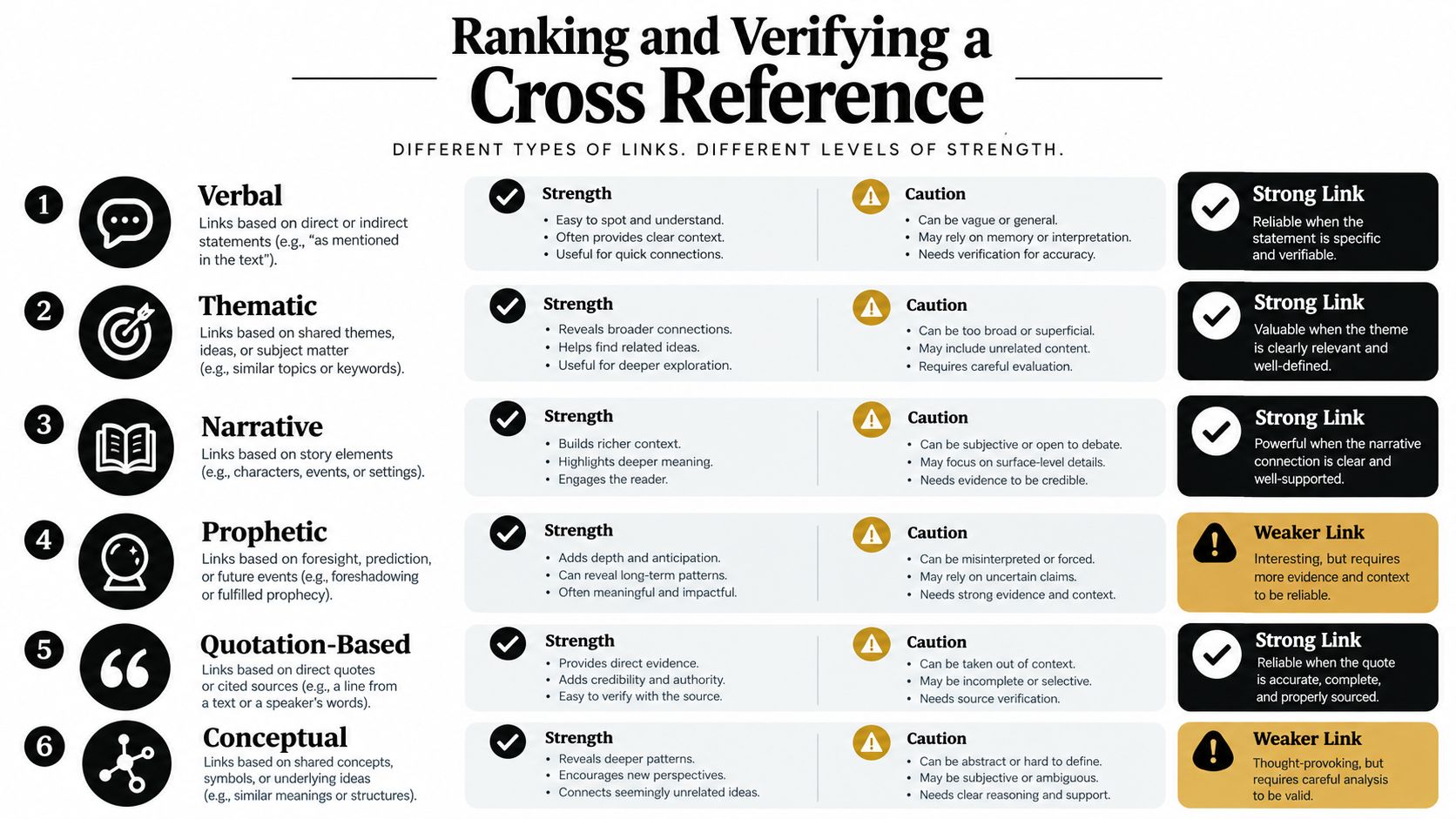
Try a two-confirmation rule before treating a link as interpretively significant. Look for two independent reasons to take it seriously, such as an explicit quotation plus a matching context, or a shared theme supported by a clear textual link. A familiar example to examine is Isaiah 53 alongside John 19. Ask whether the connection rests on the wording of the passages, their surrounding arguments, or a later interpretive tradition, then read both passages in full before drawing a conclusion.
By contrast, two verses that use the word “light” aren't necessarily connected in a meaningful way. The word could refer to different ideas in different genres or situations. Call it a verbal resemblance unless the surrounding context gives you another reason to connect the passages.
The hermeneutic workflow recommends classifying each link and looking for at least two independent confirmations before treating it as significant (guidance on word studies and context). That disciplined approach resembles effective problem solving methods for 2026: define the question, evaluate evidence, and avoid confusing a possible lead with a proven conclusion. For help examining a verse's surrounding meaning, see this guide to Bible verse explanation.
A Bounded Workflow That Connects Study to Journaling
Digital study needs an endpoint. Without one, each tap can send you to another reference, and the original passage disappears from view. Try a bounded loop: read, select, record, return.
- Read the passage in context. Read the paragraph and note its speaker, audience, genre, and main point.
- Choose only a few strong links. Follow two or three that appear directly relevant, rather than opening every result.
- Record each link's contribution. Label it as a quotation, narrative connection, shared theme, or another link type. Add a sentence explaining what the passage contributes.
- Return and synthesize. Go back to your starting text and write one sentence about what you understand more clearly now.
A research project illustrates why a long reference list isn't the same as a useful one. It reports a ground-truth Treasury of Scripture Knowledge dataset with 670,796 links across 31,085 verses, while an expert-refined project contained 12,475 final references (study of Scripture cross-reference datasets). These are different datasets and measures, not a universal scorecard. For your own study, the lesson is simple: keep a short list of links you can explain rather than collecting every possible match.
A verse-linked journal entry lets you keep the passage, your question, and your observations together. With HolyJot, for example, you can write freestyle or verse-linked notes, lock sensitive entries, and set a time capsule to revisit what you wrote later. If you're comparing collaborative annotation approaches for a group, PDF note-taking tools for teams offer another way to think about keeping comments attached to shared reading materials.
Try the loop with Psalm 23. Read the whole psalm, choose a few references that directly illuminate its images or ideas, and note what each adds without letting it replace the psalm's own language. Write a brief synthesis in your journal, then revisit it later through a time capsule. A Bible journaling guide can help you make those notes part of a steady study practice.
Pitfalls That Make Cross Referencing Unreliable
The most serious mistake is proof-texting: lifting a verse or phrase from its setting to support a conclusion the passage itself doesn't make. A sentence may sound persuasive on its own, but the speaker, audience, genre, chronology, and surrounding argument can change how you should understand it.
Another trap is assuming that a shared theme proves that one author intended to point to another passage. A thematic resemblance can be worth exploring, but it isn't the same as an explicit quotation or a clear allusion. Likewise, an app's link or an AI assistant's suggestion is a lead to examine, not an authority that settles the interpretation.
Use a short audit before you keep a connection:
- Read the full context. Check the paragraph and the larger argument, not just the linked line.
- Name the relationship. Say whether it's a quotation, parallel narrative, shared theme, or word-level similarity.
- Explain the contribution. Write one sentence stating what this passage adds to your understanding.
- Test the chain. If you follow a reference to another reference, check each connection independently.
- Mark uncertainty clearly. If the relationship is suggestive rather than explicit, label it that way.
A useful test: If you can't explain why a linked passage belongs in your notes, keep it as a question rather than building a conclusion on it.
These habits matter especially in a small group. They make it easier for someone else to review your reasoning, disagree thoughtfully, or point out a passage you've overlooked.
Your Weekly Cross Reference Workflow and Final Questions
A manageable routine can keep cross-reference study from turning into a race through search results. Choose one passage on Monday and carry one focused question through the week. On Friday, write a short synthesis; when your group meets, share the connection you found and how you checked it.
- Monday: Choose a verse and read its paragraph, chapter, and book context.
- Tuesday: Use a concordance or Bible search to find possible verbal and thematic links.
- Wednesday: Check the references in a study Bible or cross-reference edition.
- Thursday: Rank the strongest candidates by type and look for independent confirmation.
- Friday: Write a synthesis statement in your journal and note any open questions.
- Sunday: Share your reasoning with a small group and listen for context you may have missed.
Do cross-references count as Scripture?
No. The cross-reference is an editorial study aid, not part of the biblical passage. The verses it points to are Scripture, but the decision to link them comes from an editor, tool, or reader.
Can I compare different translations?
Yes. Comparing translations can show how wording varies and help you notice where a connection depends on a particular translation's phrasing. Check the surrounding passage in each translation, and don't treat a matching English word as proof that the original language uses the same term.
How should I handle Old Testament passages connected to New Testament events?
Start by reading the Old Testament passage in its own setting. Then read the New Testament passage that quotes or relates to it, and identify whether the connection is explicit or interpretive. Explain what each passage contributes without assuming that every resemblance carries the same weight.
When the references start multiplying, return to a simple rule: read the passage first, follow only strong links, and let Scripture interpret Scripture.
HolyJot brings together an online Bible, guided study plans, FaithAI cross-reference support, and verse-linked journaling, so you can keep your reading and reflections connected. Visit HolyJot to try a focused cross-reference study and save your notes for later reflection.