


You meant to pray before the day got away from you. The Bible was open, the coffee went cold, and a message from work pulled your attention elsewhere. By Wednesday, the prayer plan you downloaded is buried under other good intentions, and the old thought returns: I should pray more.
A durable Christian prayer guide doesn't depend on feeling focused or spiritually impressive. It gives you a simple way to begin, words for ordinary and painful days, and a place to notice what you prayed and what happened next.
Why Most Christian Prayer Guides Stall
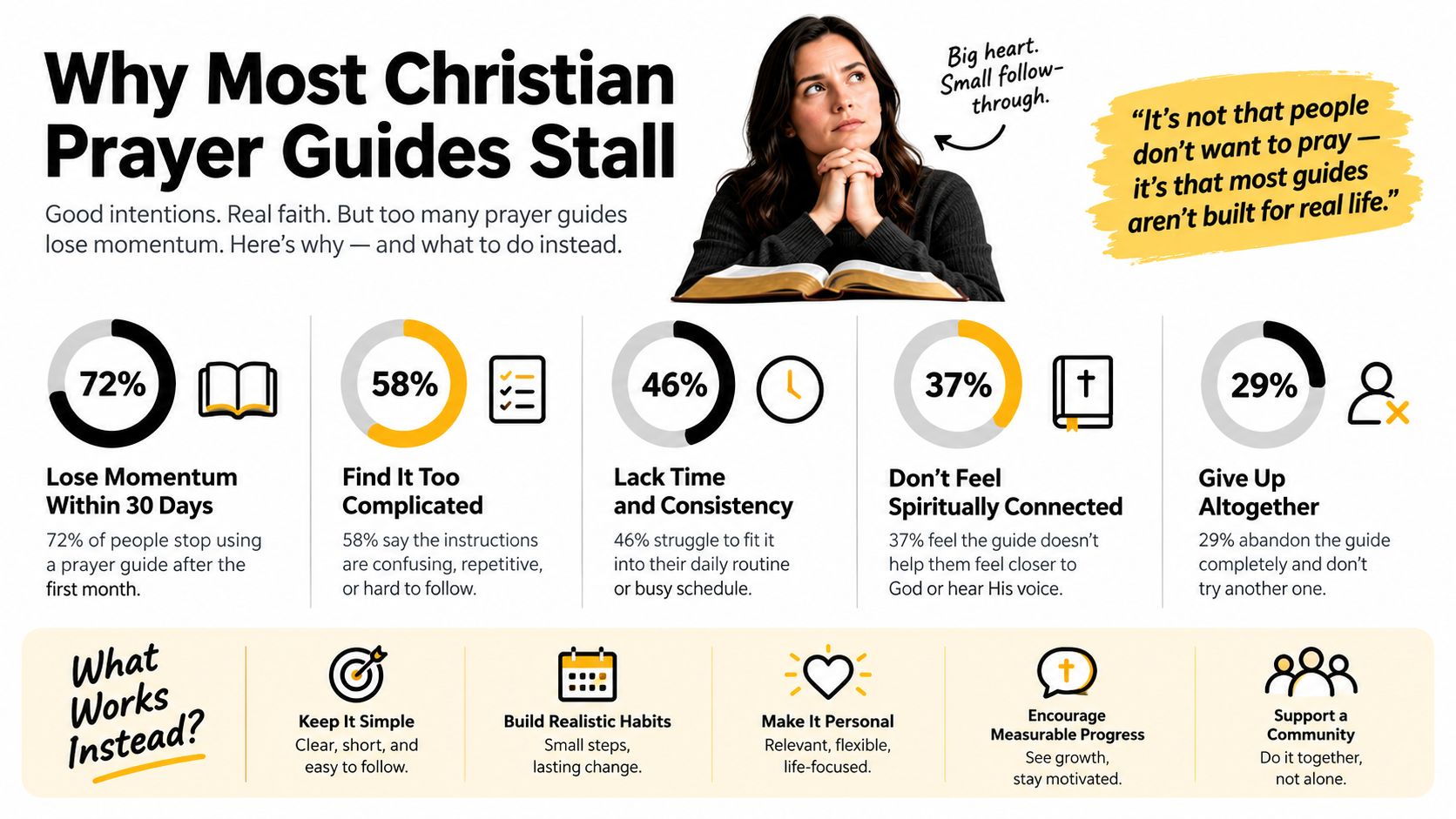
The problem usually isn't a lack of sincerity. It's that a guide asks you to pray without helping you decide what to pray, how to return when distracted, or what to do when the answer isn't clear. “Pray for my family” may be heartfelt, but it can feel hard to begin when the request has no particular person, concern, or next step attached to it.
A survey of more than 14,000 respondents found that 2% reported being very satisfied with their prayer lives, and respondents identified distraction as the largest impediment to a consistent habit, according to Crossway's survey on prayer life. That's a useful reminder that a prayer plan can be sincere and still fail in daily life if it adds friction or treats distraction as a personal defect.
Structure beats spiritual theater
A streak can encourage a habit, but it can also become a measure of worth. If missing a day makes you feel you've failed God, the tracking system has stopped serving prayer. Likewise, long, polished prayers can turn into performance when you're repeating words you don't mean to fill the silence.
A better practice has a few dependable supports: a Scripture anchor, a clear request, room for quiet, and a brief note about what you want to do next. Scripture gives the prayer a place to begin; a specific request helps you return to it; and journaling lets you record what you notice without claiming every change was caused by prayer.
A practical rule: Make the next prayer easy to start, not impressive to complete.
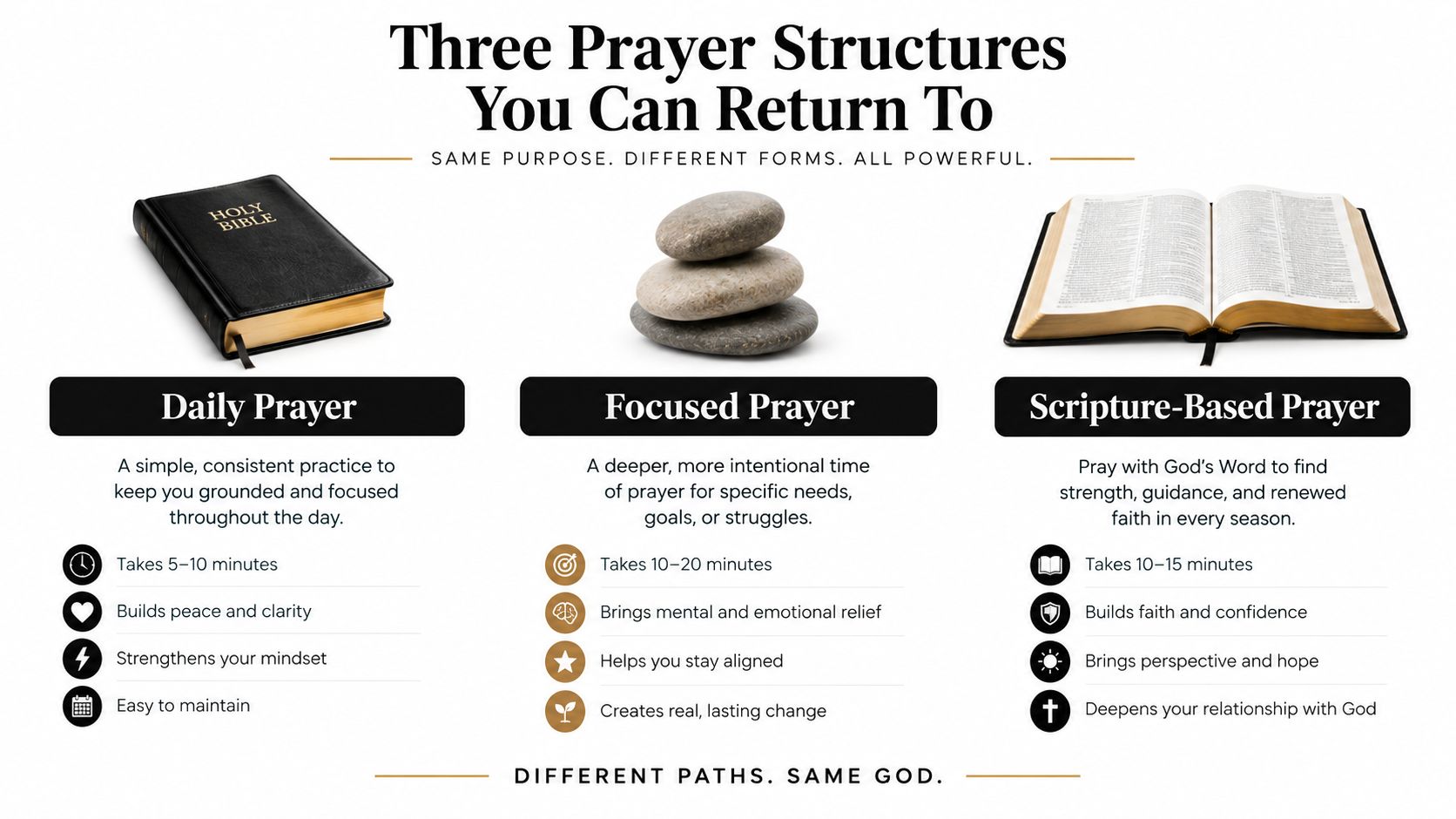
This guide uses familiar structures such as ACTS, breath prayer, and intercession, then puts them into daily and weekly rhythms. It also makes room for lament and shared prayer, because a useful guide should help you pray on the dry days, not only the days when words come easily.
Three Prayer Structures You Can Return To
Christian prayer has a global audience, but no single rhythm fits every person or culture. Across 54 countries with Christian-specific data, 61% of Christian women and 51% of Christian men reported praying daily, according to Pew Research Center's analysis of daily prayer. These figures describe prayer practice, not the use of a particular guide. They're a reason to make structures adaptable rather than assuming every reader prays in the same way.
ACTS for a full prayer
ACTS stands for Adoration, Confession, Thanksgiving, and Supplication. It offers a shape when your mind is scattered or you want to give more than one concern space. The pattern echoes the Lord's Prayer in Matthew 6, which begins with attention to God before turning to daily needs and forgiveness.
Try: “God, you are faithful. Forgive me for the sharp words I used. Thank you for the friend who checked in. Please help my sister as she waits for a decision.” The pitfall is turning each letter into a box to tick. If you have nothing to say in one part, don't manufacture a feeling or a sentence.
Breath prayer for a return to attention
A breath prayer pairs a brief line with the rhythm of breathing. Psalm 46:10, “Be still, and know that I am God,” can become a quiet prayer: inhale, “Be still”; exhale, “You are God.” Use it when you need a moment to turn your attention toward God during an ordinary task.
Breathing is a prompt, not a technique that guarantees a spiritual feeling. Keep the words simple and don't treat the exercise as a substitute for bringing a real concern to God.
Intercession for specific concerns
Intercession means praying for someone or something beyond yourself. First Timothy 2:1 encourages prayers and intercessions for others. Name the person, name the need as they've chosen to share it, and write a follow-up date so the request doesn't disappear from memory.
For example: “God, give Sam courage and practical support as he prepares for his meeting. Help me check in next week without pressing him to share more than he wants.” The main pitfall is collecting requests without revisiting them or respecting privacy.
For a full prayer, reach for ACTS; for a brief return to God mid-day, try a breath prayer; for a particular person or need, use intercession. A short video introduction to prayer can offer another starting point.
A Daily and Weekly Prayer Rhythm
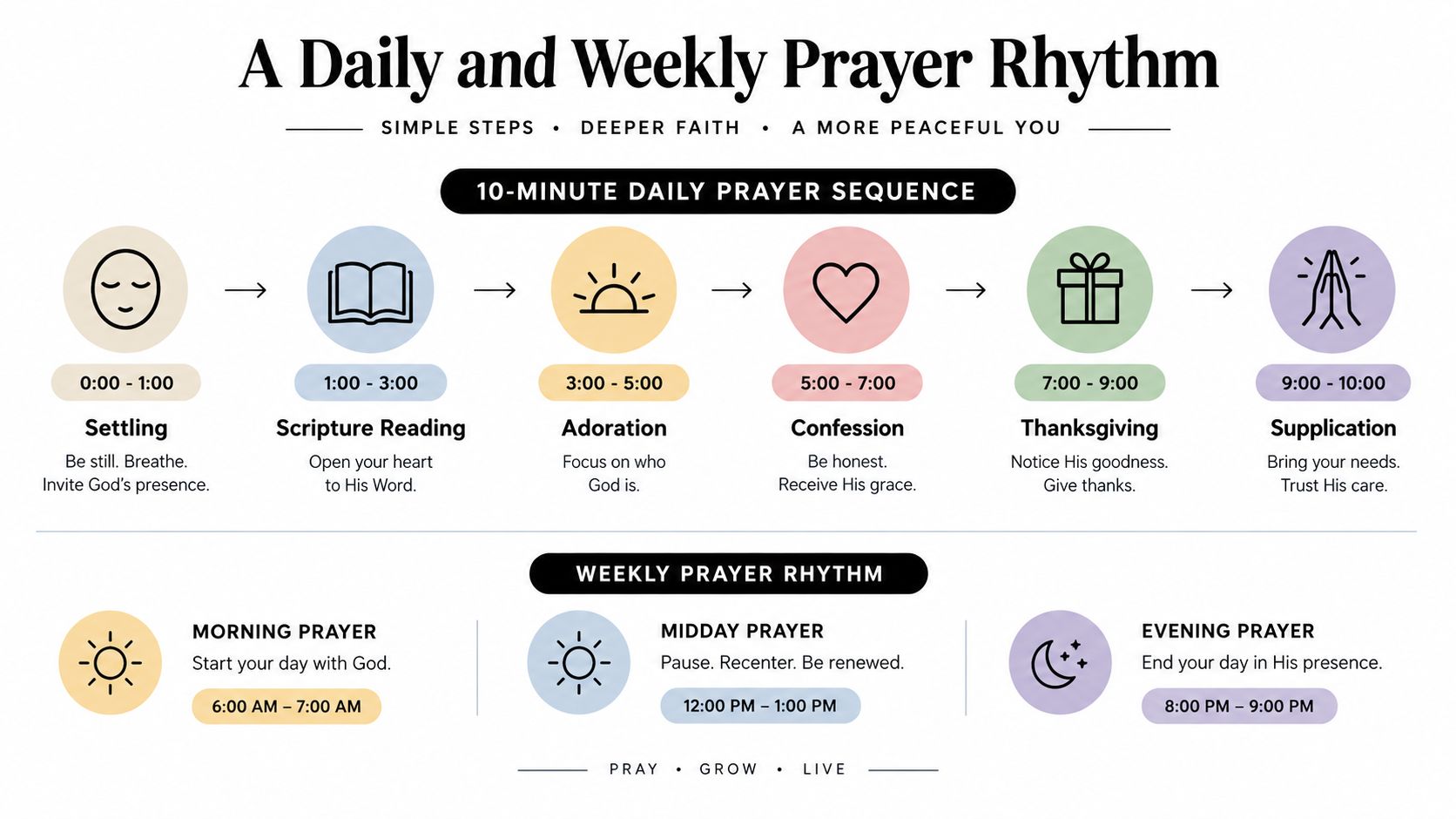
A useful rhythm should fit around work, family, and the interruptions you can't plan for. One practical daily sequence takes 10 minutes. Use a timer if it helps you stay with the practice, and keep the Bible and a notebook close enough that getting started doesn't become another task.
A simple daily sequence
- Settle, 1 minute: Sit comfortably, take a few unhurried breaths, and name what's competing for your attention.
- Read Scripture, 2 minutes: Choose a short passage. Ask what it shows you about God or what it brings to mind.
- Adore and give thanks, 2 minutes: Name one quality of God and one specific gift from your day.
- Confess, 2 minutes: Be honest about a mistake, a strained relationship, or a response you want to change. If repair is needed, name a possible next step.
- Intercede, 2 minutes: Pray for a person or concern in concrete words.
- Log, 1 minute: Write one next action and, when useful, a date to follow up.
Leave a little quiet inside these steps. You don't need to fill every pause with words.
Give the week a focus
A weekly rhythm can help you avoid praying only about whatever feels urgent. Treat the prompts below as options, not assignments you must complete perfectly.
| Day | Focus | Sample prayer |
|---|---|---|
| Sunday | Review the week | “Show me what I should remember, and what I can release.” |
| Monday | Scripture | “Help me carry this passage into my choices today.” |
| Tuesday | People you carry | “Give this person the help they need, and show me how to care well.” |
| Wednesday | Confession and self-examination | “Help me see where I caused harm and how I can make things right.” |
| Thursday | Gratitude | “Thank you for the ordinary good I might have overlooked.” |
| Friday | Silence or fasting, if appropriate | “Meet me in the quiet, and help me notice what needs attention.” |
| Saturday | Neighbors and mission | “Show me one practical way to serve someone near me.” |
Skipping a day isn't proof that you've failed. Return to the next available moment instead of trying to repay a missed prayer with an exhausting session. A rhythm is there to support a relationship, not to keep score.
When Prayer Feels Silent and Nothing Changes
Silence can hurt, especially when the prayer concerns illness, grief, safety, or a relationship you're desperate to repair. Don't turn that pain into a verdict about your faith. Lament is prayer that tells the truth about sorrow and anger while still bringing them before God.
A Cochrane review of 10 randomized trials involving 7,646 participants found no significant overall effect of intercessory prayer on recovery or mortality. That finding is a reason to present prayer as a complementary spiritual practice, not a clinical intervention, as the Cochrane review on intercessory prayer explains. A prayer guide should never promise a medical outcome or suggest that someone's illness proves they didn't pray with enough faith.

Give lament honest words
A simple lament can hold three things together: what hurts, what you still trust, and what help you need from other people. You might write:
- "I'm angry that this happened, and I'm afraid it won't change."
- "I don't understand what you're doing, but I want to keep speaking with you."
- "Please help me ask for support, and show my friends how to stay close without trying to fix everything."
The wording doesn't have to sound calm or resolved. The Psalms give Christians a language for distress as well as praise; you're allowed to bring the difficult truth into prayer rather than hide it behind reassuring phrases.
Persistent prayer doesn't guarantee the result you requested. Don't blame yourself for an outcome, and don't pressure someone else to adopt your beliefs about healing. Prayer also shouldn't delay medical or mental-health care. If you're trying to find words for hardship, this guide to prayer during difficult times can offer another starting point.
Praying Together as Families and Small Groups
Private prayer can matter, but it isn't the only way Christians sustain a prayer life. A longitudinal study of Catholic priests reported that private prayer frequency did not significantly predict future loneliness, while congregant support and relational care were more consequential predictors of wellbeing. The finding doesn't make private prayer unimportant; it underscores that people also need care from other people.
Make group prayer safe to join
Before inviting people to share requests, explain what the group will keep private and what, if anything, may be shared beyond the room. Ask permission before praying aloud about someone else's concern, and let participants pass without needing to explain. At a later meeting, follow up gently: “Would you like us to keep praying about this, or would you rather leave it there?”
A check-in can be as simple as: “What's one thing you'd like prayer for, and what kind of support would feel helpful?” Keep the list limited to details the person agreed to share. For someone who can't attend, a private message or scheduled call can preserve connection without turning their situation into group conversation. Churches looking for ways to organize remote prayer can explore online prayer groups.
Consent matters: Prayer should invite care, not pressure someone to disclose, accept advice, or perform certainty.
Use words that fit the people present
With young children, keep prayers concrete and brief: “Thank you for our dinner. Please help Grandma feel cared for tonight.” A bedtime prayer might be, “Thank you for today. Be with the people I love, and help me rest.” Children can also choose whether to speak, listen, or sit.
Teens and adults new to faith often benefit from plain language rather than unfamiliar religious phrasing. At a small-group check-in, a leader might say, “You can share as much or as little as you want. We can pray with you, listen, or help you find practical support.” If someone describes grief or distress, listen before offering an explanation. Compassion is not a detour from prayer; it's part of caring for one another.
Building a Prayer Journaling Habit
A journal can help you remember what you prayed and notice what you want to do next. It shouldn't become a ledger where every request needs a dramatic resolution. Write observations carefully: “I felt more able to talk with my brother” is more honest than claiming certainty about why a conversation changed.
For other ways to make a daily practice manageable, browse these daily prayer ideas from Scroll With God. A Scripture-linked entry can stay brief:
- Passage: What did you read?
- What stood out: Which word, image, or question stayed with you?
- What I prayed: What did you ask, confess, or give thanks for?
- What I noticed: What happened, or what remains unresolved?
- One next step: Is there someone to contact, a repair to make, or a request to revisit?
Keep prompts and reviews grounded
Use a prompt when a blank page feels difficult. Try: What am I grateful for today? What do I need to confess? Whom am I carrying in prayer? What am I afraid to ask for? What needs repair? What choice needs discernment? What in this passage challenges me? Where do I need help? What am I still waiting for? What might a caring next step look like?
At the end of the week, ask which prayers were answered, which still need carrying, where you noticed God's presence, and where you drifted. Don't force a tidy conclusion. Protect sensitive entries with a private journal or locked notes, and avoid storing other people's vulnerable details without permission. A guide to starting a prayer journal can help you choose a format. HolyJot is one option for Scripture-linked journaling, prayer-request tracking, reminders, and private notes.
A Thirty-Day Plan to Put It All Together
Build the practice gradually so it has room to take root. Treat each week as a chance to establish one support, not a test of your devotion.
- Week 1: Use the daily prayer rhythm and ACTS. Keep the session simple enough to repeat.
- Week 2: Add a brief breath prayer during a natural pause in the day.
- Week 3: Start an intercession list. Include names only with appropriate care, and note when you'll follow up.
- Week 4: Pray with one other person using the consent and confidentiality practices above.
In the United States, 44% of adults prayed at least once a day in 2023–24, compared with 58% in 2007, a decline of 14 percentage points, according to Pew Research Center's report on prayer and other religious practices. A consistent, low-friction guide can support a habit, but it shouldn't become a spiritual scorecard.
Watch for warning signs: legalistic streak-counting, copying someone else's words when they don't fit, or ignoring grief to keep the routine looking successful. This week, choose a short Scripture passage, set a recurring time cue, and share one prayer request with someone you trust. At the end of the month, adjust the rhythm to what helps you pray with sincerity and keep showing up.
HolyJot brings Scripture-linked journaling, prayer-request tracking, reminders, and private notes into one place for individuals, families, and church groups. If that would help you keep a prayer rhythm without turning it into performance, visit HolyJot and explore whether it fits your practice.