


You've postponed an apology, defended a compromise, or agreed to something that troubles your conscience. You open your Bible looking for clarity, but another question follows: Am I resisting God, or am I resisting someone who's claiming to speak for God? The difference matters, especially when fear, loyalty, and religious expectations pull in different directions.
Disobedience is more than a behavior to condemn. It involves trust, allegiance, and our willingness to receive correction. We can distort God's word to justify what we want, mistake anxiety for discernment, or use religious activity to avoid a difficult act of faithfulness.
These Bible verses about disobedience trace a path through consequences, repentance, and restoration. They also help distinguish sinful rebellion from righteous resistance to commands that contradict God.
Honest self-examination asks both whether we're refusing God and whether we've mistaken a human demand for God's command.
Read each passage in its surrounding context rather than treating it as an isolated verdict on your life. A frightened believer asking sincere questions needs different care from someone knowingly concealing harm, even though both need truth and grace. Keep a journal nearby, and notice not only what each person does, but what they believe about God, how their choices affect others, and what a faithful response would require.
1. Genesis 3:1-19 (The Fall of Adam and Eve)

The movement through consequences begins with broken trust. In Genesis, the first human couple eats from the tree of the knowledge of good and evil despite God's prohibition. Britannica identifies this account as a foundational narrative of temptation, disobedience, and the fall, connecting it with the pain, toil, and death that characterize humanity's subsequent history (Britannica's discussion of Genesis and primeval history).
The serpent's questioning matters because temptation involves interpretation as well as appetite. Adam and Eve must decide whether to trust what God has said or accept an alternative account of his intentions. Their choice isn't merely a technical violation. It damages their relationship with God.
A contemporary parallel might be someone concealing a financial decision from a spouse. Before the concealment comes a justification: disclosure would cause unnecessary conflict, or this situation deserves an exception. The useful comparison is the movement from rationalization to action, not an assumption that every difficult decision repeats Eden exactly.
Examine the story you're telling yourself
Write about a decision you're currently defending, then separate the command from your interpretation of it.
- Name the instruction. Identify the biblical teaching you believe applies, including its context.
- Expose the assumption. Ask whether you're treating God as untrustworthy, withholding, or irrelevant.
- Notice the effects. Consider who else bears the cost of your choice.
Genesis invites responsibility without reducing your identity to failure. Begin with an honest account of what you've done, rather than a general statement that you're imperfect. Specific recognition makes a specific response possible.
2. Numbers 13-14 (Israel's Refusal to Enter the Promised Land)
Fear can sound remarkably reasonable. In Numbers, Israel faces a threatening land and responds by refusing to trust God's promise, even considering a return to Egypt. Read the reports about Canaan alongside the people's response, rather than treating their refusal as a moment detached from their history with God.
The pastoral distinction is important: feeling afraid isn't the same as choosing rebellion. The issue is what the people do with their fear and whose word they ultimately trust. Their refusal also affects their community, reminding us that spiritual decisions don't always remain private.

Suppose you need to acknowledge a mistake at work. You can reasonably anticipate embarrassment or consequences, but those risks don't automatically justify dishonesty. Faithfulness may mean telling the truth while preparing carefully for what follows.
Distinguish trust from impulsiveness
A reflection on being strong and courageous without surrendering to fear can complement this passage, provided courage remains tied to God's character rather than personal ambition. Not every intimidating opportunity is a divine assignment.
In your journal, describe the feared outcome as precisely as you can. Then identify the actual obligation before you: honesty, generosity, reconciliation where safe, or another clearly grounded response. Ask a mature Christian to help distinguish that obligation from a preference you've labeled as God's promise.
The lesson isn't to ignore obstacles. Trust acknowledges the difficulty without granting fear the final authority. A faithful next step may be modest, deliberate, and supported by wise counsel rather than dramatic or publicly impressive.
3. Deuteronomy 28:15-68 (Blessings and Curses for Obedience and Disobedience)
Deuteronomy addresses Israel as a covenant community. Moses describes consequences for covenant unfaithfulness, including devastation that reaches ordinary life, national security, and life in the land. Read the warnings beside the chapter's opening blessings to understand the relationship between the commands and their consequences.
That setting limits how we should apply the passage. It isn't a formula for diagnosing a neighbor's illness, explaining someone's unemployment, or guaranteeing prosperity to a faithful Christian. Moving directly from Israel's covenant sanctions to someone else's suffering bypasses the passage's historical and theological context.
Consider a church member who loses a job and wonders whether God is punishing an unconfessed mistake. A responsible discussion won't claim access to God's hidden explanation. It can encourage honest self-examination while refusing to turn hardship into proof of guilt.
Read warnings without weaponizing them
A useful journal exercise places the chapter's blessings and curses alongside questions about communal responsibility. What kinds of faithfulness does the covenant require? How might leaders' choices affect people who have little power?
- Keep the original audience visible. Write “Israel under the covenant” before drawing a personal application.
- Avoid automatic diagnoses. Don't infer a person's spiritual condition from their health or circumstances.
- Read toward Christ. Compare the passage with Galatians 3:10-14, considering how Paul discusses the law's curse and Christ's redeeming work.
Accountability and compassion belong together. You can acknowledge that wrongdoing has consequences without claiming that every painful event is a direct punishment. When discussing this passage with others, ask what it requires of your own conduct before using it to explain someone else's pain.
4. 1 Samuel 15:10-23 (Saul's Disobedience and Samuel's Rebuke)
Saul offers a religious explanation for conduct Samuel condemns. In this difficult account of warfare and divine judgment, the king preserves what he was commanded to destroy and presents sacrifice as his justification. Samuel's rebuke places obedience above ritual performance.
The passage requires care. Its ancient judgment setting is not permission for Christians to commit violence, and a leader cannot appropriate Saul's story to demand unquestioning submission to personal instructions. The relevant challenge here is Saul's attempt to make religious activity excuse his refusal.

A present-day example might involve a volunteer who serves faithfully at church but refuses to correct dishonest business practices. Service is good, but it doesn't cancel an obligation to tell the truth. The question is whether a visible act of devotion has become an excuse to avoid a less comfortable responsibility.
For self-examination: Don't offer God a religious substitute for the faithful action you already know you owe.
Replace the explanation with a response
Write down a sentence you use to defend a questionable habit. It might begin with “At least I still…” or “But I'm doing this for…” Then describe the action you'd take if that explanation were unavailable.
Pair this reflection with putting God's word into practice. Rather than making a sweeping promise to improve, identify the conversation, correction, or change you're avoiding.
Repentance begins when we stop negotiating over appearances. You don't need a more persuasive account of your intentions if the necessary response is already clear. You need honesty, help where appropriate, and a willingness to act.
5. Jonah 1-4 (Jonah's Flight from God's Command)
Repentance requires more than changing direction outwardly. Jonah flees God's commission, experiences a storm and rescue, and eventually goes to Nineveh. Yet his anger when God shows mercy reveals a continuing conflict beneath his eventual compliance.
Read the whole book rather than stopping at Jonah's prayer or arrival in the city. The closing encounter asks readers to examine their response to God's compassion. Jonah's conduct makes the distinction between carrying out an assignment and sharing God's concern especially uncomfortable.
For a visual companion to your reading, consider the passage alongside this video.
A modern parallel might be someone who apologizes because a mediator insists, yet still resents the other person receiving kindness. The apology may be necessary and meaningful, but the speaker still has work to do. Changed behavior and a changed heart are related, not interchangeable.
Ask whom you don't want God to love
Use Jonah's flight and later anger as separate points of reflection.
- Examine avoidance. What responsibility are you evading, and what does avoidance protect?
- Examine resentment. Whose repentance or restoration would be difficult for you to welcome?
- Examine your response. Are you willing to seek another person's good without controlling the outcome?
This isn't a demand to trust someone who remains dangerous. Mercy doesn't require removing protective boundaries or pretending harm never happened.
The practical challenge is to stop treating compassion as something you can distribute only to people you find deserving. Ask God for willingness to obey, but also for honesty about the resentment that may remain after you do.
6. Romans 5:12-21 (Adam's Disobedience and Christ's Obedience)
The central question changes here. Instead of asking only what human disobedience produces, Paul directs attention to what Christ's obedience accomplishes. Restoration rests on Christ, not on our ability to construct a flawless record after failure.
Romans 5:19 explicitly contrasts the consequences of one person's disobedience with another's obedience, making it a central passage for studying the theme (the Vatican's New American Bible concordance for disobedience). Read the surrounding argument to keep grace, righteousness, and death in view rather than treating the verse as a detached slogan.
This matters when repentance becomes anxious self-punishment. Someone who has confessed a lie may keep reviewing it, hoping enough regret will finally make forgiveness secure. Paul's focus directs that person away from confidence in the intensity of remorse and toward confidence in Christ.
Compare the foundations of your hope
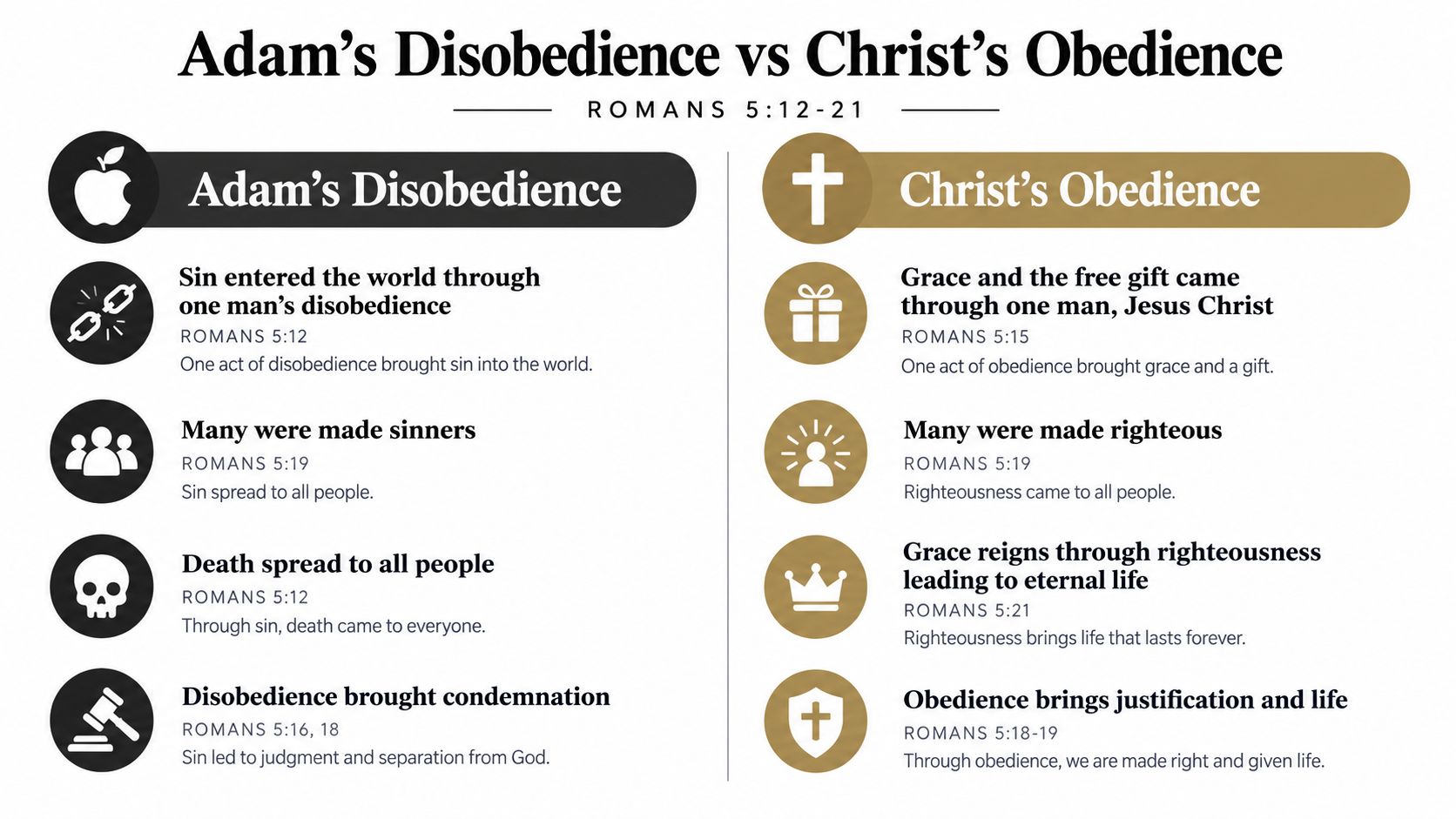
Create a journal comparison with Adam on one side and Christ on the other. Record the consequences Paul associates with each, then write about where you're looking for acceptance.
Grace doesn't make confession unnecessary. It makes honest confession possible without making despair the measure of sincerity.
A family discussion could ask how someone should respond after admitting wrongdoing. The answer should leave room for both receiving mercy and repairing harm, without treating repair as a payment that purchases God's favor.
Forgiveness and consequences are distinct. A person may need to repay money, accept discipline, or rebuild trust while resting in grace. Receiving forgiveness doesn't mean insisting that everyone else immediately feel safe, and accepting consequences doesn't mean Christ's obedience was insufficient.
7. Acts 5:17-32 ("We Must Obey God Rather Than Men")
Sometimes refusing a human command is an act of obedience to God. In Acts, the apostles continue teaching about Jesus despite the authorities' prohibition. Their response establishes an important distinction: human authority is not the highest authority.
The setting matters. The apostles aren't defending convenience or a general dislike of restrictions. They're refusing a command that conflicts with their responsibility to bear witness to Christ.
The comparison below recalls the Adam-and-Christ contrast while inviting reflection on the allegiance that shapes obedience.
A workplace example makes the distinction concrete. If a supervisor instructs an employee to falsify a report, refusing that instruction isn't sinful rebellion merely because a superior issued it. The employee should seek a truthful, proportionate response and appropriate support.
Test resistance before calling it righteous
Read Acts alongside Romans 13:1-7 rather than using either passage to silence the other. Reflection on resisting conformity to the world can help, but strong feelings alone don't establish a biblical obligation.
- Identify the conflict. What exactly have you been commanded to do?
- Name the biblical obligation. Explain the conflict using Scripture in context, not preference.
- Seek wise support. Consult trustworthy people who can challenge your interpretation and help you act safely.
Disagreement isn't automatically holy resistance. Neither is compliance automatically faithfulness.
This distinction is especially important when someone uses spiritual authority to demand secrecy about abuse or participation in wrongdoing. Protecting a leader's reputation isn't a higher duty than truth and safety. Seek appropriate safeguarding, professional, or legal help when harm is involved.
8. Hebrews 3:7-4:11 (Warning Against Disobedience and Unbelief)
A sincere question and a hardened refusal shouldn't receive the same pastoral response. Hebrews connects disobedience with unbelief through its reflection on Israel's wilderness experience, warning readers against resisting God while his invitation remains open. Its concern is sustained responsiveness, not merely outward conformity.
The language deserves attention. Vine's lexical discussion distinguishes refusal to hear from an unwillingness to be persuaded, helping readers recognize that disobedience can involve both conduct and inner posture (Vine's discussion of disobedience and disobedient). Such distinctions are study aids, not substitutes for reading the passage carefully.
Consider someone who says they want to trust God but keeps returning with difficult questions. That person may need patient explanation and companionship, not an accusation of rebellion. By contrast, someone who repeatedly dismisses clear correction while concealing harm needs direct accountability.
Respond without turning reflection into surveillance
Hebrews encourages mutual exhortation, which can become a practice of attentive friendship rather than a system of spiritual policing. A trusted friend might ask what you're learning, where you're resisting, and what support you need.
For personal reflection, write brief responses to these prompts:
- What do I understand? Name the teaching that seems clear.
- What remains uncertain? Separate unanswered questions from deliberate refusal.
- What response is possible? Choose a faithful action without pretending you've resolved every difficulty.
The warning and the invitation belong together. Don't postpone a clear response indefinitely, but don't mistake repeated anxious checking for spiritual maturity either. If fears about disobedience become intrusive or consume daily life, seek support from a thoughtful pastor and a qualified mental health professional.
Comparison Guide: Consequences, Repentance, and Restoration at a Glance
Eight passages about disobedience can blur together if you read them as one repeated warning. They aren't. Read in sequence, they move through three distinct movements: consequences (where rebellion leads), repentance (how a person turns back), and restoration (what God does with a repentant people). One passage stands outside that sequence entirely: Acts 5 describes resistance to a human command as an act of obedience to God, which is a different category altogether.
Use the table to locate the passage that matches your situation before you study it in depth.
| Passage | Movement | Core focus | Study complexity | Expected takeaway | Ideal use |
|---|---|---|---|---|---|
| Genesis 3:1–19, The Fall of Adam and Eve | Consequences | Temptation, disobedience, and its consequences | Moderate; read the narrative with attention to its sequence and consequences | Disobedience brings shame and broken relationships; Genesis 3:15 introduces hope of redemption | Foundational study of sin, temptation, and the biblical theme of redemption |
| Numbers 13–14, Israel Refuses the Promised Land | Consequences | Fear and unbelief lead Israel to reject God's promise | Moderate; compare the spies' reports and consider the wilderness context | Unbelief leads to costly consequences, while Caleb and Joshua model trust | Useful for groups discussing fear, faith, and responding to difficult decisions |
| Deuteronomy 28:15–68, Covenant Curses | Consequences | Consequences of disobedience within Israel's covenant | High; lengthy passage best read alongside Deuteronomy 28:1–14 and relevant historical context | Presents covenant consequences, including defeat and exile | Valuable for studying covenant structure and its relationship to later biblical interpretation |
| 1 Samuel 15:10–23, Saul's Disobedience | Consequences | Partial obedience and religious justification | Low to moderate; a focused narrative with a clear central rebuke | Religious acts do not substitute for obedience; Saul's choices cost him the kingdom | Concise study of accountability, self-justification, and wholehearted obedience |
| Jonah 1–4, Jonah Flees God's Command | Repentance | Flight from a calling, repentance, and mercy | Moderate; read the complete story to follow its changing perspectives | God shows mercy to Nineveh, while Jonah's response challenges the reader | Well suited to group or youth studies on calling, repentance, and compassion |
| Romans 5:12–21, Adam and Christ | Restoration | Adam's disobedience contrasted with Christ's obedience | High; benefits from close reading and context on sin, grace, and justification | Christ's obedience is presented as the answer to sin and death | Key passage for theological study of grace, justification, and redemption |
| Acts 5:17–32, Obey God Rather Than People | Holy resistance | Apostolic obedience amid conflict with authorities | Moderate; consider the surrounding events and the limits of the principle | Faithfulness to God may require resisting commands that conflict with that faithfulness | Useful for discussions of conscience, authority, and principled civil disobedience |
| Hebrews 3:7–4:11, Warning Against Disobedience and Unbelief | Warning and rest | Israel's wilderness failure as a warning to believers | High; connect the passage with Psalm 95 and its references to rest | Disobedience and unbelief can prevent people from entering God's rest | Supports discipleship and accountability studies focused on perseverance and response |
The movement column is the key to using this guide well. If you're weighing whether a human instruction conflicts with what God requires, Acts 5 is your passage; the consequences texts will only confuse that discernment. If you've already failed and need a way back, Jonah and Romans answer questions that Deuteronomy was never written to address. Matching the passage to the moment keeps each text doing the work it was meant to do.
From Recognition to Faithful Response
You don't need to leave these passages with fear alone. Disobedience can be named clearly, repented of specifically, and answered with a concrete next step. The aim isn't to become skilled at detecting failure while remaining unsure how to respond.
Consequences, repentance, restoration, and holy resistance require different responses. Consequences may require accepting discipline or repairing damage; repentance requires turning from what's wrong. Restoration involves receiving grace and rebuilding faithfully, while holy resistance requires discerning when a human command contradicts obedience to God.
Turn reflection into a faithful practice
Choose a passage that addresses your actual situation rather than the one that feels most dramatic. Read it in context, then record the pattern you recognize: rationalization, fear, avoidance, religious substitution, resentment, or resistance to correction.
- Describe the conduct. Write what happened without minimizing it or condemning your whole identity.
- Name your response. Confess a specific wrong, express a specific fear, or ask a specific question.
- Choose an action. Correct the record, return what isn't yours, seek counsel, or establish a necessary boundary.
- Invite support. Share an appropriate part of your reflection with a trustworthy Christian mentor or small group.
Be careful about what you ask of people you've hurt. An apology shouldn't pressure someone to reconcile, keep a secret, or reassure you that everything is fine. Accountability includes respecting their boundaries and allowing trust to be rebuilt rather than demanded.
Likewise, if you're the person who has been harmed, someone else's appeal to obedience must not become a tool for controlling you. Forgiveness doesn't excuse abuse or require unsafe reconciliation. The practical recovery path can include confession, grace, restitution where appropriate, and accountability without minimizing harm, as the supplied pastoral guidance emphasizes.
A journal can help you distinguish an intention from a response. Record the action you plan to take, return to the entry after you've acted, and note what still needs attention. Don't measure faithfulness only by how often you write; ask whether you're becoming more truthful, teachable, and willing to love others responsibly.
Bring unresolved questions to someone who can listen without rushing to pronounce judgment. You may need correction, reassurance, safeguarding, or help making a difficult decision. Faithful obedience doesn't require pretending you're never afraid or uncertain. It requires remaining open to God's truth and taking the next responsible step you can discern.
HolyJot offers verse-linked journaling, guided study plans, private locked notes, and private Community Hubs to support ongoing Scripture reflection. Visit HolyJot to begin an entry on one of these passages, record your response of confession or trust, and plan a concrete step toward faithful obedience.