


What do you expect prayer to do, and what do you do when the answer doesn't arrive? Many collections of Bible verses about prayer offer encouragement, but stop before showing how those passages shape an honest prayer life. Read together, these verses describe prayer as private communion, a continuing habit, grateful petition, a structured response to God, confession, intercession, abiding relationship, and integrity.
Prayer is also a focused biblical theme. Modern Bible study tools index 100, 107, 116, and 153 verses under prayer, depending on the reference site, while broader editorial counts identify 650 prayers in Herbert Lockyer's compilation and more than 375 prayer-related word occurrences in one estimate. These figures help explain why prayer passages support daily reading plans, group discussion, and verse-based journaling across both Testaments. (Bible to Life's prayer verse collection)
The eight passages below use a consistent approach. Each one receives attention to its biblical setting, its strength, a possible misreading, a related passage, a journaling prompt, and a practical HolyJot workflow. The aim isn't to collect inspirational lines. It's to let Scripture teach you how to pray when you're grateful, anxious, guilty, busy, uncertain, or praying for someone else.
1. Matthew 6:6 Prayer in Secret
Jesus places private prayer at the center of authentic devotion. In Matthew 6, He contrasts sincere worship with religious behavior performed for public recognition. His instruction to enter a room, close the door, and pray to the Father who sees in secret points toward intimacy, not display.
The passage doesn't mean every public prayer is wrong. Scripture also describes corporate prayer and shared intercession. Jesus is confronting the desire to be noticed, not the practice of praying with other believers. The question is whether God is the audience or whether human approval has become the reward.
That distinction matters for journaling. A private entry can hold fears, resentment, grief, temptation, or questions you aren't ready to share. You don't need to make your prayer sound polished before bringing it to God.

A private practice for honest prayer
Use this prompt: “What would I say to God if nobody else could read it?” Write without editing yourself, then end by naming one truth from Matthew 6:6 that you want to remember.
HolyJot's locked notes can protect sensitive prayer entries and vulnerable moments. You might create a dedicated private journal for morning or evening prayer, then use a time capsule to revisit how your concerns changed over time. Small-group members can keep personal entries private while sharing selected insights later in a trusted Community Hub.
For a practical guide to building this rhythm, explore how to pray effectively. Keep private prayer and community prayer in balance. Secrecy protects sincerity, while wise sharing can create support without turning devotion into public performance.
Practical rule: Share a prayer because trust and wisdom call for it, not because visibility makes it feel more spiritual.
2. 1 Thessalonians 5:17 Pray Without Ceasing
“Pray without ceasing” is brief, but it's easy to misunderstand. Paul places the phrase alongside rejoicing and thanksgiving, presenting a way of life rather than demanding uninterrupted spoken words. The command describes an ongoing readiness to turn toward God throughout ordinary moments.
That might happen while commuting, washing dishes, preparing for a difficult conversation, or noticing a need in someone's life. A short prayer such as “Give me wisdom,” “Thank You for this help,” or “Remember this person” can interrupt autopilot and restore awareness of God.
The verse also corrects a common all-or-nothing approach. If you miss a planned prayer time, you haven't failed beyond repair. Resume the conversation. Unceasing prayer is better understood as returning continually than as maintaining a flawless performance.
Turn interruptions into prayer prompts
Create three brief prompts in HolyJot:
- Morning attention: Record the concern or hope you're carrying into the day.
- Midday return: Add a verse-linked note after a meaningful interruption or decision.
- Evening review: Write one prayer of gratitude and one request you're still carrying.
Mobile entries make it possible to capture spontaneous prayers before they disappear. You can also set reminders, build a private streak with an accountability partner, or create a guided study plan around the phrase “pray without ceasing.” Families might share short evening prayers in a private hub, while pastors can prepare brief devotional prompts for their members.
The purpose isn't to turn prayer into another metric. A streak can encourage attention, but it can't measure closeness to God. Let the tool support the habit, while keeping the relationship at the center.
3. Philippians 4:6-7 Prayer with Thanksgiving
Anxiety can narrow attention until one fear feels like the whole truth. In Philippians 4:6-7, Paul addresses that fear directly. He tells believers to bring every situation to God through prayer and petition, with thanksgiving. The passage connects specific requests with grateful remembrance, then describes God's peace guarding hearts and minds in Christ Jesus.
Thanksgiving is not a method for producing a required mood. It helps place the concern in a larger frame. You can name what hurts, ask for practical help, and still recognize what remains good. Gratitude does not erase the problem. It keeps the problem from becoming the only thing you can see.
The promise of peace also requires honest reading. Paul does not say that every anxious person will immediately feel calm. Someone may pray faithfully and remain worried, numb, or disappointed. This passage gives that person language for bringing the condition to God instead of performing certainty.
Let the journal hold both realities
Use one HolyJot entry as a two-column prayer record. Under Requests, describe each concern and the help you are asking God to provide. Under Thanksgiving, note a person, truth, provision, or sign of faithfulness you can recognize today. Keeping both beside each other works like placing two lenses over the same situation: one names the need, while the other remembers God's presence.
End with “God, help me hold this concern without forgetting Your presence.” Later, revisit the entry and add what changed, what remains unresolved, or what you now understand differently. Partial answers and waiting belong in the record too. Do not force every outcome into the answer you hoped for.
A HolyJot study plan can guide reflection on anxiety and peace. FaithAI can help surface related passages for further reading. A family or church group can use a private Community Hub for gratitude-prayer circles, after agreeing what stays confidential. More ideas for entries are available in these prayer journal prompts.
The 2025 State of the Bible findings summarized by American Bible Society report that 98% of Scripture Engaged adults prayed during the past seven days, compared with 87% of the Movable Middle. The summary also reports lower stress scores among weekly Bible readers, 8.0 compared with 9.6, and higher hope scores, 18.6 compared with 16.8. (American Bible Society summary) These findings do not promise that journaling removes anxiety. They support a practice that joins Scripture engagement, prayer, and honest reflection.
4. Luke 11:1-4 The Lord's Prayer as a Model
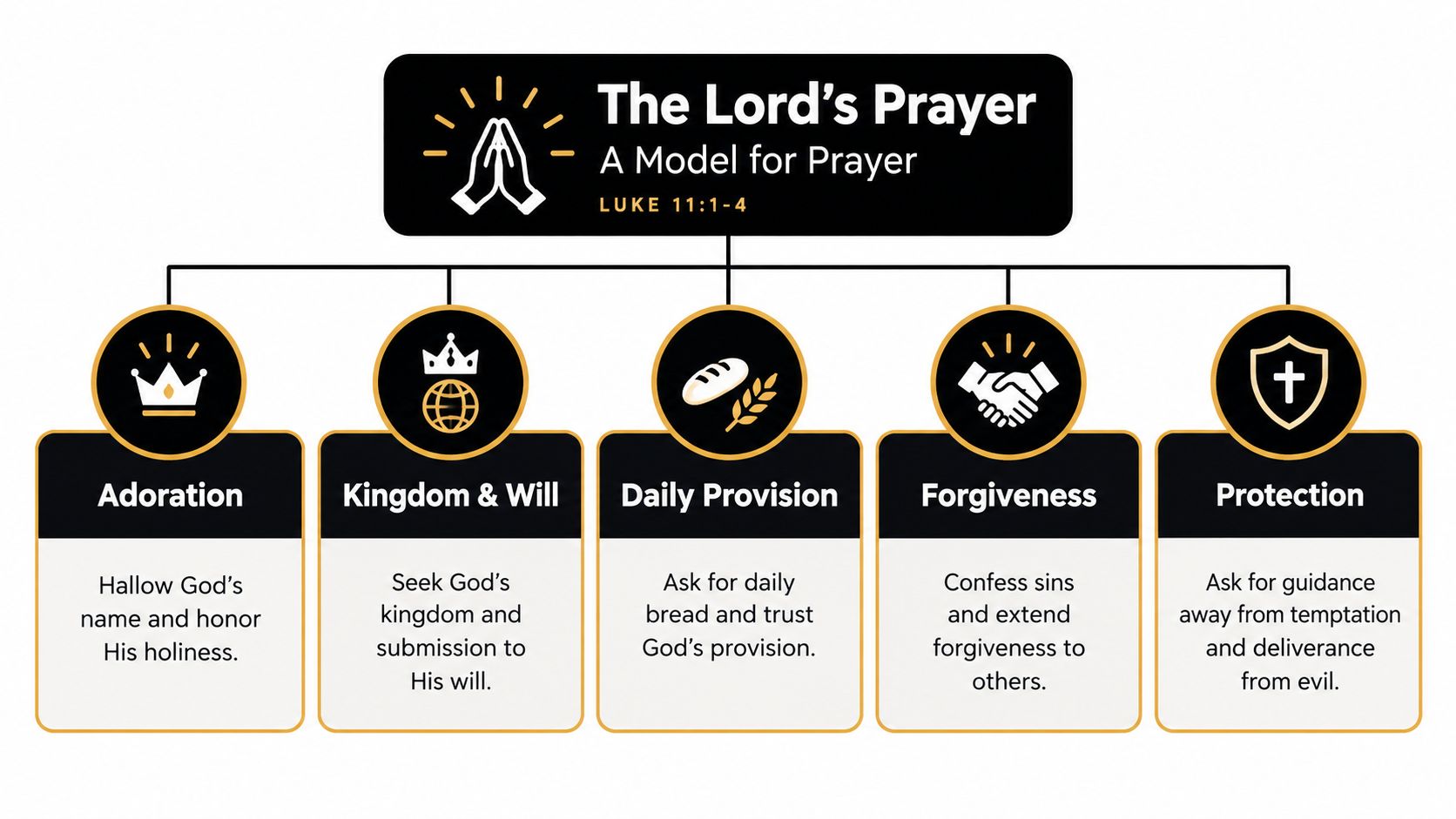
What can a prayer teach us before we add our own words? In Luke 11:1-4, the disciples ask Jesus to teach them to pray. His response moves from God's name and kingdom to daily provision, forgiveness, and protection from temptation and evil. The sequence resembles a map. It keeps prayer oriented toward God while still making room for ordinary needs.
Each movement supplies a question for reflection. “Hallowed be Your name” directs attention to God's holiness. “Your kingdom come” examines where surrender is needed. “Give us each day our daily bread” brings dependence into the present day. “Forgive us our sins” invites confession and reconciliation. “Lead us not into temptation” names spiritual danger.
Luke's account is a model, not a script that replaces personal language. Repeating the words can be meaningful, but using the prayer only mechanically can hide its purpose. Jesus gives a structure broad enough for changing circumstances and steady enough to shape spiritual growth.
Try a five-entry journal sequence. On the first day, write what honoring God would look like in one situation. On the next, record what you are releasing from your control. Continue with a concrete daily need, a relationship or action requiring confession, and a temptation that needs wise boundaries. Link each entry to the relevant verse in HolyJot, then review the series weekly to notice recurring concerns and answered prayers.
Families might reflect on one phrase during a shared prayer time. A small group could discuss how the model speaks to current community concerns, while allowing different forms of expression. FaithAI can help compare Luke 11 with Matthew 6 and locate related passages, but read the surrounding chapters yourself. Context keeps a familiar prayer connected to Jesus' instruction rather than turning it into a detached slogan.
5. James 5:16 Confession and Prayer for Healing
James places confession, mutual prayer, and healing within the life of the believing community. The verse presents prayer as shared care. Trusted relationships can provide room for repentance, specific intercession, and patient support when suffering continues.
Wisdom must guide disclosure. Confession does not require revealing private information to unsafe listeners, and a reference to healing does not promise that every physical illness will resolve as requested. James calls Christians toward faithful prayer, not shame for those who remain sick or blame for unanswered prayer.
A journal can help separate honest repentance from harmful self-accusation. Begin with four brief entries:
- Name the struggle: Describe what happened without minimizing it.
- Confess your part: Identify your responsibility without taking blame for another person's actions.
- Set a boundary: Decide what may be shared, with whom, and for what purpose.
- Record the prayer: Note the request, the support offered, and any changes you observe.
HolyJot locked notes can store personal confessions or confidential prayer requests. A private Community Hub can support a prayer circle when members agree on confidentiality, respectful language, and limits for sensitive information. With permission, an accountability partner can receive a selected entry rather than access the whole journal.
James 5:16 invites honest community, not investigation into someone else's life. Healing may include physical care, emotional support, reconciliation, endurance, or a changed relationship with God. Keep praying, seek appropriate help, and let your journal record both the request and the uncertainty, without forcing a simple explanation onto another person's pain.
6. Ephesians 6:18 Prayer in the Spirit
Ephesians 6:18 comes after Paul describes spiritual opposition and the armor of God. Prayer belongs within that whole picture, like breath sustaining someone prepared for a difficult task. Paul urges believers to pray on every occasion, use different kinds of prayer and petition, stay alert, and remember the needs of the Christian community.
This makes the verse a guide to intercession, not merely a request for personal protection. Prayer in the Spirit turns attention outward toward people, circumstances, and needs that may not change quickly. It also calls for discernment. Spiritual language should lead to faithful action, not to labeling opponents as enemies or avoiding practical responsibilities.
Turn prayer into a living record
Use a rolling HolyJot journal entry and add four headings as situations develop:
- People: Friends, family members, pastors, mentors, and others needing care.
- Places: Your neighborhood, church, workplace, city, or mission setting.
- Pressures: Conflict, injustice, illness, fear, or decisions requiring wisdom.
- Praise: Answers, encouragement, protection, and reminders of faithfulness.
A private Community Hub can support a church prayer chain or a small group's weekly focus on leaders, missions, or local needs. Time capsules can preserve earlier prayers for later review, helping the group remember what it carried and how circumstances unfolded.
Read Ephesians 6:10-20 as one unit before focusing on verse 18. Truth, righteousness, faith, salvation, and readiness surround the call to prayer. For a wider study of this imagery, explore the armor of God in the Bible.
7. John 15:7 Abiding Prayer through Relationship
John 15:7 belongs to Jesus' teaching about the vine and branches. His promise about asking is joined to remaining in Him and letting His words remain in His disciples. Prayer therefore grows from relationship with Christ. It is not a blank check for every impulse or a technique for controlling outcomes.
The question shifts from finding perfect wording to examining what shapes our desires. Are Jesus' words forming what we request, value, and accept? Abiding develops through Scripture meditation, obedience, repentance, worship, and prayer. Over time, these practices can make our desires clearer, more patient, and more attentive to others. Disappointment may remain, but it can be brought into the relationship.
Let Scripture shape the prayer
A verse-linked HolyJot entry can hold three brief reflections:
- What does this passage reveal about Jesus?
- What desire or concern does it bring to the surface?
- How should I pray in response?
Review several entries later. Look for recurring fears, changing priorities, or growing concern for another person. This review is not a grade for spiritual performance. It shows whether Scripture is becoming part of your inner conversation.
A daily Bible study and prayer rhythm gives the practice a regular place. FaithAI can surface related passages about abiding, but its suggestions should support careful reading rather than replace it. Churches can create guided plans that connect meditation with intercession. Small groups can discuss how remaining in Christ changes requests that once focused mainly on personal success.
You can also record two stages in each entry: the request you brought to God and the desire Scripture exposed beneath it. That simple comparison helps distinguish a passing impulse from a prayer being reshaped through relationship.
John 15:7 offers a responsible way to read promises about prayer. Asking remains connected to remaining. As communion with Christ deepens, prayer becomes less about securing a preferred result and more about receiving desires that reflect His words.
8. 1 Peter 3:12 Prayer with Right Living
Peter connects God's attentive hearing with the direction of a believer's life. The Lord sees the righteous and listens to their prayer, while evil brings consequences. Prayer, then, is not an isolated conversation. It is more like a path whose words and footsteps should point in the same direction.
The passage does not reserve prayer for people who never fail. Scripture also speaks of confession, repentance, mercy, and restoration. Peter confronts deliberate hypocrisy, while still leaving room for the struggling believer who turns to God for help and correction.
Read this verse when prayer and conduct begin to separate. A person may ask for peace while continuing to provoke conflict, request integrity while hiding the truth, or seek forgiveness while refusing to repair harm. The prayer becomes a mirror, showing where belief needs to become action.
Use a three-line HolyJot entry to record that movement:
- Prayer: What request, fear, or hope are you bringing to God?
- Conflict: What choice or attitude may contradict that request?
- Response: What faithful action can you take today?
A prayer for reconciliation could lead to a respectful conversation. A confession of dishonesty could identify the truth that needs to be told. A request for patience could point to a boundary that prevents retaliation.
Keep sensitive moral reflections in locked notes. If appropriate, share a selected entry with a trusted accountability partner, with permission and care. Community Hubs can support conversations about character when members encourage one another rather than police one another. FaithAI may help find related passages on righteousness, repentance, and prayer, but research should serve obedience, not replace it.
End the entry by reviewing it later. Did the requested change appear in your choices, or did the prayer remain only a wish? This practice keeps God's comfort and Peter's challenge together. God listens to those who turn toward Him, and that turning reaches into the way they live.
8-Point Comparison: Bible Verses on Prayer
| Topic | 🔄 Implementation Complexity | ⚡ Resource Requirements | 📊 Expected Outcomes | 💡 Ideal Use Cases | ⭐ Key Advantages |
|---|---|---|---|---|---|
| Matthew 6:6 - Prayer in Secret | Low, personal discipline and private space needed | Minimal, time, quiet space, optional locked journaling | Deeper personal intimacy with God; reduced performative religiosity | Private devotion, prayer journaling, sensitive reflections | Encourages sincere prayer and protects vulnerability |
| 1 Thessalonians 5:17 - Pray Without Ceasing | Moderate, habit formation and continual awareness | Low, phone reminders, short prompts, micro-devotions | Ongoing spiritual presence; increased gratitude and mindfulness | Busy schedules, micro-devotion practices, daily push notifications | Integrates faith into everyday routine; accessible anytime |
| Philippians 4:6-7 - Prayer with Thanksgiving | Low, simple practice requiring sincerity | Low, two-column journaling, guided plans for anxiety | Greater peace; practical anxiety management (complements care) | Anxiety support, gratitude groups, individual journaling | Concrete method for worry reduction; cultivates thanksgiving |
| Luke 11:1-4 - The Lord's Prayer | Low, memorisable structure but needs reflective use | Minimal, teaching guides, memorization aids | Balanced prayer covering worship, petition, confession, submission | Teaching, liturgy, family devotions, discipleship lessons | Comprehensive, adaptable model covering major prayer types |
| James 5:16 - Confession & Prayer for Healing | Moderate, requires trust, safe community norms | Moderate, confidential spaces, accountability mechanisms | Promotes healing, accountability, powerful intercession | Small groups, recovery ministries, confidential prayer circles | Fosters transparency and communal healing through confession |
| Ephesians 6:18 - Prayer in the Spirit | High, theological grounding and sustained vigilance | Moderate, teaching, coordinated intercession networks | Spiritual protection; persistent intercession for communities | Intercession teams, spiritual warfare teaching, church-wide prayer | Frames prayer as spiritual armor; encourages persistent intercession |
| John 15:7 - Abiding Prayer | High, sustained Scripture engagement and relational depth | Moderate, Bible study tools, daily devotion plans, journaling | Requests increasingly align with God's will; transformative growth | Discipleship, contemplative practices, Scripture-saturated routines | Prioritizes intimacy with Christ; integrates Word and prayer |
| 1 Peter 3:12 - Prayer with Right Living | Moderate, consistent moral reflection and accountability | Low–Moderate, discipleship resources, accountability partners | Stronger integrity; clearer conscience affecting prayer attention | Character formation groups, accountability partnerships | Links righteous living to prayer attention; motivates holistic growth |
Building a Lifelong Practice from These Eight Verses
Bible verses about prayer become meaningful when they become prayers, decisions, confessions, and habits. Reading can introduce a truth, but journaling slows you down enough to respond. The purpose isn't to create a perfect devotional record. It's to make room for honest attention to God.
Start with one passage for the coming week. Matthew 6:6 may help if you need privacy and sincerity. First Thessalonians 5:17 may fit a scattered day that needs repeated returns to God. Philippians 4:6-7 can give language to anxiety without asking you to hide it. Luke 11:1-4 offers structure when you don't know where to begin.
Choose the verse that matches your present need, then write a verse-linked HolyJot entry. Summarize the passage in your own words, describe the situation it touches, and write a prayer that doesn't pretend certainty you don't possess. If the prayer feels empty, say so. If you're angry, name the anger. If you're grateful, be specific. Honest prayer is not disrespectful because it's honest.
After writing, decide whether the entry should remain private or whether a trusted person can support you. HolyJot's locked notes can protect sensitive material. Private Community Hubs can support small groups, families, and prayer partners when everyone understands the boundaries. Time capsules can help you return to older requests and record what you now see, including waiting, partial answers, changed desires, or continued questions.
A useful starting plan is a 30-day rotation through all eight passages. Spend several days with each dimension, privacy, persistence, thanksgiving, structure, confession, intercession, abiding relationship, and integrity. You don't need to force a new insight every day. Repetition can uncover details that a quick reading misses.
FaithAI can help surface cross-references and Scripture-grounded context as questions develop. Use it to widen your reading around a passage, then return to the biblical text and its surrounding chapter. When prayer seems unanswered, include passages about waiting, God's will, and the Spirit's help in weakness. Romans 8:26, 1 John 5:14, and James 5:16 show why Christian prayer can include uncertainty, submission, and communal support rather than only confident declarations. (Bible Study Tools' prayer verse resource)
Prayer also belongs to the gathered church. Pew Research Center reports that 13% of Americans participate at least weekly in prayer groups, Bible-study groups, or religious education, while 44% pray at least daily. PRRI reports that 48% pray outside a religious service at least weekly, compared with 56% who seldom or never read sacred text. (Prayer participation summary) Those figures point to an opportunity for verse-linked prompts and shared accountability, but the deeper lesson is personal: prayer practice and Scripture engagement can strengthen each other.
Choose one passage today. Write the prayer it draws from you. Then return tomorrow, not to perform spirituality, but to remain present before God.
HolyJot lets you attach Bible verses to prayer entries, write private or verse-linked reflections, save sensitive notes with locking, and record prayer requests alongside answers. Visit HolyJot to begin a Scripture-centered prayer journal and build a daily practice around these eight passages.