


You've said yes to leading, three women have said they're interested, and now you're staring at a blank calendar wondering what Tuesday night really looks like. You don't need a perfect curriculum first. You need a group size, a fixed rhythm, and a session shape that protects time in the text. Get those decisions right, and a small group Bible study for women becomes sustainable instead of well meaning and short lived.
Choose Group Size and Rhythm First
Pick your size by the kind of conversation you want, not by how many names you can collect. I'd start with 3 to 4 members if you want depth, flexibility, and mutual accountability. Choose 6 to 10 members if you want varied perspectives and you're willing to rotate who facilitates so everyone still speaks.
Groups under three stall quickly. One absence removes half the discussion, and the other woman feels pressure to fill the silence. Groups over ten create the opposite problem, where confident speakers talk and quieter women listen for an hour and leave unknown.
| Group size | Best for | Watch for |
|---|---|---|
| Under 3 members | Intimate prayer-focused time | Discussion stalls when one person is absent |
| 3-4 members | Depth, flexibility and mutual accountability | Needs two or three committed core members |
| 6-10 members | Varied perspectives while everyone still speaks | One voice dominating without a rotating facilitator |
| Over 10 members | Larger church or community studies | Split into smaller discussion pairs or subgroups |
Fix the rhythm before you invite
Choose one weekly or biweekly slot and keep it. A changing time is the fastest way to lose women who were already coming, because work, childcare, and transport get arranged around a predictable hour. Ask the core group to commit to meeting together for at least a year, which gives trust time to form beyond polite first impressions.
Before you invite anyone, write down four things. Note your target size, your meeting day and time, your location or platform, and who facilitates the first three sessions. Our small group guidelines can help you turn those four decisions into simple ground rules.
Demand isn't the main obstacle among women already connected to church. In a 2023 Lifeway Research survey of 1,001 female churchgoers in the United States, 66% attended an adult small group or class at least once during a typical month and 57% said their church offered women's Bible studies during the previous year. That's a U.S. planning signal for churchgoing women, not a global rule, but it tells you consistency matters more than novelty.
The 60-Minute Session Blueprint
Don't confuse relational warmth with biblical engagement. A group that only chats becomes a support circle with no Bible at its center. A group that only studies loses the trust that makes honest application possible, so you need protected time for both.
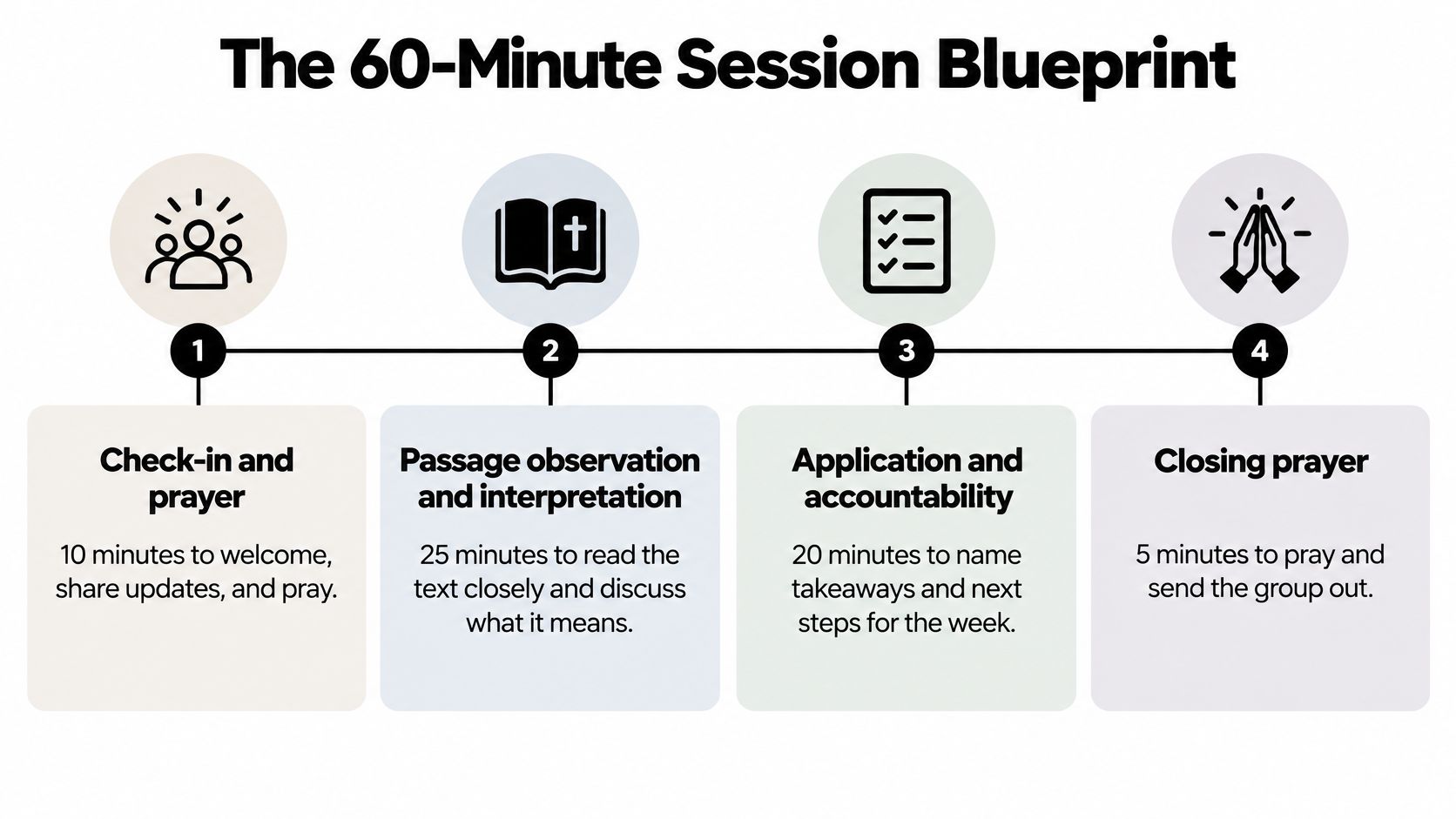
| Block | Minutes | What the group does |
|---|---|---|
| Check-in and prayer | 10 | Each woman shares one line; the group prays for named requests |
| Passage observation and interpretation | 25 | Read the text, note what it says, then work out what it means |
| Application and accountability | 15 | Each woman names one concrete change for this week |
| Intercession and next steps | 10 | Pray for one another and confirm the next meeting plan |
Keep the four blocks in this order. The text block is the heart of the session, so don't let check-in expand to fill the hour. If you want more depth, extend interpretation toward 40 minutes and shorten check-in rather than dropping application, because application is what members carry into the week.
Ask each member to prepare between meetings, even if preparation is reading the passage twice and marking one repeated word. Rotate who leads the interpretation block so one leader doesn't monopolize meaning. That rotation also trains future facilitators without a formal program.
The gap between availability and impact is worth taking seriously. In a women's ministry survey reported by Lifeway Research, 80% of ministry leaders selected Bible studies among the two most effective ways to encourage women's faith journeys, but only 10% of respondents identified community group Bible studies as the most helpful factor in their own spiritual development.
Practical rule: If nobody can name what changed since last week, the session was pleasant, not yet formative.
Watch for excessive tangents, opinion that isn't tied to the passage, and group study replacing personal Bible reading. Track attendance frequency, completion of preparation, percentage of members contributing, number of concrete applications completed, and retention over six to twelve weeks. Those indicators separate social satisfaction from sustained discipleship far better than headcount alone.
Icebreakers and Prayer Practices That Build Trust
Keep the opener to one line per woman. A long round of updates eats your text time and rewards the most talkative person before you've even opened the Bible. You're building warmth, not running a second meeting before the meeting.
One line icebreakers
- High and low: Each woman names one high and one low from her week in a single sentence each.
- Verse she's carrying: She reads or names a verse she's been carrying, with no explanation needed.
- Object from home: She shows one small object and says what it says about her week.
Say at the start that pass is always allowed. That one sentence protects a woman who's had a hard week, is new, or only needs to listen, and it stops sharing from becoming a test of belonging.
Prayer needs the same protection. Specific, chosen requests build trust. Forced disclosure breaks it.
Prayer practices that stay safe
Pray in pairs for two minutes, with each woman praying only for the request her partner chose to share. Or write requests on cards, shuffle them, and pray over each card without reading the name aloud, which lets a sensitive request receive prayer without public attention.
You can also pray through the passage itself. Thank God for what it reveals, confess one thing it exposes, and ask for one change, which keeps prayer anchored in the text you've just studied. Open with thirty seconds of silence before naming requests so quieter women can settle and think.
Our Christian prayer guide offers more patterns you can adapt for the opening and closing blocks. Close by asking each woman to name one request she'll pray for during the week. That's a small commitment, but it means prayer continues after everyone goes home.
How to Lead a Discussion That Stays on the Text
Your job isn't to have every answer. Your job is to keep returning the group to the passage, kindly and repeatedly, until members learn to do it themselves. Use the same three questions every week so the method becomes familiar.
Six steps you can follow in the room
- Choose a bounded passage: Pick one chapter or a short paragraph block the group can finish in one meeting.
- Ask what it says: With James 1:2-4, note what James tells readers to do when trials come and what he says the trial produces.
- Ask what it means: Check the context, look at a cross-reference, and ask why joy is the response instead of escape.
- Ask what should change: For example, which trial this month can you bring to God with joy rather than complaint?
- Turn it into action: Convert the answer into one prayer and one specific action for the week.
- Review next time: Open the next meeting by reviewing that action before starting the new passage.
When someone offers an opinion, ask where in the passage it comes from. Say it warmly, because you're teaching a habit, not winning an argument. If the claim can't be connected to the text, park it and keep moving.
You don't have to fill every silence. Give women a minute to look at the verses again before anyone answers.
Our notes on how to facilitate group discussions cover how to invite quieter voices in without putting anyone on the spot. Try one answer each before a second round, and thank the eager speaker while asking to hear from someone who hasn't shared yet.
Be honest about what the evidence can and can't promise. In a 10-month participatory-action study involving 70 participants, 55–67% reported growth in trust in God, sharing struggles, personal Bible reading, and applying biblical learning, associated with regular meetings, flexible scheduling, honesty, freedom, and outward-facing service. Those are associations, not proof the method causes growth, so track speaking participation, reading frequency, and application follow-through in your own group instead of promising outcomes.
Welcoming Newcomers Who Feel Unsafe or Alone
Reducing social risk often matters more than adding better discussion questions. A woman can respect your teaching and still never return if walking in alone felt exposing. Treat safety and belonging as the essential entry barrier, not a side issue.
According to Barna research reported by The Christian Post, younger women especially say they do not know anyone in a small group and do not want to go alone, and younger generations also report fears of not fitting in, intimidation, and being hurt. A biblically sound group stays inaccessible if a newcomer must enter an established circle, discuss trauma publicly, or disclose personal information before trust exists.
Build a low pressure onboarding path
- Invitation buddy: One named woman sits with the newcomer, introduces her to one other person, and checks in after the first session.
- Anonymous question slips: She can submit the question she's afraid to say aloud, and you answer it without naming her.
- Written confidentiality policy: Everyone hears on day one what's shared in the group, what isn't repeated, and how safeguarding concerns are handled.
- Optional first meeting: Nobody's asked to share personal details, pray aloud, or explain why she came.
- Hybrid or asynchronous option: Women who can't attend in person can listen, submit a reflection, or join online without becoming second class members.
Adapt safeguarding details to local norms and any church policy already in place. Don't invent promises you can't keep. If a disclosure suggests someone's at risk, follow your church's safeguarding route rather than handling it as a private group matter.
Answer the questions she's already asking
Say the answers aloud at the first meeting, in plain sentences. What happens if I come alone? Your buddy will meet you at the door and sit with you. Can I listen without speaking? Yes, listening is welcome and pass is always allowed.
How are sensitive disclosures handled? You choose what to share, requests aren't repeated outside the group, and nobody will press you for details. How do you stop one person controlling discussion? The facilitator rotates, everyone gets a first turn before second turns, and the leader redirects the group back to the passage.
Keeping Members Engaged When Attendance Drops
Start by diagnosing the symptom instead of assuming women have lost interest. Attendance often drops because of format, schedule, or life stage, not because faith disappeared in three weeks.
| Symptom | Likely cause | Fix |
|---|---|---|
| Members stop coming after week three | Schedule clash or time that no longer works | Confirm one fixed slot and send a ten-minute catch-up question for missed weeks |
| One person speaks most of the time | No structure for turns | Rotate the facilitator and use one answer each before a second round |
| Discussion drifts into opinion | Questions not tied to the text | Return to What does the passage say? before moving to meaning |
| Members read but do not apply | No application question each week | Add one concrete action and review it at the start of the next meeting |
| Newcomers stay silent | Feels unsafe to disclose | Offer a listening role, anonymous question slips and a clear confidentiality policy |
Don't assume generic devotional material will hold everyone's attention. In Barna's 2025 tracking reported by The Christian Post, weekly Bible reading was 46% among Gen Z women and 43% among millennial women, which points to format, motivation, and life stage as much as content. Some women want relational discussion, others want rigorous interpretation, historical context, and room to question inherited readings.
Give missed weeks a way back
Offer two pathways each week. The short pathway is the passage, one observation, and one application question for a busy week. The longer pathway adds cross-references, context, and a journal prompt for women who want more depth, so both arrive able to contribute.
For a missed week, send a ten minute reflection question instead of a full recap that makes her feel behind. Ask when she'll return rather than inviting a long apology. A simple message works best, such as saying you missed her, naming next week's passage, and asking how you can pray.
Watch retention alongside attendance, and pair both with preparation and completed applications. A woman who misses two weeks for caregiving but reads, prays, and returns is engaged. A full room where nobody prepares or applies anything is not, however encouraging the headcount looks.
Confirm Your Group Plan and Start This Week
A newcomer should know what to expect before she arrives. Set the meeting details and the group's first steps before you send invitations, so belonging does not depend on guessing the room's norms.
- Target size: Decide whether your group will prioritize close discussion or varied perspectives.
- Fixed slot: Set the day, time, and location or online platform.
- Facilitator rotation: Name who will lead each of the first six weeks.
- Confidentiality statement: Write the words you will read aloud at the first meeting.
- First passage: Choose a bounded passage to study over the first four to six weeks, rather than switching topics each week.
For a ready-made starting point, HolyJot's Women: Letting God Rewrite Your Story is a 7-day journey with 7 steps. Each study plan gives a daily passage, reflection prompt, and dedicated journal. HolyJot's private community hubs let small groups share, study, and grow together. Journals can stay private, or specific entries can be shared with prayer partners, small groups, or mentors. Agree on what sharing means for your group before anyone posts.
FaithAI can offer Scripture-grounded context, cross-references, and prayer guidance for your chosen passage, which you can review before the meeting. Keep the first session focused: choose the passage, confirm who is facilitating, and make space for newcomers to participate without pressure.
Choose the first passage today and send invitations this week. Include the meeting time, passage, and the name of a buddy who will welcome each newcomer. Clear details make the first visit easier to enter, while steady application and returning members show whether the group is taking root.
Start your women's Bible study with a private community hub, a guided 7-day plan, and journals that can be private or shared. Visit HolyJot to set up your group, choose a passage, and send invitations.