


What does it mean to trust the whole Bible when one passage comforts you, another confronts you, and a third leaves you confused? The familiar phrase “all Scripture is inspired by God” is often used as a slogan in debates about authority. Yet most believers face a more immediate question: if Scripture comes from God, how should I read it when life is unstable, translations differ, or a difficult passage resists easy answers?
Paul's statement in 2 Timothy 3:16 isn't merely a claim to defend. It's an invitation to understand what Scripture is, what it does, and how a Christian reader should approach it. The doctrine becomes practical when it shapes the way you study, pray, question, remember, and live.
What This Phrase Actually Asks
A believer may hold a worn Bible and wonder whether the entire book comes from God, or whether only the passages that feel true should be trusted. That question sits beneath many arguments about inspiration. It's not only, “Is the Bible inspired?” It's also, “What kind of authority does an inspired text have over me?”
Paul's sentence gives a straightforward sequence:
- All Scripture identifies what is being discussed.
- Is inspired by God states the source or character of Scripture.
- Is profitable describes its purpose.
- Teaching, reproof, correction, and training in righteousness explain how it serves God's people.
The verse doesn't say that Scripture is useful only when it confirms our instincts. It presents Scripture as something that teaches us, exposes error, restores what has gone wrong, and trains us toward faithful living. The next verse says that the servant of God may be complete and equipped for every good work, so inspiration leads directly to formation rather than stopping at theory.
The setting matters
Second Timothy is a pastoral letter. Paul addresses Timothy as a younger ministry leader who must remain faithful amid pressure, false teaching, and moral confusion. The statement about Scripture appears within an appeal to continue in what Timothy has learned and to remember the sacred writings he has known from childhood.
That setting changes how we hear the phrase. Paul isn't offering Timothy a detached definition for a classroom debate. He's telling a pressured pastor where to stand and how Scripture will serve him.
An inspired Bible isn't merely a book with divine origins. It's a living authority meant to teach and reshape a community.
Readers sometimes use this verse as a proof text for a larger doctrine of inerrancy. That conclusion may be important within particular traditions, but the verse itself emphasizes a broader pastoral reality. Scripture comes from God, and therefore believers should allow it to instruct and correct them, including when it unsettles familiar assumptions.
The phrase also raises a translation question. Does Paul mean “all Scripture is God-breathed” or “every God-breathed Scripture”? Most scholarly exegesis favors the first reading, while recognizing that the alternate distributive reading remains grammatically possible. That small grammatical question has large consequences, because it asks whether the inspiration predicate describes the scriptural corpus as a whole or each individual writing within it.
The Greek Behind “God-Breathed”
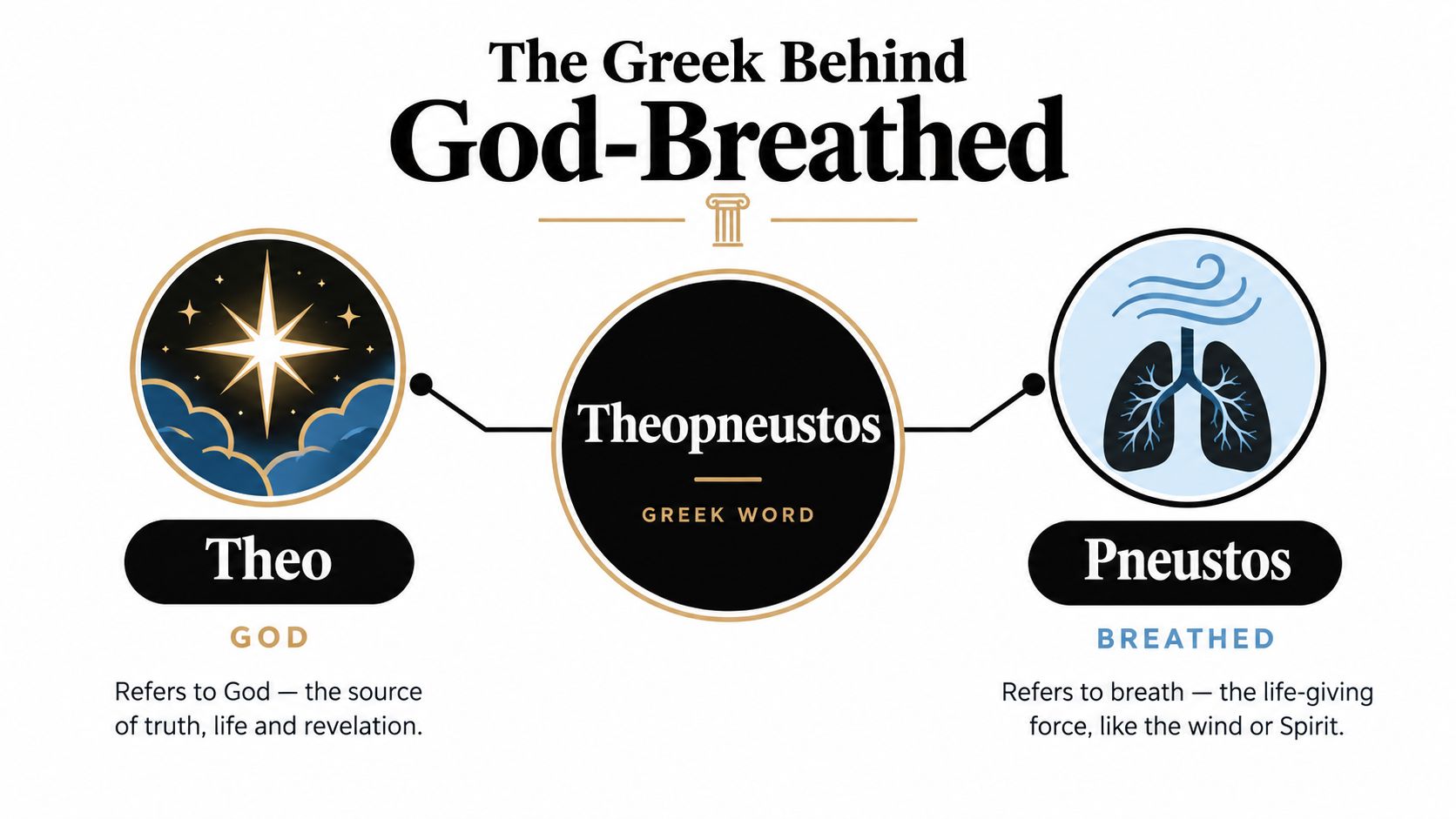
The key Greek word in 2 Timothy 3:16 is θεόπνευστος, commonly transliterated as theopneustos. It's a rare term, used only here in the New Testament. Its meaning becomes clearer when its parts are considered together.
Theos means God. Pneustos is related to breathing or being breathed. Combined, the term carries the sense “God-breathed.” The wording places God as the active source, while the written Scripture is the thing described as God-breathed.
That distinction matters because modern English can make “inspired” sound like emotional stimulation. We might say that a song inspired us, meaning it awakened a feeling or motivated an idea. But theopneustos points more directly to the text itself than to a private experience in the writer.
The theological claim, then, isn't merely that biblical authors felt close to God while writing. It's that the resulting Scripture bears a relationship to God's action. The text is the object of the claim.
Text and author belong together
This doesn't require us to imagine the human writers as passive instruments with no personality. Scripture contains different vocabularies, genres, perspectives, historical settings, and writing styles. Psalms don't sound like Romans, and a genealogy doesn't function like a prophetic oracle.
Second Peter 1:20-21 offers a complementary picture. It says prophecy didn't originate merely from human will, but that people spoke from God as they were carried along by the Holy Spirit. That passage highlights divine initiative while still presenting human speakers as real participants.
A useful working definition is this: inspiration is God's authoritative action in and through the human production of Scripture, so that the written text serves as a reliable instrument for teaching and formation. Traditions explain the relationship between God's agency and human authors differently, but this definition keeps the biblical emphasis in view.
A careful study habit
The Greek term shouldn't become a shortcut that ends interpretation. Knowing a word's root doesn't automatically settle every doctrinal question. Context, grammar, genre, manuscript evidence, and the wider witness of Scripture still matter.
Readers who want to investigate biblical words can learn practical methods through this guide to using a concordance. The point isn't to replace prayer or community with word studies. It's to slow down enough to ask what the text says before deciding what we want it to say.
Reading the Verse in Context
Second Timothy 3:16 makes the most sense when read with verses 14 through 17. Timothy has learned the sacred writings from childhood. Those writings are able to make him wise for salvation through faith in Christ. Scripture then appears as God-breathed and useful for a fourfold work: teaching, reproof, correction, and training in righteousness.
Each term adds something different.
- Teaching gives believers true instruction about God, salvation, worship, sin, hope, and faithful conduct.
- Reproof exposes what is false or morally crooked.
- Correction points toward restoration, not merely condemnation.
- Training in righteousness describes sustained formation, like discipline that develops a pattern of life.
Paul's list sounds less like a technical taxonomy and more like equipment for a pastor. Timothy needs Scripture to help a congregation know what is true, recognize error, return to the right path, and grow into a faithful way of living.
One phrase, two grammatical possibilities
The Greek phrase pasa graphe may be understood corporately as “all Scripture” or distributively as “every Scripture.” The corporate reading is commonly preferred, but the distributive option remains possible. The difference isn't trivial.
| Reading | Scope | Implication | Example |
|---|---|---|---|
| Corporate | Scripture as a whole | The entire scriptural corpus is treated as God-breathed | Narrative, poetry, prophecy, and instruction belong within one authoritative collection |
| Distributive | Each God-breathed writing | Individual writings are considered one by one | A reader asks how a particular psalm, letter, or historical passage functions as Scripture |
The corporate reading guards against selective inspiration. A reader can't merely call comforting passages inspired while treating challenging passages as disposable. It also encourages attention to genres that modern readers may overlook, including lists, genealogies, laws, laments, and narratives.
That doesn't mean every passage has the same literary purpose. A proverb isn't read like an epistle, and a lament isn't handled like a legal instruction. Whole-Bible inspiration requires genre-sensitive reading, not genre-blind reading.
The immediate context also places Scripture within the story of salvation through faith in Christ. Christians may disagree about how each passage connects to that story, but Paul doesn't treat the writings as isolated religious fragments. He sees them as sacred writings that make people wise for salvation and equip them for good work.
How Different Traditions Understand Inspiration
Christians broadly affirm that Scripture comes from God, but they don't all explain authority, canon, human authorship, tradition, and illumination in the same way. Those differences become visible when believers ask practical questions, such as who identifies the canon, how tradition should function, or whether inspiration applies to the original writings, the transmitted text, or the church's reading.
Four major streams
Roman Catholic theology joins biblical inspiration to the life and teaching authority of the church. Scripture belongs within an apostolic canon and is read alongside sacred tradition and the church's interpretive office. The community doesn't stand above Scripture as its inventor. Rather, Catholic theology sees the church as a Spirit-guided custodian and interpreter of the revelation entrusted to it.
Reformed theology emphasizes Scripture as the self-attesting word of the Holy Spirit. Reformed confessions commonly affirm that Scripture is fully truthful in its original form and sufficiently clear for matters necessary to salvation, while also recognizing the need for teachers, pastors, and careful interpretation. The text has final authority over the church, rather than the church creating the text's authority.
Wesleyan-Arminian theology places strong emphasis on the Spirit's illuminating work in believers. Inspiration and illumination remain distinct. Inspiration concerns the production of Scripture, while illumination concerns the Spirit's help as readers understand and respond to it. Human freedom, sanctification, and practical holiness receive particular attention.
Charismatic traditions often affirm the final authority of the biblical canon while also expecting present spiritual gifts, including prophecy or words of knowledge. In this framework, contemporary impressions or prophetic speech must be tested rather than placed automatically on the same level as canonical Scripture.
| Tradition | Core Claim | Extent or Scope | Role of Community or Tradition | View on Illumination |
|---|---|---|---|---|
| Roman Catholic | Scripture is inspired within the church's apostolic faith | Includes the church's received canon | Tradition and the magisterium guide authoritative interpretation | The Spirit assists the church and its members |
| Reformed | Scripture is the Spirit's authoritative word | Strong emphasis on the truthfulness and sufficiency of Scripture | Confessions and teachers serve Scripture's authority | The Spirit opens readers to understand and receive the text |
| Wesleyan-Arminian | Inspired Scripture forms believers for holy living | Emphasis on Scripture's authority alongside responsible response | Community helps believers pursue sanctification | Illumination supports transformation and faithful obedience |
| Charismatic | Canonical Scripture remains final while gifts continue | Contemporary words must be tested by Scripture | Church discernment evaluates prophetic claims | The Spirit gives present guidance without adding to the canon |
These traditions disagree at important points, and those disagreements shouldn't be disguised. Yet ordinary readers often experience the differences less as abstract systems and more as habits. One church may begin with a creed, another with a confession, another with a prayer for illumination, and another with communal discernment.
A mature reader can learn from this variety without treating every position as interchangeable. The central question remains practical: Does my approach let Scripture teach, correct, and train me, or does it only confirm what I already believe?
Textual Reliability and the Canon Question
A serious reader may object, “Before I ask whether all Scripture is inspired, how do I know which writings count as Scripture, and whether the text has been preserved?” That's a legitimate question. Inspiration is never discussed in the abstract. It concerns particular writings received, copied, translated, collected, and read by communities.
Early Christians recognized the canon through several overlapping considerations:
- Apostolicity: connection to an apostle or the apostolic witness.
- Antiquity: roots in the earliest Christian generation.
- Orthodoxy: agreement with the faith received by the churches.
- Catholicity: broad and sustained use among Christian communities.
These criteria didn't function as a mechanical invention of Scripture. They served as restraints, helping communities distinguish writings that belonged to the apostolic faith from writings that appeared later or contradicted that faith.
The text we receive
Manuscript transmission also deserves careful treatment. Greek manuscripts, early translations, and other ancient witnesses allow textual scholars to compare readings and identify places where copyists differed. Modern critical editions make those variations visible rather than hiding them.
That transparency is a reason to study textual criticism, not a reason to fear it. This introduction to textual criticism explains how readers can approach manuscript differences responsibly. A variant may affect wording without overturning the central Christian confession, and readers should distinguish a real textual question from an exaggerated claim that the Bible is therefore unusable.
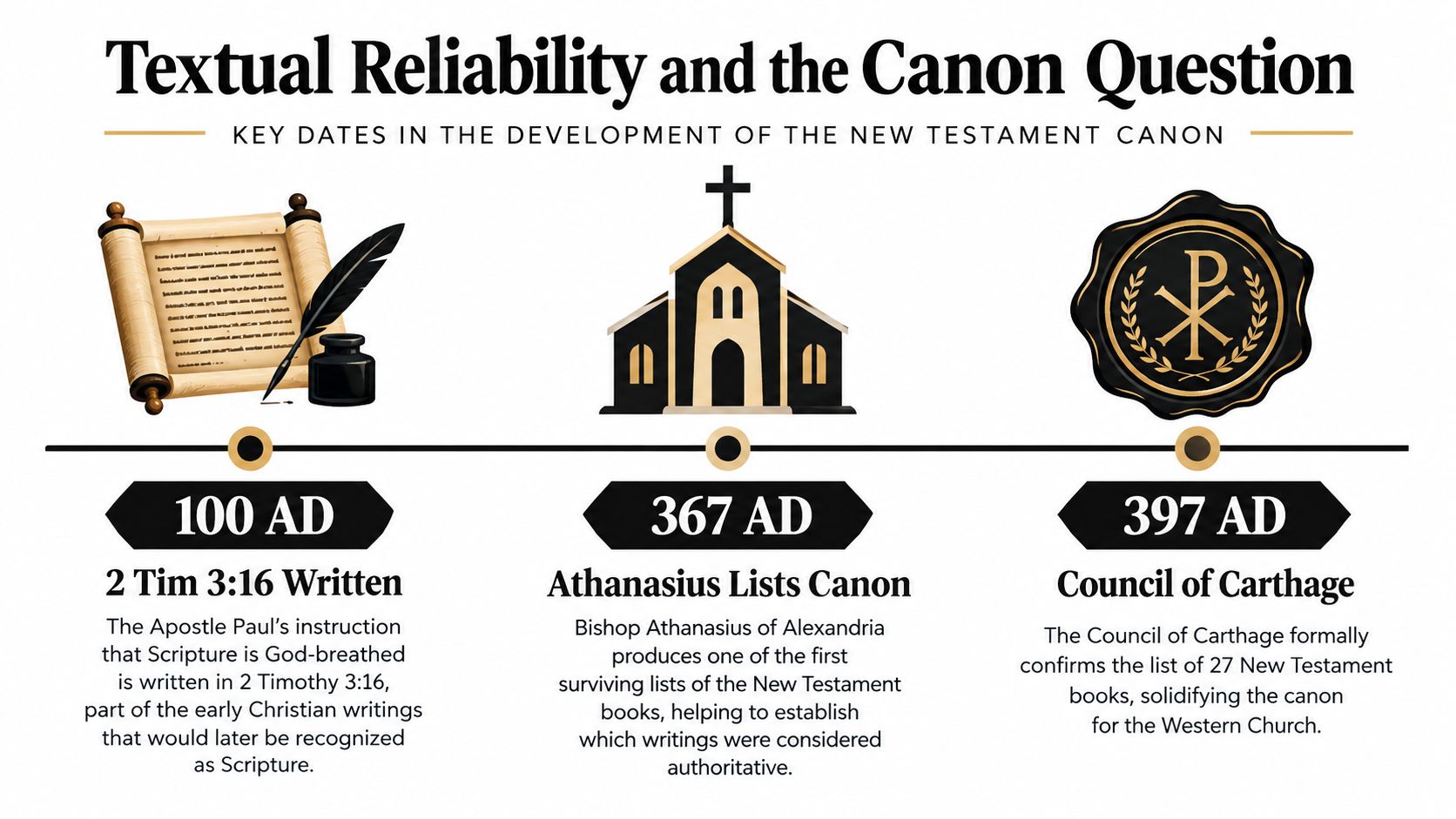
The deuterocanonical question adds another layer. Catholic and Orthodox traditions receive books that many Protestant traditions classify as Apocrypha, while many Protestant communities follow a Hebrew canon for the Old Testament and a different historical path of reception. The Septuagint, the Hebrew Scriptures, early Christian usage, and Reformation decisions all contribute to the discussion.
Christians should state these differences openly. A person's answer about the Apocrypha affects the shape of their Bible and the sources they use for theology, but it doesn't mean that every major Christian doctrine depends on one disputed boundary decision.
Confidence in inspiration shouldn't rest on pretending that no questions exist. It rests on God's character, the church's historical reception, the text's theological coherence, and responsible engagement with the evidence. Textual scholarship is a companion to careful faith because it helps readers know what they are interpreting.
Why Inspiration Matters When Life Feels Unstable
People rarely think about theopneustos during a calm afternoon. The question becomes sharper beside a hospital bed, after a moral failure, during a divorce, or in the silence that follows unexpected grief. In those moments, “Is Scripture inspired?” often means, “Can this text bear my weight when my own judgment feels unreliable?”
Recent reporting from the American Bible Society's State of the Bible 2026 describes Scripture engagement in the United States as falling back to roughly 2024 levels in 2026, while Bible curiosity remained high. The same coverage reports that Scripture-engaged Americans scored 7.4 out of 10 on calling, compared with 5.4 among Bible-disengaged Americans, and that Bible use rose during experiences such as divorce or tragedy. These findings don't prove a simple cause and effect, but they highlight a recognizable pattern. People often reach for Scripture in disruption while struggling to build ordinary habits around it.
Two ways to approach the Bible
One approach treats the Bible as a self-help manual. The reader searches for a sentence that matches the immediate feeling, extracts a promise, and moves on. That method may provide short comfort, but it can leave the reader unprepared for passages that lament, accuse, unsettle, or refuse quick resolution.
A second approach receives Scripture as a covenantal word that addresses the reader before it serves the reader's preferred mood. The Psalms give language for grief and anger. Job resists shallow explanations of suffering. The Gospels confront both despair and self-protection. An inspired text doesn't need to flatter us to sustain us.
In crisis, Scripture may not answer every question immediately. It can still teach you how to ask, grieve, confess, hope, and wait before God.
Illumination means that the Spirit helps readers understand and receive Scripture in the present. It doesn't turn every private impression into a divine command. It makes an ancient text readable now, within prayer, community, context, and obedience.
Ordinary-week devotion should therefore be unshowy. Read slowly. Repeat a sentence. Memorize a line. Pray the passage aloud. Share one honest observation with another person. The aim isn't performance or constant emotional intensity. It's a steady willingness to let Scripture address the whole person.
Practical Ways to Study and Journal Through the Doctrine
A doctrine becomes durable when it changes the way you handle a passage. You don't need to begin with an elaborate system. Start with a short reading arc, observe carefully, and record what the text does to your assumptions.
A six-day reading arc
Use one sitting for each passage, leaving enough time to reread rather than rushing to complete a quota.
- 2 Timothy 3:16: Write the four purposes of Scripture in your own words. Ask, “Which of these purposes do I welcome most, and which do I resist?”
- 2 Peter 1:20-21: Note what the passage says about human speakers and divine initiative. Ask, “How does this affect my view of the biblical writers?”
- Psalm 19:7-11: List the descriptions of God's instruction. Ask, “What does this passage expect God's word to produce in a reader?”
- John 10:35: Observe how Jesus refers to Scripture. Ask, “What does his use of the text teach me about reverence and interpretation?”
- Acts 17:11: Consider the Bereans' combination of openness and examination. Ask, “How can I test what I hear without becoming cynical?”
- Return to 2 Timothy 3:14-17: Read the whole movement again. Ask, “What kind of person is Scripture forming me to become?”
Three journal templates
Verse paraphrase: Write the verse without trying to improve it. Then paraphrase it in plain language, identify its command or promise, and name one assumption it challenges.
Translation comparison: Read the same passage in two translations. Record five lines: a wording that changed, a meaning that became clearer, a question that remains, a contextual observation, and a prayer.
Confession of trust: Begin with, “God, I don't understand…” Continue with what you fear, what the passage says, what you will refuse to pretend, and one small act of trust you can practice.
For additional ideas that connect biblical reflection with women's discipleship, PrayerPetals biblical insights can provide a supplementary starting point. Use any outside resource as a companion, not as a substitute for reading the passage in context.
HolyJot can keep this process in one place. Its Bible reader includes multiple translations, while verse-linked notes let you attach observations directly to a passage. You can create a “Doctrine of Scripture” study plan, save responses by tag, and use FaithAI to ask follow-up questions grounded in your saved insights. The Bible journaling guide offers a simple way to begin without turning journaling into a performance.
After a month, revisit the entries. Look for changes in your interpretation, recurring questions, and places where the passage moved from an idea into a practice. Inspiration is not honored only when you can explain it. It's honored when you keep returning to the text with humility, attention, and a willingness to be changed.
A Short Path Forward This Week
The phrase all Scripture is inspired by God brings together three movements. First, theopneustos directs attention to Scripture as God-breathed text, while the grammar of pasa graphe encourages a whole-corpus reading. Second, Christian traditions differ over canon, authority, community, and illumination, so honest study should name those differences rather than conceal them. Third, inspiration reaches its practical purpose when Scripture teaches, corrects, and trains a real person through an ordinary week.
Choose one passage from the reading arc. Read it in two translations, write a five-sentence entry using one of the templates, and save it in a HolyJot study plan tagged “Doctrine of Scripture.” Return to that entry after your next difficult week and ask whether your understanding has become more careful, more honest, or more faithful.
Inspiration is less a debate to win than a text to keep handling. Consistent handling, not instant certainty, shapes a Christian reader over time.
The question is no longer only whether the whole Bible comes from God, but whether you'll let that God-breathed word meet you where you are.
HolyJot gives you a Bible reader, verse-linked journaling, guided study plans, and FaithAI for Scripture-focused questions and cross-references. Visit HolyJot to begin organizing your study of Scripture and turning reflection into a steady daily practice.