


It's Wednesday night, with a couple of weeks left before Good Friday. You have a sanctuary, a small choir, and a congregation that ranges from teenagers to retirees. The musicians need a song list, the office needs an announcement, and someone has suggested a Passion play that nobody has time to rehearse.
You don't need a bigger production. You need a format your people can enter meaningfully and your volunteers can prepare without exhausting themselves before Easter.
Choosing among Good Friday service ideas starts with who can attend, what your church can realistically support, and the response you want to invite. A congregation comfortable with silence may welcome Tenebrae. Families juggling work and school may need a drop-in prayer walk or an accessible service they can follow at home.
The formats below are distinct planning choices, with setup requirements, time commitments, and ways to continue reflecting afterward. You can combine them, but keep a clear center. A Passion reading with a closing hymn is coherent; a Passion play, cantata, prayer walk, and extended sermon can leave everyone rushing.
Choose something people can participate in, not merely watch. Then give them a simple way to return to Scripture after they leave.
1. Tenebrae (Service of Darkness)
Tenebrae makes the gradual loss of light part of the congregation's prayer. Scripture, lament, and silence accompany the extinguishing of candles as worshipers reflect on Christ's suffering and death.
Choose this format when your church needs a solemn service without elaborate scenery. A small choir can support the readings, but clear voices and unhurried silence matter more than musical complexity.
Use this comparison graphic to discuss the format with your planning team.
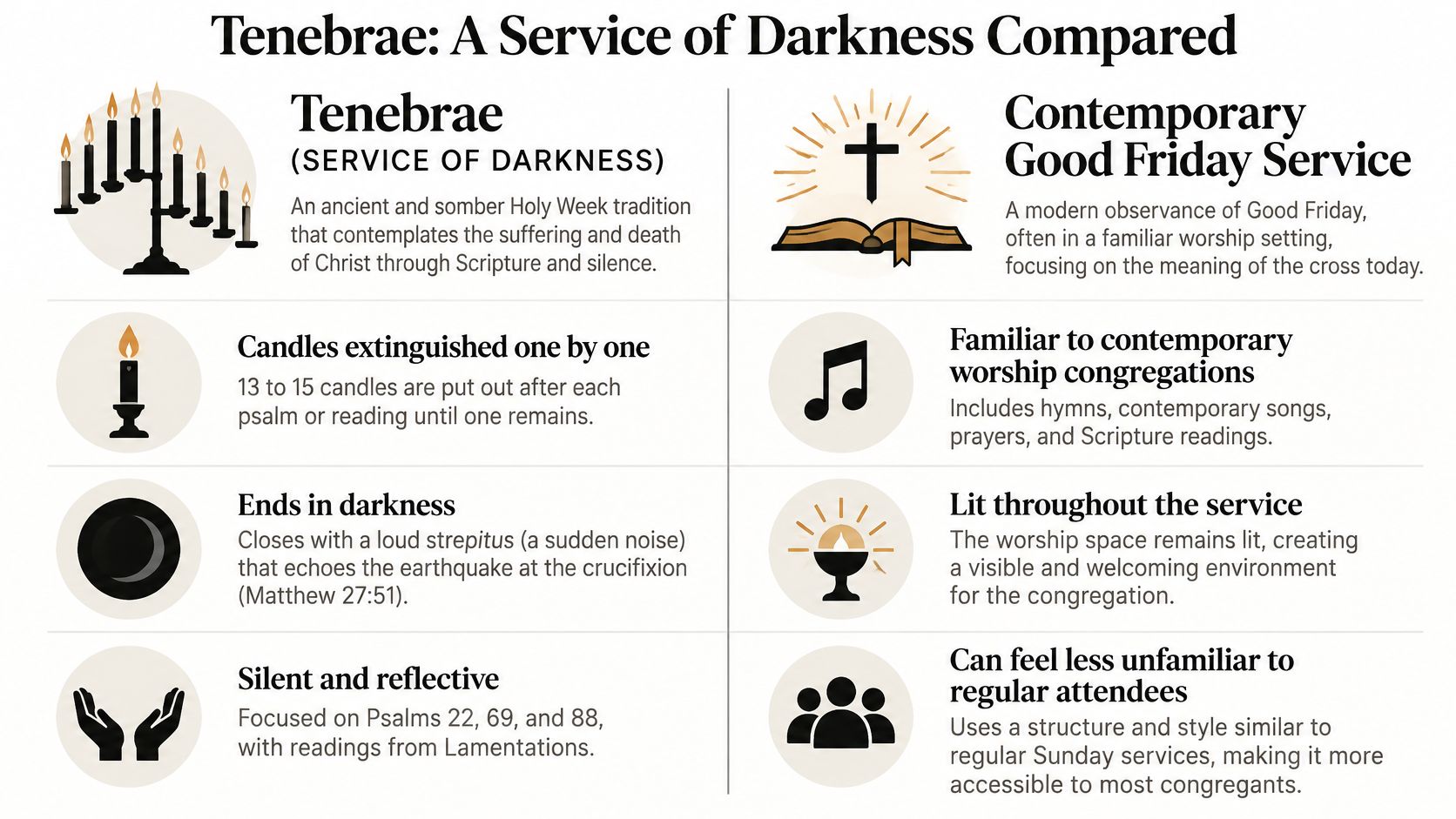
Rehearse the darkness, not just the readings
Arrange candles in secure holders, assign someone to extinguish them, and print every lighting cue in the leaders' scripts. A triangular stand is an option, not a reason to purchase equipment you'll rarely use.
Traditions differ over hiding, returning, or extinguishing the final candle. Follow your church's liturgical practice and explain the symbolism briefly rather than combining incompatible endings.
- Time commitment: Reserve an evening service slot and a separate technical rehearsal with readers, musicians, and ushers.
- Safety: Keep exits illuminated and walking routes visible. Battery candles are appropriate where open flames aren't permitted.
- Sensory access: If you include the concluding loud sound known as the strepitus, warn worshipers beforehand and offer a quiet alternative.
For example, a small congregation could alternate Gospel passages with a familiar lament, gradually dimming the room without adding a sermon after every reading.
This video offers a reference for discussing the service's pacing.
Follow-up: Send the final reading with a prompt about waiting when God seems absent. Don't rush worshipers past Good Friday's sorrow.
2. Three Hours Service (Seven Last Words of Christ)
A Three Hours service works best when people can enter and leave without feeling they've interrupted worship. It's a substantial commitment for leaders, but participants don't all need to stay throughout.
The traditional midday timing has a clear connection to the day: Encyclopaedia Britannica's Good Friday overview describes worship scheduled between noon and 3:00 p.m. to correspond symbolically with Jesus' final hours on the cross.
Build the service around Christ's final sayings, using a consistent rhythm of reading, meditation, music, and silence. The Good Friday sermon themes and outlines can help leaders prepare reflections that remain connected rather than becoming unrelated sermons.
Give every speaker the same brief
Ask contributors to explain the passage, connect it to Christ's saving work, and leave a question for prayer. Give each speaker an agreed stopping point and appoint a service coordinator who can discreetly manage transitions.
A drop-in service only works when the schedule is dependable. Don't make late arrivals guess whether they're entering a meditation or a quiet interval.
Print the sequence at the entrance and identify appropriate arrival and departure moments. Ushers need instructions about doors, seating, and conversations in the foyer.
For a community service shared among neighboring churches, distribute speaking responsibilities while keeping music and hosting under a clear lead. Shared ownership is helpful; competing service styles aren't.
Time commitment: Protect the full midday window, plus advance preparation with contributors and a sound check. If that exceeds your team's capacity, choose a shorter meditative service instead.
Follow-up: Give participants a reflection sheet organized by the sayings, inviting them to revisit whichever passage stayed with them.
3. Stations of the Cross (Via Crucis) Walk
For people who reflect better while moving, a Stations of the Cross walk offers a different pace from seated worship. Participants stop at marked locations to read, pray, and consider Christ's journey to crucifixion.
The traditional devotion comprises fourteen stations, as described by Public Holiday Checker's Good Friday guide. Some moments come from devotional tradition rather than an explicit Gospel scene, so distinguish Scripture readings from accompanying meditations.
A simple route can be reverent without resembling an elaborate outdoor installation.
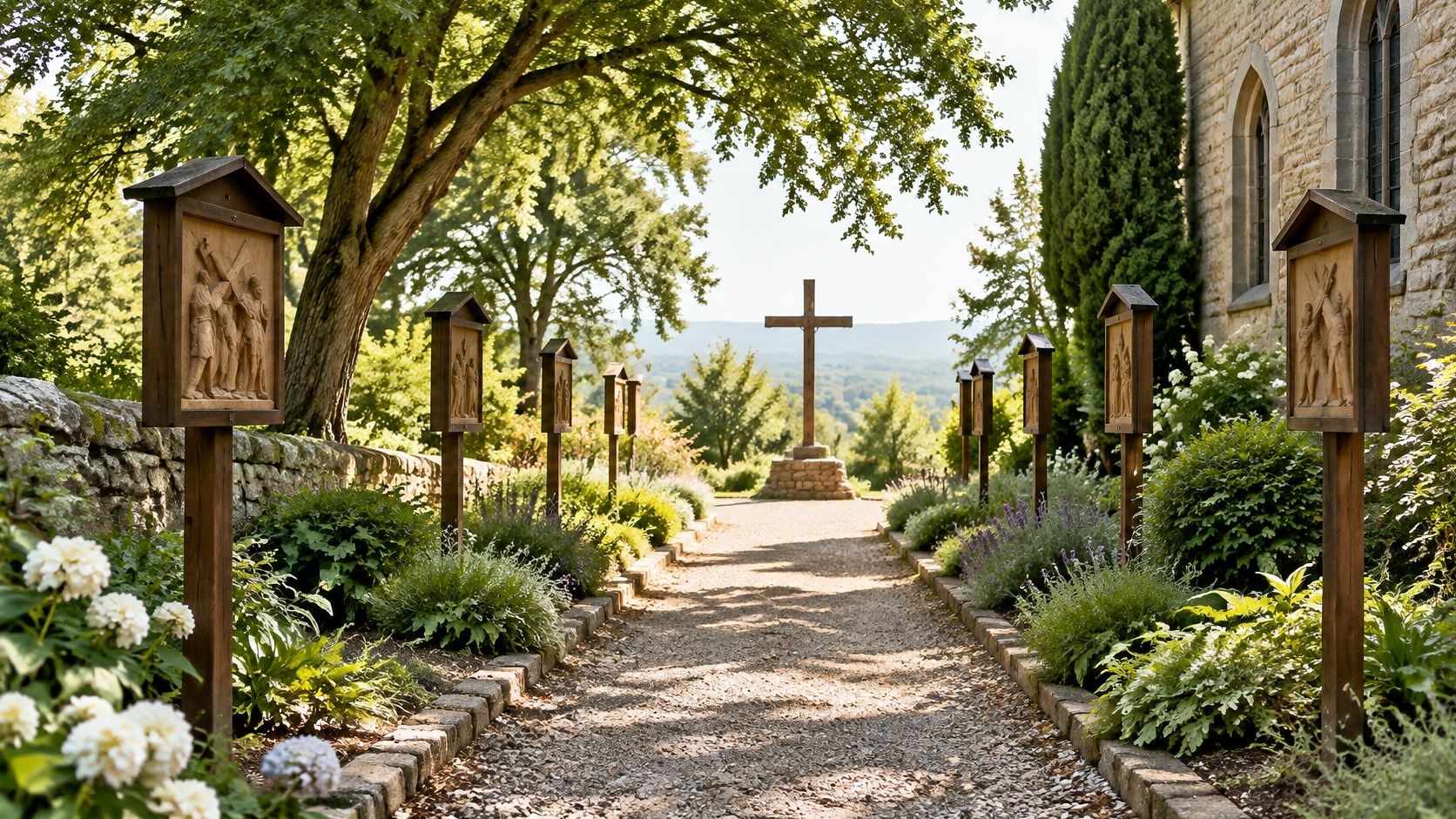
Walk the route before you publish it
Use sturdy signs, weatherproof sleeves, and a booklet that doesn't require a phone. QR codes can provide optional audio or larger text, but they shouldn't be the only way to participate.
- Access: Check gradients, door widths, surfaces, seating, and restroom access. Provide a seated version containing the same readings.
- Flow: Separate the entrance and finishing area where possible so arriving groups don't interrupt those concluding prayer.
- Weather: Decide in advance who authorizes the indoor alternative and how participants will hear about it.
A typical use case is a family arriving after school, following the route at its own pace, and stopping when children need an explanation. Give caregivers permission to simplify rather than complete every activity under pressure.
Time commitment: Offer an open arrival window and test the route at a prayerful walking pace before advertising an expected visit length.
Follow-up: Let households take the booklet home. Invite them to return to a passage about compassion and identify a practical act of care for the coming week.
4. Dramatized Passion Reading or Passion Play
Start with readers' theatre unless you already have a dependable drama team. Distinct voices can make the Passion narrative vivid without costumes, scenery, or simulated violence.
A review of more than thirty printed service orders in Reformed Worship's A Time to Weep identified historical reconstruction of the Passion, funeral-like lament, and Scripture-centered reflection as dominant formats. A dramatized reading belongs in worship when it serves attention to Scripture, not when it competes with it.
For example, a church with willing teenage and adult readers could use a narrator and assigned character voices, with everyone remaining at music stands. That removes complicated entrances and lets nervous participants concentrate on speaking clearly.
Keep the script and staging restrained
Prepare scripts with large type, marked pauses, pronunciation notes, and unmistakable speaker labels. Put microphones where readers can use them without passing equipment during solemn passages.
- Preparation: Hold a read-through before the technical rehearsal. Readers need to understand the text before learning where to stand.
- Pastoral care: Avoid graphic staging, surprise shouting, or pressure on children to enact violence.
- Interpretation: Don't portray Jewish people collectively as responsible for Jesus' death. Explain the narrative without reinforcing antisemitic stereotypes.
Time commitment: Budget for script preparation, a full read-through, and a rehearsal in the worship space. A staged production requires substantially more coordination, safeguarding, and technical support.
Resist adding a lengthy sermon that repeats everything the congregation has just heard. A brief explanation and silence may serve better.
Follow-up: Share the Gospel passage rather than merely posting performance photos. Ask participants which encounter in the narrative challenged their understanding of faithfulness.
5. Sacred Music Service of Lament (Hymns and Cantata)
Your small choir may be better served by familiar hymns than an ambitious cantata. Good Friday isn't the occasion to discover that an accompaniment track, unfamiliar score, and tired singers don't work together.
A music-centered service can combine congregational singing, a prepared choral piece, Scripture, and prayer. When I Survey the Wondrous Cross and Were You There offer different musical approaches, but either needs a key and tempo that support participation.
Choose this format when musicians already have suitable repertoire. If they're learning everything from scratch, the rehearsal burden can outweigh the benefit.
Planning judgment: Select music your congregation can pray through, not music your team feels obliged to prove it can perform.
Build the service around participation
Alternate listening with singing so worshipers don't become an audience. Print lyrics legibly, check projection contrast, and keep spoken introductions brief.
A workable example is a choir offering a prepared lament between Gospel readings, with the congregation answering through familiar hymns. An accompanist can sustain transitions without filling every silence.
Time commitment: Allow for rehearsal with the actual accompanist and a complete transition run-through. Keep the service within your normal evening worship window rather than adding material just because musicians have prepared it.
Check permissions for printing lyrics, livestreaming, and publishing recordings. Permission to perform music in the building doesn't automatically settle every recording use.
Follow-up: Share an authorized recording or a text-based reflection connecting the music to Scripture. The reflection on beauty for ashes can support a later conversation about grief and hope, without forcing a cheerful conclusion onto Good Friday itself.
6. Cross Reflection Prayer Stations
Prayer stations work when people understand what to do without needing a volunteer beside them. They fail when the room feels like an activity fair or participants must disclose something personal to take part.
Use a restrained setup: a cross, a confession area, a place for intercession, and somewhere to sit with Scripture. A simple focal point is enough.

For example, after a brief gathering, worshipers could move freely between written prayer and quiet reflection. Someone who prefers to remain seated should have the same passages and prompts available.
Make every response optional
Write instruction cards with a Scripture reference, a plain-language action, and permission to pass. Place pens and paper within reach of seated participants.
- Confession: Invite people to fold papers and place them in a covered container. Explain who will handle and dispose of them.
- Physical safety: Use blunt symbolic objects or protected displays instead of loose sharp nails and thorns. Avoid unsupervised hammering.
- Privacy: Keep prayer requests separate from confidential confession. Don't photograph readable papers or people praying without permission.
Time commitment: Allow an unhurried drop-in period, plus setup and a volunteer walkthrough. Stations need replenishing and quiet supervision even when there's no formal program.
Don't measure engagement by how many objects people touch. Someone sitting quietly may be participating deeply.
Follow-up: Offer a private journaling prompt that repeats the station's Scripture. Make clear that responding to God doesn't require uploading a confession or sharing it with the church.
7. Good Friday Prayer Vigil
An extended vigil asks the congregation to make time for prayer rather than attend a tightly scripted event. It suits churches with committed intercessors, but it needs a host plan, not just a sign-up sheet.
Start with a window you can staff reliably. Don't promise overnight access unless you can provide secure entry, responsible supervision, and a clear response to emergencies.
A quiet sanctuary can support the vigil without elaborate decoration.
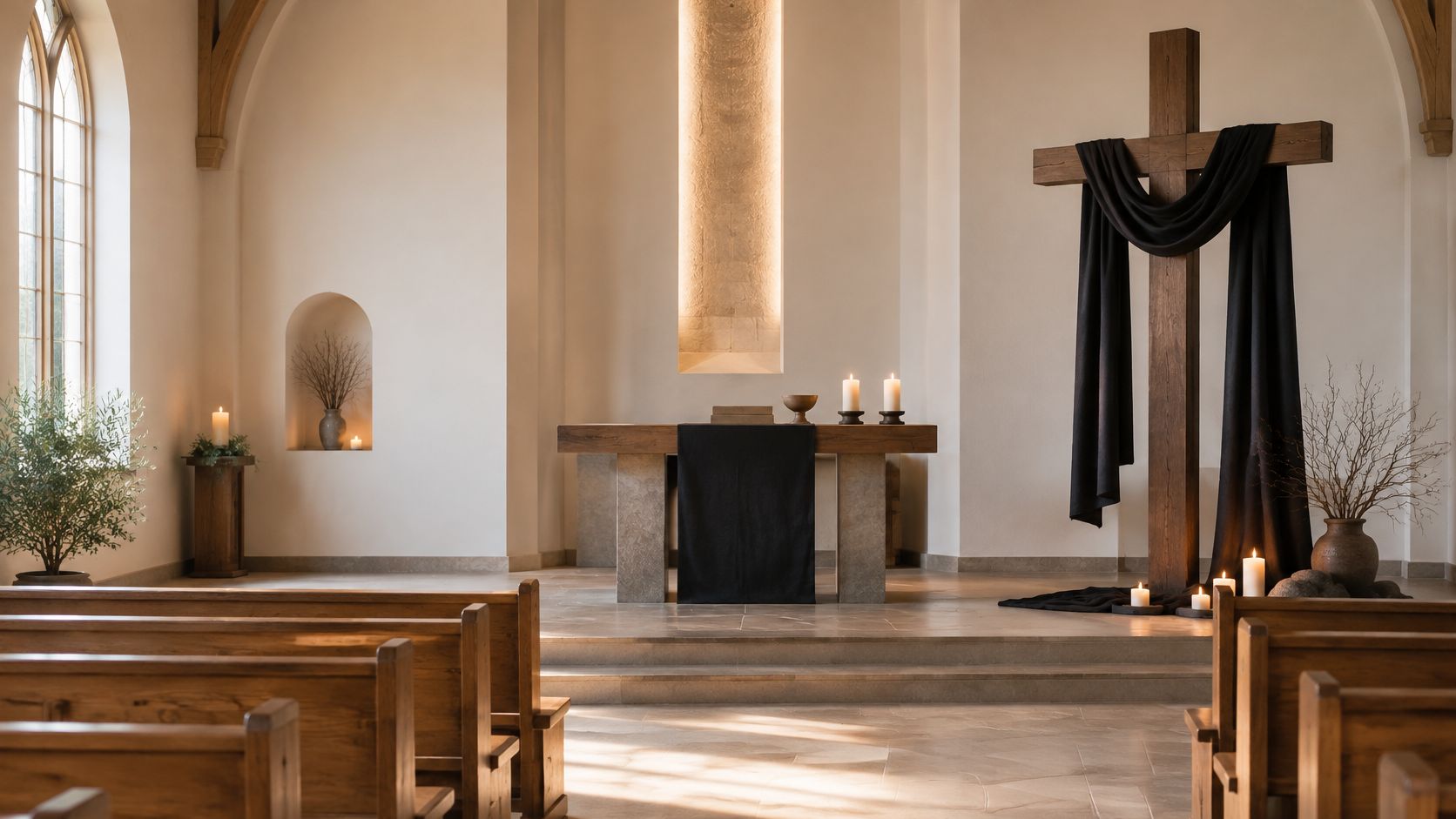
Give participants somewhere to begin
Prepare a guide that moves through Scripture, thanksgiving for Christ's sacrifice, confession, intercession, and silence. Include prayers for people facing suffering without requiring participants to search for words.
For example, a small group could take responsibility for an evening period, with members praying individually while a designated host welcomes arrivals. Remote participants can use the same guide at home.
- Coverage: Assign responsibility for opening, handovers, and closing. Keep a contact number where hosts can find it.
- Comfort: Provide suitable seating, drinking water, accessible restrooms, and enough light to read.
- Confidentiality: Share only requests approved for circulation. Keep identifying details out of public prayer displays.
Time commitment: Participants can choose a manageable prayer period; organizers must cover the entire advertised window and its handovers. An uncovered slot is a staffing issue, not a spiritual failure.
Use prayer during difficult times as an optional resource for people who feel unsure how to begin.
Follow-up: Ask permission to keep appropriate requests on a shared prayer list. Assign someone to check whether those requesting pastoral contact actually receive it.
8. Hybrid Livestream and Digital Good Friday Service
A camera at the back of the sanctuary doesn't automatically create a service people can follow at home. Remote worshipers need audible readings, visible words, and explanations of anything happening beyond the frame.
There's a practical reason to consider this pathway: a CPAS study across four English dioceses reported an estimated 36% increase in engagement among churches offering an online Church at Home option, according to the CCX Easter attendance analysis. That finding supports offering access, not assuming your congregation will achieve the same result.
Design for a caregiver joining from home, a shift worker watching later, or someone who can't manage the journey to church. Don't require candles, printing, or constant commenting.
Plan an actual at-home response
Provide a downloadable order of service and a lightweight text version. Tell remote participants when to read, pray, or remain silent, especially during physical actions they can't see.
- Technical preparation: Test speech through the actual stream on headphones. Sanctuary sound and broadcast sound aren't interchangeable.
- Accessibility: Provide captions and a corrected transcript where possible. Keep important text readable on a phone.
- Pastoral response: Assign a moderator and provide a private contact route. Don't invite sensitive disclosures into public comments.
Time commitment: Add a technical rehearsal, caption review, and replay preparation to the in-person workload. If nobody can cover these tasks, a clearly recorded reading with an accessible devotional may serve better than an unreliable livestream.
Follow-up: Publish the replay with the Scripture passage and a reflection prompt. Assess meaningful participation through watch time, voluntary responses, and pastoral connection rather than treating every stream start as attendance.
Good Friday Service Formats at a Glance
Use this table to shortlist two or three formats before you commit volunteers or budget. Duration and cost shift with your building, your musicians, and your route, so treat each row as a planning decision rather than a fixed schedule.
| Item | Best For | Typical Duration | Budget | Tech Needed |
|---|---|---|---|---|
| Tenebrae (Service of Darkness) | Quiet, atmospheric reflection on Christ's suffering | Evening or late afternoon; typically about an hour | Minimal | Minimal; candles and safe low lighting |
| Three Hours Service (Seven Last Words of Christ) | Extended biblical reflection with multiple speakers | About three hours | Low to moderate; printed booklets and speaker preparation | Minimal; sound support may help |
| Stations of the Cross (Via Crucis) Walk | Participatory, guided devotion for all ages | Often 30 to 60 minutes depending on route and pacing | Low to moderate; printed guides and simple station materials | Minimal; optional digital station resources |
| Dramatized Passion Reading or Passion Play | Vivid storytelling for families, children, and newcomers | A readers' theater takes about 20 to 30 minutes; full productions run longer | Modest for a reading; higher for a full production | Optional sound, lighting, and staging |
| Sacred Music Service of Lament (Hymns and Cantata) | Music-centered worship with a reflective tone | Typically around an hour, depending on the program | Moderate; choir rehearsal and accompanist time | Sound support may be useful |
| Cross Reflection Prayer Stations | Self-paced, hands-on prayer and reflection | Open during a set window of a few hours; each visit is self-paced | Low to moderate; printed prompts and basic supplies | Minimal; optional digital prompts |
| Good Friday Prayer Vigil | Sustained individual and community prayer | Several hours or up to 24 hours | Low | Minimal; online sign-up tools are optional |
| Hybrid Livestream and Digital Good Friday Service | Including remote participants and extending access | Matches the length of the in-person service it carries | Requires investment in equipment and technical support | Reliable video, audio, internet, and a technical team |
Two cells deserve a second look before you decide. The hybrid row is the only format where technology is a hard requirement rather than an enhancement, so treat its budget line as a commitment to equipment, rehearsal time, and a technical team. At the other end, the vigil and Tenebrae ask almost nothing financially but demand careful scheduling, since volunteer coverage and late-evening timing are where those services usually strain.
Turning One Good Friday Into a Week of Discipleship
Which format fits your people, your budget, and your timeline? That question matters more than which service looks most impressive on another church's website.
Choose a core format your team can prepare confidently. Then add a modest follow-up that helps people return to the message without requiring another event, another rehearsal, or another complicated volunteer rota.
A Tenebrae service might lead into private reflection on waiting. A Stations walk might continue through a household reading on Holy Saturday. A vigil might leave the congregation with a carefully moderated prayer list that remains available through Easter Sunday and beyond.
Make the next step easy to find
Decide on the follow-up before printing the order of service. Put the reading, prompt, or contact information where participants already look, rather than announcing a resource you still need to create.
- Give a clear invitation: Ask people to read a particular passage, pray for someone, or write a private response.
- Provide an offline option: Send home the same material on paper for anyone who doesn't use the church's digital resources.
- Name a responsible person: Assign someone to publish the reflection, monitor requests, and arrange pastoral follow-up.
Communication also deserves practical attention. If you're producing invitations or take-home guides, the distribution decisions involved in leaflet marketing for UK businesses offer a useful logistical comparison: readable print and a clear next action matter more than a crowded design. For church materials, make the service time, accessibility information, and follow-up route easy to locate.
Keep expectations gentle. Someone facing bereavement may need pastoral conversation rather than a discussion group, while a teenager may prefer a private journal entry to speaking aloud. Offer participation without making public disclosure the measure of faith.
HolyJot is one practical option for hosting Scripture-linked prompts, reading plans, and prayer lists in a private Community Hub. Paper guides, phone calls, and personal conversations still belong alongside it.
A memorable service is a beginning. When you give people a clear next step and care for those who respond, you help them carry Good Friday's message into ordinary prayer, relationships, and daily decisions.
HolyJot offers verse-linked journaling, guided study plans, and private Community Hubs for continuing reflection together. Visit HolyJot to prepare a Good Friday follow-up prompt, share a Scripture plan, and give your congregation a place to keep praying after the service.