


To approach the throne of grace means to come to God in prayer with honest, confident trust through Jesus the great high priest, expecting to receive mercy for failure and timely grace for present need (Hebrews 4:16).
Perhaps you've just spoken sharply to someone you love, and now you're trying to pray. Or you're facing a difficult decision, but the words won't come because you're wondering whether God wants to hear from you at all. You don't feel confident. You feel exposed.
Hebrews doesn't tell you to manufacture a better mood before praying. It directs your attention away from your spiritual performance and toward the high priest who makes your approach possible.
What Approach the Throne of Grace Means
The invitation is to draw near to God, not because you've earned an audience, but because Jesus represents you before him. Prayer becomes an act of trust in Christ rather than a report on how well you've behaved.
In the King James Version, the verse reads:
Let us therefore come boldly unto the throne of grace, that we may obtain mercy, and find grace to help in time of need.
Authority, generosity, and movement
Throne means that the person you approach has authority. God isn't merely a sympathetic listener who wishes he could help. He rules, judges rightly, and deserves reverence.
Grace describes the welcome available through Jesus. God's holiness hasn't disappeared, but believers aren't told to wait at a distance until they've become impressive enough to enter.
Approach calls for a response. You turn toward God, address him, and bring your actual condition into prayer rather than merely thinking that prayer might be useful.
An open Bible can help keep that invitation in view when your feelings pull you elsewhere.

Think of a child entering a king's study because a trusted member of the royal household has opened the door and welcomed them inside. The king's authority remains, but the child doesn't have to negotiate access alone. The analogy has limits, but it helps distinguish welcome from entitlement.
The verse also belongs to a larger argument. The writer first presents Jesus as a high priest who understands human weakness, then urges believers to come. That order matters: Christ's character and work come before the command to pray confidently.
Access to God, Then and Now
To understand the invitation, begin with the sanctuary arrangement behind it. Worshipers brought offerings into the outer court, priests served in the Holy Place, and a curtain separated that space from the Most Holy Place.
These boundaries communicated that God was present among his people, but that approaching his holy presence wasn't casual. Ordinary Israelites could worship, pray, and receive God's care without entering the innermost sanctuary. Restricted sanctuary access must not be confused with an absence of personal faith or prayer.
The sanctuary boundary
Under the Levitical system, the high priest alone entered the Most Holy Place, once each year on the Day of Atonement, carrying sacrificial blood, as the BibleMaximum explanation of Hebrews describes; the Jerusalem Temple's destruction in AD 70 further highlights why access through Christ isn't dependent on a surviving sanctuary.
The Old Testament instructions originated in the tabernacle setting, before the Temple. Keeping that distinction clear prevents us from treating every sanctuary detail as though it belonged to the same historical moment.
At the heart of the tabernacle's inner sanctuary stood the Ark of the Covenant and its cover, traditionally called the mercy seat. This wasn't a chair where a human priest sat. It was the sacred location associated with God's presence and the atonement ritual.
The Bible Hub explanation of the throne of grace connects this imagery with Exodus 25:21–22, where God meets and communicates with Moses, and Leviticus 16, where sacrificial blood is sprinkled in the annual ceremony; it also places the invitation within Hebrews 3–5 and its developing argument about Jesus' priesthood.
A throne associated with mercy
A courtroom offers a useful comparison. The judge's bench communicates authority, while a merciful judgment shows how that authority may be exercised toward someone in need.
Hebrews brings royal and sanctuary imagery together. God remains sovereign, yet those who come through Jesus encounter a throne characterized by grace. The writer isn't merely saying that God is kind in a general sense. He's explaining why believers may draw near to the holy God.
Access to God in the Levitical System and Hebrews 4:16
| Aspect | Levitical Temple | Hebrews 4:16 |
|---|---|---|
| Who may enter the Most Holy Place | High priest only | Every believer, through Jesus |
| How often | Once a year, Day of Atonement | Ongoing, at any time of need |
| What is carried | Sacrificial blood | Honest need and faith in the high priest |
| Where access happens | Physical sanctuary behind a curtain | Before God's throne of grace |
| What is received | Atonement for the nation | Mercy for failure and grace for present help |
The comparison concerns access to God's presence, not permission for Christians to enter an earthly Temple chamber. Nor does honest need replace sacrificial blood as an offering. Believers bring their petitions because Christ has accomplished the priestly work they couldn't accomplish themselves.
Mercy and grace belong together, although distinguishing them helps us pray. Mercy meets us in guilt and misery; grace includes God's generous provision for the need before us. These aren't sealed compartments, as though mercy concerns only the past and grace only the future.
You don't bring a record that proves you deserve admission. You come relying on the high priest who represents you.
For prayer beyond this passage, these Bible verses about prayer offer language for praise, confession, dependence, and petition.
Greek Words That Shape the Verse
A useful way to hear the Greek is to assemble its movement: come near, speak openly, receive mercy, and find help suited to your need. The vocabulary describes an encounter with God, not a technique for producing a particular feeling.
The Bible Hub commentaries on Hebrews explain that proserchesthai has a worship-related sense in Hebrews and the Septuagint, while parrēsia conveys confidence, frankness, or freedom of speech. The same discussion identifies the communal exhortation and the purpose clause that connects approaching with receiving.
Drawing near and speaking freely
Proserchesthai means to approach or draw near. The Septuagint is the ancient Greek translation of the Hebrew Scriptures, so this worship vocabulary carries an established biblical setting. You come as someone invited into relationship with God, not as a stranger trying to attract his attention.
Parrēsia describes the manner of that approach. It allows candid speech rather than a polished performance. You can acknowledge resentment, confusion, or doubt without pretending those struggles are virtues.
Honesty doesn't require endorsing everything you feel. You can tell God that you're angry and also ask him to correct what's wrong in your anger.
Key Greek Terms in Hebrews 4:16
| Greek term | Core meaning | Role in Hebrews 4:16 | Practical reading |
|---|---|---|---|
| proserchesthai | To come near, approach | The action of approaching | Come as a worshiper, not a stranger |
| parrēsia | Confidence, frankness, freedom of speech | The manner of coming | Speak openly, including doubt and anger |
| eleos | Mercy | What believers receive | Receive forgiveness without self-punishment |
| charis | Grace, favor | What believers find for their need | Ask for strength for the next task |
| eukairon boēthēia | Timely help, help at the right moment | Describes the help sought | Name the moment when you need help |
| thronos | Throne, seat of authority | The place of approach | Remember God's holiness and rule |
The table's transliterations are learning aids. More precisely, boētheian is the noun form in the phrase eis eukairon boētheian, expressing help appropriate to the time of need. It doesn't promise that God will follow a deadline you set.
A shared invitation with a purpose
The wording is let us, not merely an instruction to an isolated individual. Christians can practice this approach together, bringing another person's weakness to God without treating that person as an outsider.
The small word hina, meaning so that, introduces the intended outcome. Prayer isn't an entrance examination; believers approach to receive what they lack.
A practical prayer might therefore acknowledge Jesus' welcome, name an uncomfortable truth, and ask for fitting help. The grammar gives prayer direction without requiring elaborate language.
Confidence Without Presumption
Bold prayer and demanding prayer aren't the same thing. Confidence trusts the welcome God gives through Christ; presumption assumes that welcome obliges God to provide the outcome we choose.
The Sacred Texts Guide commentary on Hebrews grounds confident approach in Jesus' sympathetic, sinless priesthood rather than personal worthiness or emotional certainty. That distinction protects anxious believers from thinking their hesitation disqualifies them, while also correcting those who confuse faith with control.
Ask directly without taking control
Jesus' prayer in Gethsemane models a request that is both earnest and submitted. He doesn't conceal the suffering before him or treat surrender as a reason not to ask. He entrusts his desire to the Father's will.
Submission, then, isn't the cancellation of petition. It's the refusal to make your preferred answer the condition of continued trust.
Common Misreadings of Confident Prayer
| Misconception | What Hebrews 4:16 supports | Corrected practice |
|---|---|---|
| Boldness means demanding a specific result | Confidence rests on Christ's priesthood | Ask clearly, then submit the outcome |
| Only confident feelings make prayer valid | Confidence is grounded in mediation, not emotion | Pray honestly even when you feel dry |
| You must be worthy before you approach | Mercy is received, not earned | Confess, then receive mercy without self-punishment |
| Reverence disappears in bold prayer | The throne signals holiness and authority | Pair boldness with worship and honest lament |
Lament belongs within reverent prayer. You can grieve, ask why, and admit that waiting hurts without pretending to understand God's purposes.
Unanswered prayer also requires care. A delay isn't proof that you used the wrong words, and continued hardship isn't automatic evidence of inadequate faith. Some needs remain painful even while God sustains the person who prays.
A useful test: Can you keep the request open before God without making a particular answer the price of trusting him?
You may not be able to answer yes immediately. Bring that resistance into prayer too. Submission can begin with the admission that you want to trust God but are frightened of what that trust might involve.
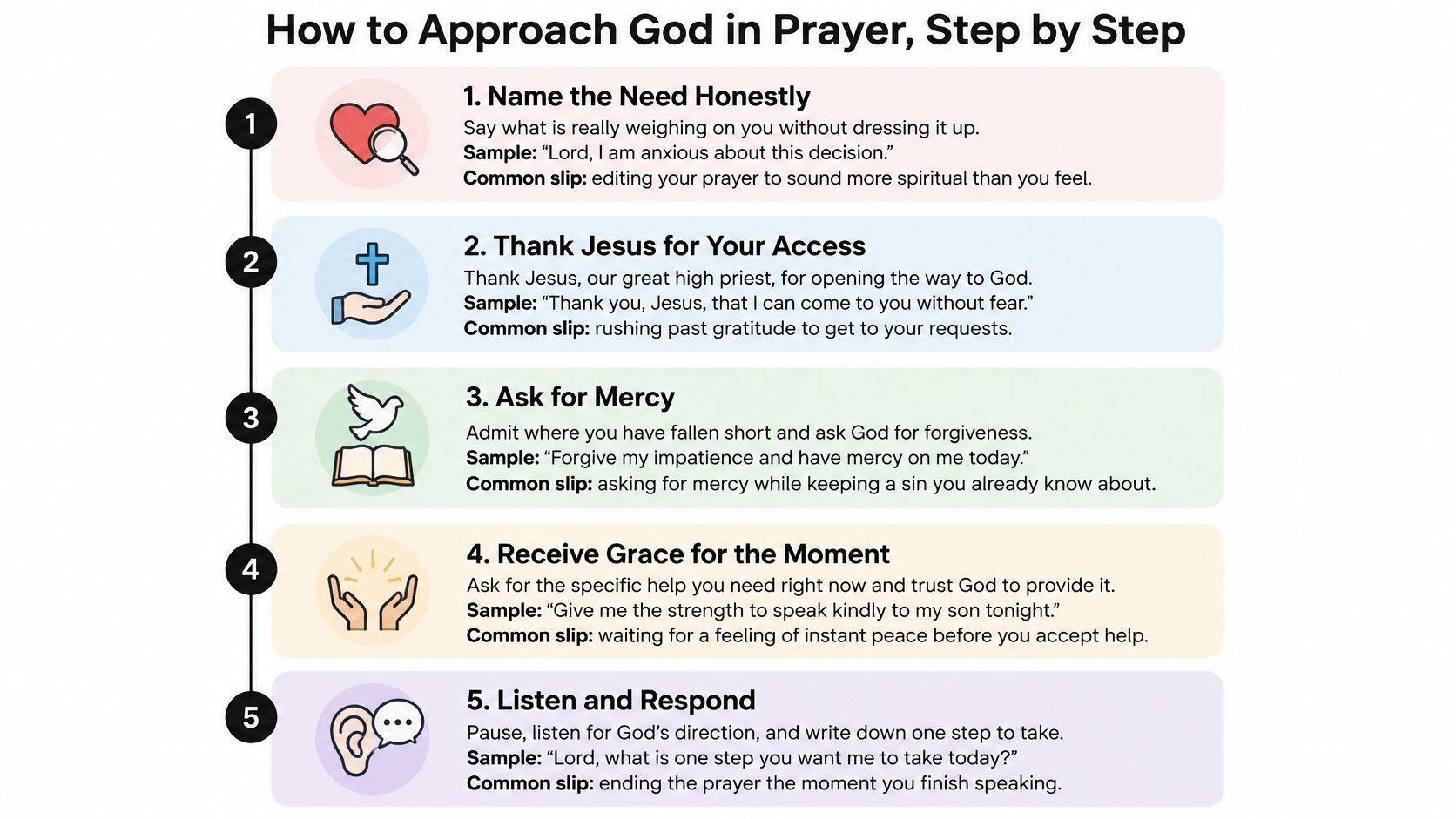
How to Approach God in Prayer, Step by Step
You don't need an impressive prayer vocabulary to begin. Across 35 countries surveyed in 2024–2025, at least half of adults in 14 countries said they prayed daily, according to Pew Research Center's survey of spiritual and religious practices. That describes a habit, not the quality of anyone's prayer.
The visual guide offers a compact approach; the practice below separates receiving help, submitting the outcome, and recording your response.
A repeatable prayer practice
Name the need plainly. Begin with what is truly weighing on you: Lord, I'm anxious about this decision. The common slip is editing your prayer until it sounds more respectable than your real concern.
Receive mercy. Confess a specific wrong and accept forgiveness through Christ: I confess my impatience; thank you for your mercy. Don't confuse ongoing self-punishment with repentance; receiving forgiveness should lead toward repair, including an apology when needed.
Ask for timely help. Identify the situation in which you need God's provision: Give me wisdom for the conversation on Thursday. A broad request can be sincere, but naming the conversation helps you recognize what you're asking for.
Name the grace needed for your next action. Bring the request close to the task ahead: Give me patience to listen before I speak. Avoid waiting for all anxiety to disappear before taking a faithful, practical step.
Submit the outcome. Tell God what you hope for while entrusting the result to him: Please bring reconciliation, and help me obey you even if the conversation remains difficult. The common slip is treating submission as passivity instead of preparing carefully and acting responsibly.
Rest and record. Pause, then write the request, any relevant Scripture, and the action you intend to take. Don't assume every thought that occurs during silence is God's instruction; weigh impressions against Scripture and seek wise counsel for consequential decisions.
If you need help establishing a sustainable routine, this Christian prayer guide can support the practice without turning it into a rigid script.
Pray the pattern as a whole
Here's a sample prayer you can adapt rather than repeat mechanically:
Father, I'm afraid of tomorrow's conversation. Thank you that Jesus opens the way to you. Forgive my impatience and help me receive your mercy. Give me wisdom, a listening heart, and courage to speak gently. I ask for reconciliation, but I entrust the outcome to you. Help me rest, then record the next faithful step. Amen.
You can also use the following video as a prompt for further reflection on approaching God in prayer.
Journaling Prompts and Group Questions for Reflection
Writing helps you distinguish what you're asking God to change from what you're reluctant to surrender. It also gives you somewhere to record questions without forcing a tidy conclusion.
Prompts for personal prayer
Choose the prompt that exposes your present need rather than trying to complete every prompt at once.
- Confidence: Where am I trying to approach God on my own terms?
- Mercy: What failure do I need to receive mercy for today?
- Grace: What help do I need for the day ahead?
- Submission: Which outcome am I holding too tightly?
- Timely help: When did I receive help I didn't expect?
- Scripture: What does the passage's description of Jesus show me that I'd forgotten?
- Honesty: What does my most honest prayer sound like this week?
Use a simple entry method: copy the verse, describe the need, write your response or unresolved question, and date the entry. Leave room for a later note rather than inventing an answer before you have one.
For a difficult conversation, an entry might distinguish the request for reconciliation from your responsibility to apologize. That distinction helps you notice obedience even when the other person's response remains outside your control.
These prayer journal prompts can help when you know you need to pray but aren't sure where to begin.
Questions for a small group
- What does the throne suggest about God's authority, and how should that shape our reverence?
- Which challenges your prayer life more: parrēsia, or frankness, or eleos, mercy?
- Why does the invitation say let us, and what might that change about praying together?
- When have you prayed boldly and encountered a refusal or a delay? Share only what you're comfortable discussing.
- How can we confess failure and receive mercy together without pressuring anyone to disclose private details?
- What practice will we try together before our next meeting?
Facilitation note: Read the surrounding passage aloud before discussion, including the description of Jesus that precedes the invitation. Let participants pass, keep personal disclosures confidential, and ask permission before offering advice.
Close by praying for the needs people have willingly shared. Don't turn someone's confession into a teaching example while they're still vulnerable.
Start Approaching the Throne This Week
Begin with a modest practice you can repeat. You're learning to bring your real life before God, not trying to produce an impressive journal.
- Opening day: Read the passage about Jesus' priesthood and the invitation to approach, then write its meaning in your own words.
- Following day: Name the need you're most tempted to hide.
- Next day: Confess a failure and write what receiving mercy would change.
- Midweek: Ask for help with an approaching responsibility.
- Following day: Identify the grace needed for your next action.
- Next day: Name the outcome you need to entrust to God.
- Closing day: Review your entries and mark a request as answered, clarified, or still open.
At HolyJot, we offer a Bible journaling experience for Christians seeking closeness to God through reflection, study, and personal writing. You can attach Scripture from six Bible translations to entries; FaithAI responds from Scripture, and entries can remain private or be shared with a prayer partner or small group.
The screenshot below shows the platform.

Choose a time, a verse, and an honest request for today. Come before you feel ready, relying on Jesus rather than on your ability to pray well.
HolyJot offers Scripture-linked journaling and Bible-anchored prompts to help you bring real needs into prayer. Visit HolyJot to begin an entry on approaching the throne of grace, recording your request and the help you're seeking.