


Matthew 7:7 and Luke 11:9 contain the promise “ask and it will be given to you,” but the passage presents prayer as a persistent relationship, not a magical guarantee. The Bible's own pattern is ask, seek, and knock, a movement of trust, attention, and endurance.
You may be reading these words late at night, with a prayer that hasn't changed but an answer that hasn't arrived. Perhaps you've asked for healing, direction, reconciliation, work, or strength, then wondered whether silence means you've asked badly or believed too little. That question deserves honesty rather than a quick religious slogan.
The promise invites confidence, but it doesn't turn God into a vending machine. It teaches believers to bring real needs into a continuing relationship, to seek wisdom as well as outcomes, and to keep listening when the path remains unclear. A helpful overview of this broader approach appears in this Bible verse explanation, which places prayer within Scripture rather than isolating one sentence from its setting.
Understanding the Promise in Context
A woman has prayed for her adult child through months of crisis. At first, her prayers are specific and urgent. Later, they become shorter. Eventually, she sits in silence because she no longer knows what to ask. Matthew 7:7 speaks into that changing experience, but not as a promise that every requested result will arrive on the believer's preferred schedule.
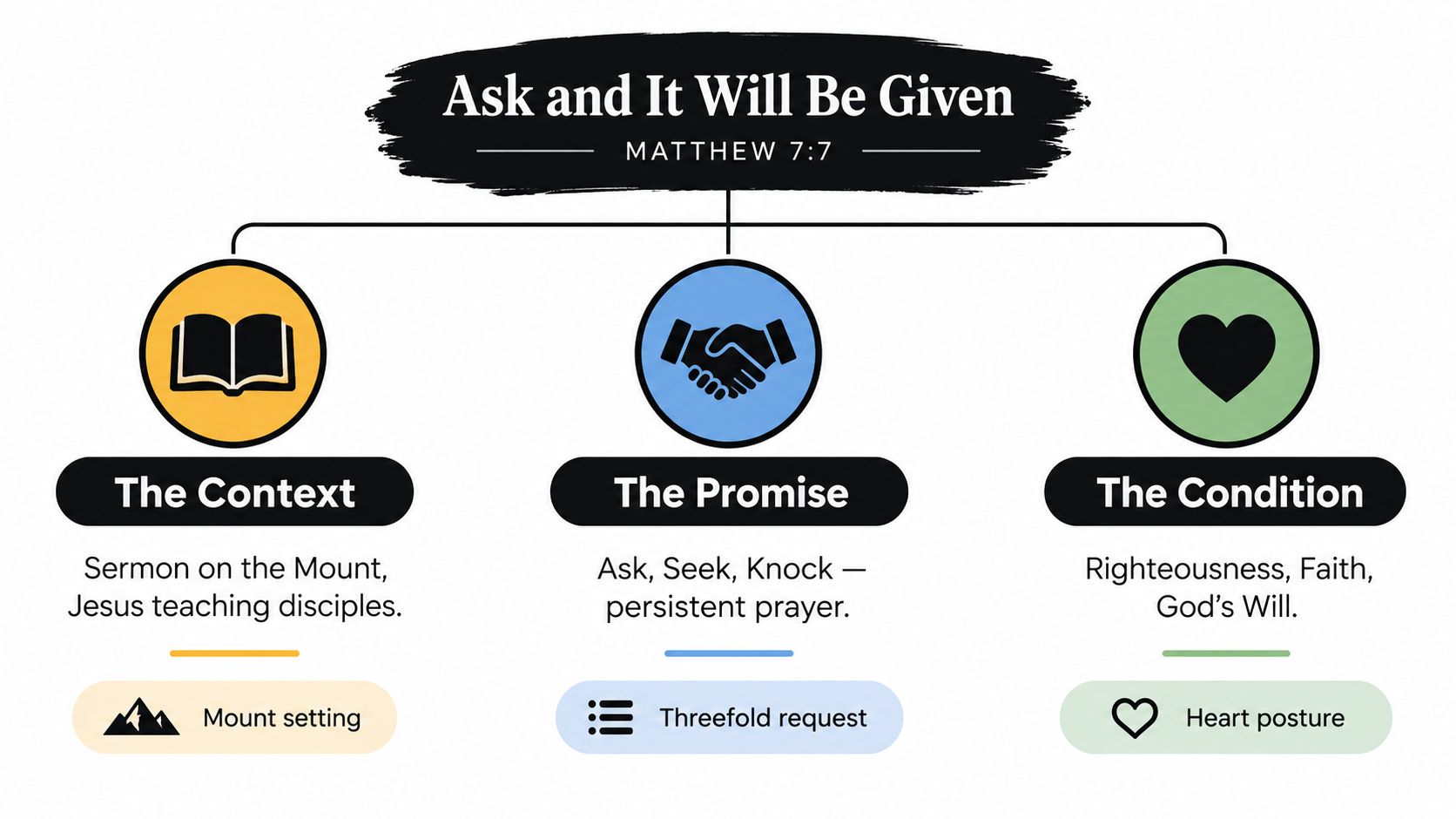
The phrase belongs to the Sermon on the Mount, one of the best-known teaching blocks in the New Testament. Matthew 7:7 is immediately reinforced by Matthew 7:8, which repeats the promise in three parallel clauses: everyone who asks receives, the one who seeks finds, and the one who knocks will have the door opened. The same saying appears in Luke 11:9–10, showing that it was preserved in two Gospel traditions rather than standing as an isolated line. (Historical and textual context)
That setting matters. Jesus isn't offering a detached technique for obtaining whatever a person wants. He teaches disciples about life before God, including trust, righteousness, judgment, generosity, and the shape of faithful desire. The surrounding Sermon on the Mount places prayer inside a larger vision of transformed character.
A promise with movement
The verbs create motion. Asking gives the need a voice. Seeking turns the person toward understanding, God's presence, and wise action. Knocking expresses continued approach when a door hasn't opened yet. The language doesn't describe passive wishing. It describes a posture that keeps engaging.
That distinction helps when prayer feels unanswered. A person may ask for a particular job, seek wisdom about how to serve faithfully, and knock by continuing to make responsible applications and receive counsel. The answer, if it comes, may involve the requested outcome, a changed desire, new understanding, or a different door.
Read the verse as an invitation to remain present with God. Its force isn't reduced when the answer takes a form you didn't predict. Rather, the context protects the promise from becoming a formula.
The Pattern of Persistent Action
“Ask, seek, knock” isn't careless repetition. Mainstream scholarly interpretation of Matthew 7:7–11 reads the three verbs as a deliberate three-step intensification pattern. The movement begins with a request, deepens into active pursuit, and continues with determined persistence. (Exegetical study of Matthew 7:7–11)
Consider the progression in ordinary life. You ask a trusted friend for advice. You seek by gathering information, reflecting on what you've heard, and examining your motives. You knock when you take the next faithful step and return for guidance after the first attempt doesn't settle everything. Each action remains connected to the same relationship, but each requires more involvement.
| Verb | Spiritual posture | A useful question |
|---|---|---|
| Ask | Honest dependence | What am I bringing to God without hiding it? |
| Seek | Attentive pursuit | What wisdom, truth, or understanding do I need? |
| Knock | Enduring openness | How can I remain faithful while the outcome is uncertain? |
This pattern challenges the demand for instant results. A transactional reading says, “I made the request, so I should receive the product.” A relational reading says, “I have brought my need to God, and I will continue to seek God's wisdom and presence as I live through it.” The second reading doesn't make disappointment disappear, but it gives prayer a wider purpose than acquisition.
Practical rule: Let every request include a desire for wisdom, not only a demand for a specific result.
Matthew 7:11 frames the promise around God giving good gifts to those who ask. That language matters because a loving response isn't identical to granting every immediate preference. A child may ask for something harmful without understanding its consequences. The parent's goodness determines the response. In the same way, Christian trust includes confidence in God's character while admitting that human perspective is limited.
The verbs also make room for changing prayers. You may begin by asking for an outcome, move toward seeking clarity about your responsibilities, and eventually knock through patient obedience. Persistence doesn't mean repeating words mechanically. It means continuing a living conversation.
Addressing the Silence of Heaven
A person may pray faithfully for healing, reconciliation, or guidance and still face the same uncertainty the next morning. The difficult question remains: if Jesus says, “ask and it will be given to you,” why do sincere prayers sometimes seem unanswered?
Blaming every disappointed believer for lacking faith adds shame to grief. Scripture and Christian experience include waiting, lament, confusion, and requests that do not receive the hoped-for response. A faithful interpretation must hold the promise together with the fact that suffering continues. It must also take the question seriously rather than using a quick explanation to end the conversation.

Prayer isn't a guaranteed transaction
A transactional reading treats prayer like an exchange. The person supplies enough words, certainty, or religious effort, and God must supply the requested result. When that result does not come, the person may conclude that the prayer was defective. This reading overlooks the passage's emphasis on good gifts, relationship, and persistent action.
A relational reading gives prayer a wider purpose. God welcomes honest requests, while prayer also shapes how people wait, discern, repent, act, and care for others. The request may change as understanding grows. Circumstances may change, or they may not. Sometimes the most truthful prayer for a season is, “I don't understand, but I am still here.”
Research helps explain why prayer can feel different from one person to another. An analysis of the nationally representative Baylor Religion Survey found that prayer expectancies, meaning whether people believe God answers prayers, were associated with lower anxiety, while prayer efficacy and some support-seeking forms of prayer correlated with higher anxiety. (Prayer expectancies and anxiety) This does not show that expectation guarantees an outcome or that faith works like positive thinking. It suggests that a person's understanding of prayer can shape the emotional experience of praying.
The distinction matters. Trust that God is responsive may help someone feel held during a long wait. Certainty that one specific result must appear can intensify fear, shame, or panic. Mature prayer allows hope without pretending to control God.
If emotional strain makes prayer difficult, this feeling overwhelmed prayer guide offers a gentle starting point. Readers can also find language for painful seasons in this resource on prayer during difficult times.
A cited international survey of young people is sometimes used to describe prayer as conversation, reflection, and communal practice, but the available Bible Hub commentary does not substantiate the reported percentages. The safer conclusion is qualitative: asking can involve more than trying to obtain something. Prayer may include relationship with God, honest self-examination, and shared practice with others.
The following video may help readers sit with the passage devotionally rather than treating it as a detached promise.
Prayer is common, yet practice varies widely. Some readers need encouragement to begin, while others need permission to admit disappointment, exhaustion, or doubt. That range of experience does not cancel the invitation to pray. It shows why the promise should be approached as a relationship sustained through uncertainty, not as a formula that guarantees immediate results.
Practical Steps for Daily Practice
A prayer habit becomes more sustainable when it gives both emotion and attention somewhere to go. You don't need elaborate language. You need a structure that helps you name the request, examine it closely, and return to God without pretending certainty.
Use a notebook, a private digital journal, or a shared group space. Write the date and begin with one sentence that describes your actual state. “I feel afraid about this appointment” is more useful than a polished sentence that hides fear.
A three-part journal rhythm
Ask clearly. Write the request in concrete language. Avoid turning it into a performance. “Please give me wisdom about whether to accept this role” is different from “Make everything work out.” Then add, “What am I hoping this answer will change?”
Seek thoughtfully. Record what you need to understand, not just what you want to happen. Consider Scripture, wise counsel, practical information, and the responsibilities already in front of you. Ask, “What would faithfulness look like today, even before I know the outcome?”
Knock faithfully. Name one action that keeps you engaged without trying to force an answer. You might make a difficult phone call, apologize, attend a support group, ask for help, or return to prayer tomorrow. Persistence should include obedience, not only repetition.
This method separates desire from discernment. It also prevents prayer from becoming a list that you never revisit. When circumstances change, update the request rather than judging the earlier prayer as a failure.
Review without forcing a conclusion
Set aside time to look back at previous entries. Notice changes in your understanding, relationships, decisions, and emotional state. Don't label every positive development an answer or every delay a divine message. Record observations carefully, and leave room for uncertainty.
You can use prompts such as:
- My honest request: What am I asking for today?
- My deeper concern: What fear, hope, or value sits underneath it?
- My next faithful action: What can I do without controlling the result?
- My open question: What remains unresolved?
- My gratitude: What good, however small, can I acknowledge?
Shared prayer adds another dimension. A trusted friend or small group can help you notice blind spots, carry burdens, and resist isolation. Community doesn't remove the mystery of unanswered prayer, but it can keep disappointment from becoming a private verdict about your worth.
Prayer journaling isn't a way to pressure God. It's a way to become more honest, attentive, and available to wisdom.
Using HolyJot to Deepen Your Prayer Life
Digital tools can support spiritual discipline when they reduce friction without pretending to replace prayer. A platform such as HolyJot lets users keep Bible reflections, prayer requests, and related notes in one place. Its verse-linked entries can connect a personal concern directly to the passage being studied, while its prayer features support recording requests, sharing them with a group, and tracking prayers marked as answered.
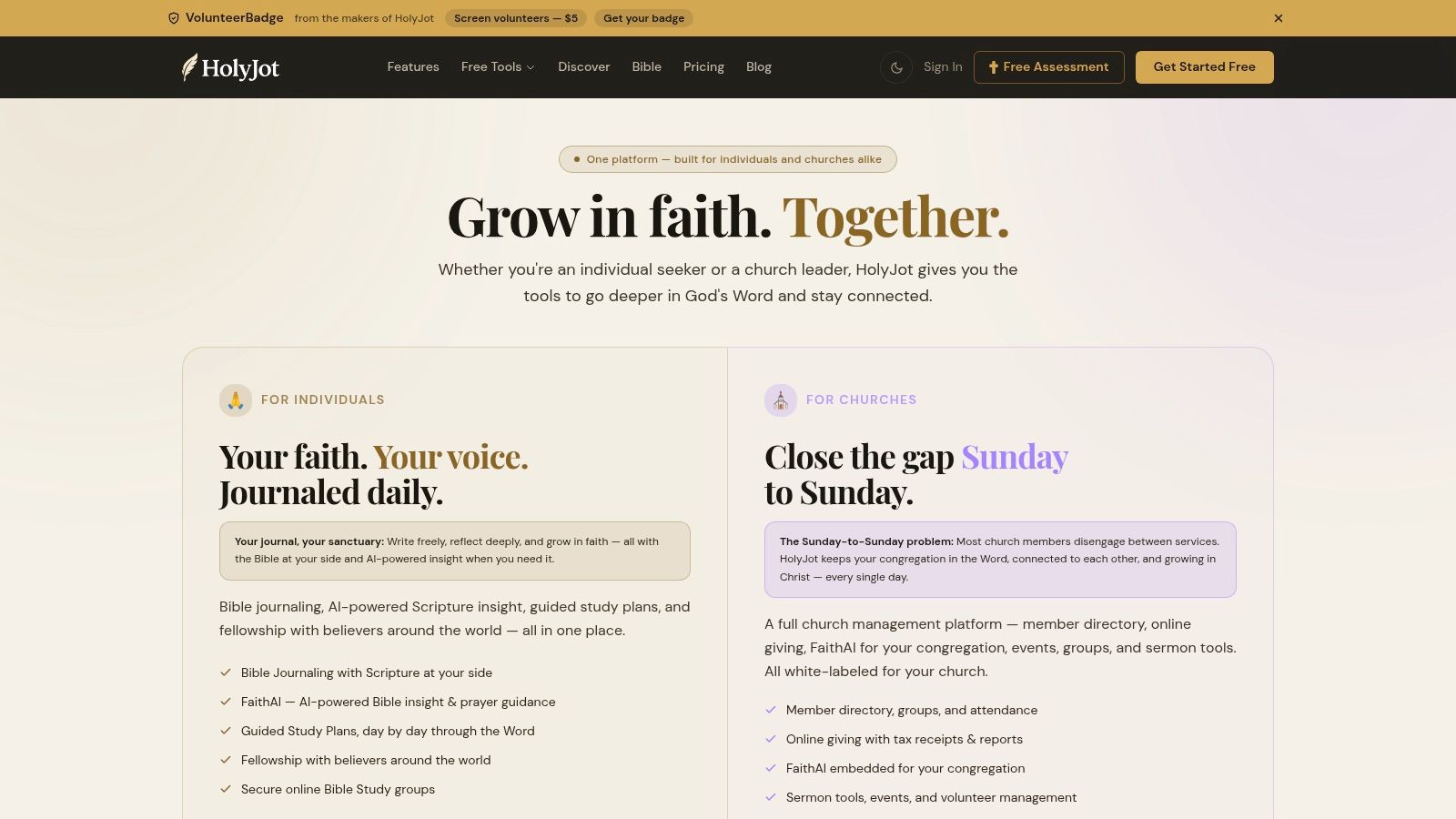
That arrangement fits the movement of Matthew 7:7. You can write the request under ask, add questions and Scripture references under seek, and return to the entry as you continue knocking. A prayer wall or group space can also make persistence communal rather than solitary, allowing people to respond with encouragement instead of offering shallow explanations.
Let technology serve attention
FaithAI can provide Scripture-grounded context, cross-references, and prayer guidance when you don't know how to continue a reflection. Used carefully, that kind of prompt can help you ask better questions, such as “What does this passage reveal about God's character?” or “What responsibility is mine in this situation?” It shouldn't make decisions for you or claim certainty about why a prayer has not been answered.
The same principle applies to streaks and reminders. A reminder can help you return to a practice, but a missed day isn't spiritual failure. The value of a tool lies in helping you remember, organize, and revisit what matters. The relationship remains personal and cannot be automated.
For readers building a wider Scripture habit, a daily Scripture reading guide can help connect prayer with regular engagement in the Bible. That connection protects Matthew 7:7 from becoming a slogan detached from the teaching around it.
Use any platform with discernment. Keep sensitive entries private when appropriate, invite trusted people into shared prayer intentionally, and review answered-prayer records with humility. A changed circumstance may be an answer, but so may be new courage, clearer wisdom, restored compassion, or the strength to keep walking without a complete explanation.
Living Out the Promise Every Day
“Ask and it will be given to you” gives permission to bring your real life before God. You don't have to make your requests impressive, hide your disappointment, or wait until your faith feels strong enough. Asking begins with honesty.
Seeking adds attention. It asks you to listen for wisdom, examine your motives, consult trustworthy people, and remain open to a response that doesn't match your first preference. Knocking adds endurance, the willingness to continue practicing faith while the door appears closed.
That pattern offers a healthier alternative to both extremes. It rejects the idea that prayer is a mechanism for controlling outcomes, but it also rejects passive resignation. You can pray with hope and act with responsibility. You can trust God without calling every delay a punishment or every desired result a guaranteed promise.
The verse also reaches beyond individual requests. Because prayer can be communal and reflective as well as personal, a church group, family, or close circle can practice asking together. People can share needs, listen without fixing, and remember that unanswered prayer calls for compassion rather than suspicion.
A simple daily rhythm might look like this:
- Name the request without disguising your need.
- Seek understanding through Scripture, reflection, and wise counsel.
- Take one faithful action while releasing control of the outcome.
- Return tomorrow with gratitude, grief, or both.
That final step matters. Persistence isn't measured by emotional intensity. Sometimes it looks like a confident prayer. Sometimes it looks like opening the journal when you feel numb. Sometimes it means allowing another person to pray for you because you can't find words.
Let Matthew 7:7 become a path rather than a password. Ask for what you need, seek the God who hears, and knock with the humility to receive wisdom, transformation, or an answer you didn't design. Begin today by writing one honest request and one faithful next step, then return to it with patience.
HolyJot offers Bible journaling, verse-linked notes, prayer requests, answered-prayer tracking, Scripture-grounded FaithAI guidance, and private community spaces for shared reflection. Visit HolyJot to create a prayer practice that helps you ask, seek wisely, and keep knocking.