


What does “be fruitful and multiply” mean if we read it as more than a familiar wedding verse? Many readers hear a simple instruction about having children, but Genesis places the phrase inside a broader four-part commission. Human fruitfulness belongs with multiplication, filling the earth, and responsible rule over creation.
The meaning becomes clearer when we slow down. The Hebrew verb behind “be fruitful” matters, the repetition after the Flood matters, and the relationship between blessing and command matters. The phrase can speak about fertility, but it also reaches toward family life, stewardship, continuity, and the work of building a flourishing human community.
What This Phrase Really Asks
The common shorthand answer is, “Have children.” That answer identifies one important part of the passage, but it leaves out the shape of the sentence in Genesis 1:28. God's charge contains four connected movements: be fruitful, multiply, fill the earth, and subdue it. The phrase doesn't stand alone as a slogan about family size.
Genesis presents human reproduction within a vocation. People are called to continue human life, extend across the earth, and exercise a form of responsible authority over the created order. The wording connects fertility with stewardship, not fertility with private achievement.
A useful starting point: Read the phrase as a commission with several clauses, not as an isolated sentence for weddings or family planning.
The Hebrew helps us see why. The verb parah means “to bear fruit,” and its use in Genesis carries a generational sense. “Multiply” adds continuing increase, while “fill” describes the spread of human life across the earth. “Subdue” then turns toward the work of ordering and cultivating the world people inhabit.
The phrase also has a canonical trajectory. It appears in Eden and returns after the Flood, where Noah and his family receive a renewed charge. That repetition makes the wording part of a recurring biblical pattern linking human fertility, stewardship, and civilization-building. A historical overview of the phrase's interpretation notes that readers have understood it both as a direct command and as a blessing describing human fecundity, while its grammatical structure still places reproduction at the center of the passage (the Genesis 1:28 study).
So the be fruitful and multiply meaning is layered. It begins with biological fruitfulness, expands into generational continuity, and sits inside a larger calling to inhabit and care for the world. Hold the phrase as a covenantal mandate that reaches beyond sentiment into vocation.
The Hebrew Roots of Fruitful and Multiply
The first key word is the Hebrew verb פָרָה, parah. Its basic sense is “to bear fruit.” In Genesis 1:28, it points naturally toward human offspring, but the image is richer than a bare biological instruction. Fruitfulness suggests life that produces, continues, and becomes capable of sustaining further life.
The second expression, commonly represented as “multiply,” strengthens that direction. The paired wording presents growth across generations rather than a single act of reproduction. “Be fruitful” identifies the production of offspring, while “multiply” extends the picture toward an expanding human family.
Genesis 1:28 then moves through a sequence:
- Be fruitful: Produce and sustain human life.
- Multiply: Extend that life across generations.
- Fill the earth: Spread human presence throughout the created world.
- Subdue it: Bring the earth under ordered, responsible human care.
The sentence therefore develops from life, to growth, to presence, to vocation. The final clauses keep readers from reducing fruitfulness to private family expansion. Genesis joins reproduction to the human task of inhabiting and tending creation.
The wording also echoes the blessing given to living creatures in Genesis 1:22. Animal life receives a command to be fruitful and multiply in the sea and on the earth, and humanity receives related language in a distinct setting. The human charge includes the same creational pattern of flourishing, then adds filling, subduing, and ruling. The result is a mandate that is biological and cultural at once.
English readers can easily miss this structure because “be fruitful and multiply” sounds like one compact phrase. A careful word study, such as the guidance offered in how to use a Bible concordance, helps you trace the Hebrew term across its contexts instead of treating one translation as the whole meaning.
The grammar also deserves care. Some interpreters hear a command, while others emphasize blessing or divine enablement. These readings need not erase one another. God blesses humanity with fruitfulness, and that blessing gives shape to human responsibility.
The central point is simple: fruitfulness is the first movement in a four-part creation mandate. It's not a slogan detached from the earth, the family, or the work of responsible human culture.
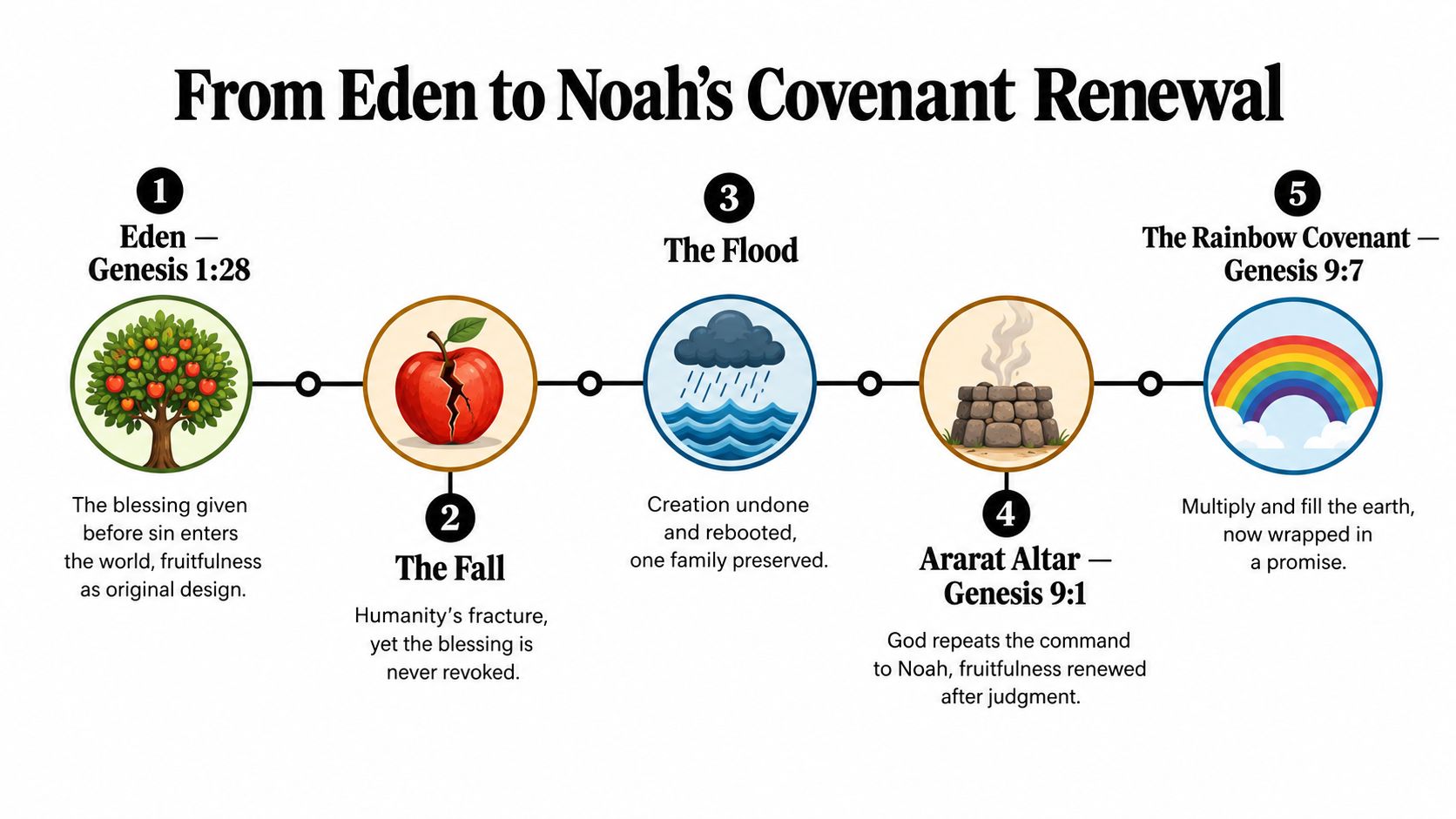
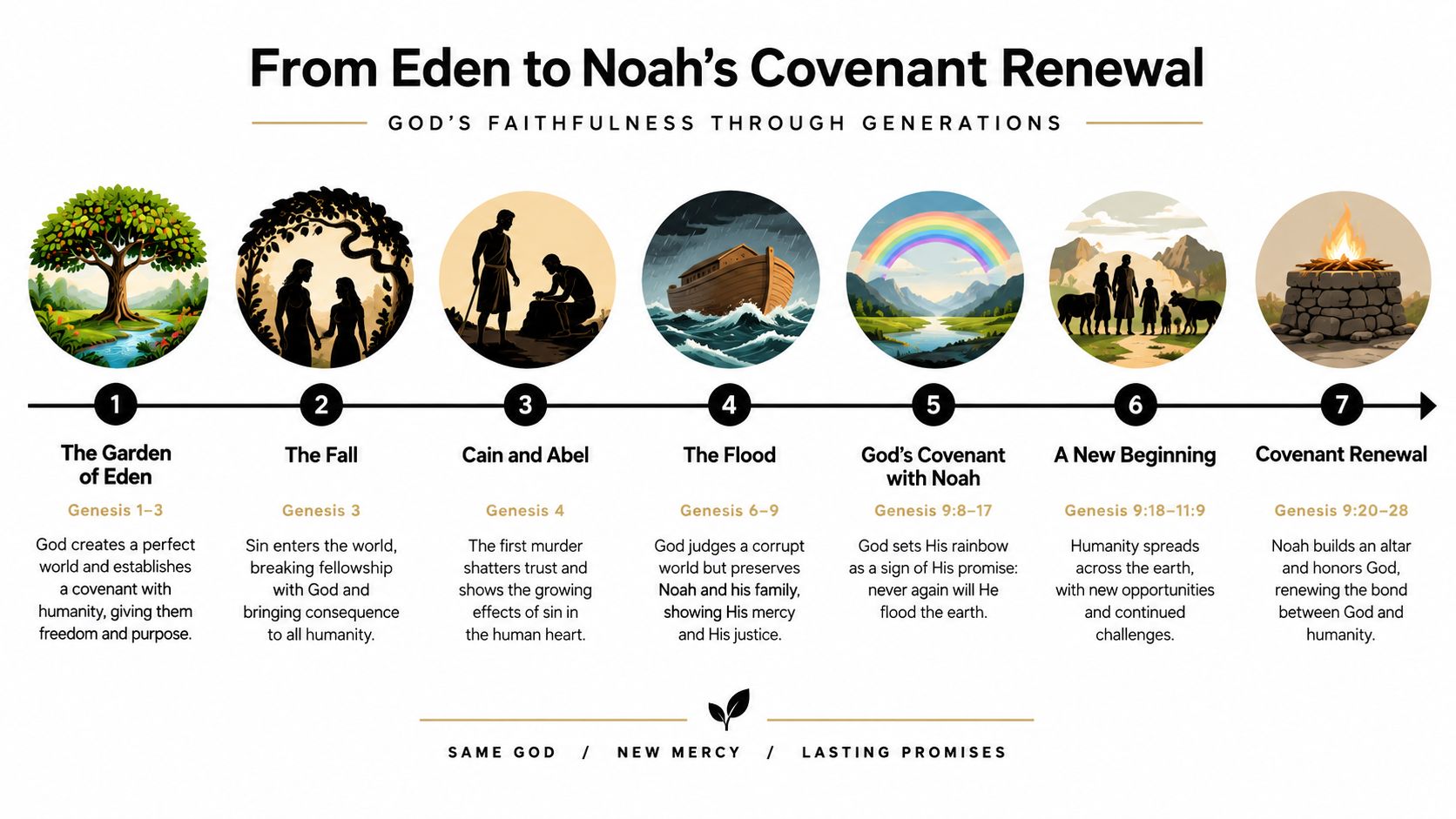
The visual timeline below gives another way to see the movement from creation to renewal.
From Eden to Noah's Covenant Renewal
Genesis first places the command in Eden, before the entrance of sin into the human story. That setting matters. Fruitfulness belongs to the original created order, not to a later emergency response to human failure. The first couple receives the blessing as part of humanity's beginning, alongside the responsibility to fill and govern the earth.
The command's presence before the Fall also prevents a common misunderstanding. Human reproduction isn't presented as a punishment or as a remedy for sin. It belongs to the goodness and continuation of created life. At the same time, the Fall changes the circumstances in which people carry out the vocation. The mandate remains, but human work, family life, and the earth itself become marked by fracture.
Genesis then returns to the language after the Flood. Noah receives the command in Genesis 9:1, and the wording is repeated again in Genesis 9:7. This repetition creates a deliberate connection between Eden and the post-Flood world. Humanity has passed through judgment, yet God renews the calling through one preserved family.
Repetition after judgment
The Noahic setting adds a new dimension. In Eden, the command stands at the opening of human history. After the Flood, it stands at the beginning of a renewed human society. The world has experienced catastrophic unmaking, but God doesn't discard the human vocation. He reaffirms fruitfulness, multiplication, and the filling of the earth.
The phrase's authority therefore rests on more than its first appearance. Its repetition after the Flood makes it a recurring covenant pattern. The wording links the first human commission with a renewed charge to Noah and his descendants, extending the horizon toward the human family that will emerge from that line.
This continuity also explains why the phrase has remained influential in discussions of family, population, and social responsibility. A historical account of its cultural reach records the phrase being discussed during an era when the world population was said to be about 1,800 million people, showing how biblical language entered debates about population and hunger (the phrase's historical overview). The number belongs to that historical report, not to Genesis itself.
The Edenic commission and its Noahic echo are not identical in atmosphere. Eden presents original blessing; Noah receives renewal after judgment. Yet the central language remains stable. God's purpose for human continuity survives human failure, and the command continues to join family life with the wider work of inhabiting and ordering creation.
How Major Traditions Interpret the Command
Jewish and Christian interpreters have generally recognized a literal reference to human fruitfulness, but they don't all explain the relationship between reproduction, marriage, and dominion in the same way. The command's wording creates room for agreement about its original subject while inviting different theological applications.
Jewish interpretation often places the verse within the goodness of family continuity and the responsibility to participate in the preservation of human life. Some Jewish readings also extend fruitfulness beyond biological offspring toward moral, communal, and spiritual productivity. In that approach, a person may ask not only whether life is being continued, but also whether one's work contributes to the faithfulness and strength of the community.
Catholic readings commonly connect the passage with marriage, family, and the transmission of life, while holding those themes together with stewardship. The verse doesn't function as a detached fertility formula. It belongs to a vision of human beings receiving life as a gift and exercising responsibility within creation.
Many Protestant readings describe Genesis 1:28 as part of a broader cultural mandate. Family life remains important, but so do work, learning, social institutions, creativity, and care for the world. Reformed commentators often emphasize that human beings serve God not only through private devotion but also through faithful activity in ordinary life.
Orthodox approaches frequently read humanity's calling in liturgical and priestly terms. People are placed within creation to receive it gratefully, offer it back to God, and tend it rather than exploit it. Fruitfulness then belongs to a larger vocation of communion between God, humanity, and the created order.
| Tradition | Primary Emphasis | Notable Source or Thinker | Key Nuance |
|---|---|---|---|
| Jewish | Human continuity and communal responsibility | Rabbinic interpretation | Fruitfulness may include moral and spiritual productivity |
| Catholic | Marriage, family, and transmission of life | Natural law theology | Reproduction belongs with responsible stewardship |
| Reformed Protestant | Cultural vocation and ordered human work | Reformed commentators | Dominion includes work, learning, and social responsibility |
| Evangelical Protestant | Family, culture, and mission | Evangelical biblical teaching | Spiritual multiplication may be related to the wider mandate |
| Orthodox | Priestly tending of creation | Orthodox theological tradition | Humanity fills and cares for creation as an act of worship |
These traditions shouldn't be flattened into identical positions. They agree that the verse has a real procreative sense, but they differ in how directly it governs individual decisions and how strongly its later implications should be extended to culture, mission, and spiritual formation.
The safest reading keeps both dimensions visible. Human fruitfulness is real, and it serves a larger human vocation. Neither a fertility-only reading nor a purely metaphorical reading captures the full movement of Genesis 1:28.
Translation Differences You Can See in English Bibles
English translations often preserve the familiar phrase “be fruitful and multiply,” but they make different choices around the surrounding verbs. Those choices influence how readers hear the passage. A translation can make the verse sound more like a blessing, a command, a cultural charter, or a broad statement about human increase.
The Hebrew verb parah is usually represented by “be fruitful.” Some translations use “increase” in related contexts, which can sound broader and less explicitly biological. Yet the Genesis setting supplies the meaning. The paired verb “multiply,” followed by “fill the earth,” keeps the passage connected to offspring and generational expansion.
The four clauses in English
Genesis 1:28 contains four movements, even when English readers remember only the opening pair. “Be fruitful” and “multiply” address human continuation. “Fill the earth” describes geographic expansion, while “subdue” and “have dominion” describe humanity's relationship to the rest of creation.
The two authority verbs also matter. Translators commonly render kabash as “subdue” and radah as “have dominion” or “rule.” Those English words overlap, but they aren't identical. Keeping both clauses visible helps readers see that the passage doesn't stop with population growth.
| Translation | Key Verb Choices | Tone | Notable Difference |
|---|---|---|---|
| KJV | “Be fruitful,” “multiply,” “replenish,” “subdue,” “have dominion” | Formal and traditional | “Replenish” can sound like refill, though the context concerns filling |
| NIV | “Be fruitful,” “increase in number,” “fill,” “subdue,” “rule” | Clear and contemporary | Makes numerical growth more explicit in wording |
| ESV | “Be fruitful,” “multiply,” “fill,” “subdue,” “have dominion” | Formal and close to traditional phrasing | Preserves the compact four-part structure |
| NASB | “Be fruitful,” “multiply,” “fill,” “subdue,” “rule” | Precise and formal | Keeps the commands distinct |
| CSB | “Be fruitful,” “multiply,” “fill,” “subdue,” “rule” | Readable and direct | Uses familiar verbs while retaining the broader mandate |
Translations also differ in how explicitly they express the scope of rule. Some add wording such as “over the earth” to clarify what the command concerns. Others preserve a more compact syntax and expect readers to follow the relationship between the clauses.
A translation comparison shouldn't become a contest over one perfect English wording. The Hebrew structure remains the controlling guide. If you're learning how translation decisions work, what textual criticism is can help you distinguish questions about manuscript wording from questions about translation style.
Read several versions side by side, then return to the whole sentence. The be fruitful and multiply meaning becomes clearer when “fruitful” isn't separated from “fill,” “subdue,” and “rule.”
What the Phrase Means for Christians Today
Christians shouldn't use Genesis 1:28 as a simplistic command that applies identically to every person in every circumstance. The passage has a literal sense connected to human fruitfulness, yet Scripture also shows that faithful service can take different forms. Marriage, singleness, childlessness, parenthood, adoption, spiritual mentoring, and community service all require pastoral care rather than blunt formulas.
The first application is family life. For those called to marriage and children, fruitfulness can include welcoming and raising children with patience, wisdom, and faith. The verse doesn't treat children as achievements or tools for proving obedience. It places family within God's work of sustaining generations.
Four directions for faithful practice
Family and formation. Parents shape more than household routines. They teach habits of prayer, truthfulness, work, mercy, and responsibility. Fruitfulness includes the long work of helping another person mature.
Stewardship. “Fill the earth” and “subdue it” don't authorize careless domination. They call people to cultivate places, use resources responsibly, repair what they damage, and create conditions in which human and nonhuman life can flourish.
Discipleship. Christians can speak of spiritual multiplication without pretending that it replaces the original procreative sense. Jesus' command to make disciples gives believers a clear New Testament pattern for investing in people who can themselves teach and serve others.
Church growth. A growing congregation isn't defined only by attendance. It becomes fruitful when members welcome outsiders, care for the vulnerable, train leaders, share possessions, and form a community where faith can take root.
Pastoral safeguard: Never use this verse to shame people who are infertile, single, or called to a life without biological children.
The phrase can become practical through ordinary actions. A mentor who teaches a younger believer, a family that practices hospitality, a church member who helps restore a neglected neighborhood, and a congregation that equips new servants all participate in forms of generational continuity.
Ask yourself:
- Where am I cultivating life rather than merely consuming what others have built?
- Who receives my time, wisdom, or practical help?
- Does my work bring greater order and care to the place where I live?
- Am I treating fruitfulness as a gift to receive and share, or as a status to display?
That approach keeps the verse from becoming a decorative wedding quotation. It honors the original reproductive meaning while recognizing the wider patterns of fruitfulness that shape Christian discipleship.
Cross-References and Pathways for Deeper Study
A good study of Genesis 1:28 should lead outward, not end with one verse. The Bible uses related language across creation, covenant, blessing, character, mission, and spiritual maturity. Reading those passages together helps you test interpretations instead of building a theology from a single familiar phrase.
Creation and blessing
Begin with Genesis 1:28 and Genesis 9:1. Read each passage in its surrounding chapter, paying attention to what God has just created, judged, or renewed. Then add Psalm 127:3-5 and Psalm 128, which present children, household life, work, and blessing within a wisdom framework.
These passages don't erase the complexity of family experience. They give you biblical language for receiving life as a gift while resisting the idea that a person's spiritual worth depends on household circumstances.
Covenant and fruitfulness
Genesis 17:6 develops fruitfulness in the context of Abraham's covenant identity. Isaiah 61:9 uses generational language in a prophetic setting, while Galatians 5:22-23 turns attention toward the fruit of the Spirit. The connection isn't that every use of “fruit” means the same thing. The value lies in observing how Scripture uses fruitfulness to describe visible effects of God's work.
For New Testament mission, read Matthew 28:19-20, Acts 2:41-47, and Colossians 1:10. These passages give concrete pictures of disciples being made, communities forming, and believers bearing fruit through good works and growing knowledge of God.
A practical study route
Choose one pathway rather than opening every reference at once:
- Word study: Trace parah with Blue Letter Bible or STEP Bible, checking each occurrence in context.
- Theological study: Read a chapter on creation and providence in a trusted systematic theology.
- Commentary study: Compare Gordon Wenham on Genesis, Derek Kidner on Genesis, and Christopher Wright's work on creation theology.
- Group study: Pair Genesis 1:28 with Genesis 9:1 and ask how blessing, judgment, and renewal shape the mandate.
- Journaling: Record one observation, one question, and one practice after each reading.
A cross-reference Bible study method can keep the process focused. Read steadily over two weeks, returning to the Hebrew observations only after you understand each passage in context. The purpose isn't to collect references. It's to learn how Scripture's themes develop without forcing every verse into the same meaning.
Living Inside a Creation Mandate
The phrase shouldn't remain a wedding wall plaque. Genesis presents it as an active charge, and its four verbs offer a practical pattern for Christian life: be fruitful, multiply, fill, and subdue.
To be fruitful in character means cultivating a life that produces visible goodness. The New Testament's language about the fruit of the Spirit gives Christians a concrete direction. Practice patience in one strained relationship, choose truth when exaggeration would benefit you, or make peace where resentment has become habitual.
To multiply means investing in people who can carry faithful work forward. Mentor someone younger in the faith, invite a new believer into regular study, or help another person learn a skill you once had to learn alone. Multiplication isn't about collecting dependents. It's about developing people who can serve with maturity.
To fill means showing up in the places God has given you. Serve your neighborhood, welcome someone who lacks community, participate in your church's care for members, or bring steady kindness into your workplace. Presence matters because communities change through repeated acts of faithfulness.
To subdue means bringing order to what has been neglected or broken. That may involve honest work, creative problem-solving, advocacy for justice, repairing a home, tending a garden, or creating systems that help people flourish. Responsible dominion refuses both passivity and exploitation.
A simple practice for the week
Choose one action for each verb:
- Fruitfulness: Make space for prayer and examine one area of character.
- Multiplication: Encourage or mentor one person intentionally.
- Filling: Practice hospitality or serve a local need.
- Subduing: Repair, organize, or improve something within your responsibility.
The command is gift before task. God speaks blessing before assigning work, and that order protects the mandate from becoming a program of anxious achievement. You don't create fruitfulness by force. You receive life, cultivate it faithfully, and offer its benefits to others.
Study Genesis 1:28 slowly, write your observations, and turn one clause into a prayer for the coming week. HolyJot offers Scripture-linked Bible journaling, guided study plans, and FaithAI prompts that can help you record those reflections and connect them with related passages. Use it to build a consistent study habit around creation, covenant, discipleship, and daily practice.