


The command “be strong and courageous, do not be afraid” is above all a charge for leadership and transition, not merely a general comfort for private fears. The phrase family appears 11 times across the Bible, showing a repeated biblical pattern for facing responsibility under pressure.
You may be carrying a responsibility that feels larger than your preparation. Perhaps you're taking over a ministry, making a difficult family decision, beginning a new season at work, or trying to guide people who look to you for steadiness. In moments like these, Joshua 1:9 can sound like a personal message for anxiety, and it certainly speaks hope to fearful people. Yet its first setting is more demanding: God gave this command to Joshua after Moses died, when Joshua inherited responsibility for leading Israel into Canaan.
That context changes how we read the verse. It doesn't tell us to manufacture confidence, deny danger, or pretend that fear isn't present. It calls us to act faithfully when fear, uncertainty, and public responsibility meet. The command joins courage, obedience, leadership, and God's presence.
Understanding the Original Context
A leadership transition can unsettle an entire community. People wonder whether the new leader is ready, whether the old vision will continue, and whether the dangers ahead have been understood. Joshua faced all of those pressures at once. Moses, the leader associated with Israel's deliverance and wilderness journey, had died, and Joshua now had to guide the people toward the Promised Land.
The biblical setting wasn't a quiet moment of private reflection. Israel stood at the edge of a new stage in its history, facing an occupied land and the risks that accompany movement into unfamiliar territory. Joshua's responsibility involved the direction of a large community, not only the management of his own emotions.

A command shaped by succession
Joshua 1:9 appears after God tells Joshua to arise, cross the Jordan, and lead the people. The command belongs to a succession moment. Moses' death creates a gap in human leadership, but the passage presents God's purpose as continuing through a new servant.
That helps explain why the phrase is repeated. The command isn't an isolated inspirational line. One biblical count identifies 11 occurrences, with the wording appearing three times in connection with Moses, five times in Joshua, twice from David, and once from Hezekiah (the biblical pattern behind “be strong and courageous”). The repetition places courage within recurring moments of national change, danger, and responsibility.
The earliest occurrence is connected with Israel's transition under Moses. Before the people entered the Promised Land, Moses told them to be strong and of good courage. Joshua later received the same charge after Moses' death. David used related language when preparing Solomon for the work of building the temple, and Hezekiah used it while Judah faced the Assyrian threat.
| Setting | Leadership pressure | Meaning of courage |
|---|---|---|
| Moses and Israel | Entering a new land | Move forward in trust |
| Joshua's succession | Inheriting responsibility | Lead faithfully after loss |
| David and Solomon | Preparing the next leader | Continue the work |
| Hezekiah and Judah | Facing national threat | Resist panic and remain faithful |
Why the setting matters today
A reader may open Joshua 1:9 because of anxiety, grief, or uncertainty. That application isn't wrong, but it can become incomplete if we remove the verse from its narrative setting. Joshua wasn't told merely to feel better. He was told to take responsibility for a community while relying on God's promise rather than his own ability.
That distinction gives the verse a practical edge. Courage may mean having a difficult conversation, accepting a new assignment, protecting people who depend on you, or faithfully continuing a task you didn't choose. The question isn't only, “How can I calm down?” It is also, “What faithful responsibility is in front of me?”
A better reading: Joshua 1:9 offers comfort to fearful people, but it first forms responsible people who must act under pressure.
Breaking Down the Language and Meaning
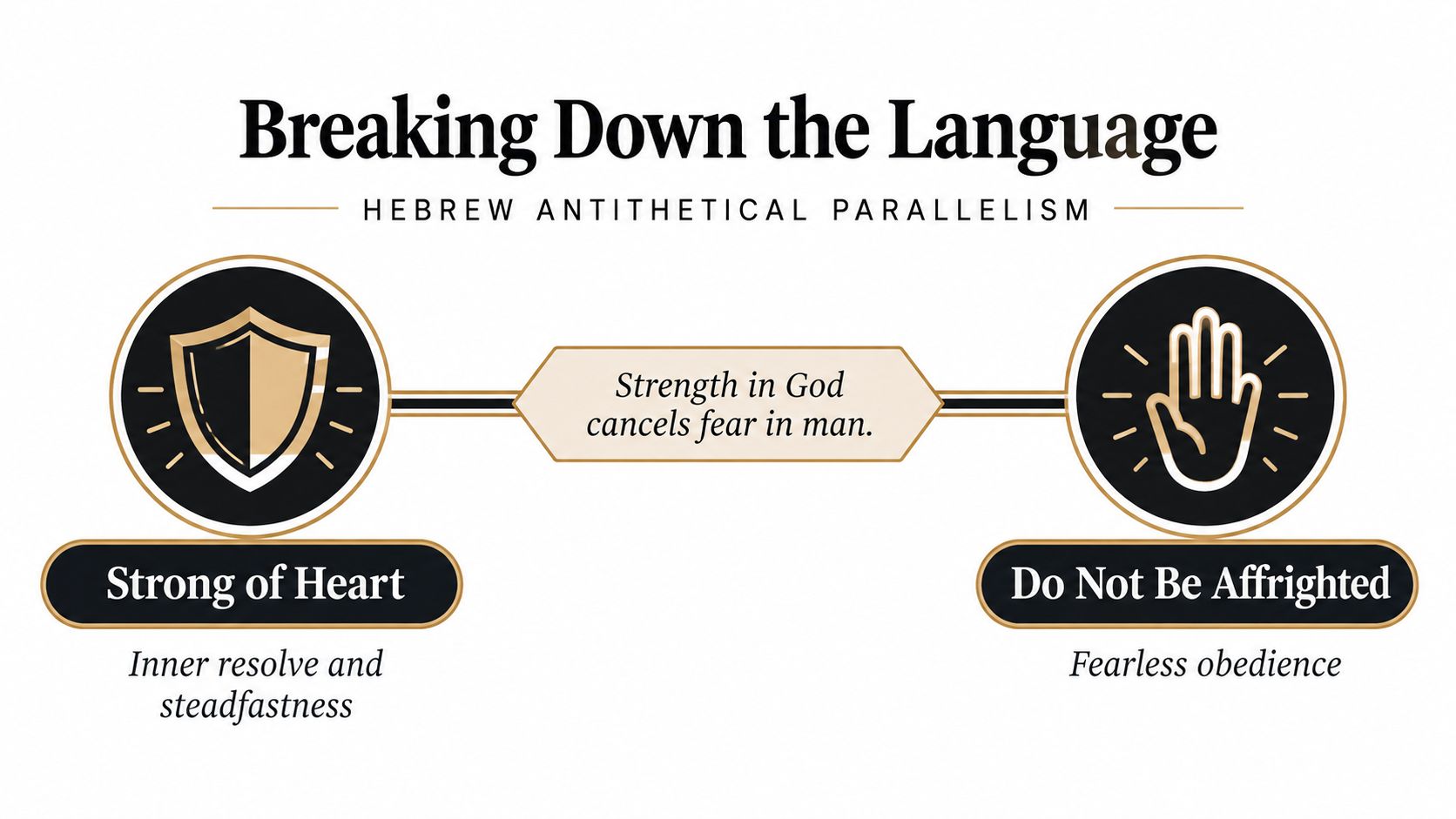
Joshua 1:9 uses a tightly balanced rhetorical pattern. The positive command, “be strong and courageous,” stands beside the negative command, “do not be frightened or dismayed.” Scholarly commentary describes this as antithetical parallelism, a structure that clarifies one idea by placing it against its opposite (commentary on the courage command and God's presence).
The verse doesn't define strength as the absence of emotion. It defines courage against paralysis, panic, and collapse. A person can feel threatened and still choose a faithful action. In that sense, biblical courage isn't emotional numbness. It's resilient obedience while danger remains real.
Strength is directed toward action
The command begins with strength and courage, then rules out frightened and dismayed responses. These are not four unrelated suggestions. Together, they reshape how a leader responds to threat.
A fearful leader may rush, withdraw, blame others, or delay every decision until certainty arrives. Joshua's command points in another direction. He must remain steady enough to obey, deliberate enough to lead, and courageous enough to move forward without controlling every outcome.
The passage also places courage within a larger pattern. Joshua is told to keep God's instruction close, meditate on it, and practice it. The surrounding verses connect successful leadership with covenantal faithfulness, not military confidence alone (Joshua 1:6–9 and the relationship between obedience, steadiness, and leadership).
“Do not be afraid” doesn't mean “feel no fear”
Many readers hear “do not be afraid” as though God were criticizing the existence of fear. The wording works better as a command about what fear must not control. Fear can alert us to danger, expose our limits, and lead us to seek wisdom. It becomes destructive when it dictates disobedience or prevents necessary action.
The final reason for courage is not Joshua's personality. It is God's presence: “the LORD your God is with you wherever you go.” The promise changes the decision-making environment. Joshua doesn't receive a guarantee that every step will feel safe. He receives assurance that he won't carry the assignment alone.
| Fear-driven response | Courageous response |
|---|---|
| “I must eliminate all uncertainty.” | “I can obey with incomplete information.” |
| “I can't move until I feel confident.” | “I can take the next faithful step.” |
| “This responsibility proves my inadequacy.” | “God's presence is larger than my capacity.” |
The phrase “be strong and courageous, do not be afraid” therefore calls for more than positive self-talk. It trains attention. Instead of allowing the threat to become the largest reality, the leader remembers God's command, God's instruction, and God's accompaniment.
Exploring Cross-References and Biblical Themes
Joshua 1:9 belongs to a wider biblical vocabulary of courage. Deuteronomy 31:6 gives the command to the whole community before its transition into the land. Joshua 10:25 repeats the language in a military setting, while 1 Chronicles 28:20 applies it to Solomon's responsibility. In 2 Chronicles 32:7–8, Hezekiah uses related encouragement while Judah faces the Assyrian threat.
The settings differ, but the pattern remains recognizable:
- A person or community faces a serious assignment.
- God or a faithful leader gives a command to stand firm.
- The promise of divine presence supports that command.
- Courage becomes visible through obedient action.
This pattern keeps the command from becoming a slogan detached from circumstances. Moses speaks during a national transition. Joshua receives it during succession. David prepares Solomon for a work that will outlast him. Hezekiah speaks while enemies threaten Judah. The repeated formula addresses public responsibility across generations (Joshua 1:9 and its related biblical passages).
A command, a presence, and a response
Deuteronomy 31:6 emphasizes that God will not leave or forsake his people. Joshua 1:9 emphasizes God's presence wherever Joshua goes. The command and the promise belong together. Courage isn't produced by staring harder at the danger or by repeating affirmations about personal strength. It grows as people remember who has called them and how they are being accompanied.
Isaiah 41:10 develops a similar theme, pairing the command not to fear with God's strengthening, helping, and upholding presence. The emphasis isn't private comfort separated from responsibility. God comforts people so they can remain faithful within difficult circumstances.
That connection also helps pastors and small-group leaders teach the passage responsibly. A person struggling with anxiety may need tender reassurance, wise support, and professional care. Joshua 1:9 shouldn't be used to shame someone for feeling afraid. At the same time, the original context invites that person to ask whether courage includes a concrete act of trust, honesty, service, or leadership.
For readers who want to trace these relationships in a repeatable way, a cross-reference Bible study method can help compare the command, the crisis, the promise, and the response in each passage. The result is a fuller theology of courage: God's presence doesn't remove responsibility. It makes faithful responsibility possible.
Practical Steps for Daily Application
Reading Joshua 1:9 once may encourage you for a moment. Practicing it requires a slower process that connects the text to a real responsibility. The point isn't to force a dramatic spiritual experience. It's to let Scripture shape one decision at a time.
Start with the verse itself
Read Joshua 1:9 slowly. Read it in more than one translation if you can, paying attention to the repeated ideas: strength, courage, fear, discouragement, God's command, and God's presence. Major English translations preserve nearly identical wording. The NIV says, “Be strong and courageous. Do not be afraid; do not be discouraged,” while the ESV says, “Be strong and courageous. Do not be frightened, and do not be dismayed” (Joshua 1:9 in the NIV).
Don't rush to application. First ask what the verse says and what it doesn't say. It doesn't promise an easy assignment. It doesn't tell Joshua to trust his instincts instead of God's instruction. It directs him to lead under the assurance of God's presence.
Name the responsibility
Write one sentence that begins, “The responsibility in front of me is...” Be specific. “I need to address tension on my team” is more useful than “I need to be braver.” “I need to ask for help with my health” is clearer than “I need to stop worrying.”
Then identify the fear attached to that responsibility. Are you afraid of rejection, failure, conflict, disappointing someone, or losing control? Naming the fear prevents it from becoming a vague atmosphere that influences every decision.
Choose a faithful next action
Select one action that reflects obedience and wise courage. That might be scheduling a conversation, asking a trusted believer to pray with you, preparing carefully for a new role, apologizing, or setting a necessary boundary. Courage often looks ordinary because it operates through faithful habits.
Use this simple journal pattern:
- Text: What does Joshua 1:9 command?
- Context: What kind of responsibility did Joshua carry?
- Fear: What is making me hesitate?
- Action: What faithful step can I take today?
- Prayer: What do I need to entrust to God?
A daily Scripture reflection practice can keep this work from becoming occasional inspiration. Return to the verse, record what changed, and notice whether your decisions are becoming steadier, more honest, and more obedient.
Courage grows through repeated attention to God's presence, followed by concrete action.
Using HolyJot for Deepened Study
A digital tool can either encourage passive consumption or support active discipleship. The difference lies in how you use it. Saving an attractive verse image may lift your mood, but verse-linked journaling asks you to record what the passage means, what concerns it exposes, and how you intend to respond.
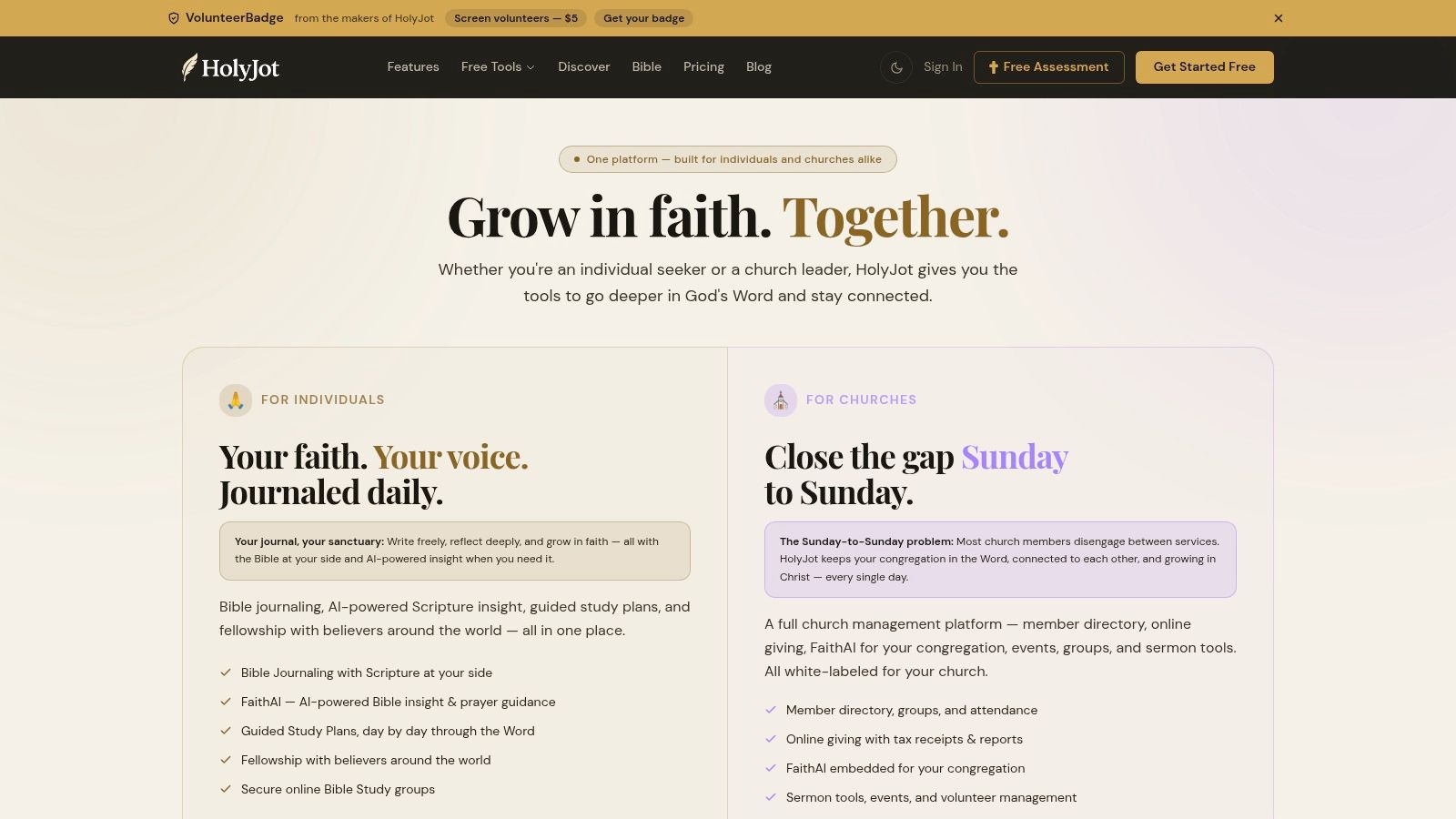
HolyJot combines a full online Bible, multiple translations, verse-linked and freestyle journaling, guided study plans, FaithAI for Scripture-grounded context and cross-references, memory features, locked sensitive notes, time capsules, streaks, and private Community Hubs. Those functions support the practice described above because they connect reading with observation, prayer, action, and later review.
Turn a verse into a study record
Open Joshua 1:9 and attach a journal entry directly to the verse. Record the historical setting, compare the NIV and ESV wording, and note the difference between private reassurance and a leadership charge. Then add the responsibility you're facing and the action you believe faithfulness requires.
FaithAI can help surface related passages such as Deuteronomy 31:6, 1 Chronicles 28:20, and 2 Chronicles 32:7–8. Use that assistance as a study aid, not as a substitute for reading the biblical text in context. Ask questions that sharpen interpretation, such as, “Who is being addressed?” “What threat is present?” and “What does God's presence authorize this person to do?”
Build continuity without pretending
A time capsule can preserve today's prayer for later reflection. A locked entry can give you a private place to write about fear, conflict, or a leadership decision. A Scripture memory feature can help you revisit the verse in context rather than reducing it to a detached phrase.
The value of these tools isn't that technology creates courage. It lowers practical barriers to returning to Scripture and organizes the record of your response. Over time, your journal can show where you acted, where you avoided action, where you needed counsel, and where you recognized God's faithfulness.
For a group, a private Community Hub can hold shared prompts and discussion around the passage. A church leader might pair the study with a conversation about succession, responsibility, or serving during uncertainty. Used this way, a digital platform supports attention and accountability while leaving spiritual discernment, pastoral care, and obedience to people and God.
Reflections, Prayers, and Group Discussion
Joshua 1:9 becomes more useful when it reaches the page, the prayer, and the conversation. Reflection slows down the impulse to apply the verse too quickly. It gives you room to distinguish between fear that needs comfort, fear that signals wisdom, and fear that is keeping you from a faithful responsibility.
Journaling prompts
Choose one prompt and write without trying to sound polished:
- Responsibility: What responsibility has come to me that I didn't expect?
- Transition: Where am I grieving the end of one season while entering another?
- Fear: What outcome am I trying to control?
- Courage: What would resilient obedience look like in this situation?
- Presence: How would my next decision change if I trusted that God is with me?
- Leadership: Who may be affected by my avoidance, silence, or faithfulness?
- Instruction: What biblical truth should guide me before I act?
- Action: What is one wise step I can take without waiting to feel fearless?
- Support: Which trusted Christian, pastor, counselor, or friend should I invite into this struggle?
Write a second entry later that describes what happened after the action. Did the situation change? Did your fear change? Did you discover that courage meant speaking, waiting, apologizing, delegating, or asking for help? That follow-up protects the verse from becoming a slogan and helps you recognize formation in ordinary events.
A prayer for a new responsibility
Lord, you know the responsibility in front of me and the fear I carry into it. Teach me to distinguish reckless confidence from faithful courage. Give me wisdom to obey your instruction, humility to seek help, and steadiness to take the next right step. Remind me that your presence doesn't depend on my perfect performance. Amen.
A prayer for leaders in transition
God of every generation, strengthen those who receive responsibility after someone else has served faithfully. Help them honor what came before without being trapped by it. Give them courage to lead with integrity, patience to listen, and trust to release what they cannot control. Be present with their communities as they move into an uncertain season. Amen.
A prayer when fear dominates
Faithful God, I feel frightened and discouraged, and I don't want to pretend otherwise. Meet me in this fear, show me what wisdom requires, and keep fear from becoming my master. Place trustworthy people around me and guide me toward one faithful action today. Amen.
Questions for a small group
A group can read Joshua 1:1–9 aloud and discuss the passage before sharing personal applications. Leaders should avoid pressuring participants to disclose more than they want to share, especially when fear involves trauma, mental health, abuse, or serious conflict.
Use questions such as these:
- What changes for you when you read Joshua 1:9 as a leadership-transition charge?
- Which details in the surrounding passage show that Joshua's task involved more than private emotion?
- How does the promise of God's presence relate to the command to act?
- What is the difference between denying fear and refusing to let fear govern you?
- Where might courage involve surrendering control rather than taking more control?
- How can a church encourage a new leader without placing an impossible burden on that person?
- What support should Christians seek when anxiety becomes overwhelming or persistent?
- What action could this group take to help one another practice courage during the coming week?
A facilitator can use a guide for leading a Bible study to keep the discussion grounded in observation, interpretation, application, and prayer. The central question isn't whether everyone feels bold by the end of the meeting. It's whether the group has heard the text accurately and can identify a faithful response.
The command “be strong and courageous, do not be afraid” doesn't ask you to become a fearless person isolated from weakness. It calls you to receive responsibility with humility, resist fear's control, remain attentive to God's instruction, and take the next faithful step in the presence of God.
HolyJot provides verse-linked journaling, Bible study tools, multiple translations, FaithAI context, prayer guidance, memory features, and private spaces for individual or group reflection. Visit HolyJot to turn Joshua 1:9 from a familiar quotation into a structured practice of Scripture, prayer, and courageous action.