


You open your Bible with good intentions, read a few verses, feel something important, and then stall. The blank page beside the passage feels bigger than it should. If you're using an NIV journaling Bible, that moment matters. If the text is easy to understand, you're more likely to write an honest observation instead of drifting into vague thoughts or quitting after two minutes.
That's why a Bible Journal NIV habit works best when it stops trying to be a craft project and starts acting like a repeatable system. Plenty of people enjoy color, art, and wide margins. There's nothing wrong with that. But for most daily journalers, the problem isn't a lack of creativity. It's friction. Too many decisions. Too much page setup. No easy way to find what you wrote three months ago when you need it again.
The habit sticks when each entry has a clear structure, a verse you can return to, and a place to keep private prayers without losing them. That can happen on paper or on a screen. The key is building a rhythm you can keep on an ordinary Tuesday.
Why Journaling with the NIV Changes Your Quiet Time
At 6:40 a.m., a quiet time can fall apart fast. You read a few lines in Psalms, underline one phrase, and then lose the moment trying to decide what kind of journal entry this is supposed to become. That hesitation is usually the problem.
The NIV helps because it reduces one layer of friction right away. Clear wording makes it easier to move from reading to response while the passage is still fresh. An independent guide on Bible note-taking and readable translations makes the same basic point. Journaling gets easier when you can understand the text without stopping every few words to rework the sentence in your head. If you are still weighing translations for daily use, this guide on the best version of the Bible to read can help you choose with your actual reading habits in view.
That does not mean the NIV is automatically deeper than another translation. It means it often asks less of you at the exact moment when consistency is fragile. On a rushed weekday, that matters.
Readability gives you something to capture
A quiet time changes when you stop treating journaling as page design and start treating it as retrieval. The goal is not a beautiful spread you may never revisit. The goal is a record you can find later, trust, and keep private when needed.
With the NIV, I can usually spot the sentence that needs a response sooner. That might be a repeated phrase, a command, a warning, or a promise I need to carry into the day. Clear text shortens the distance between reading and writing, and that short distance is what keeps many journalers from skipping the habit altogether.
Good entries are also honest about limits. Some mornings only give you five minutes. A journaling method that requires decoration, long reflections, or perfect handwriting will fail on ordinary days. A method that lets you capture one verse, one observation, and one private prayer has a better chance of surviving a real schedule.
Short entries strengthen review later
The value of a Bible journal NIV practice is not only what happens in the moment. It is what happens three months later when you need to trace what God has been pressing on your heart, and you can find it.
A useful quiet-time entry usually includes a few small pieces:
- Date
- Passage or verse reference
- One clear observation
- One response for today
- One prayer you may want to keep private
The entry that helps most later is usually the one you were willing to finish today.
That is why NIV journaling changes quiet time for many people. It lowers the effort needed to start, and it makes it easier to leave a clear trail behind you. Over time, that trail becomes more valuable than any single polished page.
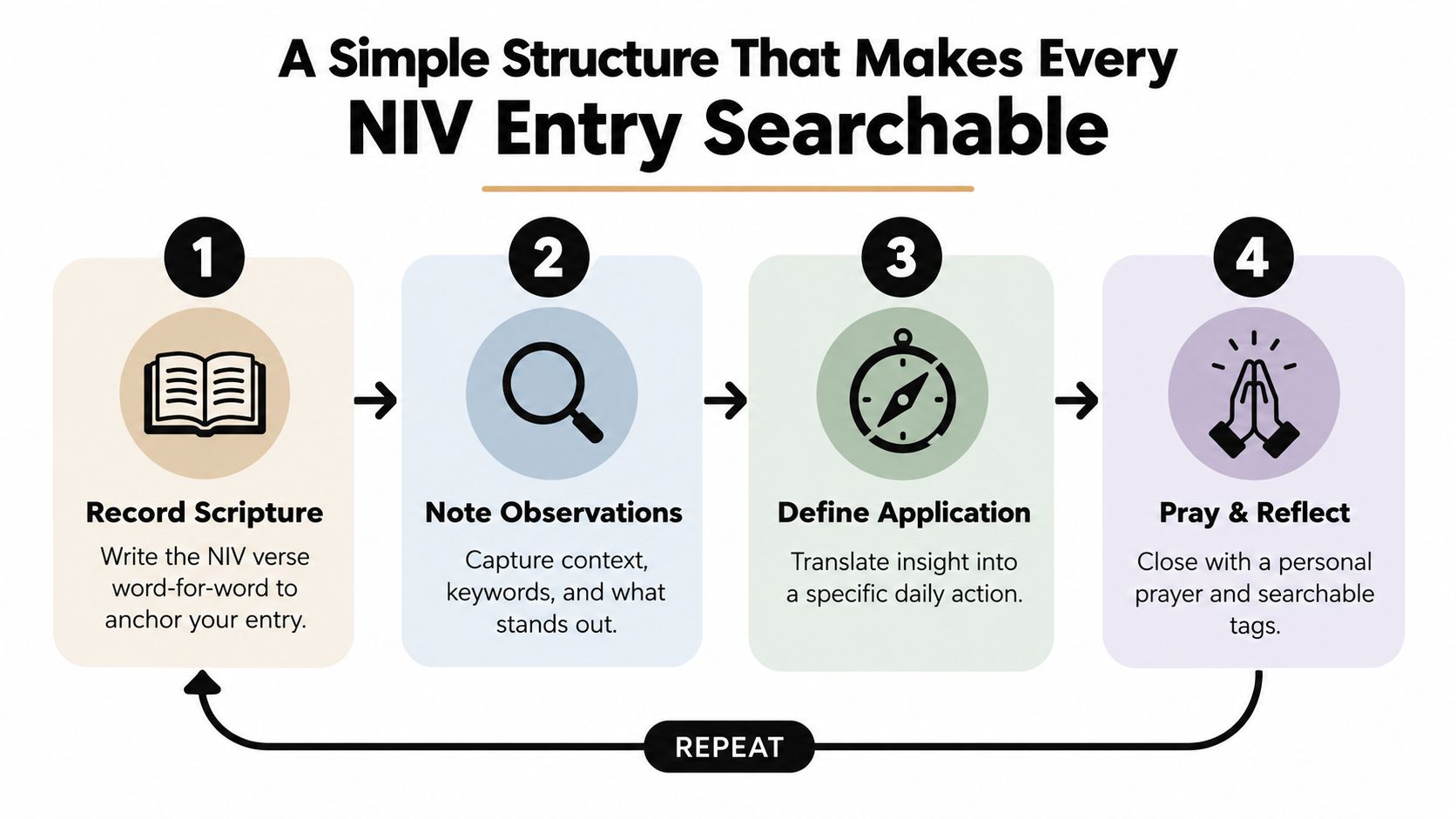
A Simple Structure That Makes Every NIV Entry Searchable
A good NIV journal entry should do two jobs at once. It should help you respond to Scripture now, and help you find that same thread again six months from now without rereading an entire notebook.
That second job is where many journaling methods break down. Pretty pages are enjoyable, but they are hard to scan, hard to search, and often too exposed for honest prayer. A repeatable structure solves all three problems. It gives each entry the same bones, keeps private details contained, and makes verse-linking possible later.
The daily format that removes guesswork
Use the same five-part entry every time:
- Date
- Verse or passage reference
- Observation
- Response for today
- Prayer
That is the whole structure. Keep each part short enough to review at a glance.
I have found that a fixed format matters more than a creative format. If every entry starts differently, old notes turn into a stack of memories instead of a usable record. If every entry starts the same way, you can flip through Romans, Psalms, or John and spot patterns fast.
Practical rule: Put the reference near the top, write one clear observation, one concrete response, and one prayer you can review later.
A slightly fuller version works well if you want better search and cross-reference later: passage, summary, observation, question, response, prayer. It takes an extra minute, but that extra minute often saves ten when you revisit a theme like fear, patience, confession, or obedience.
Build each note so it can be found again
Searchable does not only mean digital. Paper can be searchable too if the structure stays consistent.
The key is labeling entries in a way your future self will use. Instead of writing a long reflection under “today's thoughts,” add simple handles such as:
- Topic: anxiety, gratitude, forgiveness
- Type: promise, warning, command, question
- People: David, Paul, Israel, disciples
- Link verse: another passage connected to the same theme
These labels make review much easier. They also keep the journal from becoming a private scrapbook with no retrieval system.
A simple entry might look like this:
- Date: May 14
- Reference: Philippians 4:6 to 7
- Observation: Paul ties peace to prayerful dependence, not control.
- Response: Pause before lunch and name the worry instead of carrying it.
- Prayer: Teach me to bring specific anxieties to You.
- Topic: anxiety
- Link verse: 1 Peter 5:7
Now the entry can be found by book, date, topic, or theme. That is what keeps a journal useful.
Observe first, then respond
The fastest way to fill a journal with vague entries is to jump straight to application. The NIV is readable enough that this temptation comes early. A verse feels familiar, and the pen starts moving before the text has been examined.
Slow that down for a minute.
Before writing the response, check a few anchors:
- Who is speaking
- Who is being addressed
- What repeats
- What comes before and after
- What the verse is doing, such as comforting, correcting, warning, or promising
This keeps the note tied to the passage instead of your mood. It also improves your later review, because the entry records what the text said, not only how the morning felt.
What makes entries harder to search
Two habits usually cause trouble over time.
- Writing in long paragraphs with no labels
- Mixing observation, application, and prayer into one block of text
Both feel natural in the moment. Both make retrieval harder later.
Short sections work better because each line has one job. You can skim twenty entries in a few minutes, trace repeated verses, and keep sensitive prayers brief or coded if privacy matters in your home. That trade-off is worth making. You lose some page artistry, but you gain a journal you can use.
Short, structured entries survive busy weeks better than detailed pages that require ideal conditions.
Setting Up Your Bible Journal NIV System for Digital or Print
You read a passage in the NIV, write a thoughtful page, and two months later you cannot find it when the same struggle comes back. That is the moment a journal either becomes a habit tool or a stack of memories.
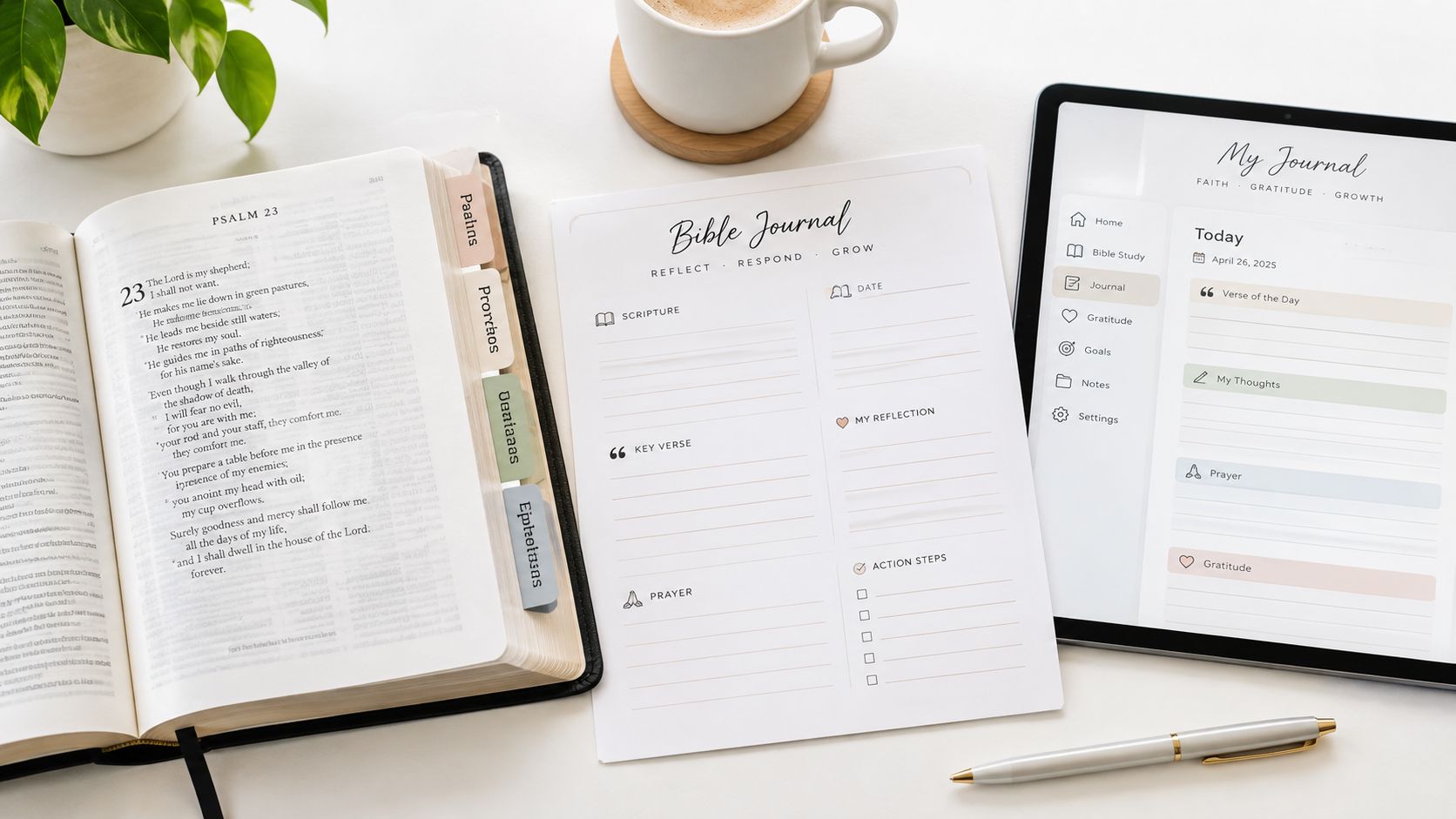
A useful NIV journal needs three things. It needs a place for the entry, a way to find it again, and enough privacy that you will keep writing. Decorative pages can be enjoyable, and these Bible journaling ideas for beginners can help if you like the print side of the practice. Consistency usually depends more on retrieval and privacy than page design.
Print works when you build retrieval into the notebook
Paper slows the process down in a good way. For many journalers, that makes observation cleaner and prayer less distracted. The trade-off is obvious later. Handwritten pages are harder to search, and a beautiful notebook becomes frustrating if every useful note disappears into page 47.
A print setup holds up better with a fixed layout:
- Leave a header line for date, book, chapter, and verse range.
- Keep the passage reference large and consistent so you can flip for it fast.
- Use one section for observations and one for response instead of blending everything together.
- Reserve a margin for tags such as fear, waiting, repentance, family, or praise.
- Add a simple index in the front or back with page numbers by Bible book.
That sounds plain. Plain is the point. In my experience, the journal pages I revisit are rarely the prettiest ones. They are the ones with clear references, short labels, and enough white space to scan in under a minute.
Digital works when the verse is the anchor
Digital journaling solves a different problem. It gives you search, cross-device access, and more privacy if you do not want sensitive prayers sitting open on a kitchen table. It also creates a new risk. If notes live in random folders or generic daily documents, they drift away from the passage that started them.
A better setup links each entry to the verse first, then sorts it in a few practical ways:
| Organizer | What it helps you find | Best use |
|---|---|---|
| Date | What you were learning in a specific week or season | Review over time |
| Bible reference | Every note tied to Psalm 23, James 1, Romans 8, and so on | Passage study |
| Theme or tag | Repeated threads like anxiety, forgiveness, wisdom, prayer | Pattern tracking |
| Privacy level | Notes you can revisit publicly versus notes that should stay personal | Honest writing |
One useful digital implementation is HolyJot, which supports verse-linked entries, includes full NIV text, and can surface cross-references through FaithAI. That helps if you want one note attached to one passage instead of buried in a general notes app.
A short walkthrough helps if you're thinking digitally first:
Choose the system you can maintain on an ordinary Tuesday
Print fits people who think better with a pen, do not mind manual indexing, and want fewer digital distractions. Digital fits people who want searchable entries, verse-linking, and stronger privacy across devices.
Hybrid setups can work too. I have seen the best results from keeping only one primary archive. For example, read and mark in a physical NIV, then store final journal entries digitally. Or draft digitally, then copy only the entries worth keeping into a print journal. What usually breaks the habit is maintaining two full systems at once.
Keep the setup light. If each entry requires custom formatting, color decisions, and a perfect block of quiet time, the journal will not survive a busy week. A searchable, private, repeatable system will.
Prompts and Templates That Turn NIV Verses Into Daily Practice
You read the passage, underline one line, and then stall. The problem usually is not sincerity. It is having no repeatable way to turn an NIV verse into a useful entry you can find again later.
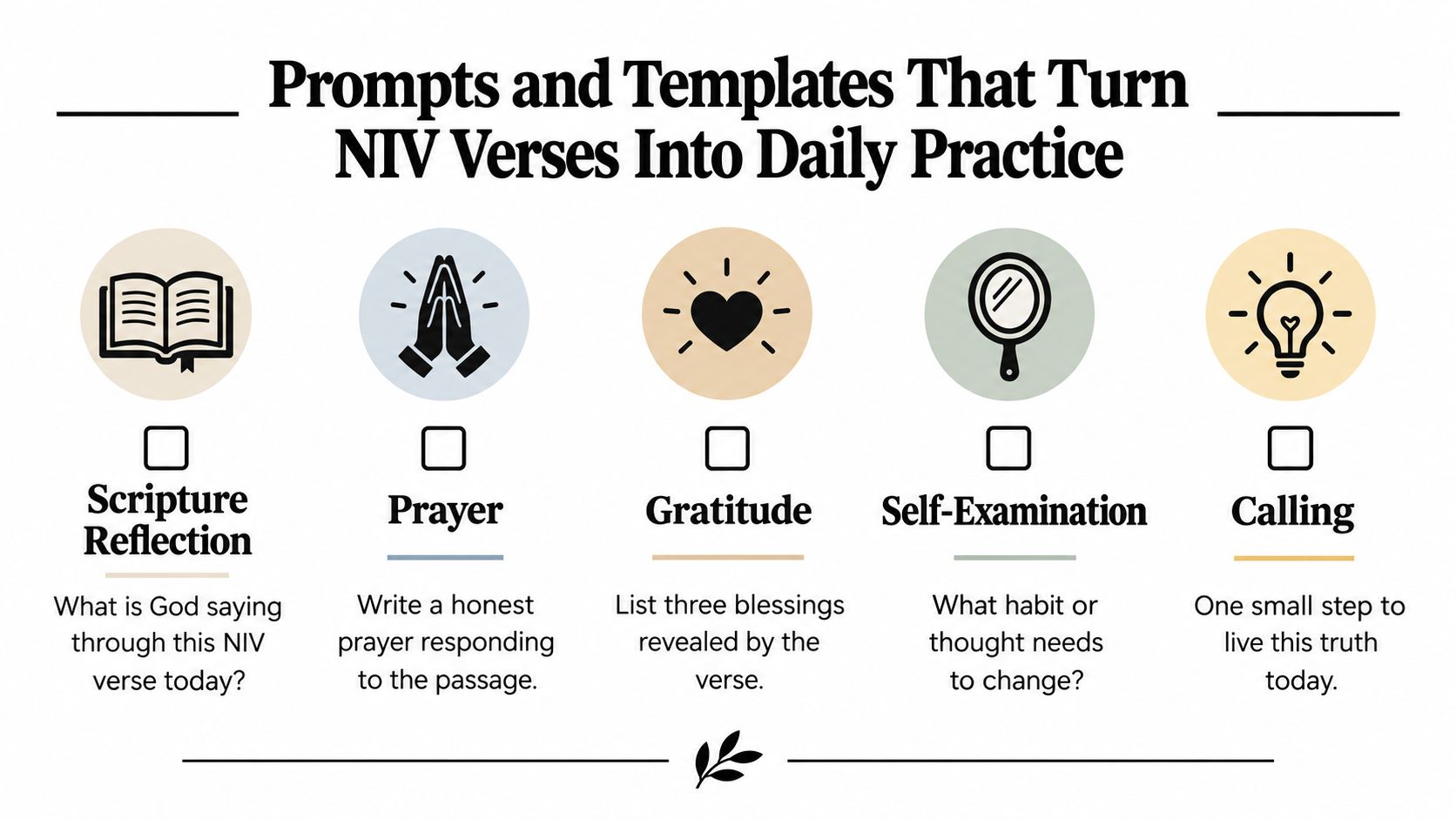
Good prompts solve that. They give each entry a job. They also keep journaling from drifting into decorative pages with no clear thread back to the text. If you want extra ideas, this list of Bible journaling prompts for Scripture-based reflection is useful, but one prompt per session is usually enough.
Five prompts that work on ordinary days
Use one prompt, answer it clearly, and tie the entry to a verse reference.
- Scripture reflection. What does this passage say in plain words before I react to it?
- Prayer response. What do I need to say to God because of this verse?
- Gratitude. What in this passage calls for thanks?
- Self-examination. What habit, fear, motive, or attitude does this text expose?
- Obedience. What is one action I can take today because this is true?
These prompts work because they move from text to response without asking for a polished devotional voice. In Philippians 4, an anxious reader can name the exact worry and write how the passage corrects it. In James 1, the entry can turn into a decision note about where wisdom is needed. In the Psalms, gratitude often comes from naming one aspect of God's character and one way it meets the day in front of you.
Pick one prompt. Finish it.
Choose Your Daily NIV Journal Template
| Template | Best For | Time Needed | What You Write |
|---|---|---|---|
| 5-minute daily template | Busy mornings, new journalers, consistency | Short | Date, verse reference, one observation, one application, one prayer |
| Verse-mapping template | Study days, harder passages, group prep | Longer | Passage, structure, key terms, cross-references, takeaway |
The short template keeps the habit alive. The longer one helps when the passage has a knot in it and a quick reaction would stay vague.
A deeper template for slower days
For denser passages, I use a simple study sequence: write the reference, mark the structure, note repeated words, connect one or two cross-references, then end with a one-sentence takeaway and one response. That format works well for inductive study and verse mapping because it slows interpretation before application.
It also makes old entries easier to retrieve. If every note includes the same core fields, you can search by verse, theme, or repeated struggle instead of rereading random pages.
Use the deeper template for passages that need patient work, or for entries you may want to revisit in counsel, teaching, or prayer. Do not make it your daily default unless your schedule can hold it. Consistency usually comes from a format you can complete while the coffee is still hot.
Staying Consistent With Privacy Streaks and Time Capsules
Most journaling advice is good for day one and weak for week three. That's where consistency usually breaks.
The trade-off between paper and digital becomes sharper over time. A paper journal gives you quiet and simplicity. A digital journal gives you searchable notes, private reflections, cross-references, and long-term tracking. That distinction matters because newer coverage has started treating digital journaling as its own category rather than a simple replacement for paper, and one recent trend article notes a 40% rise in searches for "AI Bible journal" in early 2026 (digital Bible journaling trend coverage).
Privacy is not a side feature
A lot of people stop journaling when they suspect someone else might read the page. That's not a small problem. It changes what gets written.
If you journal about temptation, grief, anger, family stress, or doubt, you need clear boundaries. Practical privacy habits look like this:
- Lock sensitive entries so confession and prayer stay private.
- Separate personal prayers from shareable notes if you study with a spouse, mentor, or small group.
- Use private group spaces carefully for discussion notes while keeping the deeper personal layer to yourself.
That kind of setup especially helps busy adults, new believers, and small groups who need a routine they can repeat without turning every note into public content.
Gentle accountability works better than pressure
Habit tools don't need to feel intense. They just need to make the next day easier.
A streak works when it reminds you to show up, not when it shames you for missing a day. A time capsule works when it lets you revisit an older prayer and notice how your understanding has changed. Weekly review also matters. Even a short glance through recent entries can reveal repeated fears, answered prayers, or passages you keep returning to.
A separate trend and market overview also points to a gap in current Bible journaling content. Much of it still assumes a generic devotional reader or emphasizes creative journaling, while the stronger unanswered need is a low-friction, repeatable routine that can be searchable, private, and shareable in the right setting (Bible journaling market and user-segment gap)).
A sustainable journaling habit protects honesty, reduces setup friction, and gives you a reason to come back tomorrow.
Your Next Entry and How to Keep the Habit Going
Start smaller than you think you need to.
Pick one NIV passage you already love. Not a chapter you feel guilty about avoiding. Not a study project you've postponed for months. Just one passage you can read slowly tomorrow morning without resistance. Then write four lines: date, verse reference, one observation, one application, one short prayer.
A simple seven-day pattern helps:
- Days 1 to 3. Use the short daily format.
- Day 4. Do one deeper mapping entry on a single passage.
- Days 5 and 6. Return to the short format.
- Day 7. Review the week's entries and note one repeated theme.
Keep one rule for sharing. If an entry mainly records insight from the passage, it may be worth discussing with a trusted group. If it mainly contains confession, grief, or a prayer you're still living through, keep it private for now.
Perfection is what kills this habit. A repeatable system keeps it alive. If your Bible Journal NIV practice becomes easy to start, easy to search, and safe enough for honesty, you'll stop treating journaling like an occasional burst of motivation and start using it as part of daily discipleship.
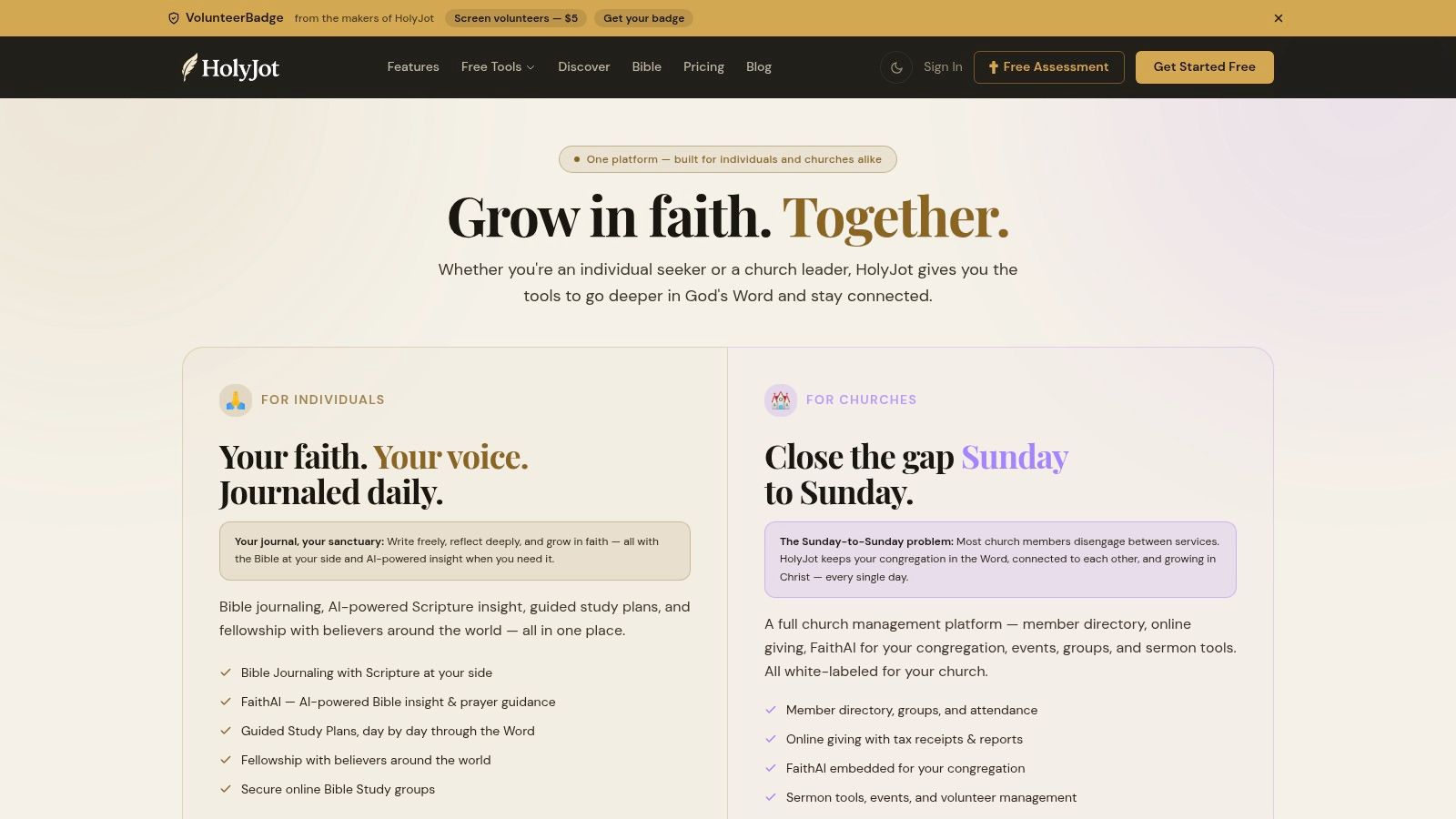
HolyJot gives you a practical way to do this with verse-linked NIV journaling, private notes, streaks, time capsules, and group spaces when you want to share selectively. If you want a Bible journaling system that's built for daily use rather than occasional inspiration, visit HolyJot.