


Sunday attendance can look healthy while weekday participation fades. People hear the sermon, greet friends in the lobby, and leave with good intentions. By Tuesday, the conversation has usually ended, the unanswered question has been forgotten, and the next point of contact is another Sunday service.
A sustainable Bible study at church closes that gap by giving people a repeatable place to ask questions, practice Scripture, and build relationships. The strongest ministries don't treat groups as an optional activity beside worship. They use them as the relational structure that helps people move from listening to participating, and from occasional inspiration to daily formation.
The Sunday to Sunday Engagement Challenge
A church can have a full sanctuary and still struggle to create meaningful connection during the week. The problem usually isn't a lack of spiritual interest. It's that Sunday offers a large gathering, while discipleship requires smaller settings where people can speak openly, receive encouragement, and return to the same ideas over time.
Small groups provide that bridge. Lifeway Research's 2024 report on small groups found that the average church has seven ongoing adult Bible study groups with 69 weekly participants, while 91 people connect with a group at least once during a three-month period. Those figures describe a ministry pattern that is already familiar across churches: worship gathers the congregation, while Bible study creates recurring contact points for formation and care.
The harder question is what happens after the first visit. A guest may attend a group once because a friend invited them, then disappear because the schedule felt unclear, the discussion didn't fit their needs, or nobody followed up. Lifeway's analysis of why worship attendees don't participate in groups identifies the same conversion problem. The average church reaches 44% of worship attendees through small groups, and 67% of church leaders say half or fewer of their worship attendees participate in ongoing Bible study groups. The full Lifeway analysis shows why attendance growth requires more than launching another class.
Practical rule: Design the next connection before the current one ends.
A group leader can close each meeting by naming the next gathering, sharing the reading, and inviting one specific response during the week. A ministry director can assign follow-up responsibility instead of assuming the leader will remember. A digital space can hold the reading plan and discussion between meetings, but it should support real relationships rather than replace them.
The goal isn't to make every church event busier. It's to create a dependable rhythm in which Sunday introduces the theme, the group explores it, and weekday practices help people live it.
Choosing the Right Bible Study Format
Different formats solve different ministry problems. A relational group may help people feel known, while a verse-by-verse class may answer the need for careful interpretation. Trouble starts when leaders choose a format because it worked elsewhere without asking what their congregation needs now.
| Format | Best For | Leader Prep Time | Primary Goal |
|---|---|---|---|
| Relational small group | Newcomers, pastoral care, mixed maturity | Moderate | Belonging, prayer, and shared practice |
| Sermon-based follow-up | Churches seeking a simple Sunday-to-weekday bridge | Low to moderate | Reinforcing the sermon through discussion |
| Topical deep-dive | Specific pastoral questions or seasonal needs | Moderate to high | Applying biblical themes to lived concerns |
| Verse-by-verse exegesis | Participants seeking theological depth | High | Context, interpretation, and biblical literacy |
Relational small groups
These groups work best when the church wants people to build trust while studying Scripture. The leader still prepares carefully, but the meeting gives room for prayer, personal reflection, and mutual encouragement. The trade-off is consistency. Without a clear passage and discussion plan, the group can become a general conversation club.
Sermon-based follow-ups
A sermon-based group lowers the preparation barrier because the church has already established the main passage and direction. Leaders can ask what participants noticed, where they disagreed, and what obedience might look like during the week. This format is efficient, but it can become repetitive if every meeting just reviews the sermon rather than opening the text for deeper conversation.
Topical deep-dives
Topical studies are useful when a congregation is facing a clear pastoral question, such as grief, vocation, money, hospitality, or reconciliation. They connect Scripture to life quickly, but leaders must guard against collecting isolated proof texts. A good topical study traces the theme across the wider biblical story and acknowledges where passages require careful context.
Verse-by-verse exegesis
This model rewards patient preparation and gives mature participants a substantial encounter with the text. It can also intimidate newer readers or turn the leader into a lecturer. Keep the group accessible by explaining historical background in plain language, asking observation questions before interpretation questions, and allowing participants to connect meaning with practice.
Choose the format according to pastoral purpose, leader capacity, and participant readiness. A church may use sermon-based groups for broad access, topical studies for targeted care, and expository classes for deeper training. The formats don't compete. They create different entry points into the same discipleship pathway.
Curriculum Planning and Selection
Curriculum selection should begin with the people in the room, not with a publisher's catalog. A resource can be faithful and well written yet still fail because it asks too much of new readers, assumes a level of theological knowledge the group doesn't have, or offers no bridge from discussion to daily action.
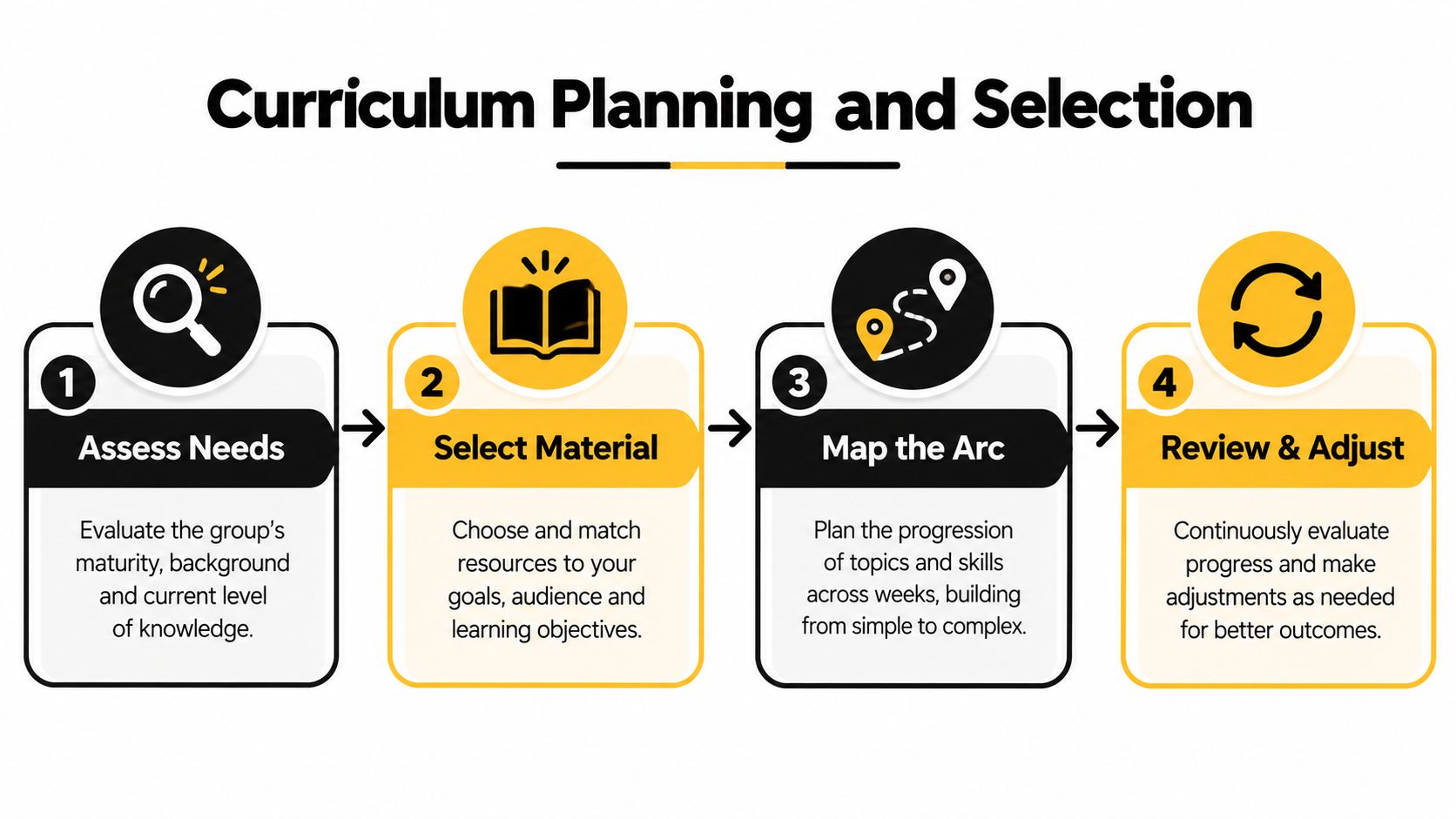
Assess the group before choosing material
Start with a short listening process. Ask what participants hope to understand, what makes study difficult, and what they would like to practice between meetings. Leaders should also identify whether the group includes seekers, new believers, long-time members, or people carrying painful experiences with church.
A useful assessment considers:
- Biblical familiarity: Can participants locate the passage and understand its basic context?
- Pastoral need: Is the group processing grief, transition, conflict, isolation, or a season of service?
- Learning preference: Will people engage through reading, conversation, reflection, prayer, or practical exercises?
- Available capacity: Can members complete preparation, or should most discovery happen together?
Select material that serves the purpose
Publisher-produced curriculum offers structure, leader notes, video support, and a tested sequence. That reduces preparation pressure, especially for volunteer leaders. Custom guides allow the pastor or ministry director to respond to the church's language, sermon series, and local concerns, but they require stronger review for clarity, theological balance, and accessibility.
Use a resource review such as the one outlined in this Bible study curriculum guide. Check whether the material keeps the biblical text central, provides context without overloading the session, welcomes questions, and ends with a practical response.
Map the arc before the first meeting
Whether the study runs for six weeks or twelve, give the series a visible progression. Early sessions can establish context and shared vocabulary. Middle sessions can explore tension, interpretation, and application. The final meetings should help participants consolidate what they have learned and identify a continuing practice.
A simple session pattern works across many formats:
- Open with connection: Invite a brief check-in or reflection from the previous week.
- Read the passage: Use more than one voice when appropriate, and allow silence.
- Explore the text: Move from observation to interpretation, then to application.
- Name a practice: Give participants one specific action, prayer, or conversation.
- Close with follow-up: Share the next reading and explain how people can respond.
Review the arc after each meeting. If discussion stays abstract, add a concrete scenario. If participants feel rushed, remove supplemental material. A curriculum is a servant of formation, not a test of how much content a group can cover.
The Impact of Frequency on Spiritual Growth
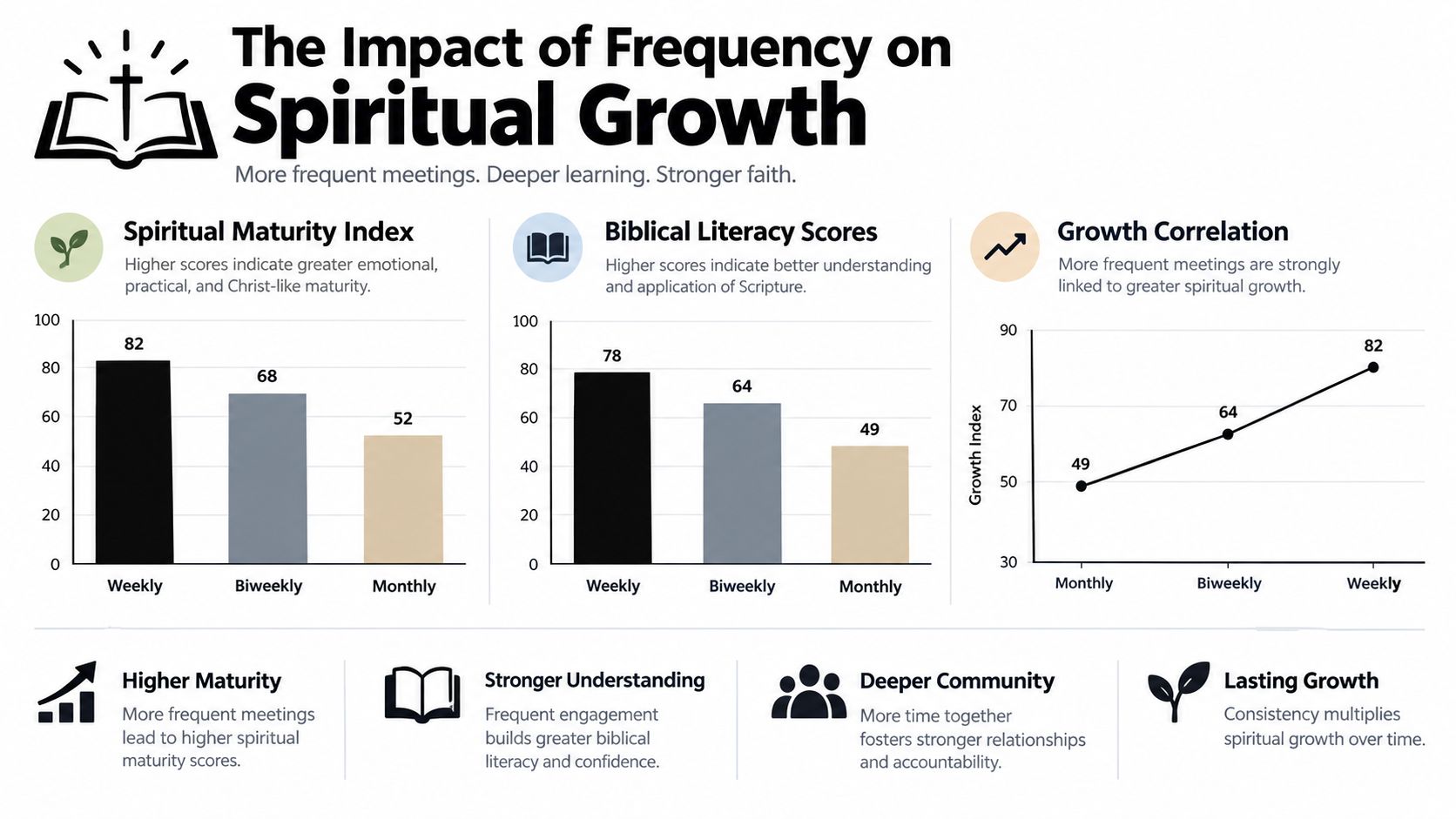
Meeting more often isn't automatically better. A group can meet frequently and still produce shallow conversation if the sessions lack trust, preparation, or a clear connection to life. Yet consistent participation creates more opportunities for people to remember Scripture, practice honesty, receive correction, and notice change.
The available data points to frequency as a meaningful discipleship variable. Churchgoers who attend a small-group Bible study five or more times per month have a discipleship score of 74.1, compared with 72.4 for those attending three to four times monthly, 67.2 for those attending once or twice monthly, and 60.4 for non-participants, according to Lifeway Research's analysis of small-group participation and discipleship scores.
Why cadence matters
Frequency creates repeat exposure, but repetition alone isn't the mechanism. People need enough continuity to remember the previous conversation, report on a practice, and hear how someone else handled a similar challenge. A monthly gathering may offer valuable fellowship, yet it leaves more time for habits and relationships to lose momentum.
The same Lifeway analysis reports that Bible engagement scores rise from 60.6 with little or no small-group participation to 79.4 when participation reaches four or more times per month. The practical lesson isn't that every church must add meetings. It's that leaders should remove avoidable barriers to regular participation and protect a dependable rhythm.
Optimize consistency before adding content
A church trying to improve participation should examine the experience around the meeting:
- Scheduling: Offer times that match the actual lives of members, not only the preferences of existing leaders.
- Group fit: Help newcomers find a group based on location, life stage, language, and format.
- Follow-up: Contact absent members with care, not surveillance. Ask what support would make returning easier.
- Between-meeting practice: Keep the assigned reading short enough to complete and specific enough to remember.
- Leadership coverage: Build a substitute plan so one volunteer's absence doesn't cancel the group.
The strongest cadence is the one people can sustain without treating participation as another burden.
Frequency also changes how leaders measure success. Counting enrollment tells you who expressed interest. Tracking repeated participation, completed practices, and personal stories gives a clearer picture of whether the group is becoming part of weekly life. The church should pursue regularity, but it must pair regularity with thoughtful facilitation and pastoral care.
Moving From Information to Transformation
A group can answer every interpretation question correctly and still leave people unchanged. Participants may understand the passage's setting, vocabulary, and argument while remaining unsure how it speaks to their work, family, anxiety, conflict, or treatment of a neighbor.
The Anglican Communion's “Mind the Gap” study material identifies the distance between espoused theory and theory in practice, between one-time study and continual formation, and between isolated passages and the wider biblical context. That challenge should alter how leaders write questions. “What does this verse mean?” is necessary, but it isn't sufficient.
Ask questions that lead somewhere
A strong discussion usually moves through four layers:
- Observation: What does the passage say, and what details might we overlook?
- Interpretation: What did this mean in its original setting, and how does it fit the wider canon?
- Self-examination: What assumption, habit, fear, or relationship does this passage challenge?
- Practice: What will you do, discuss, repair, resist, or begin before the next meeting?
The final layer should not become a forced promise or public confession. People need permission to choose an honest next step. “Pray for my colleague” may be appropriate for one participant, while another needs to seek counsel, set a boundary, apologize, or ask for help.
Make room for people who feel outside the center
Inclusive discussion isn't the same as abandoning doctrinal clarity. It means recognizing that participants hear a passage through different experiences, cultures, histories, and wounds. A leader can ask who is visible in the text, who is vulnerable, whose perspective is missing, and how the church might reproduce the attitudes the passage confronts.
Tearfund's Bible study resources prompt participants to examine the attitudes of crowds, religious insiders, and the church toward marginalized people. That approach gives a group practical language for identifying social blind spots without turning the discussion into a political performance.
Facilitators should also set boundaries. Don't pressure people to disclose trauma. Don't let one person's testimony become the standard for everyone else. Correct harmful interpretations with patience, and refer serious pastoral, safeguarding, or mental-health concerns to qualified leaders.
Transformation usually appears in small signs: a participant returns to the passage during the week, a difficult conversation becomes possible, a group notices someone who has been overlooked, or a prayer changes from abstract language to a specific act of love. The study has done its work when Scripture travels beyond the meeting.
Digital Tools for Weekday Engagement
The group meeting shouldn't carry the entire weight of discipleship. Digital tools can extend the conversation into the days when members are working, commuting, caring for children, or recovering from exhaustion. Used well, technology keeps the shared passage visible without turning the church into a stream of notifications.

Build a simple weekday rhythm
A leader can post the next passage, one observation question, and one prayer prompt after the group meets. Members can read the text, write a short reflection, and respond to one another before the next gathering. The process works because the digital activity is connected to a real conversation, not because the platform contains endless content.
Faith journaling tools can support verse-linked notes, private reflections, prayer prompts, and shared reading plans. AI-assisted study can help a participant compare context, surface cross-references, or generate questions from a passage. Leaders should review AI-generated material before sharing it, check that interpretations remain faithful to the church's teaching, and make clear that an assistant supports study rather than replacing Scripture, pastoral judgment, or community.
A private online Bible study community can give members one place for reading plans, reflections, announcements, and follow-up. Keep the design quiet. One meaningful prompt is more useful than a feed crowded with reminders.
Design for access and privacy
Accessibility needs attention from the beginning. Captions, transcripts, readable documents, and multiple ways to respond help people participate when hearing, vision, language, or mobility creates barriers. Churches planning recorded or hybrid studies can also explore iScribe for hearing loss as a resource for making spoken teaching and discussion easier to follow.
Privacy matters just as much as convenience. Don't require people to publish sensitive prayer requests to a general channel. Give members private journaling options, explain who can see group posts, and establish a clear policy for pastoral disclosures. Leaders should never use engagement data to shame people who miss a reading or meeting.
A practical digital sequence might look like this:
- After worship: Share the passage and one question connected to the sermon.
- Midweek: Invite a short reflection, audio response, or prayer request.
- Before the group: Remind members of the meeting goal, not just the time.
- After the group: Record the practice participants chose and the next reading.
Technology closes part of the Sunday-to-Sunday gap, but it can't create trust by itself. The church still needs leaders who notice absence, welcome questions, and connect digital reflection to embodied community.
Equipping Leaders and Launching Groups
A Bible study leader doesn't need to be the most knowledgeable person in the room. The leader needs to prepare the passage, create a safe structure, ask useful questions, notice who isn't speaking, and help the group take one faithful step.
That shift from expert teacher to guided facilitator changes recruitment. You can invite people who are dependable, curious, emotionally mature, and willing to learn. Someone who can explain every theological detail but dominates discussion may be less effective than a thoughtful listener who helps others engage the text.
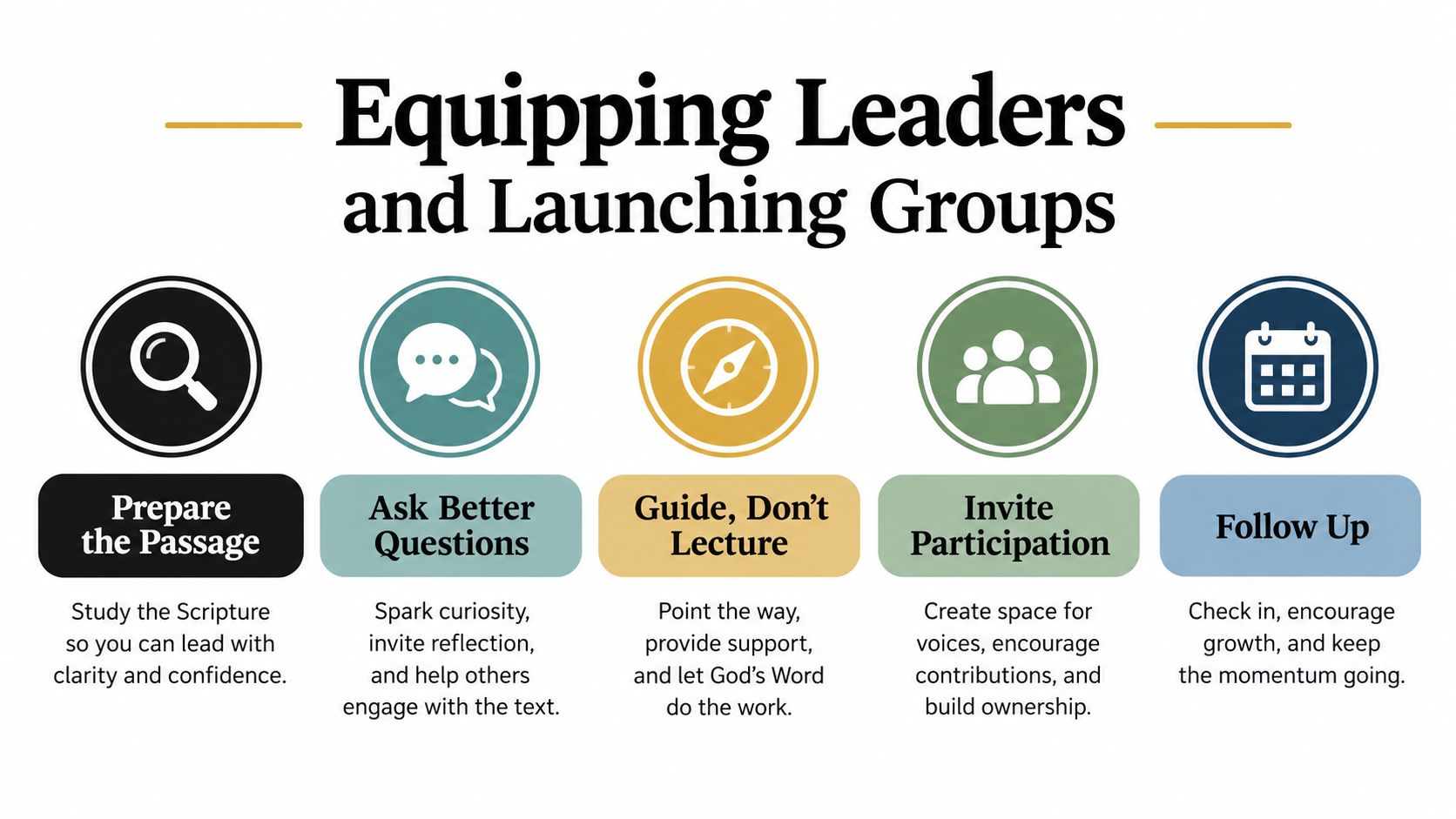
Give leaders a repeatable checklist
Before launching a group, make responsibilities explicit:
- Prepare the passage: Read it repeatedly, consult reliable context, and identify the central tension or invitation.
- Ask better questions: Write prompts that move from observation to interpretation and practice.
- Guide, don't lecture: Set a time boundary for teaching, then let participants work with the text.
- Invite participation: Use names, pauses, paired discussion, and multiple response options.
- Follow up: Contact people who are new, absent, or carrying a pastoral concern.
Leaders also need a support system. Schedule regular coaching, provide a contact for difficult situations, and give volunteers permission to say when a session isn't working. A church management platform can help coordinate groups, roles, attendance, events, and follow-up, but leaders shouldn't experience those tools as surveillance.
Peer learning can strengthen this support because facilitators learn from one another's questions, adaptations, and failures. Resources such as Fluidwave peer learning insights offer useful language for creating a culture where leaders exchange practical knowledge instead of working in isolation.
For a more detailed preparation workflow, use this guide on how to lead a Bible study. Start each new group with a clear purpose, a named leader and backup, a meeting location, a communication channel, a first study arc, and a follow-up plan for visitors. Review the group after its opening cycle. Ask what helped people return, where the conversation stalled, and what needs to change before the next launch.
HolyJot brings Bible journaling, online Scripture reading, guided study plans, FaithAI support, private Community Hubs, and church group management into one environment for weekday discipleship. Visit HolyJot to create a more consistent rhythm between Sunday worship and the next Bible study meeting.