


The Bible is open on the table, but nobody is looking at it. One child is negotiating over dessert, another is watching a tablet under the table, and your teenager has perfected the expression that says this was never their idea. You meant to lead a meaningful family devotion. Three minutes later, you're closing the Bible and wondering whether the problem is your schedule, your leadership, or your family's interest in faith.
Usually, it isn't a spiritual failure. It's an operating failure. The passage is too long, the questions fit adults but not children, and nobody knows what to do when attention collapses. A useful family Bible study guide has to work inside real household conditions, including noise, uneven maturity, resistance, and weeks when the parent leading the discussion feels tired or spiritually dry.
Why Most Family Bible Times Quietly Disappear
A family Bible study often disappears in the same way a neglected exercise routine does. The intention is sincere, but the plan depends on an ideal evening that rarely arrives. Dinner runs late, someone needs help with homework, a toddler is overtired, and the parent postpones the study until the household is calmer. The calmer evening never comes.
The problem becomes clearer when you look at the available evidence. A 2018 doctoral study from Liberty University found that 54.187% of surveyed Christians never spent time reading God's Word with their family, while 37.931% did so rarely. Only 5.419% reported doing so most every day, and 2.463% every day. The study also reported that 95% rarely to never led family devotion or Bible study, suggesting that leadership and repeatable structure can be bigger obstacles than interest. Read the Liberty University doctoral study
The four planning failures behind the fade
Most families aren't missing a Bible. They're missing a format that survives an ordinary week.
- The session is too ambitious. A long reading and a chain of questions create pressure. Once one person loses focus, the entire plan feels broken.
- The passage serves the adult leader. Parents often choose what they want to study rather than what the whole room can enter. A dense theological passage may be worthwhile, but it needs age-appropriate access points.
- There is no recovery plan. If the toddler melts down, the teenager refuses to answer, or dinner needs clearing, the family has no shorter version ready.
- Every meeting must feel profound. That expectation makes simple faithfulness seem inadequate. A child naming one detail and a parent praying one honest sentence can be a successful session.
Practical rule: Plan the version your family can repeat on a difficult evening, not the version that looks impressive on a peaceful one.
A sustainable rhythm may involve one short weekly meeting, a passage read aloud, a few open questions, and prayer. That structure doesn't lower the value of Scripture. It removes unnecessary friction so the family can return to it. The first win isn't covering more material. It's making the next gathering easy to begin.
The Core Method That Holds Any Passage Together
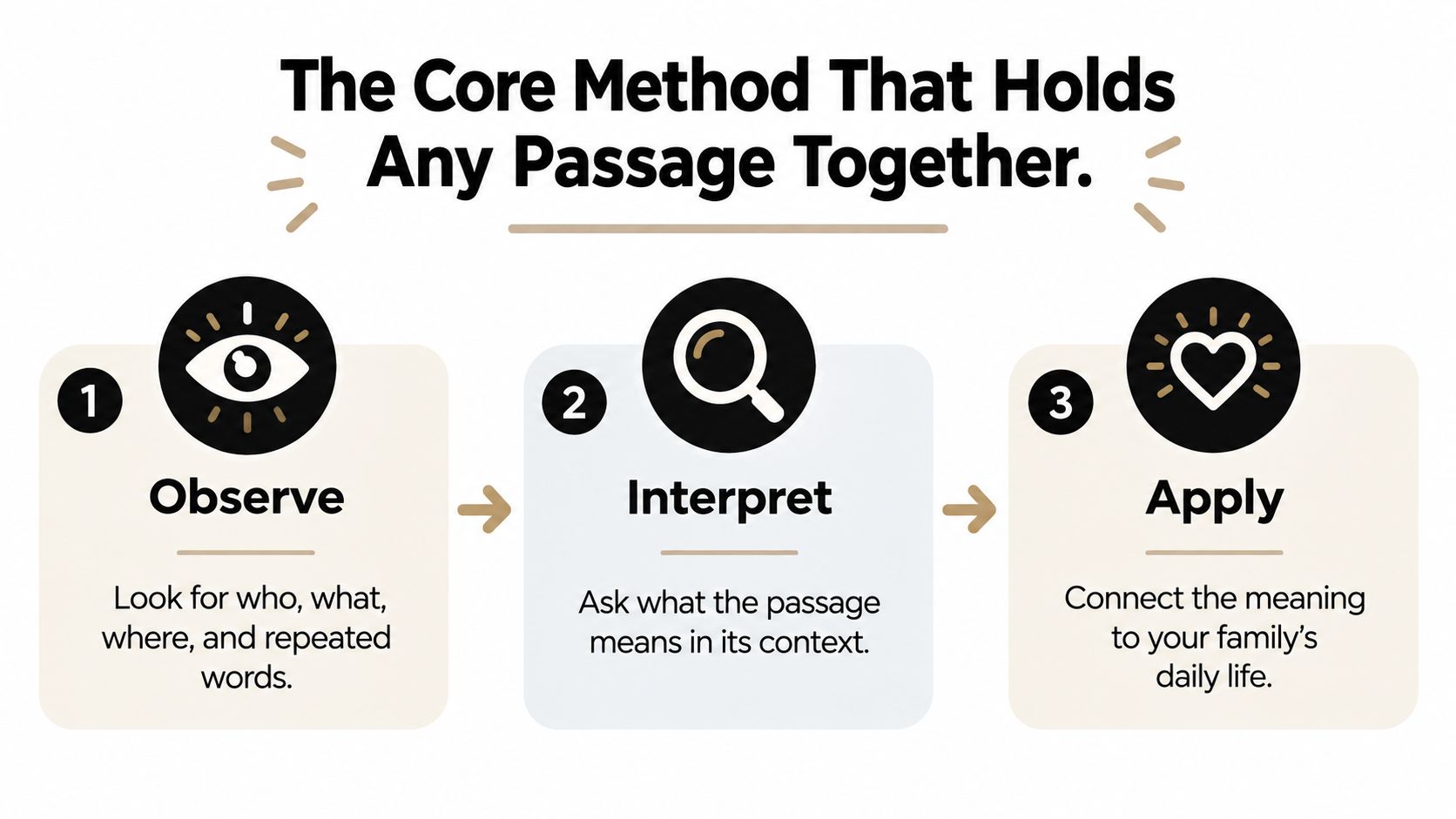
A reliable method gives the family somewhere to go when the conversation stalls. Use Observe, Interpret, Apply. The sequence keeps children from guessing what a verse means before anyone has noticed what it says, and it helps adults avoid pulling isolated phrases away from their context.
Observe what is on the page
Read the passage aloud, then ask the family to notice before they explain. Who appears? What happens? Where does the scene take place? What words, actions, or ideas repeat? With younger children, observation may sound like, “What did the shepherd do?” Older children can identify a change in mood, a command, a contrast, or a repeated image.
A second reading helps. Ask one person to retell the passage without adding an interpretation. If the group is studying a short parable such as the lost sheep, a preschooler might point out the missing sheep, an elementary child might describe the search, and a teen might notice how the story presents the shepherd's priorities.
Interpret the passage in context
Interpretation asks, “What does this mean here?” It doesn't begin with, “What does this remind me of?” Look at the surrounding paragraph, the speaker, the audience, and the kind of writing. A parable, a psalm, a narrative, and a letter shouldn't all be read in exactly the same way.
Use plain questions: What problem is this passage addressing? What does the main character value? What would the first hearers have understood? Parents don't need to deliver a lecture. They need to keep the group anchored to the passage before moving toward personal conclusions. The observation, interpretation, and application approach offers a helpful companion framework for this sequence.
Apply one concrete truth
Application turns understanding into a response. Choose one action, attitude, or prayer, not a list of improvements for every family member. After reading about the lost sheep, the application might be to notice someone who feels left out and take one practical step toward them during the week.
Finish with prayer connected to the passage. A child can pray, “Help us look for people who are alone.” A teen can name a relationship where patience is difficult. An adult can pray for courage to act. The method is a guardrail, not a script. If the family has a rich observation conversation, you don't need to force a rushed application before closing.
Adapting the Study for Every Age at the Table
A mixed-age study works when everyone shares the same passage but not the same task. Preschoolers shouldn't be expected to interpret symbolism like adults, and teenagers shouldn't be trapped in questions designed only for small children. Give each person an entry point that respects their development and still keeps the family together.
The simplest rule is concrete first, meaning second, personal response third. Younger children need visible details and short answers. Elementary children can explain cause and effect. Teens can examine assumptions, context, and tension. Adults can model humility by answering directly rather than turning every response into a correction.
One passage, four levels of participation
| Age Tier | Observe | Interpret | Apply |
|---|---|---|---|
| Preschoolers | “Who is there?” “What did you see?” | “Was that kind or unkind?” “How did the person feel?” | “Who can we help?” “What kind thing can we do?” |
| Elementary kids | “What happened first?” “What changed?” | “Why did the person act that way?” “What does this teach us?” | “Where could you practice this at school or home?” |
| Teens | “What tension or repeated idea stands out?” | “What would the original audience have heard?” “What question does this raise?” | “What choice or relationship does this challenge?” |
| Adults | “How does this passage fit its surrounding section?” | “What does the text claim, assume, or reveal about God and people?” | “What will we change, practice, or pray about this week?” |
Preschoolers can draw a scene, point to a repeated word, or act out a character. Elementary children can retell the passage or keep track of the family's answers. Invite teens to ask the uncomfortable question, compare translations, or summarize the discussion in their own words. Adults should guide the pace and resist answering every question first.
For a practical devotional structure that can be adjusted to different ages, use this guide to doing a devotional. The key isn't to give every child a separate lesson. It's to rotate attention so the little ones aren't ignored and the older ones aren't patronized.
A useful family rhythm: Let the youngest answer first for one observation question, ask an elementary child to retell, invite the teen to interpret, and let an adult name one application.
When attention drops, shorten the question rather than raising your voice. A child who can't discuss the whole passage may still identify one person, one action, and one way to respond.
A Ready-to-Use Four-Week Family Plan
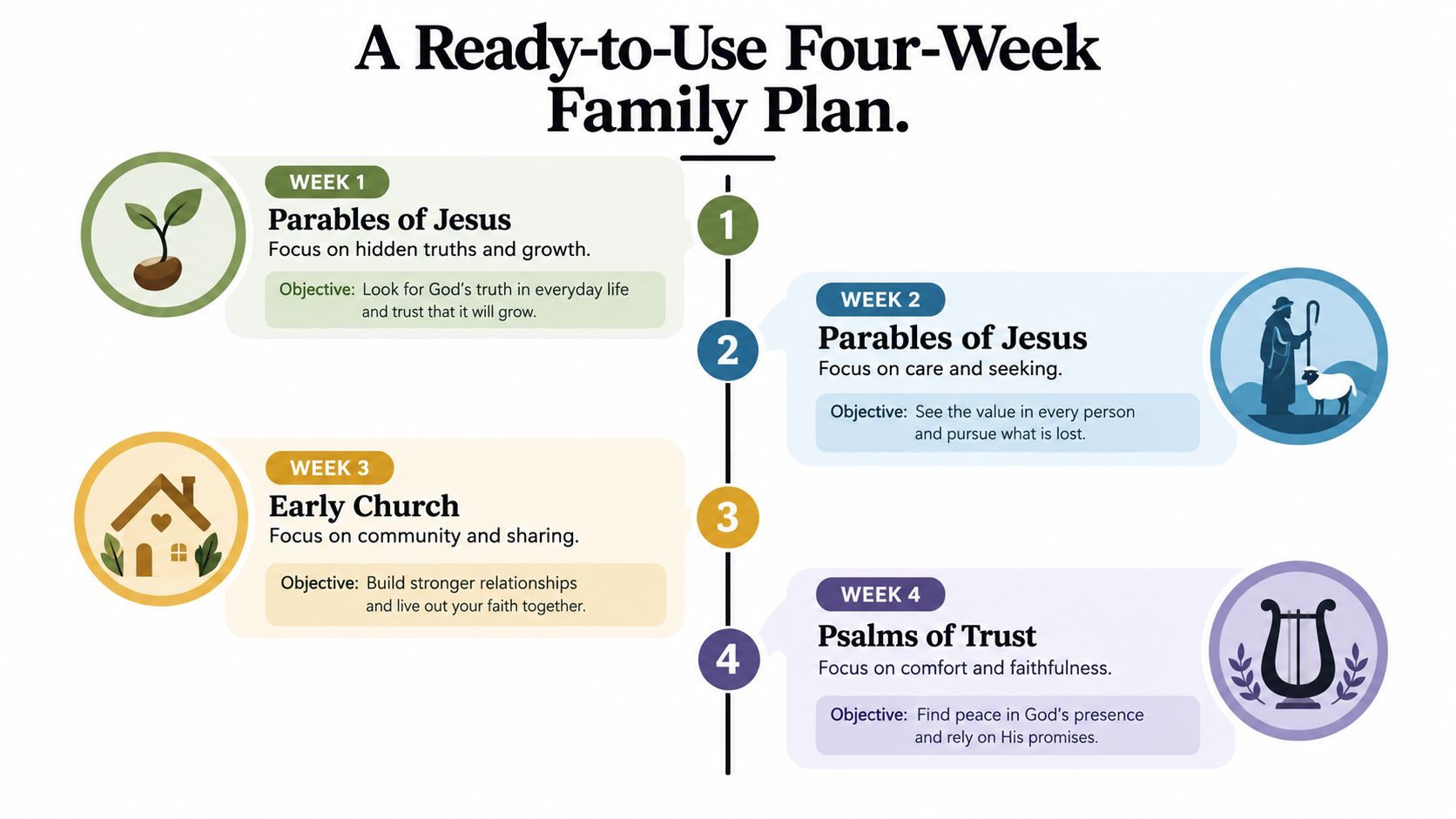
A starter plan should remove decisions, not create a new project. Use one shared theme across the month, prepare the passage before the meeting, and give each session the same basic flow. The family learns the rhythm while the content changes.
Week 1 and week 2
Week 1, the parable of the sower, Matthew 13:1-23. Read the shorter story first, then explain that the surrounding verses provide Jesus' interpretation. Ask, “Which parts of the story did you notice?” Have the children retell what happened to each seed. Ask older participants what the different soils might represent, then choose one question: “What could help us receive God's word with more attention this week?”
Week 2, the lost sheep, Luke 15:1-7. Begin with an open question, “What would make someone search for one missing sheep?” Let a younger child draw the shepherd's search. Ask the family what the story reveals about care and value, then apply it by choosing one person who may need attention. Close by praying for that person without turning the prayer into a public correction.
A 20-minute session flow can stay consistent:
- Two minutes: Welcome, settle, and offer a short prayer.
- Five minutes: Read the passage aloud, with a second reading if appropriate.
- Eight minutes: Ask one observation question, one retell or interpretation question, and one application question.
- Five minutes: Name one action and pray.
Week 3 and week 4
Week 3, the early church, Acts 2:42-47. Ask what the believers did together. Have an elementary child list the shared activities while a teen considers which practices build community. Application can be a shared meal, a practical act of generosity, or an intentional welcome to someone outside the household.
Week 4, a psalm of trust, Psalm 23. Read slowly. Invite children to identify what the shepherd provides, and ask teens and adults where the psalm expresses confidence, fear, or movement through difficulty. Choose one phrase to carry into the week and pray for someone who needs comfort.
If only ten minutes remain, read the passage, ask one question each from Observe and Apply, and pray. If the meeting falls apart, don't label the week a failure. Read one verse at breakfast or let a child choose a phrase for bedtime prayer. On Sunday evening, select the next passage, place the Bible and journals together, and assign one small preparation role. A beginner-friendly Bible study framework can provide further structure when the family wants more guidance.
A short video can support the plan when it serves the conversation rather than replacing it:
Choosing the Right Weekly Format for Your Home
The best format is the one your household can sustain through its current season. A family with toddlers may need movement and short prompts. A home with older children may have enough calm for deeper discussion, but school, work, and activities can still make a formal meeting difficult. Don't copy a routine just because another family praises it.
| Format | Time per Week | Prep Needed | Best Age Fit | Conversation Depth |
|---|---|---|---|---|
| Sit-down family devotion | One protected short meeting | Passage and questions prepared beforehand | Elementary through adult, with adaptations for preschoolers | Moderate to deep |
| Dinnertime table study | Woven into an existing meal | Very light, usually one passage and prompt | Mixed ages when answers stay brief | Brief but frequent |
| Bedtime one-on-one rotation | Individual conversations across the week | Passage or question selected for each child | Preschoolers through teens | Deep with one child |
| Weekend deeper dive | A longer unhurried gathering | More reading, context, and activities | Older children, teens, and adults | Deepest, but less flexible |
Match the format to the friction
A sit-down devotion creates a clear boundary, which helps families who need protected time. It fails when the meeting is treated like a classroom and the leader speaks for most of the session. Keep the reading short and assign participation.
A dinnertime study works because the family is already together. The trade-off is interruption. Use one question, not a full lesson, and let answers carry into cleanup or the next day.
A bedtime rotation gives each child focused attention. It won't feel like a whole-family practice, but it can reach a child who rarely speaks in a group. A weekend deeper dive offers room for context, creative activities, and teen questions, yet it requires more preparation and is easier to postpone.
Ask three questions before choosing: When is the household naturally together? Which child currently needs the safest space to talk? Does the parent leading have enough energy for preparation? Choose the format that answers those questions now, then reassess as children grow. A routine can change without becoming a failure.
When the Room Gets Hard, Resistance and Mixed Faith
Resistance isn't always disrespect. A teen who says, “I don't believe that,” may be testing whether honesty is safe. A child who zones out may be tired, overwhelmed, or unable to follow the language. A spouse who disagrees with the teaching approach may be protecting the household from pressure rather than rejecting every spiritual conversation.
Treat the response as information. Don't turn the study into a loyalty test.
Lower the emotional stakes
Set ground rules before the difficult moment arrives:
- No pop-quiz theology: Nobody has to produce the approved answer on demand.
- No forced sharing: A person may listen, pass, or write privately.
- Questions are welcome: The parent can say, “I don't know yet. Let's keep looking.”
- Critique the idea, not the person: Disagreement doesn't justify ridicule.
- Application isn't punishment: Don't use the passage to expose a family member's recent mistake.
When a teen pushes back, try, “What part feels unclear or unconvincing?” If a child refuses to answer, say, “You can listen today. You can choose the first question next time.” If adults disagree, name the shared purpose: “We want this to be a safe conversation about Scripture, not a fight over who can control it.”
Mixed-faith homes need a wider doorway. Begin with passages that open discussion about kindness, honesty, courage, forgiveness, responsibility, and care for vulnerable people. Family members can discuss what the text says and what value it presents without pretending that everyone holds the same doctrine. Don't smuggle coercion into a supposedly neutral question, and don't ask a skeptical person to perform belief.
Families supporting neurodivergent children may also need sensory adjustments, visual schedules, movement breaks, or alternative ways to answer. A Christian autism parenting guide can help parents think through broader adaptations for faith conversations and family routines.
“You don't have to settle every question tonight. You do have to keep the conversation safe.”
Keep these phrases where the leader can see them:
- “Tell me what you noticed before we decide what it means.”
- “You can disagree and still stay in the conversation.”
- “Let's separate what the passage says from what we're assuming.”
- “Would you rather answer aloud, draw, write, or pass?”
- “We can pray sincerely, even when we're uncertain.”
A family study survives difficult seasons when relationship remains more important than a polished conclusion.
Building a Sustainable Habit and Your Next Steps
A journaling platform can support the routine, but it shouldn't replace parent-led conversation. Use technology to hold the passage, questions, private reflections, and follow-up in one place. The parent still sets the tone, notices who hasn't spoken, and decides when the family needs to stop.
A tool such as HolyJot combines Bible journaling, an online Bible, guided study plans, FaithAI support for Scripture-grounded context and prayer guidance, and private Community Hubs that can include families or small groups. Families can use shared or private entries, age-specific suggestions, and discussion prompts to reduce the friction of lost notebooks, forgotten passages, and the awkward silence that follows “Any thoughts?”
Use Sunday evening as the reset point
Keep preparation small enough that it doesn't become another household burden.
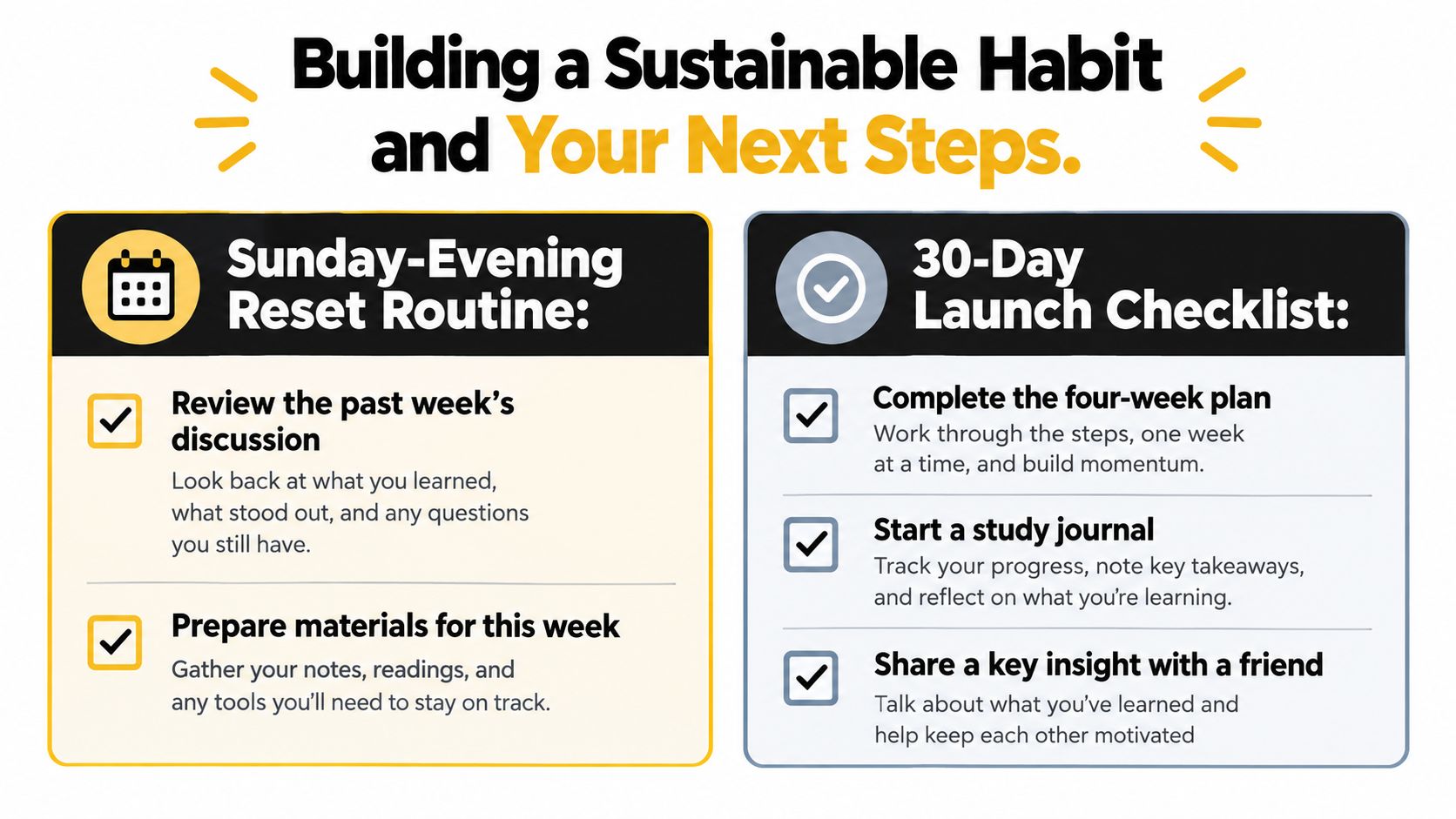
- Review the previous conversation. What question stayed with someone? Did the chosen application happen?
- Choose the next passage. Keep it short and decide which translation or children's resource will support the reading.
- Protect the meeting time. Put the recurring appointment on the family calendar.
- Assign one role per person. One child can read, another can draw, a teen can bring a question, and an adult can prepare the opening prayer.
- Create a fallback. Decide what the ten-minute version will be before the week becomes crowded.
A shared journal gives the family a memory of the conversation, while private entries let a teen or parent process openly without making every reflection public. AI-assisted prompts can suggest questions or context, but the family should test those prompts against the passage and keep discernment with the people at the table.
A 30-day launch checklist
Days 1-7: Choose the first passage, hold the first short study, and record one observation from each willing participant.
Days 8-14: Let a child or teen lead one question. Notice whether the question was too easy, too abstract, or well matched to the group.
Days 15-21: Add the first shared journal entry. It can contain one sentence, one drawing, or one prayer.
Days 22-30: Review the month. Keep the format that created honest participation, remove the part that caused unnecessary friction, and choose the next theme.
Don't wait for a quiet house or perfect confidence. Open a short passage this week, ask what everyone notices, and end before the room becomes resentful.
HolyJot gives families a place to keep shared or private Bible journal entries, guided study prompts, Scripture-based context, and prayer reflections in one weekly rhythm. Visit HolyJot to set up your family study space and begin with one passage, one question, and one honest prayer.