


You bought the notebook, chose a meaningful pen, and promised yourself that this time prayer journaling would become part of your daily life. A few entries later, the notebook is sitting beneath a pile of books, and opening it feels like another obligation you've failed to keep. The problem usually isn't a lack of faith or sincerity. It's a system that asks for too much effort at the exact moment your attention is already depleted.
Learning how to start a prayer journal is less about creating beautiful pages and more about building a reliable place to meet God. A useful journal should help you pray sincerely, connect prayer with Scripture, remember what you've asked, and review how your faith has developed. It can be handwritten or digital, structured or free-flowing, but it needs to remain simple enough to use when motivation fades.
Building a Sustainable Prayer Habit
An abandoned journal often reveals an unrealistic starting point. Many beginners plan long devotional sessions, buy elaborate supplies, and wait for a quiet morning that rarely arrives. Prayer journaling doesn't require a perfect setting. A guide for beginners recommends writing one sentence every day instead of attempting a long session once and then stopping, while also choosing a memorable cue such as morning, lunch, or evening (this beginner's prayer journal guide explains the approach).
Start by attaching the journal to something you already do. Keep it beside your Bible, open the app after your morning coffee, or write immediately after reading Scripture. The cue should be stable, visible, and easy to repeat. If the journal is stored in another room and requires several setup steps, you've created friction before prayer even begins.
Practical rule: A short entry you can repeat is more valuable than an impressive entry you can't sustain.
Make repetition the first milestone
For the first season, measure attendance rather than eloquence. Write a sentence such as, “Lord, give me patience in the conversation I'm avoiding today,” or record one thing you're grateful for. The same beginner guidance recommends choosing a portable journal and noting one to five things you're thankful for each day, because a low barrier makes the practice easier to preserve.
This principle resembles the discipline required to create a realistic workout habit. You don't begin by demanding an extreme routine. You choose a repeatable action, place it near an existing behavior, and make restarting easy.
Use Scripture as a dependable cue
A verse can give your mind somewhere to begin when emotions are scattered. Read a short passage, copy a phrase that stands out, and respond with a prayer. HolyJot's guide to daily Scripture reflection offers another way to connect Bible reading with written reflection without turning the practice into a writing assignment.
A mixed-method study of spiritual diary writing in Korea found that participants writing 5–7 times per week had significantly higher spiritual-growth and psychological-wellbeing scores than lower-frequency writers (the study published in the Journal of Religion and Health). That doesn't mean every entry must be long or emotionally profound. It supports a practical target of frequent, brief sessions, with consistency carrying more weight than literary quality.
Choosing Your Journal Format and Structure
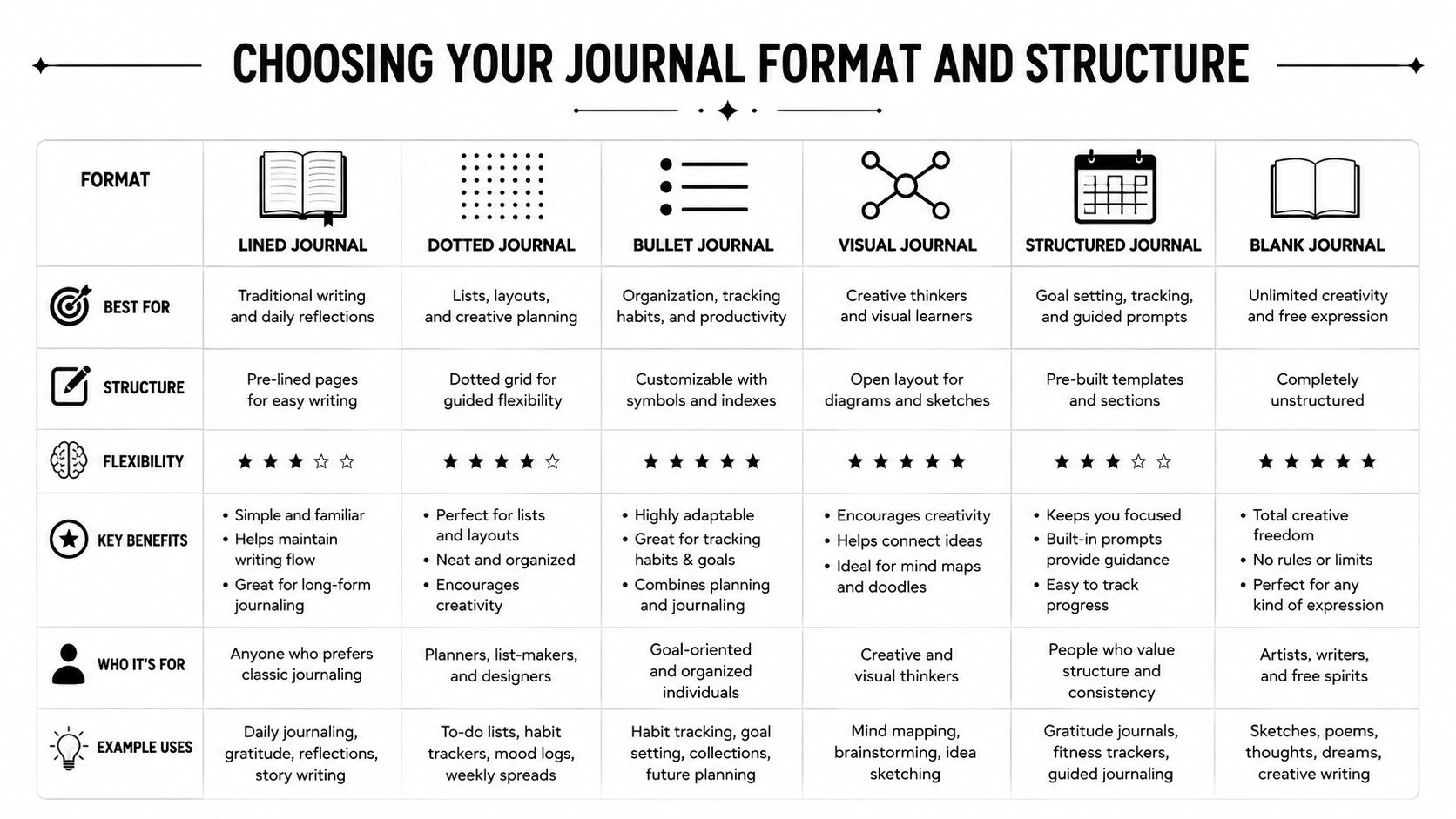
A blank page gives you freedom, but freedom can become indecision. One day you may want to write a full reflection on Scripture, while the next you may have only enough energy to name a concern and ask God for help. Choose a baseline structure that keeps the journal usable without forcing every prayer into the same emotional shape.
| Format | What it includes | Best use |
|---|---|---|
| Verse-linked entry | Scripture, response, prayer | Bible study and discernment |
| Freestyle prayer | Unfiltered thoughts and requests | Strong emotion or complex situations |
| ACTS framework | Adoration, Confession, Thanksgiving, Supplication | Beginners needing clear guidance |
| Micro-entry | Date, verse, request, gratitude, action | Busy or distracted days |
| Request tracker | Person, need, prayer, follow-up | Intercession and accountability |
| Answer record | Request, development, reflection | Remembering God's faithfulness |
Start with a framework, then loosen it
The ACTS model, Adoration, Confession, Thanksgiving, and Supplication, gives beginners a dependable sequence. You might begin by naming who God is, acknowledge where you need forgiveness, identify specific gratitude, and then bring your requests. It keeps the entry relational rather than turning prayer into a list of demands.
A church-based prayer journaling resource recommends combining quiet space, an opening prayer, Scripture, a date, gratitude, requests, and notes about answered prayer (this prayer journal template resource outlines that structure). Dating entries matters because it turns scattered thoughts into an archive you can revisit. Over time, you'll be able to distinguish a passing worry from a recurring concern and a request from an answer.
Keep a minimum format for demanding days
A useful minimum entry can be five lines:
- Date: Record when you're praying.
- Verse: Note the passage or phrase guiding you.
- Request: Name one concern plainly.
- Gratitude: Thank God for one specific provision.
- Action: Identify one faithful response for the day.
Use freestyle writing when you need to process grief, confusion, confession, or a complicated decision. Use the framework when you're tired or distracted. The right structure isn't the most beautiful one. It's the one that helps you begin without making you feel trapped.
Managing Privacy and Long-Term Organization
A prayer journal may hold confessions, family concerns, relationship struggles, doubts, and hopes. Treat privacy as part of the system from the start. Paper notebooks avoid some digital risks, but they can still be misplaced or read by someone else. Digital journals add questions about passwords, sharing, device access, and administrator visibility.
Separate entries by purpose and sensitivity. A request for a friend's recovery can use a searchable category so you can review it later. A private confession may belong in a restricted note, or under a neutral label that does not expose its content on a lock screen. If you share a journal with a family member or small group, keep personal reflections in a separate space.
Design for retrieval, not just storage
A dated archive becomes useful when each entry follows consistent labels. Categories such as gratitude, intercession, lament, decision, and answered prayer make recurring concerns easier to find. Use searchable terms that support review, while avoiding labels that reveal sensitive details on a shared device.
The underlying diary study of daily prayer experiences, involving 254 participants and 3,288 daily reports, found that prayer experiences could be captured reliably at the day level. 3.92% of entries were eliminated for quality reasons, as summarized by the underlying diary study of daily prayer experiences (Journal of Psychology and Christianity, 254 participants) as summarized by Bible Expert. The practical lesson is to use a stable template with a date, verse or intention, request, reflection, and action step. Consistent entries are easier to compare than irregular essays.
Search also improves how you review prayers. Filter requests, add notes when circumstances change, and revisit prayers that once seemed forgotten. An answer may be a clear resolution, a changed attitude, new wisdom, or a continued call to pray. Leave room for outcomes that do not fit a simple answered-or-unanswered category.
Protect vulnerable entries deliberately
Use a strong device passcode, enable journal locks, and check whether entries are private, shared, or visible to administrators. Before joining a community space, decide which material belongs there. For a practical explanation of how encrypted services protect data in transit and storage, read HolyJot's overview of end-to-end encryption.
Digital journaling is not automatically safer than paper. It becomes safer when you control access, review sharing settings, and keep sensitive material out of collaborative spaces. Privacy makes honest reflection easier, and honest reflection gives a prayer journal lasting spiritual value.
Leveraging Digital Tools for Daily Consistency
A phone can interrupt prayer, but it can also remove the obstacles that make prayer journaling inconsistent. The useful question isn't whether digital tools are spiritual enough. It's whether the tool helps you open the journal, focus your attention, and preserve what you write without adding unnecessary work.
Consider a busy parent who remembers prayer journaling only after the day has ended. A dedicated digital workflow can place the entry near the time they already read Scripture, preserve a short record, and make the next session easier to start. The tool supports the discipline, but it doesn't replace prayer or discernment.
Build a three-minute workflow
A workable digital routine can look like this:
- Open the same entry point: Use a daily journal page rather than searching through folders.
- Read one passage: Attach a verse or write down the phrase that caught your attention.
- Respond briefly: Record one request and one gratitude.
- Choose a next step: Write what obedience, patience, service, or attention might look like today.
- Close without editing: Prayer isn't improved by polishing every sentence.
HolyJot provides a prayer journal environment where users can write freestyle or verse-linked entries, attach Scripture, use FaithAI for Scripture-grounded reflection prompts, maintain streaks, lock sensitive notes, and set time capsules for later review. These features make it one possible option among digital systems, particularly for someone who wants writing, Scripture, reminders of consistency, and future review in one place.
Use streaks as a prompt, not a verdict
A streak can remind you that a practice matters, but it shouldn't become a measure of spiritual worth. If you miss a day, the streak ends. Your relationship with God doesn't. Use the visual record to notice patterns, such as evenings when you're consistently too tired, then move the cue to a more realistic time.
Time capsules can serve a different purpose. Write a prayer for a future season, a decision you're discerning, or a hope you want to revisit, then schedule it for later review. When the entry returns, record what changed and what didn't. That turns the journal into a conversation across time rather than a stream of disconnected notes.
AI prompts can help when you're stuck, but treat them as scaffolding. Let a Scripture-grounded prompt open reflection, then write your own prayer in your own words. A generated question should never become a substitute for reading the passage, listening carefully, or seeking wise pastoral counsel.
Practical Templates and Daily Prompts
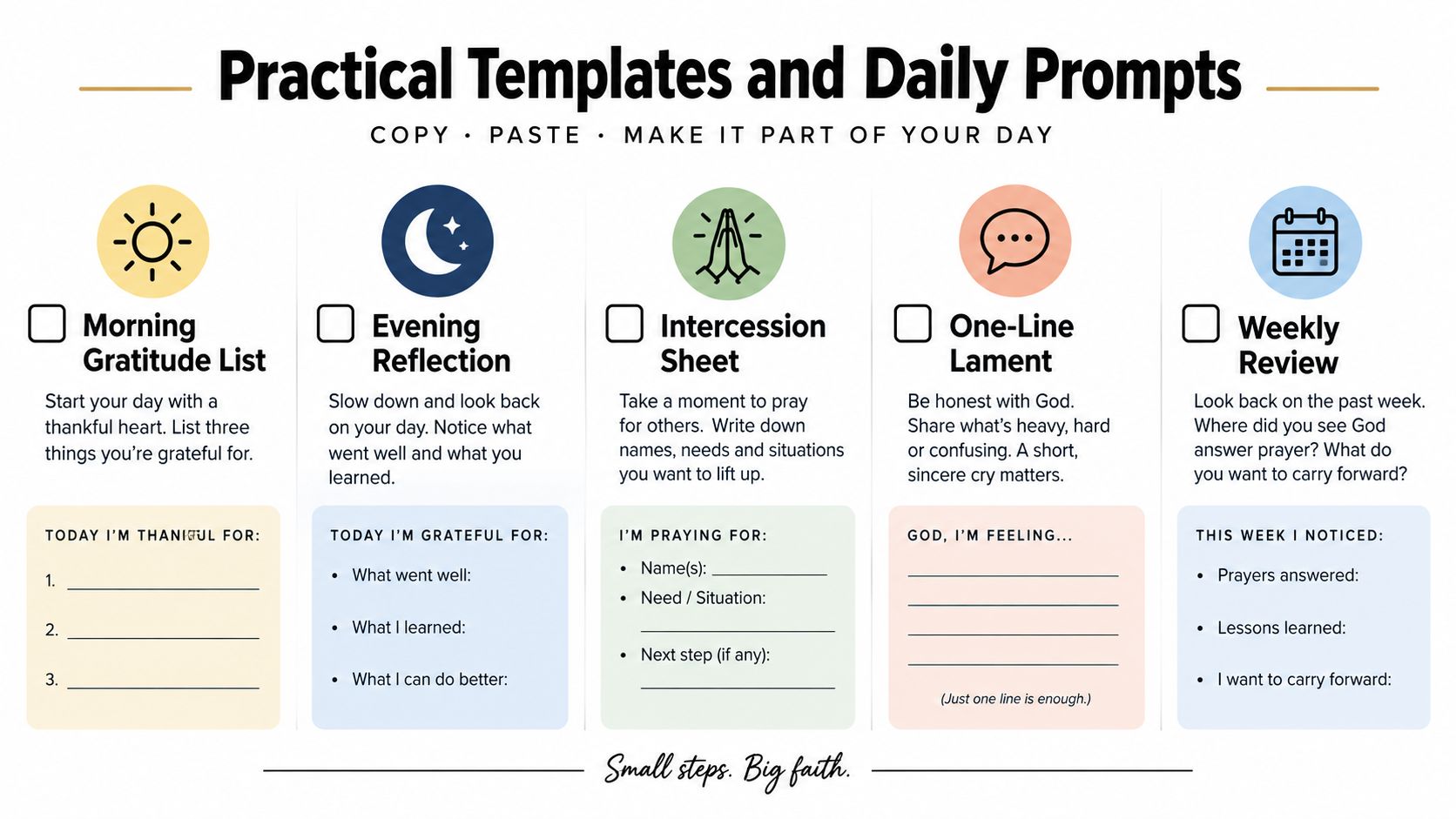
Blank screens create a specific kind of resistance. You may know you want to pray, yet still spend the available time deciding whether to write about Scripture, a relationship, an emotion, or a practical need. A small set of copy-ready templates removes that first barrier.
The five-line daily entry
Copy this into a note or template:
- Date:
- Verse or phrase:
- Lord, today I'm asking for:
- I'm grateful for:
- My faithful next action is:
This format works because it captures attention, prayer, gratitude, and response without requiring a long narrative. Add one sentence about your emotional state if that helps you review patterns later.
For a broader collection of prompts organized around Scripture and different prayer needs, use these prayer journal prompts. Don't treat prompts as questions you must answer perfectly. Treat them as doors into honest conversation.
Match the prompt to the season
Morning gratitude
- Thank God for one person.
- Thank God for one provision.
- Thank God for one quality of His character.
Evening reflection
- Where did I notice grace today?
- What am I carrying into sleep?
- What needs confession, release, or continued prayer?
Intercession
- Who has asked for prayer?
- What specific need can I name?
- How can I serve this person as well as pray?
Lament
- What hurts right now?
- What am I afraid to say aloud?
- What do I need from God in this pain?
Review
- Which requests remain active?
- Which answers or changes should I record?
- What theme keeps returning in my prayers?
For family devotionals, let each person contribute a gratitude and a request, while keeping private material private. In a small group, use a shared intercession list for agreed requests and reserve personal confession for an individual journal. A good template creates common ground without demanding identical spiritual experiences.
Troubleshooting Common Journaling Roadblocks
A missed week does not mean the practice failed. It shows where the system broke down: the cue came too late, the template took too long, the journal was hard to reach, or your circumstances changed.
Restart with one recognizable action. Write the date and a sentence. Do not reconstruct every missed entry or schedule a punishing catch-up session. A grace-based restart protects momentum better than guilt.
When prayers feel repetitive
Repeated requests often reflect unresolved circumstances, sustained intercession, or a deeper layer you are still learning to see. Keep the request, then change your angle. Note what you have learned, what action is available to you, and whether the hoped-for outcome has changed.
A prayer review can also correct a narrow definition of an answer. Record changes in wisdom, patience, courage, provision, or relationships alongside visible outcomes. Preserve uncertainty when nothing is clear yet. That record makes the journal more honest and gives later reflection something concrete to examine.
When the system becomes too complicated
Too many categories, colors, tags, and templates can turn prayer into administration. If organizing takes longer than praying, remove features until an entry takes only a few minutes. Keep the date, Scripture, request, gratitude, and action line. Add detail only when it helps you reflect or find the entry later.
If your template has grown past five lines, cut it back to date, verse, request, gratitude, and action for two weeks before adding anything else. A searchable digital journal can support retrieval, but searchability does not justify a burdensome daily form. Test the system on a tired day, not only when motivation is high.
Review the setup when motivation fades. Move the cue, shorten the template, secure sensitive notes, or change formats. Missed days provide information, not a verdict. A resilient prayer journal is built by returning.
HolyJot provides a digital place to connect prayers with Scripture, use guided prompts, protect sensitive entries, and revisit prayers through streaks and time capsules. Start with the five-line template, then visit HolyJot to create a journal that remains practical when your schedule and motivation change.