


You sit down with a Bible, a notebook, and good intentions. Then the day starts demanding your attention. The page stays blank, your prayer feels scattered, and a practice meant to bring you closer to God starts feeling like another task to complete.
Learning how to use a prayer journal daily doesn't require polished writing or long devotional sessions. It requires a simple way to show up, capture what matters, and return often enough for the practice to become familiar. A digital journal can make that easier with quick prompts, verse-linked entries, private storage, and gentle habit tracking.
Setting Realistic Goals for Your Faith Journal
A blank page creates pressure because many people assume a prayer journal should contain profound insights every time. That expectation turns private prayer into a performance. You don't need to write an essay, explain a theological doctrine, or produce language that sounds devotional. You need to bring your actual thoughts before God.
Start by choosing the smallest version of the practice that still feels meaningful. That might be a sentence of gratitude, a direct request, or a note about what you're struggling to surrender. On a difficult day, “Lord, I feel overwhelmed and I need your help today” is a complete prayer journal entry.
Decide what your journal is for
A journal can serve different purposes, and identifying yours prevents frustration.
- Spiritual processing: Use writing to slow down, name emotions, confess sincerely, and listen for what Scripture brings to the surface.
- Prayer tracking: Record people, situations, and requests so you can return to them instead of relying on memory.
- Spiritual memory: Note answered prayers, convictions, decisions, and moments when a passage became personally significant.
- Daily connection: Create a small ritual that keeps prayer present in your ordinary schedule.
You don't have to use the same purpose every day. A heavy season may call for processing. A busy morning may call for a quick request. A quiet weekend may give you room to review older entries.
A useful habit principle applies here: goals work better when they describe a repeatable action rather than an impressive result. Anyone building a lasting practice can benefit from this broader guide to lasting client results, especially its emphasis on making goals practical and sustainable.
Make the minimum easy
Choose a regular cue, such as after breakfast, before sleep, or immediately after reading Scripture. Then define a minimum entry that takes little effort. You might write the date, one honest sentence, and one request. If you have more to say, continue. If you don't, stop without guilt.
A spiritual growth journal guide can help you connect daily notes with longer-term reflection, but the essential practice remains simple. Consistency matters more than volume. Your journal should help you pray, not make you feel judged by your own stationery.
Practical rule: Make your ordinary entry so easy that you can complete it on an inconvenient day.
Use a digital journal when carrying a notebook is unrealistic. A phone-based quick-capture entry lets you record a prayer in the moment, then return later when you have more attention. The best format is the one you'll use with honesty.
Choosing Between Freestyle and Verse-Linked Entries
Freestyle and verse-linked journaling solve different problems. Freestyle writing gives your thoughts room to move. Verse-linked writing gives your attention a clear place to begin. Neither approach is spiritually superior, and forcing one format every day creates unnecessary friction.
| Format | Use it when | What to write |
|---|---|---|
| Freestyle | Your emotions feel tangled or urgent | A candid prayer, complaint, fear, decision, or stream of thoughts |
| Verse-linked | You feel distracted, dry, or unsure where to begin | A passage, what stands out, your response, and one way to live it |
| Short list | Your time and energy are limited | Gratitude, requests, people to pray for, and one sentence of surrender |
Choose freestyle for emotional honesty
Freestyle entries work well when you need to process grief, conflict, disappointment, or a difficult decision. Start with the sentence you keep avoiding. Don't edit it into religious language. Write what you actually feel, then turn that feeling toward God.
For example, you might write, “I'm angry about this conversation, and I don't know how to forgive without pretending it didn't hurt.” That statement gives you somewhere real to pray from. You can ask for wisdom, examine your response, and identify a concrete next step without rushing to a neat conclusion.
Freestyle writing also helps when you need to pray quickly. A few lines in a mobile journal may be more faithful to the day than postponing prayer until you have time for an elaborate template.
Use Scripture when your attention needs an anchor
Verse-linked entries are useful when your mind keeps wandering or your prayers have become repetitive. Read a passage, copy a phrase that catches your attention, and ask what it invites you to notice, trust, confess, or practice. An AI Scripture assistant can help surface related passages or suggest a reflection prompt, but it shouldn't replace reading the text carefully or making your own judgment.
Keep the response personal. “This verse is true” is less useful than “I keep asking for control, but this passage is challenging me to release the outcome of this conversation.” The second sentence gives you something specific to bring into prayer.
You can also combine both methods. Begin with a verse, respond to it briefly, then let the entry become a freestyle prayer. On another day, start with an unfiltered concern and search Scripture afterward for grounding. Let the structure serve the conversation rather than dictate it.
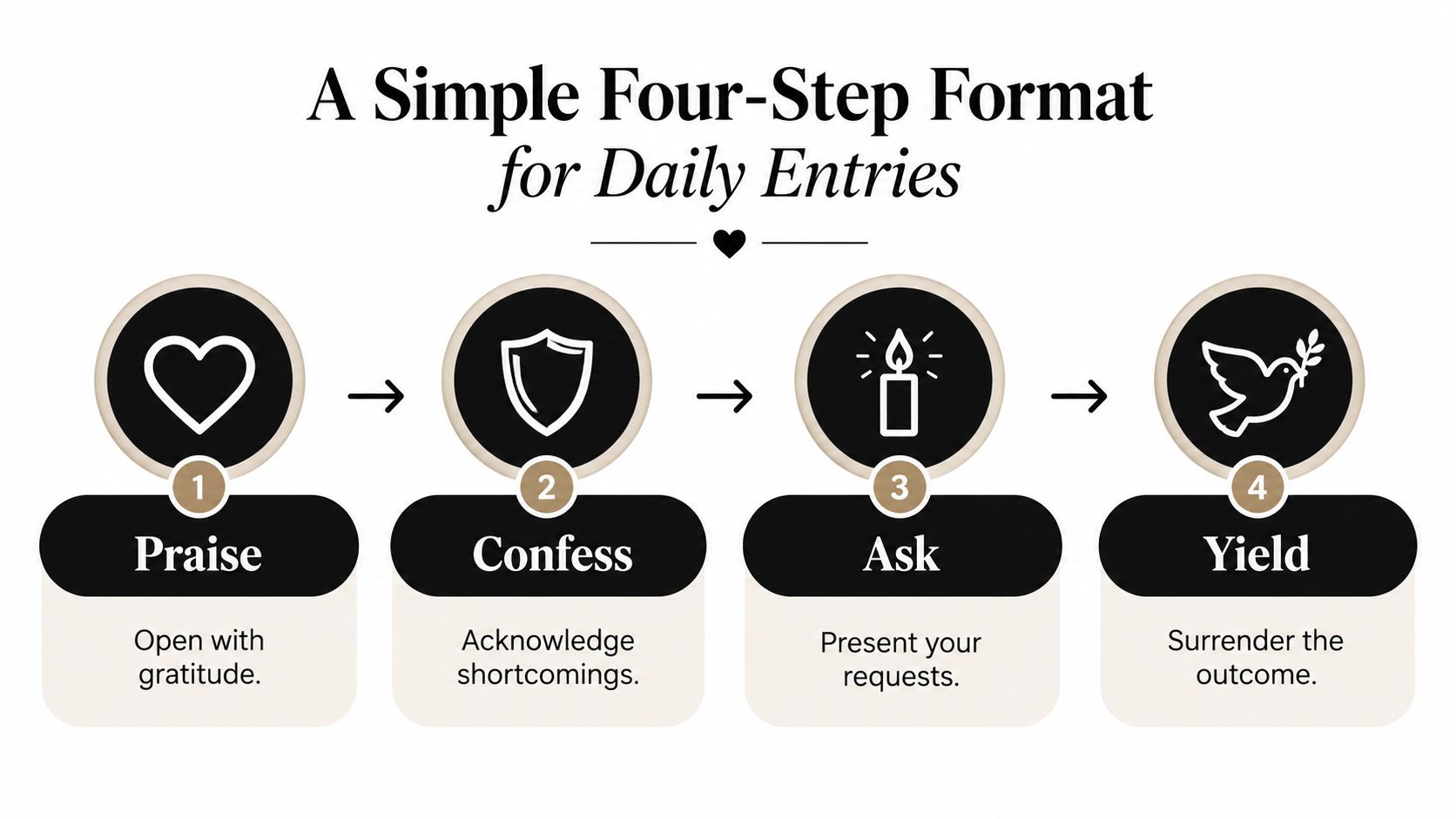
A Simple Four-Step Format for Daily Entries
When you don't know how to begin, use a four-step sequence that moves from attention to response. The format is short enough for a busy day but flexible enough for deeper reflection.
Start with a prompt
Write a Scripture passage, a single verse, or a prayer question at the top of the entry. If you don't have a reading plan open, use a prompt such as, "What do I need to bring openly to God today?" Starting with a defined focus prevents the blank page from becoming a test of creativity.
If you use an AI tool for Scripture reflection, ask it for context, cross-references, or a follow-up question tied to the passage. Treat the response as a study aid, not as divine authority. Check the cited text yourself, consider the passage in context, and keep your final reflection rooted in Scripture rather than in a generated answer.
Record your first response
Write what you notice before trying to sound wise. You may feel comforted, challenged, confused, resistant, or reminded of someone. That first response often reveals where the passage meets your real life.
Don't erase uncertainty. A prayer such as “I understand the words, but I don't yet know how to trust them here” can be more spiritually useful than a forced conclusion.
Name one application or request
Move from reflection to action. Choose one specific response for the day, or write one prayer request that connects directly to what you've noticed. Keep it observable and modest: apologize before defending yourself, call someone who is isolated, pause before replying, or surrender a decision you can't control.
A prayer journal isn't meant to collect thoughts without changing how you live. The application gives the entry a practical direction.
Review what came before
End by looking at a past entry when you have time. Notice recurring fears, repeated requests, answered prayers, changes in attitude, or guidance you had forgotten. This review turns isolated entries into a record of spiritual formation.
The Ignatian Examen prayer resource offers another way to examine your day through gratitude, awareness, and response. You can use a similar rhythm without making every entry elaborate. A brief look backward may reveal patterns that are invisible when you only focus on today's concern.
The four steps don't need equal space. Your prompt might take one line, your response several paragraphs, and your application only a phrase. The framework exists to get you moving, not to control the length of your prayer.
Protecting Sensitive Prayers and Private Reflections
Honest prayer requires a reasonable sense of safety. You may want to write about family conflict, doubt, resentment, sexual temptation, church disappointment, or a decision you aren't ready to discuss. If you suspect someone might casually open your notebook, you'll probably edit yourself before you reach the truth.
A physical notebook can work well when you have a private place to store it. In a shared home, however, privacy may depend on hiding the book or hoping others respect it. A digital journal with a lock and private archive can create a clearer boundary, provided you use a strong device passcode and understand the platform's privacy settings.
Separate raw processing from permanent conclusions
Write the first version, but don't assume every emotion deserves to become a final judgment. A prayer written in anger can help you process what happened without becoming the statement you want to live by. Give yourself room to revisit it after the intensity has passed.
Time capsules can help with this distinction. You can seal a sensitive entry and choose to review it later, allowing time for prayer, counsel, and perspective. The point isn't to hide from the issue. It's to avoid rereading raw words before you're ready or reacting to them repeatedly.

Before choosing a digital tool, check whether it offers a lock, private entries, archive controls, and a clear way to export or delete your data. Don't place another person's confidential information into a shared group space without permission. If you need guidance on handling personal material responsibly, review this resource on sensitive information protection.
Privacy should support honesty, not isolation. If an entry describes abuse, danger, self-harm, or a situation requiring immediate help, a locked journal isn't a substitute for contacting a trusted person or qualified professional.
Building a Consistent Habit with Streaks and Tracking
The strongest evidence for regular spiritual diary writing points toward frequency rather than occasional intensity. A mixed-method study in Korea included 385 adults and found that participants who wrote a spiritual diary 5 to 7 times per week scored significantly higher on spiritual growth and psychological well-being than less frequent writers. The same study reported that 48.8% wrote 5 to 7 times weekly, 44.7% wrote 1 to 4 times weekly, and 6.5% wrote less than once a month, as detailed in the study on spiritual diaries and well-being.
That finding doesn't mean God measures faith by a counter. It does suggest that regular writing gives reflection more opportunities to shape attention, memory, and daily decisions. A short entry repeated often may serve spiritual formation better than a long entry that appears only when circumstances feel ideal.
Build the habit around an existing cue
Attach journaling to something you already do. Open the journal after making coffee, following a morning Bible reading, during a commute if you're not driving, or before turning out the light. Keep the first action visible and immediate. If you need to search for the notebook, find a pen, and decide what format to use, the routine has too many decisions.
Use a streak counter as feedback, not as a spiritual score. A missed day means you resume today. Don't write a guilt-filled entry to compensate, and don't double the length of tomorrow's session. The goal is to protect the return.
Remember: A streak can measure presence, but it can't measure sincerity, obedience, or the depth of your relationship with God.
Track patterns that help you pray
A simple log can show which routine fits your life. Record the time of day, entry type, and whether you reviewed an older prayer. You might discover that freestyle writing works best after difficult workdays, while verse-linked entries are easier in the morning.
Broader journaling evidence provides useful context, while not proving that prayer journaling and therapeutic journaling are identical. A 2022 systematic review and meta-analysis reported an average statistically significant 5% reduction in mental health scores for journaling interventions compared with control groups, with larger reported benefits for anxiety at 9% and PTSD symptoms at 6%, and a smaller benefit for depression at 2%. The findings are summarized in this systematic review and meta-analysis of journaling interventions.
Prayer frequency also appears as a repeated daily behavior in research. A daily-life prayer study with 254 participants produced 3,288 daily reports, with 33.07% praying at high frequency, 21.26% at moderate frequency, and 45.67% at low frequency, according to the same linked research source. Use those figures as context, not a target. Your tracker should help you notice patterns and return to prayer, not pressure you into pretending.
Private community features can also help some people maintain momentum, especially when a small group shares prompts or encourages regular practice. Choose carefully. A community should invite honesty and prayer, not turn personal devotion into public competition.
Overcoming Common Friction Points and Burnout
Most journaling problems are practical rather than theological. You miss the usual time, lose your train of thought, feel emotionally tired, or start believing that a short entry doesn't count. Solve the actual obstacle instead of responding with a stricter rule.
- You don't have enough time: Use a quick capture with one sentence, one verse, and one request. Save deeper reflection for a day with more margin.
- You feel spiritually dry: Use verse-linked journaling and write the truth of what you're experiencing. You don't need to manufacture emotion before praying.
- You keep forgetting: Set a reminder beside an existing routine, then make the entry open directly to a new page.
- You missed several days: Resume without explaining the absence. A return is more useful than a confession about failing to maintain the perfect schedule.
- You repeat the same requests: Review older entries and add what has changed, what remains unresolved, and what you're learning while you wait.
- Writing feels burdensome: Switch from a fixed-time routine to carry-anywhere journaling. Capture a prayer on your phone, then stop before the practice becomes resentment.
Micro-prompts keep the habit alive without lowering its honesty. Try “What am I grateful for?”, “Who needs prayer today?”, “What am I avoiding?”, or “Where do I need wisdom?” One clear question can do more than a complicated template when your attention is limited.
HolyJot offers a digital prayer journal with freestyle and verse-linked entries, Bible translations, guided study plans, FaithAI prompts and Scripture-grounded cross-references, private locks, time capsules, streak tracking, and community hubs. Visit HolyJot to choose a lightweight way to record daily prayers, connect entries to Scripture, and build a routine that can survive busy days.