


Guided study is a structured, question-led approach where prompts move you from observation to interpretation to application with light facilitation, not lecturing. In education research, fully guided instruction means showing learners what to do and how to do it, followed by practice and corrective feedback, and it can help novice-to-intermediate learners handle new information without unnecessary cognitive overload.
You may recognize the problem immediately. You open your Bible during a quiet moment, read a passage, and then pause. You understand the words, but you're not sure what to notice, what the passage means in context, or how it should shape your day. A blank page can feel less like an invitation and more like a test.
Guided study gives that moment a gentle structure. It doesn't replace prayer, curiosity, or the work of reading Scripture. It supplies the next useful question, helps you stay with the text, and creates a path from reading to response.
The important question, then, isn't only “What is guided study?” It's also, “How should I design it for this person, this group, and this season?” The right number of prompts, the order of those prompts, and the amount of leader involvement will change depending on whether you're studying alone, welcoming new believers, or leading an experienced group.
This guide moves from the basic idea to practical choices. You'll see how guided study differs from unguided reading and lecture-heavy teaching, why structured support helps new learners, how common formats compare, and how digital tools such as HolyJot can connect a Sunday message with ordinary weekdays.
Introduction to What Guided Study Means Today
A reader might begin with a familiar passage, perhaps a Gospel story or a psalm, and still feel unsure how to proceed. Reading the text once can provide comfort, but it may not reveal the details that matter, the questions that deserve patience, or the concrete response that belongs in our life.
Guided study turns that uncertainty into a sequence. A prompt asks you to observe before you interpret. Another helps you connect the passage with its setting and surrounding verses. A final question invites you to respond through prayer, a decision, a conversation, or an act of obedience.
That sequence matters because spiritual growth often gets interrupted by friction rather than resistance. People may want to study faithfully but lack a starting point, a manageable rhythm, or a way to tell the difference between what the text says and what they assume it says.
Guidance is a form of welcome
A guided study isn't meant to make Scripture feel mechanical. Think of it as putting trail markers on a path. The markers don't walk for you, and they don't dictate every thought. They help you avoid losing the route when the terrain is unfamiliar.
For a new reader, that support can include definitions, background, examples, and direct feedback. For a mature reader, it might be a short set of prompts that opens space for cross-references, theological reflection, and honest application.
Available explanations of guided Bible study commonly describe it as a structured, question-led method, while also emphasizing that the leader acts as a facilitator rather than a lecturer. They offer formats for both individual and group use, but often leave the practical design choices open. That gap is where thoughtful discipleship begins.
The promise of a simple practice
You don't need an elaborate curriculum to start. You need a passage, a sequence of questions, and enough space to write or speak.
By the end of this guide, you'll be able to choose a format that fits your setting, adjust the structure for learner maturity, and create a study rhythm that continues beyond a single meeting. The aim isn't to produce perfect answers. It's to help people notice Scripture clearly, understand it responsibly, and practice what it teaches.
What Guided Study Is and How It Works
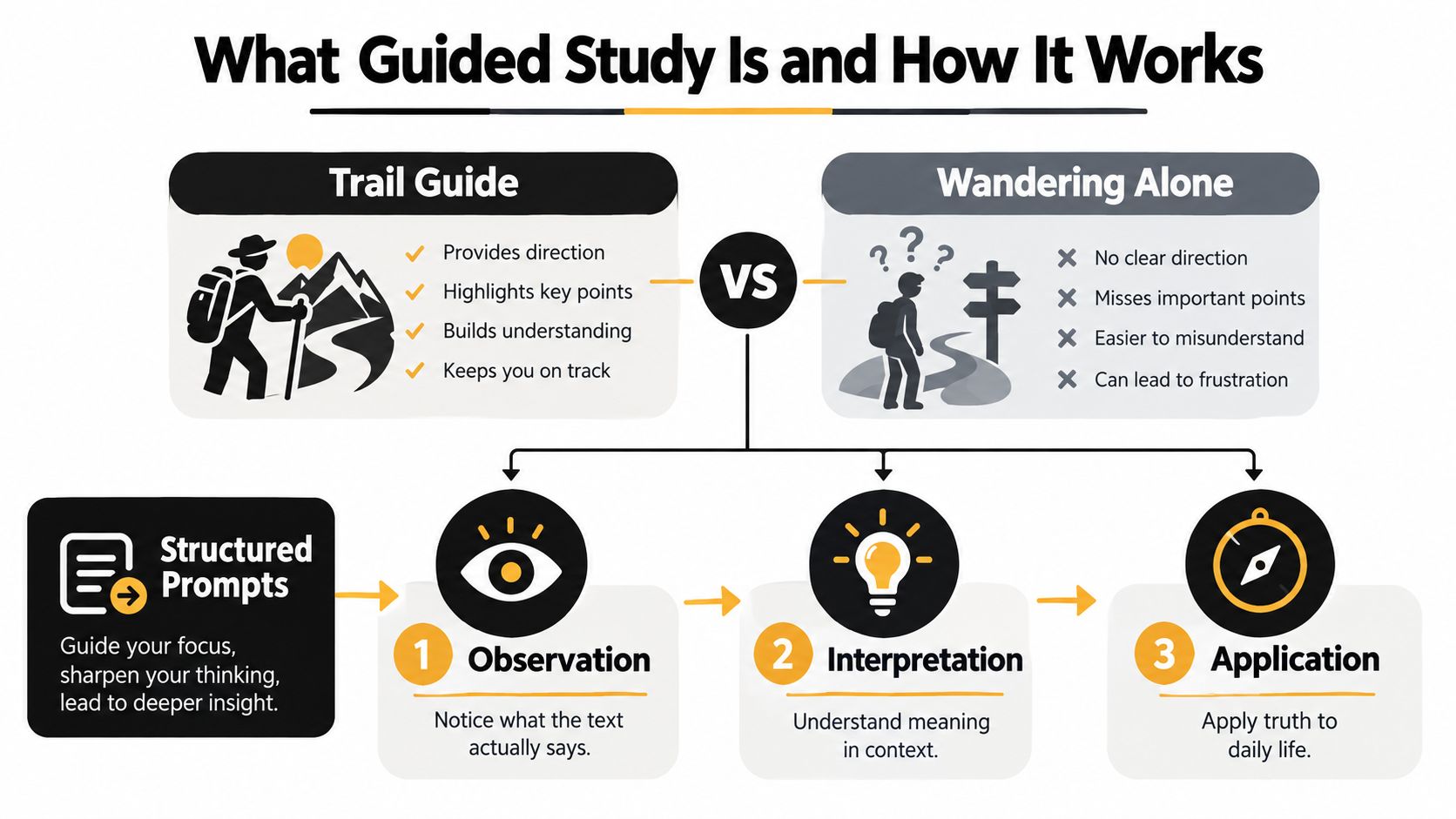
A useful way to understand guided study is to compare it with a trail guide. A trail guide doesn't carry you to the destination. Instead, the guide points out landmarks, warns you about confusing turns, and helps you read the terrain. Guided study works the same way with a biblical passage.
Guided study is a structured path of prompts that helps learners observe a text, interpret its meaning, and apply its truth, while a facilitator keeps the process moving without taking over.
Unguided reading can be valuable. You may read a chapter devotionally, notice a phrase, and pray from it. But without a question or purpose, your attention can drift toward familiar ideas. You may also jump to application before asking what the author intended.
Lecture-heavy teaching has the opposite risk. A teacher may explain the passage accurately, but learners can remain passive. They receive conclusions without practicing the process of finding evidence, weighing context, and forming a faithful response.
The three movements
Observation asks, “What does the text say?” Look for repeated words, commands, contrasts, people, actions, emotions, and changes in location or circumstance. Stay close to the passage. A question such as “What does the speaker do after hearing the news?” keeps the learner anchored in evidence.
Interpretation asks, “What does this mean here?” Consider the surrounding paragraph, the book's purpose, the historical situation, and the relationship between the passage and the rest of Scripture. Interpretation isn't a license to make the text say whatever feels meaningful. It gives meaning a context.
Application asks, “How should this shape my life?” A strong application is specific enough to practice. Instead of “I should trust God more,” a learner might identify one anxious conversation in which they need to pray before responding, or one act of reconciliation they have avoided.
Questions should move in that order because application without observation can become projection. Interpretation without application can become information that never reaches the will.
For a practical companion to this method, see how to study the Bible effectively, especially if you're building a repeatable personal rhythm.
What the facilitator does
The facilitator prepares the route, asks the next useful question, and notices when the group needs clarification. They don't need to answer every question immediately. Often, the better response is, “What in the passage leads you to that conclusion?”
A facilitator may tighten the structure when learners are new, the passage is difficult, or discussion is wandering. They can loosen it when participants are experienced, engaged, and able to support observations with cross-references. Light facilitation doesn't mean absent leadership. It means leadership that protects participation and points attention back to the text.
The process can also work through a recorded lesson or digital plan, as long as the learner still performs the work. The tool should guide attention, not remove discovery.
Why Guidance Helps You Learn and Retain More
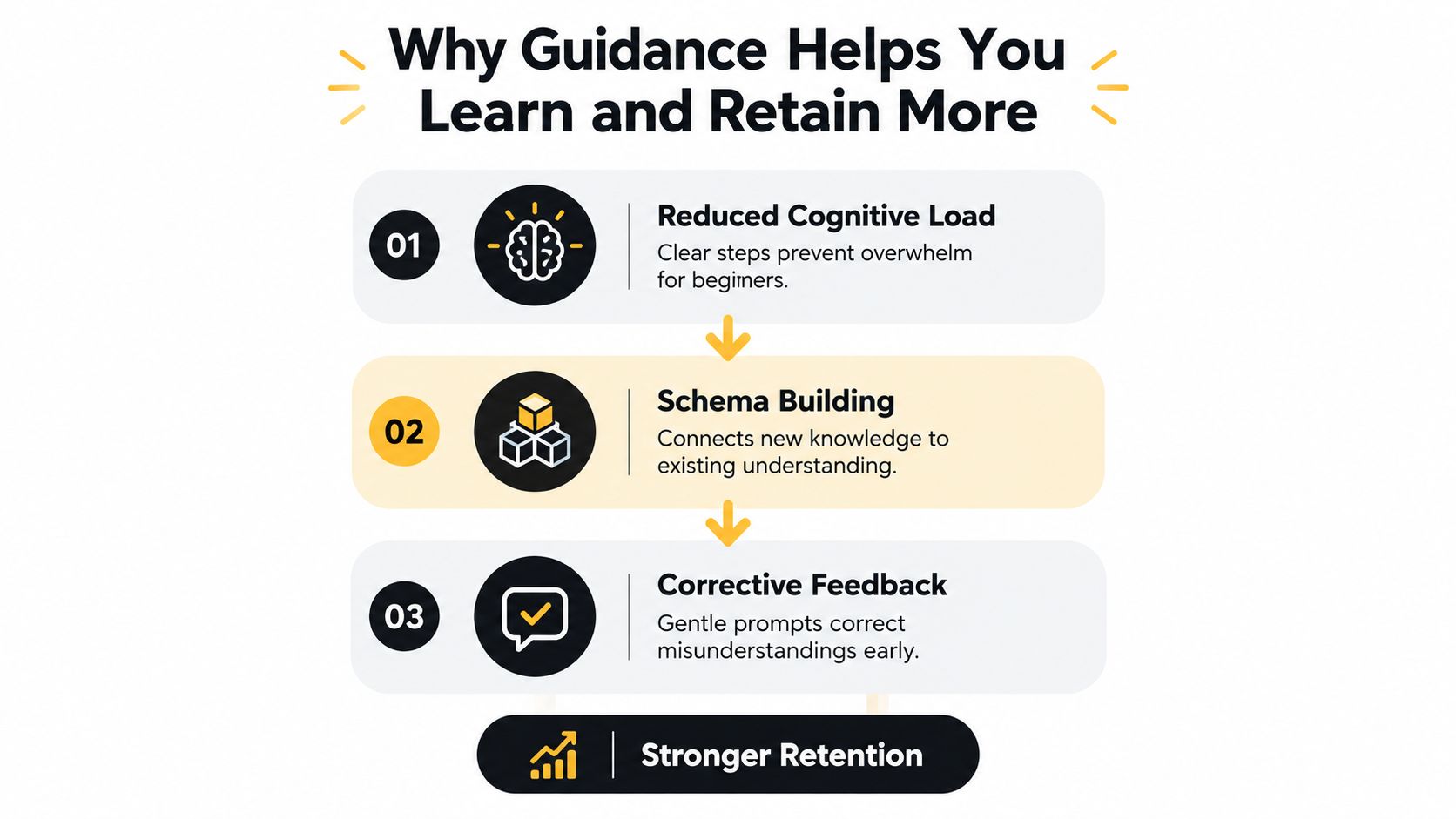
New information consumes attention. When a learner is trying to understand unfamiliar biblical vocabulary, literary context, cultural background, and personal meaning at the same time, the study can become tiring before understanding takes root.
Education research summarized by Clark, Kirschner, and Sweller describes fully guided instruction as explicit teaching that shows learners what to do and how to do it, followed by practice with corrective feedback. Their review reports that, for novel information, controlled experiments found this approach outperformed partial or minimal guidance for novice-to-intermediate learners because it reduced cognitive load during initial schema acquisition. You can read the source in the American Federation of Teachers summary of the research.
The principle translates naturally into discipleship. A new Bible reader may not yet know how to identify a repeated theme, distinguish genre, or connect a paragraph with its surrounding argument. A prompt gives the learner one manageable task instead of asking them to solve the whole study at once.
Guidance should change with maturity
Support isn't a permanent substitute for independence. It works more like training wheels. Early prompts might point directly to the relevant verse or define the task clearly. Later prompts can become broader, asking learners to compare passages, identify tensions, or explain why a conclusion fits the text.
A leader can calibrate structure through three design decisions:
- Question count: Use enough prompts to prevent confusion, but not so many that learners only complete a worksheet. A newer group may need separate questions for noticing, meaning, and response. An experienced group may combine related observations.
- Question sequence: Begin with what participants can see, then move toward meaning and practice. This order helps people build an interpretation instead of defending a first impression.
- Facilitator intervention: Step in when a misunderstanding blocks progress or a participant dominates. Hold back when learners are reasoning carefully and listening to one another.
Group size also affects the design. In a small circle, one open question may create rich conversation. In a larger gathering, narrower prompts, written responses, or paired discussion can give more people a way to participate.
Why the need feels timely
The need for clear entry points isn't limited to beginners. The Prepared Heart overview of Bible study types notes that Bible use in the United States rose from 38% to 41% in 2025, and that Scripture engagement increased among Gen Z and Millennials. Those figures point to more people beginning, resuming, or reshaping their engagement with Scripture, not to a single uniform audience.
That variety calls for flexible guidance. A person returning after years away may need a welcoming explanation of how to read a passage. A seasoned group may need fewer prompts and more room for careful cross-reference work. Good design doesn't ask, “How much guidance is best?” It asks, “What support will help these learners take the next faithful step?”
Three Common Formats of Guided Study Compared
You have ten quiet minutes before work, but you are unsure where to begin. A daily devotional can give you one passage, one question, and one prayer. A reading plan can carry that practice through a book or theme. A facilitator-led group can add conversation when insight grows through listening to others. These formats use observation, interpretation, and application, yet each solves a different study problem.
A daily devotional offers the simplest starting point for solo practice. It pairs a short reading with focused reflection and a prayer or action prompt. The written material supplies the facilitator role, so the learner can begin before work, during a lunch break, or before bed.
A plan-driven study provides a longer route. It may arrange passages by biblical book, theme, or spiritual practice, then use a question sequence for each session. Like following trail markers, the plan connects one reading to the next and shows how separate passages contribute to a wider journey.
A facilitator-led small group adds conversation and accountability. The leader prepares the passage, frames the questions, and manages participation. Learners gain insight from the text and from hearing how others observe, interpret, and apply it.
Which Guided Study Format Fits Your Context
| Format | Best For | Structure Level | Facilitator Role |
|---|---|---|---|
| Daily devotional | Solo readers and family routines | Focused and compact | Written prompts guide the learner |
| Plan-driven study | Readers pursuing a book or topic | Continuous and sequenced | Planner sets the path and pacing |
| Facilitator-led small group | Churches, families, and discussion circles | Flexible but intentional | Leader protects participation and clarity |
Choose the format by naming the job the study must do. If beginning is difficult, use a devotional. If continuity is missing, use a plan. If isolation or shallow discussion is the concern, use a group with a capable facilitator.
The design should also change with maturity and group size. New believers may benefit from several concrete questions that make participation feel safe. Experienced readers may need fewer prompts and more room for cross-references or theological exploration. In a family, short questions can invite children and adults into one conversation. In a larger church gathering, written responses or paired discussion can help more people participate.
Digital tools can connect Sunday conversation with weekday practice. A lectio divina app can guide a solo reader through reading, meditation, prayer, and contemplation. A group leader can adapt those movements for shared discussion, then invite members to record a response before the next meeting.
Choose the smallest structure that solves the actual problem. More prompts are not automatically better, and less structure is not automatically more mature.
The right question is whether the sequence keeps learners present to the passage and gives them a clear next action. A dependable structure should feel like a handrail, supporting attention without taking every step for the learner.
Benefits for Personal Discipleship and Church Engagement
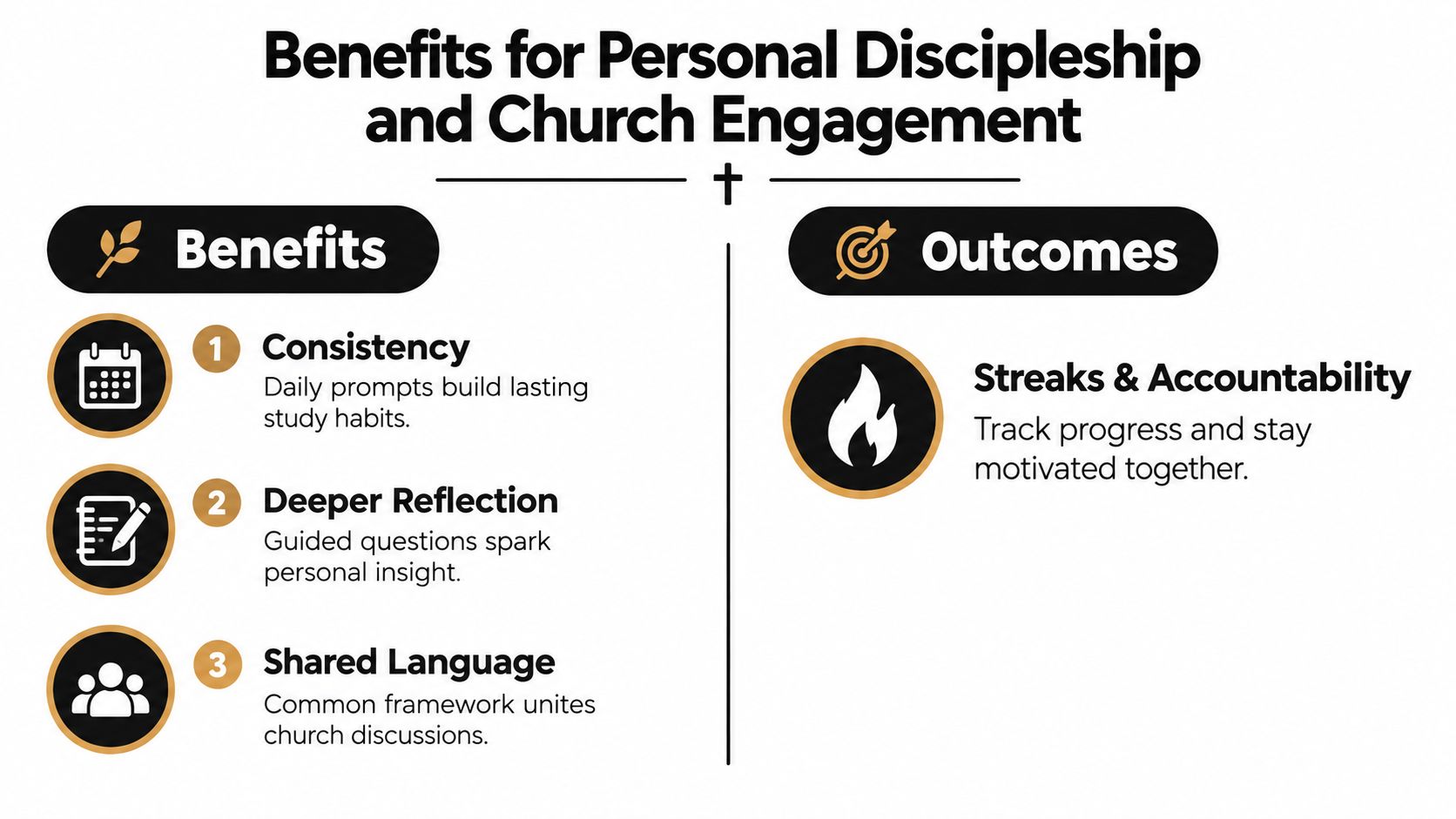
Guided study helps people turn good intentions into visible practices. A reader who once opened the Bible only when inspiration arrived can use a prompt to create a repeatable beginning. A group that discussed a sermon enthusiastically on Sunday can continue the conversation through a shared passage, journal response, or prayer request during the week.
The benefit isn't merely completing material. It is developing a shared way to pay attention. Participants learn to ask what the text says before debating what they think, and they gain language for describing conviction, confusion, and next steps.
What changes for an individual
Consider two mornings. In the first, a reader chooses a random chapter, skims it while distracted, and closes the Bible with a vague sense that they ought to do better. In the second, the reader follows a simple path: notice a repeated idea, explain it in context, write one honest response, and pray about a concrete action.
The second practice creates useful evidence of engagement. The reader can look back at journal entries, recognize recurring questions, and see how prayer and obedience have developed. A streak or reminder can support consistency, but the deeper measure is whether the person is becoming more attentive and responsive to Scripture.
What changes for a church
A congregation can use guided study to create continuity between gathered worship and dispersed life. A sermon passage can become the center of a family conversation, a small-group question set, or a personal journal prompt. Leaders can also identify where people need clarification rather than assuming attendance equals understanding.
For group health, watch for practical signals:
- Participation: More people refer to the passage itself instead of relying only on personal opinions.
- Continuity: Members return to earlier questions and report how they practiced a response.
- Shared language: Families, groups, and leaders use the same observation-to-application process.
- Accountability: Participants can invite one another into prayer without turning progress into performance.
Guided study doesn't remove spiritual dryness or guarantee agreement. It gives people a common practice for staying engaged when motivation varies. That steady framework can make church discipleship feel less like a weekly event and more like a connected pattern of attention, conversation, and response.
Guided Study Plan Examples and How HolyJot Supports Them
A guided plan becomes easier to design when you start with the learner's next action. Consider a short Gospel overview for a new reader. Each day can begin with a passage, move through an observation question, ask what the scene reveals about Jesus, and end with a journal prompt about trust or obedience.
A topical prayer plan needs a different pace. The prompts might invite the reader to name a concern, connect it with a biblical promise, pray for another person, and record what they want to remember. The purpose isn't to force a conclusion. It's to give prayer enough shape that the person can remain honest and attentive.
A small-group series can add a shared layer. The facilitator might send the passage before the meeting, ask each person to bring one observation, and use the gathering to test interpretations together. Afterward, participants can record an application and return to it during the week.
From prompt to journal to community
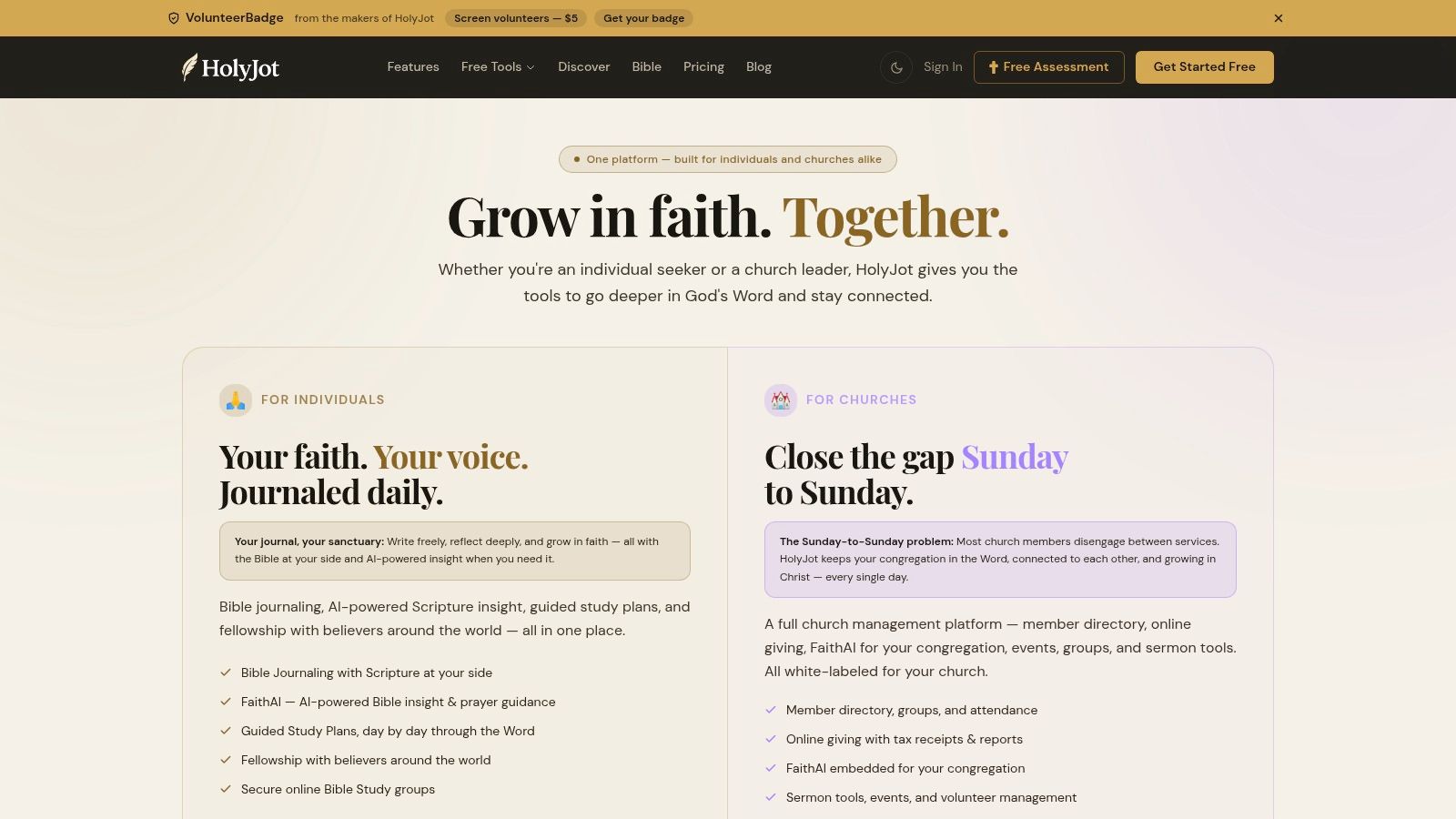
HolyJot is one option for organizing this workflow. Its faith journaling and church management platform combines an online Bible with guided study plans, FaithAI context and cross-references, prayer guidance, verse-linked journaling, locked notes, time capsules, and streak tracking. Community Hubs can support private spaces for small groups, families, and friends, while church portals include tools for members, roles, groups, attendance, events, volunteers, sermon libraries, giving, and reports.
The value of these features depends on how they're used. A FaithAI prompt should help a reader investigate Scripture, not outsource reflection. A streak should encourage return, not become a spiritual scorecard. A Community Hub should carry a thoughtful question into the week, not create another noisy feed.
If you're organizing study across devices, a resource on how to build a digital study system can help you think about notes, reading, and review as one connected workflow.
A practical weekly setup
Start with one passage and keep the design visible:
- Read: Mark what surprises, repeats, or raises a question.
- Understand: Use context and cross-references before forming a conclusion.
- Write: Record one sentence about meaning and one sentence about response.
- Share: Bring a question or application to a trusted person or private group.
- Return: Revisit the entry and note what changed in your thinking or practice.
A daily Scripture reading guide can provide another starting point for selecting passages and establishing a rhythm. Whether you use paper, a notes app, or a dedicated platform, preserve the learner's active role. The tool should make the path clearer while leaving room for prayer, surprise, and responsible interpretation.
Start Your Guided Study Journey with Confidence
You don't need to redesign your entire devotional life to begin. Choose one audience, one passage, and one purpose. A solo reader might start with a short devotional prompt. A family might ask one observation question at dinner. A small-group leader might send a passage in advance and invite each person to bring one detail they noticed.
Use this quick launch checklist:
- Name the learner: Decide whether the study serves a new reader, a mature group, a family, or your own practice.
- Choose the container: Pick a devotional, a plan, or a facilitated conversation.
- Set the sequence: Move from observation to interpretation to application.
- Limit your intervention: Explain what blocks understanding, then let learners do the thinking.
- Create a return point: Schedule a prayer, journal review, or group conversation that brings the response back into view.
If the first attempt feels simple, that's a strength. Guided study should reduce confusion without removing wonder. As learners grow more capable, reduce the scaffolding gradually and replace direct prompts with questions that invite comparison, reflection, and faithful judgment.
The most sustainable plan is one people can repeat. Start small enough to practice, clear enough to explain, and relational enough to share. Then adjust the question count and facilitator role based on what your learners need, not on a fixed template.
HolyJot brings together Bible reading, guided study plans, verse-linked journaling, prayer support, and private community spaces for individuals, families, groups, and churches. Visit HolyJot to explore its free tier and choose a guided plan that can turn your next Scripture reading into a consistent path from observation to application.