


A grandmother leaned over a hospital bed and whispered, “All glory to God,” after the doctor delivered hopeful news. On Sunday, thousands of believers may sing the same words together, yet the heart of the confession remains unchanged: the credit, honor, and praise belong ultimately to God.
A Phrase That Travels Across Centuries
The hospital room and the sanctuary seem far apart. One holds a quiet voice, a tired body, and a family waiting for mercy. The other holds music, many voices, and a congregation joining in public worship. Still, both moments use the phrase as an act of reorientation. The speaker looks beyond the immediate event and acknowledges God as the source and rightful recipient of praise.
That movement gives the phrase its staying power. “All glory to God” isn't merely a religious way to say “I'm grateful.” It's a confession about where honor belongs. A person may recognize the skill of a physician, the dedication of a parent, or the discipline behind an achievement, while still refusing to treat human ability as ultimate.
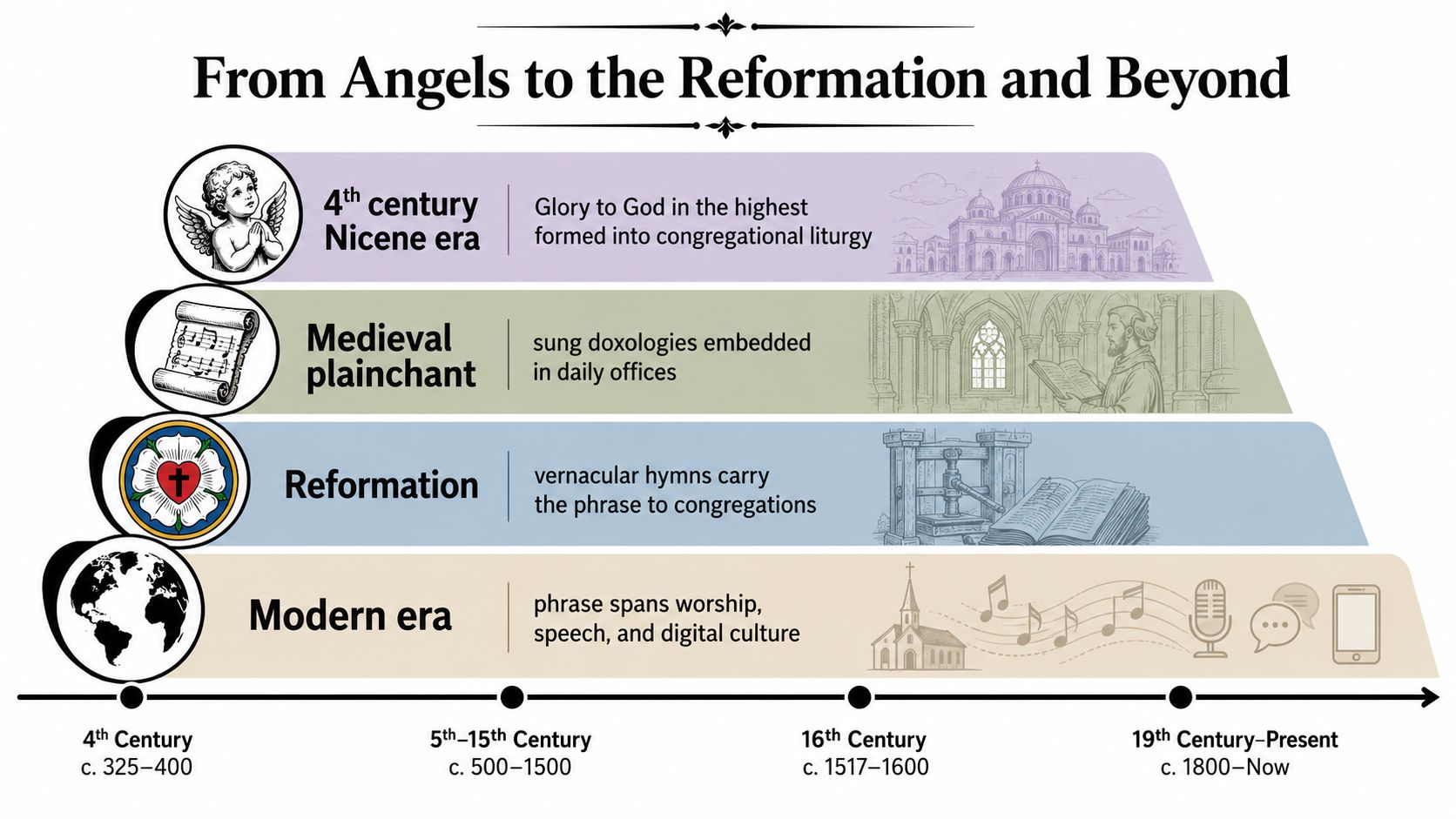
The words have traveled through several forms. In the Christmas story, angels announce, “Glory to God in the highest,” to shepherds near Bethlehem. Christian tradition received that announcement as the first Gloria, a pattern of praise that later entered the church's worship. In the Reformation, Soli Deo Gloria, meaning “to God alone be the glory,” became one of the Five Solas used to summarize Protestant belief. Hymns carried the confession into homes and congregations, while believers today place shortened versions of it in prayers, testimonies, and social captions.
Each setting adds a shade of meaning without erasing the others. The phrase can be whispered after frightening news, sung after a sermon, written beneath a photograph, or spoken at the end of a testimony. It functions as doxology, as theology, and as a practical discipline of humility.
That last use matters in a culture built around visibility. A believer can sincerely praise God and still feel pressure to make the praise circulate around personal achievement. The phrase therefore asks more than, “Did I mention God?” It asks, “Where did my words direct attention, and whom did they make central?”
To understand how to answer, begin with the kind of speech the phrase represents.
What Doxology Actually Means
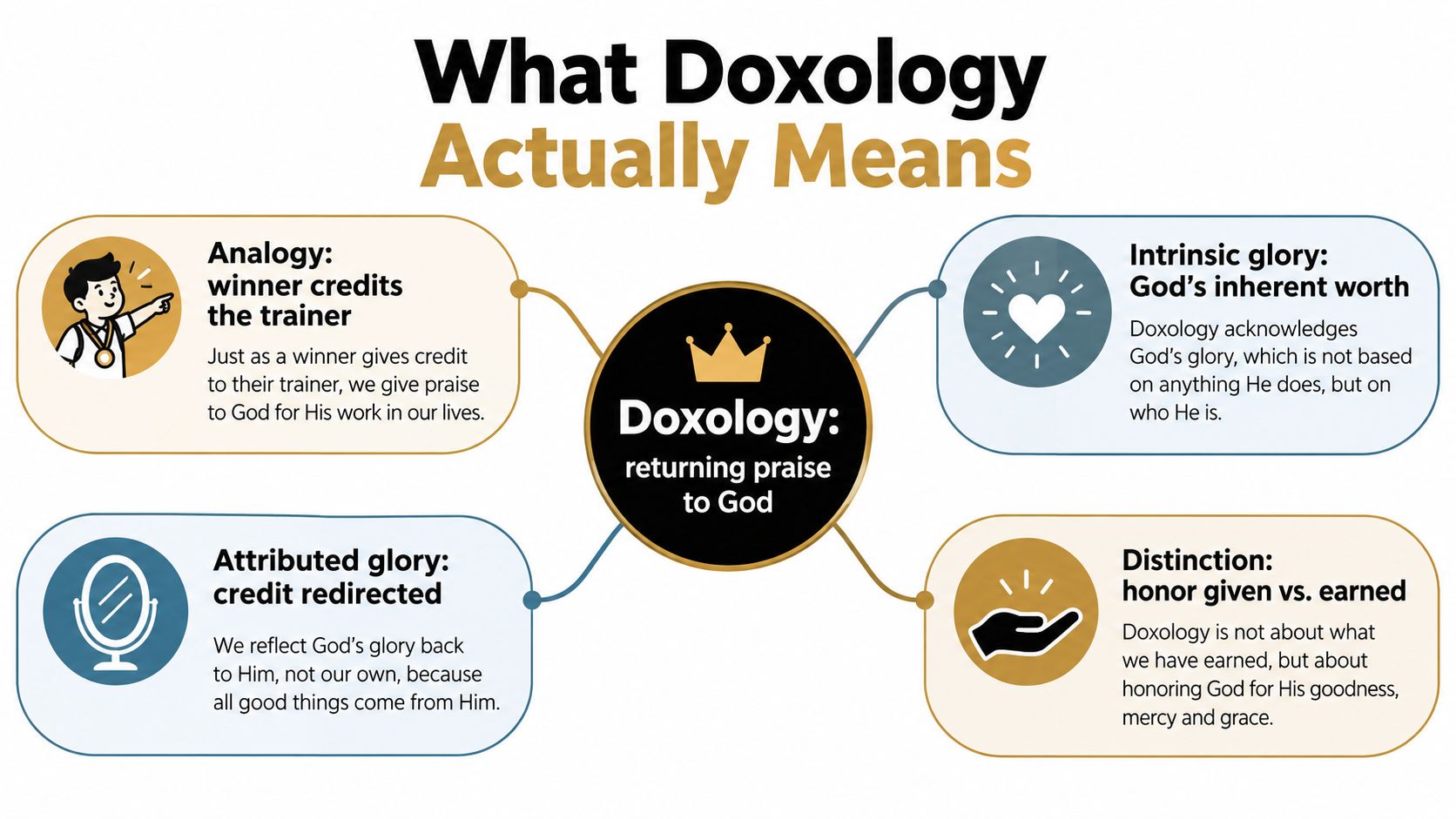
Doxology is a short expression of praise that returns credit to God. Think of a child who wins a race, runs toward a parent, and points immediately to the person who trained, encouraged, and stayed present through practice. The child crossed the finish line, but the gesture says, “This achievement didn't begin with me.”
Christian theology uses the word in a deeper way. God's intrinsic glory is the fullness, beauty, worth, and majesty God possesses in Himself. He doesn't become more worthy because people praise Him. Ascribed glory is the honor creatures give when they recognize and declare what is already true about Him.
The distinction keeps believers from imagining that worship supplies God with something He lacks. When a congregation sings, “All glory to God,” it isn't adding brightness to God's character. It's acknowledging that brightness and placing human success, gratitude, and wonder in their proper relationship to it.
The Greek root doxa carries the sense of opinion, estimation, or honor. The Hebrew idea often associated with glory, kabod, conveys weight or heaviness. Together, these ideas help explain why biblical glory is more substantial than visual radiance. To glorify God is to treat Him as weighty, worthy, and deserving of serious attention.
Three familiar forms
Churches use doxology in several recognizable patterns:
- The Greater Doxology: “Glory be to the Father, and to the Son, and to the Holy Spirit.”
- The Lesser Doxology: praise directed to the Father through the Son in the Spirit.
- A simple ascription: phrases such as “All glory to God,” “To God be the glory,” or “Glory to God alone.”
A worship team may express this through a song, while a congregation may embody it through coordinated worship clothing, including choir stoles for worship that visually support a shared act of praise. The garment doesn't create worship, but it can serve the same communal purpose as a hymn refrain, directing many individuals toward one confession.
Practical rule: If your praise makes God the source, center, and destination of honor, it is functioning as doxology.
This definition also clarifies a common confusion. Saying “all glory to God” doesn't require pretending that people made no effort. It means human effort is received as dependent, gifted, and accountable rather than self-originating. The biblical passages connected with the phrase make that pattern visible.
Where the Bible Points Us
The phrase draws its force from a broad biblical pattern, not from one isolated line. Each major passage contributes a different question: Where does redemption begin? Who may receive ultimate glory? What does worship sound like? How should ordinary life respond?
In Luke 2:14, angels announce Jesus' birth with “Glory to God in the highest,” joining divine praise to peace on earth. The words appear at the beginning of the gospel story as a public announcement that salvation comes from God's action. The shepherds aren't being told to admire human potential. They're hearing that God has acted, and heaven responds with praise.
Isaiah 42:8 adds exclusivity. God declares that He won't give His glory to another. In this setting, “all glory” isn't inflated religious language. It recognizes that ultimate honor can't be divided between God and rival objects of worship, whether idols, institutions, leaders, or personal achievement.
Psalm 29:1-2 turns the principle into an invitation. Worshipers are called to ascribe glory and strength to the Lord and to worship in the beauty of holiness. The psalm shows that giving glory involves deliberate speech, posture, and communal attention. Praise doesn't remain an internal feeling. People name God's worth together.
1 Corinthians 10:31 brings the confession into ordinary decisions: whether eating, drinking, or doing anything else, believers are instructed to do all to God's glory. The verse prevents Christians from limiting the phrase to church music or dramatic testimonies. Work, meals, conversations, rest, and responsibility can all become places where a person redirects credit and practices obedience.
| Scripture | Shade of Meaning | How It Shapes the Phrase |
|---|---|---|
| Luke 2:14 | Redemption begins with God's action | Praise responds to divine initiative |
| Isaiah 42:8 | Ultimate glory belongs uniquely to God | Human achievement can't claim final honor |
| Psalm 29:1-2 | Worship actively ascribes glory | Believers name God's worth together |
| 1 Corinthians 10:31 | Ordinary life can honor God | The phrase becomes a daily pattern, not only a lyric |
For a guided way to sit with the psalms and observe these movements of praise, a Psalm study guide can help turn a familiar passage into a slower exercise in observation and prayer.
From Angels to the Reformation and Beyond
A congregation can hear the angels' announcement in Luke 2, then repeat its central praise centuries later in a hymn, a motto, or a brief prayer. The wording may change with the setting, yet the direction of worship remains the same: attention turns from human achievement toward God.
According to the Catholic Encyclopedia entry on the Gloria in Excelsis, the hymn's liturgical use traces to the East Syrian tradition in the 4th century, with the fuller Latin form appearing by about 690 in the Antiphonary of Bangor. These dates show how a biblical proclamation became a durable worship formula. The church preserved the words by placing them in recurring prayer, where worshipers could learn them, sing them, and carry them into daily devotion.
A confession gains new settings
During the Reformation, this same confession took the form Soli Deo Gloria, meaning “to God alone be the glory.” Alongside the other Five Solas, it marked a boundary. Institutions, leaders, ceremonies, and human ability could serve God, but none could receive the ultimate honor that belongs to him.
The phrase also appeared in Ad maiorem Dei gloriam, “for the greater glory of God,” the motto associated with the Jesuits. In Protestant hymnody, “To God Be the Glory” gave the confession a form that congregations could sing together. Evidence places the hymn in print by 1870, giving it a publication history of at least 155 years as of 2026 (Bible Hub).
These expressions did not replace Luke 2:14. They worked like different vessels carrying the same water. Liturgy, church identity, hymnody, preaching, and personal devotion each gave believers a way to practice the same theological instinct. A medieval worshiper, a Reformation preacher, and a believer writing a prayer beneath a photograph may ask one searching question: Will this moment gather attention around me, or return praise to God?
Modern worship music continues this pattern through repeated refrains and spontaneous prayer. A short line can be memorable because generations of Christians have already carried it. Saying it today joins a conversation that began in Scripture and continued through the worshiping church.
Giving God the Glory in a Branding Culture
Personal branding creates a real tension for believers. Social platforms reward visibility, polished presentation, and repeated association with a recognizable person. In that environment, “all glory to God” can become a spiritual hashtag that appears humble while still directing attention toward the speaker's talent, platform, or influence.
Consider a worship leader posting a photograph from a powerful stage moment. The caption praises God, but the image, wording, and engagement may still center the leader's performance. Contrast that with a nurse privately thanking God after a workshop or prayer was answered in a hospital ward. Neither person's public or private setting automatically proves sincerity. The difference lies in what the words are doing.
Use these questions before posting:
- Who benefits from the attention? Does the message point readers toward God's character and mercy, or mainly toward the poster's skill?
- Where does the testimony land? Does it encourage other people to trust Christ, or does it only celebrate what Christ did for me?
- Would silence still be faithful? If no one saw the post, would thanking God privately still feel like obedience?
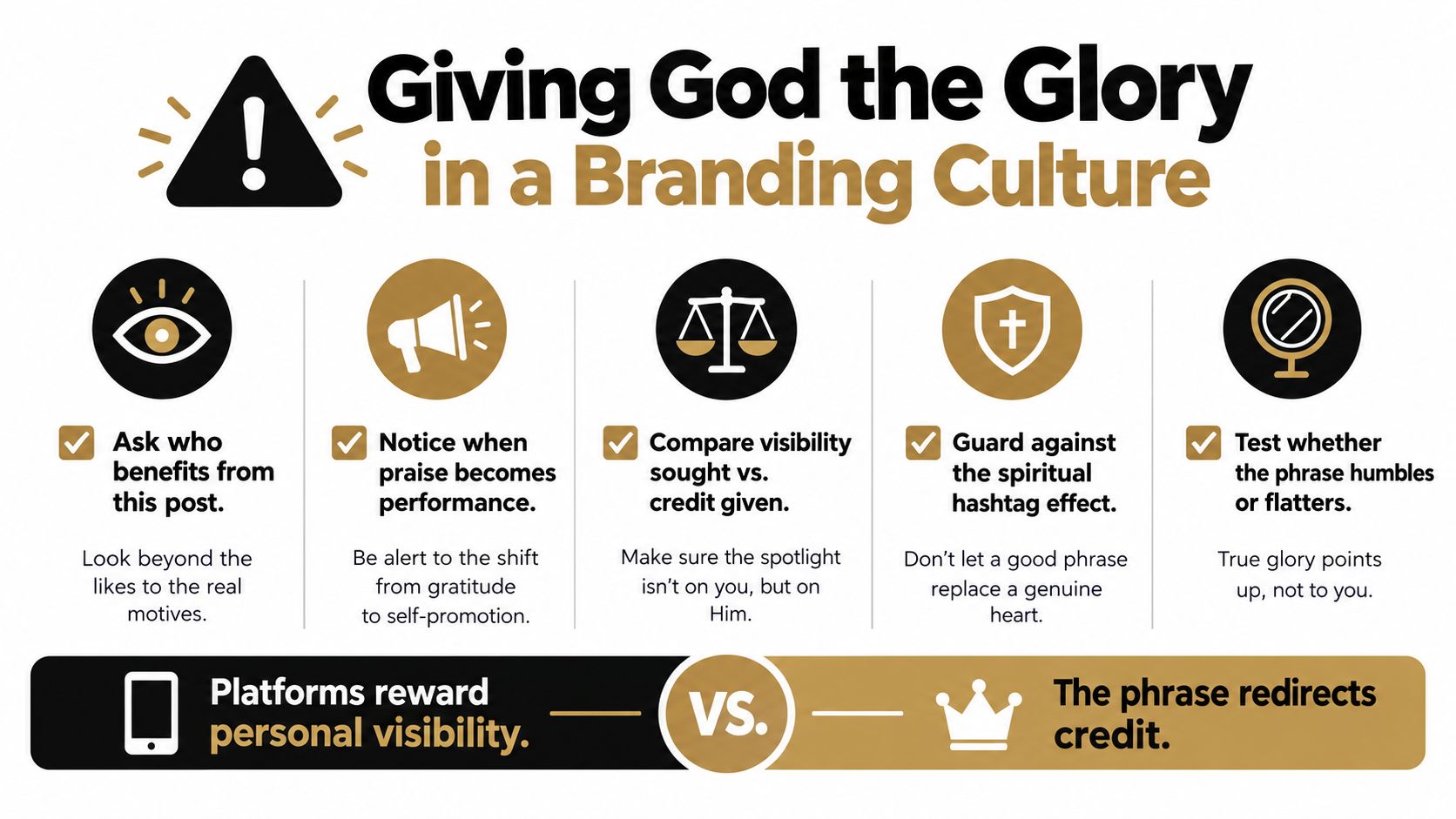
A fourth question can expose the difference between witness and promotion: Does the post make God more knowable, or does it make the believer more marketable? A testimony may include names, circumstances, and personal effort. Humility doesn't require vagueness. It requires truthful attribution.
For further reflection on resisting patterns that shape attention and identity, read this study on being conformed to the world. The issue isn't whether Christians may communicate publicly. The issue is whether Christian language becomes decoration for the same self-exalting habits it claims to resist.
A brief video can also help worship teams and church leaders discuss how music and public ministry direct attention:
Ask before you publish: Does this sentence redirect credit, or merely attach God's name to my self-presentation?
The older meaning of the phrase gives a better standard. Giving God glory means giving credit, not gathering it. A believer can share good news without turning the news into a monument to personal importance.
Praying, Worshiping, and Journaling the Phrase
A young believer may first say “all glory to God” after an answered prayer, then discover that the words reach further. They can shape how we receive success, admit weakness, thank other people, and serve without turning service into self-advertising. Repetition matters when it trains attention, like a path becoming clearer each time we walk it.
Four prayers to begin with
Morning dedication
Father, receive this day as an offering. Guide my plans, correct my motives, and use my work for the good of others. All glory to You.
Gratitude
God of mercy, You are faithful, patient, and generous. Thank You for meeting me in weakness, providing what I needed, and drawing me toward Christ. All glory to You for who You are and for the mercy You give.
Confession
Lord, I have kept credit for myself and wanted people to notice what I have done. Forgive my pride, teach me to receive every gift with humility, and help me honor You without performing humility for others.
Sending prayer
Jesus, send me into my work, relationships, and responsibilities with courage and love. Let my words serve people and point beyond me. All glory to God.
Worship gives a congregation a shared way to practice this reorientation. A leader might invite the church to speak the phrase together before a song. A worshiper can read a related passage slowly, then respond with the phrase rather than rushing ahead. A service may close with a simple doxology, gathering every voice into one final act of praise.
Songs also carry history. If a worship leader has questions about a song's words, authorship, or place in worship, reading the history of this worship song can provide context before the congregation sings it.
Five prompts for a journal
- Notice gifts: What gift, provision, relationship, or opportunity have you noticed for the first time this week?
- Record mercy: Write about one answered prayer without making yourself the hero of the account.
- Redirect success: What quiet success are you tempted to keep as personal property? Offer it back to God in a sentence.
- Name dependence: Where did you need wisdom, patience, strength, or forgiveness today?
- Write a doxology: Finish this sentence in your own words: “God, all glory belongs to You because…”
A Scripture-linked journal keeps reflection connected to biblical text rather than vague positivity. HolyJot offers Scripture-linked entries, prayer journaling, guided study plans, and FaithAI guidance for Bible context, cross-references, and prayer. The tool matters less than the pattern: return to the passage, name the gift, confess the rival source of credit, and praise God specifically.
For a simple structure, use this guide to starting a prayer journal. Each entry can become a small act of truthfulness, turning a familiar phrase into a practiced response to grace.
Doxologies, Captions, and a Final Breath
Short words can carry deep theology when they're chosen carefully. The following lines work as prayers, worship responses, or writing prompts because each one keeps praise specific rather than decorative.
Lines to remember
- Gloria Patri: “Glory be to the Father, and to the Son, and to the Holy Spirit.”
- A hymn-shaped confession: “All glory, laud, and honor to You, Redeemer King.”
- A classic refrain: “To God be the glory, great things He has done.”
- A spontaneous prayer: “God, You gave the strength, opened the way, and sustained me. All glory belongs to You.”
The first line names the Trinity. The second honors Christ as King. The third connects praise with God's works. The fourth shows how personal prayer can remain concrete without turning the speaker into the center.
Church leaders who want to understand how vestments communicate identity and worship context can consult the Stoles.com clergy stoles guide. Physical symbols, musical lines, and spoken prayers all need the same care. They should support worship rather than compete with it.
Captions that redirect attention
A caption doesn't need to be long to be honest:
- “Grateful for the gift, dependent on the Giver. All glory to God.”
- “This answer came with mercy I couldn't manufacture.”
- “Thankful for every person who helped, and for God's grace through them.”
- “The work was shared, the strength was received, and the praise belongs to God.”
- “May this moment encourage trust in Christ, not admiration of me.”
Pair a short caption with a specific Scripture image when that serves the message. Use only the hashtags that clarify the post, such as #SoliDeoGloria and #ToGodBeTheGlory, rather than filling the caption with religious phrases that say little.
Let “all glory to God” become a daily exhale. Speak it when success arrives, when help comes gently, when correction exposes pride, and when ordinary work goes unnoticed. The phrase begins as a definition, becomes a confession, and matures into a habit of returning every good thing to its true source.
Use HolyJot to turn that habit into a written rhythm through Scripture-linked journaling, prayer entries, and guided study prompts. Visit HolyJot today, choose a passage such as Luke 2:14 or 1 Corinthians 10:31, and write one specific sentence that gives God the glory for what He has entrusted to you.