


One platform can't serve every prayer community well. A private prayer board, a guided devotional app, a weekly Scripture cohort, a public discovery space, and a church-controlled hub each solve a different participation problem. The right choice depends on the rhythm you can sustain, not the length of a feature list.
Before joining, decide what you need: group access, structure, denominational fit, privacy, moderation, cost, and a leader who can keep participation healthy. Joining an existing group is different from hosting one. A directory may help you find people, while a private hub may give a church the control it needs to protect relationships and information.
Online prayer has a credible history, from early religious discussion networks to organized digital communities, but technology can't create trust by itself. Prayer groups online work best when the tool supports Scripture, honest sharing, consistent care, and a clear path back to embodied community when that matters.
1. Online Christian Community App, HolyJot
HolyJot is the strongest all-round option when prayer needs to live inside a broader discipleship and church-care environment. Individuals and small groups can use private prayer boards, fellowship channels, group Bible studies, journaling, and a full in-app Bible. Members can share requests with a defined group, mark when they've prayed, add Scripture encouragement, and receive updates when prayers are answered.
The private-campus model matters. A group doesn't have to build its spiritual life inside a general-purpose social feed where church conversations compete with unrelated notifications. Churches can create branded Community Hubs with member directories, roles, groups, attendance, event RSVPs, volunteer coordination, sermon libraries, and giving through Stripe with tax receipts. That makes HolyJot useful for leaders trying to connect weekday prayer with the rest of church operations.
Where HolyJot fits best
The platform also supports freestyle and verse-linked journaling, privacy locks, time capsules, guided study plans, and streaks. FaithAI adds Scripture-grounded context, cross-references, and prayer guidance. A church can embed it on its website and train it on materials such as bulletins, doctrinal statements, and study resources, though leaders should review those materials and monitor doctrinal alignment.
- For small groups: Use a private prayer board with a weekly Scripture prompt and a simple answered-prayer update.
- For church leaders: Put prayer, events, sermon resources, and member communication in one controlled hub.
- For individuals: Pair a shared request board with a private prayer journal practice, so public participation doesn't replace personal reflection.
HolyJot is secure, encrypted, and easy to launch, with a free tier for individuals and starter churches. Advanced administration, white-labeling, deeper reports, and larger-scale customization require paid plans and setup. FaithAI is also only as useful as the church's uploaded material, so it should assist pastoral care rather than replace it.
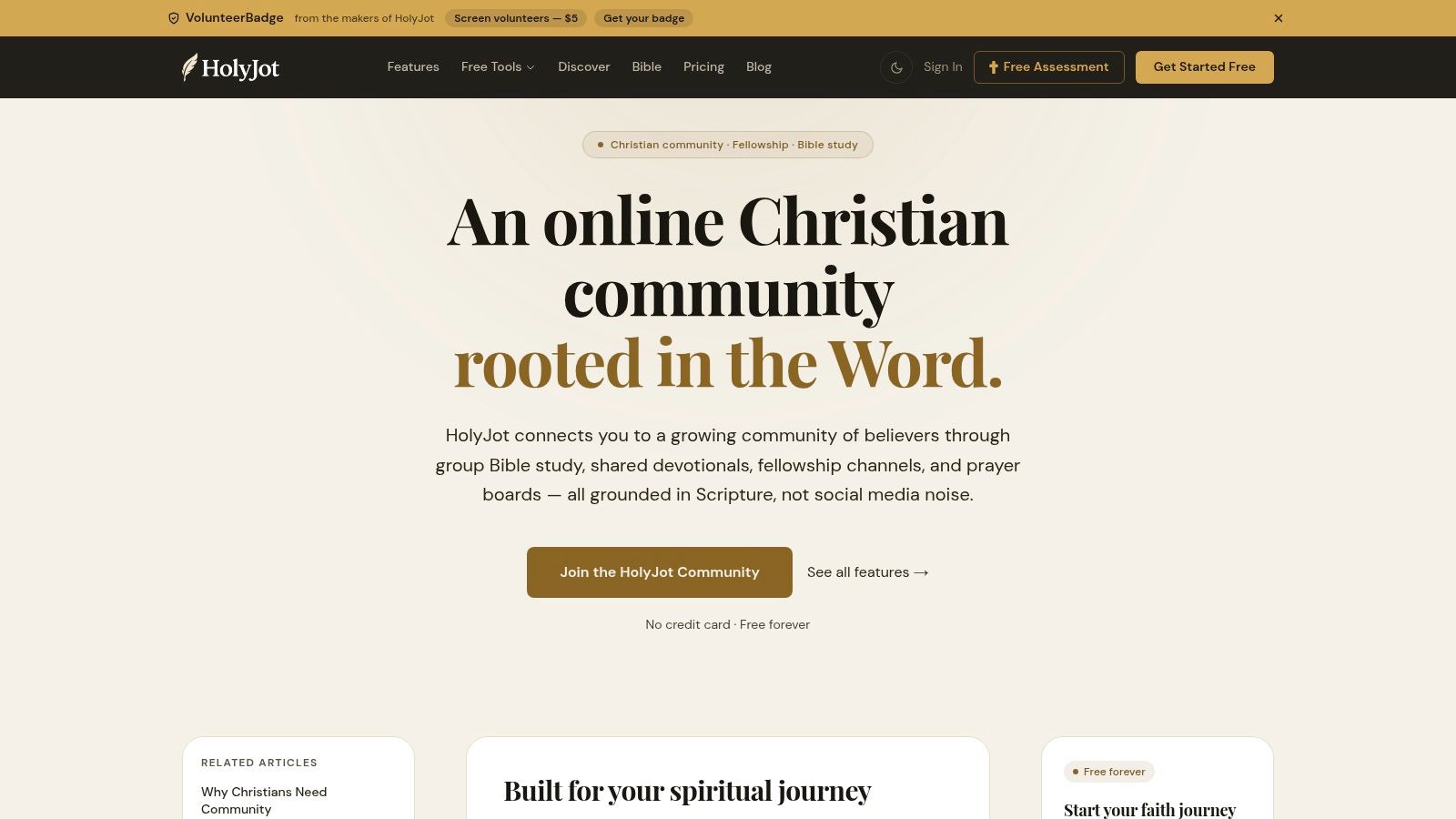
Practical rule: Choose HolyJot when your group needs both a prayer space and a dependable home for discipleship, communication, and church administration.
2. YouVersion Bible App for Prayer and Groups
YouVersion works best when prayer sharing needs to stay close to Scripture. Individuals, families, and established small groups can use shared prayers, private prayer lists, Prayer Chains, Bible Plans, notes, and guided devotional content in one familiar app. That combination makes it a practical entry point for mixed-denomination groups that want a common biblical focus without introducing a specialized platform.
Its strongest role is a lightweight layer between meetings. A leader can select a Bible Plan, invite participants, ask each person to add one prayer request, and return to the same discussion during the week. This supports guided devotional practice and private prayer sharing, while keeping the group's activity connected to reading and reflection.
A simple setup works better than opening several separate conversations. Choose one plan, set one recurring prayer prompt, and agree on how members should respond to requests. The app does not establish those group habits for you, so leaders should define confidentiality, expected response times, and what information should remain outside the shared space.
YouVersion for Churches gives congregational teams a broader option for organizing prayer than a personal prayer list. It may suit a church that wants to connect Scripture engagement with its existing ministry activity. It does not provide the detailed roles, advanced moderation, member workflows, or extensive administrative reporting found in a full church community platform.
Choose it for: Scripture-centered prayer among friends, families, or an existing church group.
Avoid relying on it for: Complex pastoral-care workflows or a large community requiring close moderation.
Use it well: Start with one Bible Plan and one prayer prompt, then review participation before adding more activity.
The app is free, and its familiar Scripture tools reduce the effort required for new participants. It is less suitable for broad community discovery, because the most natural experience begins with people who already share a group or invitation path. For context on other Bible-centered tools, see the best devotional apps. Explore the YouVersion Bible App when accessibility and Scripture engagement matter more than administration.
3. Echo Prayer with ECHO+ for Groups
Echo is designed for focused participation, not broad community browsing. The app centers on creating prayer requests, setting reminders, maintaining a prayer list, and praying consistently. That makes it a practical fit for a family, ministry team, or small group that already knows one another and wants shared prayer without an unrelated activity feed.
ECHO+ adds shared prayer lists and private Feeds where members can post requests and updates. The web app extends the mobile experience, allowing participants to use the device that suits them. Notifications and reminders can keep prayer visible between meetings, although they do not replace a person who guides the group's attention and follows up on sensitive needs.
Echo works best through a direct invitation. A pastor, family member, or small-group leader generally creates the group and brings participants in, rather than relying on strangers to discover an open prayer community. That narrower entry point can make vulnerable sharing feel safer, while placing more responsibility on the leader to establish trust and clear expectations.
Set the group's rhythm before adding requests. A family can keep a short list of recurring needs and attach a reminder to a shared prayer time. A ministry team can reserve the Feed for requests that need updates instead of general announcements. A small group should agree on confidentiality, response boundaries, and which details should stay outside the shared space. Prayer journal prompts can help members turn private reflection into consistent prayer without forcing every concern into the group Feed.
The trade-off is administrative and relational. A prayer list records needs, but it does not explain who should respond, when an update is appropriate, or how to handle a crisis. Leaders still need to check in, clarify expectations, and decide whether a request belongs in a shared space.
ECHO+ group features require a paid membership, which may make adoption harder for a small ministry. The focused design may still suit users who want fewer distractions than a broader church platform. Choose Echo for private prayer sharing among an existing group, and look elsewhere for public discovery or extensive community administration. Visit Echo Prayer when reminders and a simple shared prayer list match the group's needs.
4. Hallow
Hallow works best for guided Catholic prayer, so it fits parishes, Catholic families, and groups that want a shared devotional rhythm rather than an open request board. The library includes the Rosary, Daily Gospel and Lectio Divina content, meditations, novenas, and seasonal challenges. A leader can choose one guided session and give everyone the same prayer structure, even if they do not join at the same time.
The social side is narrower than a general community app, which is part of the appeal. Friends, families, and parishes can share intentions and reflections without turning the space into an unstructured feed. That format suits a novena, a parish prayer campaign, or any group that wants curated material first and conversation second.
For groups that need consistency, Hallow is easy to start. A participant who feels unsure about how to begin can press play and follow clear direction. A family plan can also make adoption simpler across a household, with support for up to six people according to the product's stated offering.
Guided practice with clear limits
The trade-off is scope. Hallow is centered on Catholic prayer, so Protestant, Orthodox, or interdenominational groups may find the content less fitting. Much of the library and social functionality sits behind a paid plan, and pricing can vary, so leaders should treat access as part of the setup rather than an afterthought.
Use Hallow for Rosary groups, novenas, parish campaigns, and guided household prayer. Decide whether members are meant to complete the same session or just share intentions. Keep the discussion focused with one reflection question after the audio, instead of creating a second, loose social thread.
A parish still needs a clear process for pastoral follow-up when shared reflections surface deeper concerns. Guided audio gives the group a common starting point, but it does not replace personal care. Hallow is the clearest fit here for a Catholic group that wants structured devotional content with limited but useful sharing.
5. Pray.com
Pray.com fits groups whose first need is community discovery. Members can join or create communities, post prayer requests, respond to others, and use a broad audio library that includes daily prayers, Bible audio, stories, and meditations. That mix gives a new group several workable entry points, whether it starts with a daily audio prayer or a request thread.
The platform is mobile-first, so it suits people who want to find a topic-based or ministry community without already belonging to a local church group. A church or organization can also use the community tools to gather people around a shared purpose. For a host, the range of options can help, but it also means the group needs a clear decision about which feature does the primary work.
Discovery with a clear rule set
Public or discoverable communities make it easier to join, but they also raise the need for moderation. A leader should decide whether the space welcomes requests from anyone, whether members may offer advice, and how the group responds when a post involves crisis, medical concerns, or personal information. Prayerful intent does not remove the need for safeguarding.
The audio library can support a repeatable practice. A leader might ask members to use one daily prayer, add a related request, and reserve one day for updates. Keep the routine simple enough that people know what to do without guessing.
A practical setup matters here: one person should watch for sensitive posts, one standard should guide replies, and the group should have a predictable rhythm for check-ins. That reduces drift when audio, community posts, and premium content all sit in the same space.
- Good for: Finding broader communities, forming topic-based groups, and adding audio to a prayer routine.
- Less suitable for: Leaders who want every conversation, member role, and pastoral process under their own control.
- Watch for: Feature sprawl, especially when audio, community posts, and premium content compete for attention.
Basic features are available without payment, while many premium series and content require a subscription after a trial. The wide range helps with discovery, but a group leader still has to supply focus. Pray.com is worth testing when joining a community matters as much as maintaining a private prayer list.
6. Bible Study Fellowship Online
Bible Study Fellowship Online is for people who want a stable cohort with Scripture discussion and prayer, not a drop-in prayer feed. Participants join online small groups that meet weekly, often by video, and work through BSF curriculum with lesson questions, notes, and audio lectures. The structure gives prayer a place inside a sustained pattern of study, conversation, and relationship.
This model is particularly helpful for participants who struggle to maintain a private devotional habit. A group leader doesn't have to create every prompt from scratch, and members know what preparation is expected before the meeting. Participants can also change groups if scheduling becomes difficult, which gives the program some flexibility without abandoning the cohort model.
Why structure helps
BSF's strength is accountability over time. A weekly gathering encourages members to return, listen carefully, and pray for people they have come to know. That depth is different from posting a request in a large community and receiving several brief reactions.
The same structure can frustrate someone seeking immediate access or spontaneous participation. BSF follows a study-year rhythm and expects a meaningful weekly commitment. It isn't the right tool for someone who wants to browse public prayer groups or join a conversation for a single request.
A stable cohort is a better fit than an open feed when people need the same faces, the same preparation, and a dependable time to pray.
Use the lesson resources as the spine of the meeting, but don't let the curriculum eliminate personal care. Reserve time for members to describe what they need prayer for, and agree on how the group will protect sensitive details. BSF Online is free to join and suits participants looking for disciplined, interdenominational Bible study with prayer built into the relationship.
7. Alpha Find an Alpha
Alpha is the most welcoming option for seekers, newcomers, and people unsure whether they belong in a prayer group. Its discussion-based course explores life, faith, and Jesus through video talks, open conversation, and moments of prayer ministry. Many churches host Alpha online, so participants can use the filterable Find an Alpha directory to look for a suitable group.
The time-boxed format lowers the social risk of joining. A newcomer isn't being asked to commit indefinitely to an unfamiliar church community. They can attend sessions, ask honest questions, listen to other perspectives, and gradually decide whether a deeper prayer or discipleship group is appropriate.
A gentle entry point, not a complete discipleship plan
Alpha's online groups generally follow a set course cadence rather than allowing instant, anytime entry. That can make the program feel intentional, but it also means someone may need to wait for the next cohort. The introductory content is another deliberate trade-off. It creates room for questions, yet participants seeking advanced theological study will need a next step after the course.
- For hosts: Explain the purpose of prayer ministry and make participation voluntary.
- For guests: Attend with curiosity, and don't assume you need polished answers or public prayer experience.
- For churches: Prepare a follow-up path before the cohort ends, such as a small group, church gathering, or one-to-one conversation.
The Alpha App supports session content and journaling, giving participants a way to continue reflecting between meetings. Guests can attend without paying, while the hosting church provides the structure and care. Find an Alpha is a strong choice when the first goal is helping someone take a safe step toward Christian community.

7-Platform Online Prayer Groups Comparison
| Product | Implementation Complexity 🔄 | Resources & Cost ⚡ | Expected Outcomes 📊 | Ideal Use Cases 💡 | Key Advantages ⭐ |
|---|---|---|---|---|---|
| Online Christian Community App, HolyJot | Moderate–High: setup for white‑labeling, admin features & FaithAI training 🔄 | Free generous tier; paid plans for advanced admin, AI tuning; staff time required ⚡ | High engagement & discipleship; improved Sunday‑to‑Sunday retention 📊⭐ | Starter to mid‑sized churches wanting branded private campuses and admin tools 💡 | Integrated discipleship + church management + trained FaithAI; secure private hubs ⭐ |
| YouVersion Bible App (Prayer + Groups) | Low: plug‑and‑play for individuals and groups 🔄 | Completely free; minimal setup and training ⚡ | Moderate scripture engagement and shared prayer lists; wide reach 📊 | Mixed‑denomination communities or churches seeking zero‑cost, low‑friction adoption 💡 | Massive user base, familiar UI, strong Scripture tools (plans, notes) ⭐ |
| Echo Prayer (with ECHO+ for Groups) | Low: focused app; upgrade for group feeds adds small setup 🔄 | Free basic; ECHO+ paid for group features; affordable for small teams ⚡ | Improved prayer habit via reminders; private group sharing when upgraded 📊 | Small ministries, families, or groups wanting a simple prayer habit tool 💡 | Laser‑focused on prayer with minimal distractions; easy onboarding ⭐ |
| Hallow | Low–Medium: simple group connection; content curation for parishes 🔄 | Subscription for premium content; family plan available ⚡ | High guided audio engagement for Catholic rhythms; consistent group prayer 📊 | Catholic prayer groups, parishes, families seeking curated liturgies & meditations 💡 | High‑quality Catholic content (Rosary, Lectio, novenas) and parish features ⭐ |
| Pray.com | Low–Medium: discovery and community tools; leaders set norms to keep focus 🔄 | Free basic features; many premium series require subscription ⚡ | Broad community engagement and audio‑anchored prayer rhythms 📊 | Forming topic‑based or ministry communities, US‑centric groups 💡 | Built‑in discovery, large audio library, easy community formation ⭐ |
| Bible Study Fellowship (BSF) Online | Medium: structured curriculum and weekly cohort management 🔄 | Free to join but requires time commitment from leaders and members ⚡ | Deep, consistent spiritual growth and accountability across weeks/months 📊⭐ | Participants seeking year‑long, dependable small‑group Scripture study and prayer 💡 | Proven curriculum, leader resources, stable cohort model ⭐ |
| Alpha (Find an Alpha) | Medium: schedule cohorts, facilitate discussions and prayer ministry 🔄 | Free for guests; leaders use provided materials and app; time‑boxed ⚡ | Welcoming onboarding; short‑term bonding and introduction to group prayer 📊 | Seekers and newcomers wanting a gentle on‑ramp into community and prayer 💡 | Time‑boxed, discussion‑based format with prayer ministry and video talks ⭐ |
Choose a Rhythm You Can Sustain
The best tool depends on the participation problem you need to solve. Choose HolyJot when you want a private, church-controlled hub that combines prayer with Bible study, journaling, groups, member care, events, and administration. Choose YouVersion when the group needs accessible, Scripture-centered prayer sharing with minimal onboarding.
Echo is the better fit for a focused prayer list and reminder habit, especially when the group already knows one another. Hallow suits Catholic groups that want guided audio prayer, Rosaries, novenas, and shared intentions. Pray.com is strongest for people who want community discovery and a broader audio experience. BSF Online offers the most dependable cohort structure for participants who want weekly Bible study and prayer over time. Alpha provides the gentlest entry point for seekers and newcomers who need conversation before deeper commitment.
The wider context supports choosing carefully. Pew Research Center found that in 2023, 7% of U.S. adults said they ever participated in online prayer groups, Scripture study groups, or religious education programs, compared with 19% who participated in person. Weekly participation was 4% online and 11% in person, while 21% used apps or websites to help with Scripture reading. Those findings show that digital devotional behavior reaches beyond group prayer, but regular online group practice still needs deliberate design. Pew Research Center's report on religion and online life provides the underlying benchmark.
A practical hosting standard
Online prayer groups also shouldn't promise that a virtual space fully replaces embodied community. Research on digital prayer describes real benefits in accessibility and closeness, alongside limitations in accountability and communal depth. Research on online prayer groups and digital religion is useful for leaders weighing convenience against the pastoral value of physical presence.
Before launching, a host should:
- Define the purpose: State whether the group exists for prayer requests, guided devotion, Bible study, pastoral support, or a combination.
- Name the tradition: Explain the church or denominational context so participants know what theological assumptions shape the group.
- Choose access deliberately: Decide between invite-only membership and discoverable enrollment, rather than leaving access unclear.
- Collect only necessary information: Don't request personal details that the group doesn't need to pray, communicate, or provide care.
- Set confidentiality rules: Tell members what may be repeated outside the group and what requires pastoral escalation.
- Create a predictable cadence: Choose a recurring prompt, meeting time, or reminder pattern that people can realistically maintain.
- Review participation: Look for silence, unanswered requests, and uneven leadership before those problems become normal.
The best online prayer group isn't the one with the most features. It's the one whose structure helps people pray faithfully, speak frankly, notice one another, and receive care when a digital conversation isn't enough.
HolyJot gives individuals and churches a secure place for shared prayer boards, Scripture study, journaling, private Community Hubs, and church administration. If you want prayer groups online to connect with a sustainable discipleship rhythm rather than another disconnected app, visit HolyJot and explore a hub built for daily faith and real community.